
Iranian missiles hit Jordan’s Muwaffaq Salti Air Base three times in a single week, killing two American soldiers and leaving a third missing in action. The fatal strike landed Friday, July 17. Secretary of State Marco Rubio called it one missile that leaked through.
Missiles do not get through the same runway three times in one week by accident. Jordan built its American partnership to stay deniable, and that choice is now showing up as a gap in the sky over Azraq.
A Base Hit Three Times in a Week
The pattern is hard to wave away. Muwaffaq Salti, a Royal Jordanian Air Force base near the desert town of Azraq, absorbed two direct hits within 48 hours before Friday’s strike killed the two soldiers. Jordanian forces intercepted another wave of Iranian missiles and drones on Tuesday, the same day Rubio and President Trump both addressed the losses in public.
Two soldiers died in the Friday strike: Private Isabella Gonzales, of Carrollton, Texas, and First Lieutenant Tyler James Feehan, of Hawaii. Both were assigned to Army Air Missile Defense Command, the branch built specifically to shoot down the kind of missile that killed them. A third soldier remains missing.
A missile got through. We shot down almost all the missiles. One leaked through … it’s heartbreaking.
Rubio said that of the strike, describing the Iranian attack that killed the two soldiers at the Jordanian base.
The Pentagon, pressed after CBS News obtained internal figures, acknowledged Monday that nearly 100 American service members have been injured this month alone in Iranian strikes on bases across the Middle East, a toll that does not include Friday’s dead and wounded in Jordan.
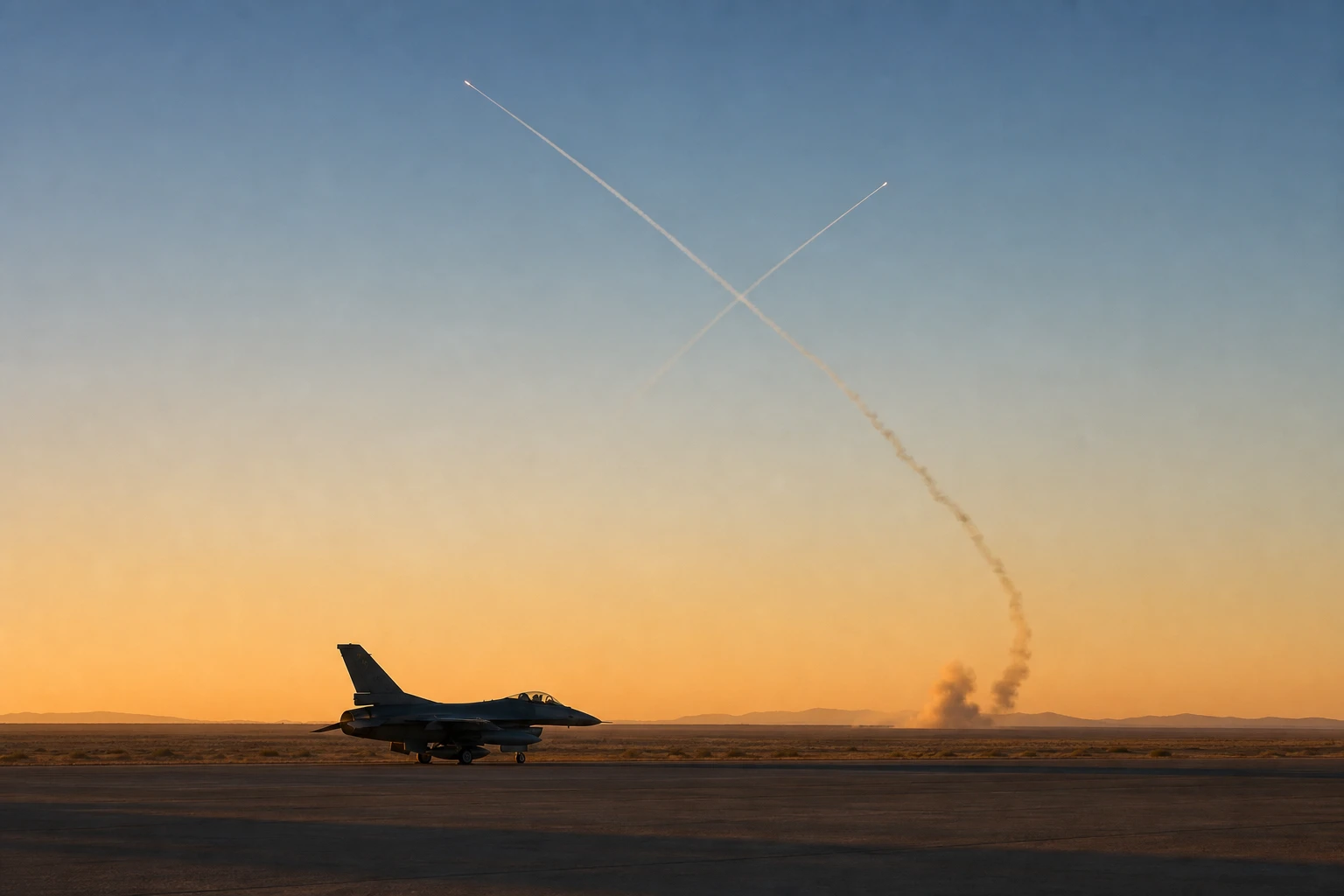
How Iran Beats the Intercept
Jordanian Lieutenant General Qasid Mahmoud, a retired deputy chief of staff for the country’s armed forces who has studied Iran’s missile program for years, described a two-part tactic to CBS News. Tehran, he said, has upped its game.
Mahmoud said Iranian forces use cheap missiles to distract the radar, then send in a better missile that changes its final target in the last 30 or 40 kilometers of flight. That late change of course, he said, is what makes the real threat so hard to stop.
- Cheaper decoy missiles launch first, drawing Jordanian and U.S. radar and interceptor attention toward false tracks.
- Interceptors and sensors spend themselves against those decoys, burning limited interceptor stock and the seconds needed to reassess.
- A separate, higher-end missile alters course in the last 30 to 40 kilometers of flight, a maneuver current intercept logic is not built to expect from an inbound ballistic track.
Outside reporting backs up the shift. The Financial Times has reported that a March strike on Qatar’s Ras Laffan gas complex used missiles capable of evading U.S.-made Patriot systems. South Korea’s Seoul Economic Daily reported this week that the Institute for the Study of War, a Washington think tank, believes Iran may now be firing missiles built with maneuverable reentry vehicles, technology Tehran is thought to have pushed hard after its 12-day war with Israel in June 2025, possibly with Chinese and Russian help.
The Deal That Never Says the Word Base
The legal foundation underneath the American presence is a Defense Cooperation Agreement signed at Amman on January 31, 2021, and in force since that March. The text itself grants U.S. forces unimpeded access to agreed facilities and areas for training, exercises, transit and the temporary staging of aircraft and vehicles, well short of a declared, permanent base.
Jordanian Foreign Minister Ayman Safadi pushed that framing at the time, telling lawmakers the deal “does not authorize American forces to carry out combat actions” inside the kingdom and was limited to training and counterterror cooperation. The government pushed it through without a parliamentary vote, publishing it by royal decree in March 2021. Lawmaker Saleh Armouti called it a violation of the constitution and Jordan’s sovereignty.
That argument never went away. In a parliamentary session in January 2026, months before this month’s strikes, Armouti raised the identical objection, and House Speaker Mazen Qadi rejected it again. A Congressional Research Service update from that same month noted that Washington has never officially acknowledged its presence at Muwaffaq Salti, months before the missiles started landing there.
Why Do Bahrain and Kuwait Look Safer on Paper?
Bahrain and Kuwait host declared, heavily fortified American installations, Bahrain as home to the U.S. Navy’s Fifth Fleet and Kuwait with roughly 13,000 personnel spread across more than half a dozen bases. Both countries have a clearer legal basis to build the kind of layered, permanent air defenses that Jordan’s outposts were never designed to match.
| Host Country | Nature of U.S. Presence | Approx. Troop Presence | What Iran Has Hit in 2026 |
|---|---|---|---|
| Jordan | 2021 access agreement; presence at bases like Muwaffaq Salti still not officially confirmed | Roughly 3,800 | Base struck three times in a week; two soldiers killed, one missing |
| Bahrain | Declared installation; headquarters of the U.S. Navy’s Fifth Fleet | Not publicly detailed | Radar installation destroyed in an earlier strike this year |
| Kuwait | More than half a dozen declared bases | Roughly 13,000 | Patriot battery, radar and ammunition depot targeted at Ali Al Salem |
Iran has still reached both countries. A strike earlier this year destroyed a radar installation in Bahrain, and Tech Times reported that an Iranian barrage in mid-July hit the Patriot battery, radar and ammunition depot at Kuwait’s Ali Al Salem base, part of a wider round of strikes on US bases in Bahrain and Kuwait after the truce collapsed.
Fortification narrows the gap. It has not closed it. Jordan, without the same declared footprint, starts from further behind.
Tower 22 Warned Everyone in 2024
This is not the first time a lightly defended American position in Jordan has cost soldiers their lives. On January 28, 2024, a one-way attack drone struck Tower 22, a small logistics outpost near the Syrian border, killing three U.S. soldiers, Sergeant William Rivers, Specialist Kennedy Sanders and Specialist Breonna Moffett, and wounding dozens more.
An Army investigation later found the attack was “most likely preventable.” The Washington Post reported the inquiry cited failures ranging from complacency and indecisiveness to outright negligence, and that the attacking drone may have been mistaken for a U.S. aircraft returning to base.
Tower 22 was a remote logistics stop, not a runway hosting F-16 squadrons, so the exposure looked different on paper. The underlying weakness was the same. A base sized its defenses for the declared, minor role it was supposed to play, not the target it had actually become.
The Domestic Bind Amman Can’t Escape
Jordan’s government has spent this war insisting it is neutral, even as its air force shoots down Iranian drones and its bases absorb missiles meant for Americans. King Abdullah II has told parliament the kingdom is not a party to any war, even while its largest air base takes repeated hits.
The tension keeps resurfacing in the same chamber. Armouti’s 2026 objection echoed the one he raised in 2021, and Speaker Qadi’s rejection echoed his predecessor’s, too. Jordan is squeezed between a treaty relationship with Washington, a border with Israel, and a domestic public with little enthusiasm for either.
Declaring Muwaffaq Salti an American base and arming it accordingly would help close the defense gap. It would also hand domestic critics the exact proof they have been asking for since 2021. Jordan has paid a steady cost for hosting US troops since the war widened. That cost increasingly includes American lives lost on Jordanian soil.
What’s Still Unconfirmed at Muwaffaq Salti
CENTCOM spokesman Captain Tim Hawkins told CBS News it would be inappropriate to detail how the missiles got through while the incident remains under review. President Trump, for his part, blamed unnamed “other operators” at the base, without saying who he meant.
- Confirmed: CENTCOM says the July 17 strike killed two soldiers, left one missing and required four medical evacuations to Jordanian hospitals.
- Confirmed: Jordanian forces intercepted additional Iranian missiles and drones on Tuesday, four days after the fatal strike.
- Unconfirmed: What President Trump meant by “other operators” who “let something through” at the Jordanian base.
- Unconfirmed: The specific reason interceptors missed the incoming missile, which CENTCOM says remains under review.
Hawkins said the review of Friday’s strike was still open this week. Jordanian air defenses shot down another wave of Iranian fire less than four days later.
Frequently Asked Questions
Does the U.S. have a permanent military base in Jordan?
No formally declared permanent base exists. American access runs through a layered set of agreements, a 1996 Status of Forces Agreement, a 2006 update and the 2021 Defense Cooperation Agreement, none of which grant the kind of publicly acknowledged base status Washington holds in parts of the Gulf.
What is a maneuverable reentry vehicle?
It is a missile warhead engineered to change course during the final seconds of its flight instead of following a fixed ballistic arc. That late maneuver is designed to defeat intercept systems tuned to predict a straight inbound path, and Iran is believed to have accelerated the technology after its 2025 war with Israel.
How many U.S. troops are stationed in Jordan?
Recent estimates put the figure at roughly 3,800, up from about 3,188 at the end of 2023. The increase tracked with rising regional tension following the escalation in Gaza that October.
Where else has Iran targeted U.S. forces in the Gulf this year?
Beyond Jordan, strikes have hit a radar installation in Bahrain and a Patriot battery, radar and ammunition depot at Kuwait’s Ali Al Salem base. The United Arab Emirates alone had intercepted more than 500 ballistic missiles and over 2,000 drones as of early April, with the wider campaign killing 13 people there.
