
Egypt is negotiating with Shell, TotalEnergies, BP and commodities trader Hartree Partners to lock in 15 to 18 cargoes of liquefied natural gas (LNG) a month for at least three years. Three trading and industry sources described the talks to Reuters, calling it the deepest supply commitment Cairo has chased since it lost its footing as a regional gas exporter.
Egypt has run this play before. A nearly identical shortage forced the same kind of scramble a decade ago, and this time the country’s finances have far less cushion to absorb it.
Cairo Chases Its Largest LNG Commitment Yet
The talks cover a multi-year package that could stretch to five years, according to the sources, with pricing built around a premium of roughly $1.5 above the Title Transfer Facility (TTF), the Dutch hub price that serves as Europe’s benchmark for natural gas. Nothing is finalized. Egypt’s petroleum ministry, Shell, TotalEnergies and BP did not respond to requests for comment, and talks for 15 to 18 cargoes a month remain in progress. Hartree Partners declined to comment.
One detail stood out to the sources involved. A third source described a strong will to work with Americans, hinting at where Cairo would rather send its dollars if it has a choice.
The counterparties named so far each carry their own history with Egypt’s gas trade:
- Shell – long a shareholder in Egypt’s Idku export terminal, now on the other side of the table as a potential long-term supplier
- TotalEnergies – holds a smaller legacy stake in Idku alongside other Egyptian energy interests
- BP – separately ramping up its own Egyptian upstream drilling, discussed further below
- Hartree Partners – a commodities trading house named by two of the sources as a party to the talks
None of the companies have confirmed volumes or pricing publicly, and the sources cautioned that terms could still shift before anything is signed.
The Same Shortage, a Decade Apart
The current scramble is not Egypt’s first. A near-identical sequence played out between 2013 and 2015, when falling output forced the same two export terminals, Idku and Damietta, into the same corner.
- 2013: Egypt’s Damietta LNG terminal goes idle as gas once earmarked for export gets redirected to the domestic grid.
- 2014: Idku’s operator declares force majeure on exports, and preliminary agreements are signed to import gas from Israel’s Leviathan and Tamar fields instead.
- 2015 to 2017: Eni discovers and then brings online the Zohr field, the biggest gas find in the eastern Mediterranean.
- 2018 to 2022: Egypt turns net exporter, and LNG shipments from Idku and Damietta hit a record in 2022.
- 2023 to 2025: Zohr’s output slides, arrears to Eni pile up, and both terminals halt exports repeatedly to cover domestic shortfalls.
- 2026: The Israel-Iran conflict cuts pipeline flows from Israel, Idku suspends exports again, and Cairo opens talks for its largest LNG import deal yet.
The pattern repeats because the underlying fix, new Egyptian gas supply, never fully arrived. Zohr covered the gap for a few years. It has not been enough since.
Zohr’s Peak Came and Went Fast
Zohr turned Egypt into a net gas exporter almost overnight after Eni brought it onstream in 2017. Output at the field alone climbed to nearly 2.8 billion cubic feet a day in the third quarter of 2021, according to Egypt’s State Information Service account of the field’s arrears and output slide, before slipping under 2 billion cubic feet a day by early 2024.
Two things drove the drop. Water filtration problems slowed the wells, and delayed government payments to Eni stalled new drilling. Egypt’s total arrears to international oil explorers reached $6.4 billion, a debt that discouraged the very investment needed to keep output up.
Egypt’s total gas production told a similar story. It stood at 3.5 billion cubic feet a day in April 2025, less than 60 percent of its early-2021 peak above six billion cubic feet a day, according to JODI data. Government figures for the fiscal year that just ended put average production under 4.4 billion cubic feet a day, a number officials expect to slip to 4.2 billion cubic feet a day, the lowest in nine years, in the fiscal year that started this month.
Why Are Idku and Damietta Falling Quiet Again?
Egypt suspended roughly 350 million cubic feet a day of gas destined for Idku’s export cargoes to Shell and Petronas this spring, after fighting between the United States, Israel and Iran disrupted the flow of gas from Israel’s Tamar and Leviathan fields into Egypt. It was the same terminal, doing the same thing, for a familiar reason: not enough gas to cover both exports and the domestic grid.
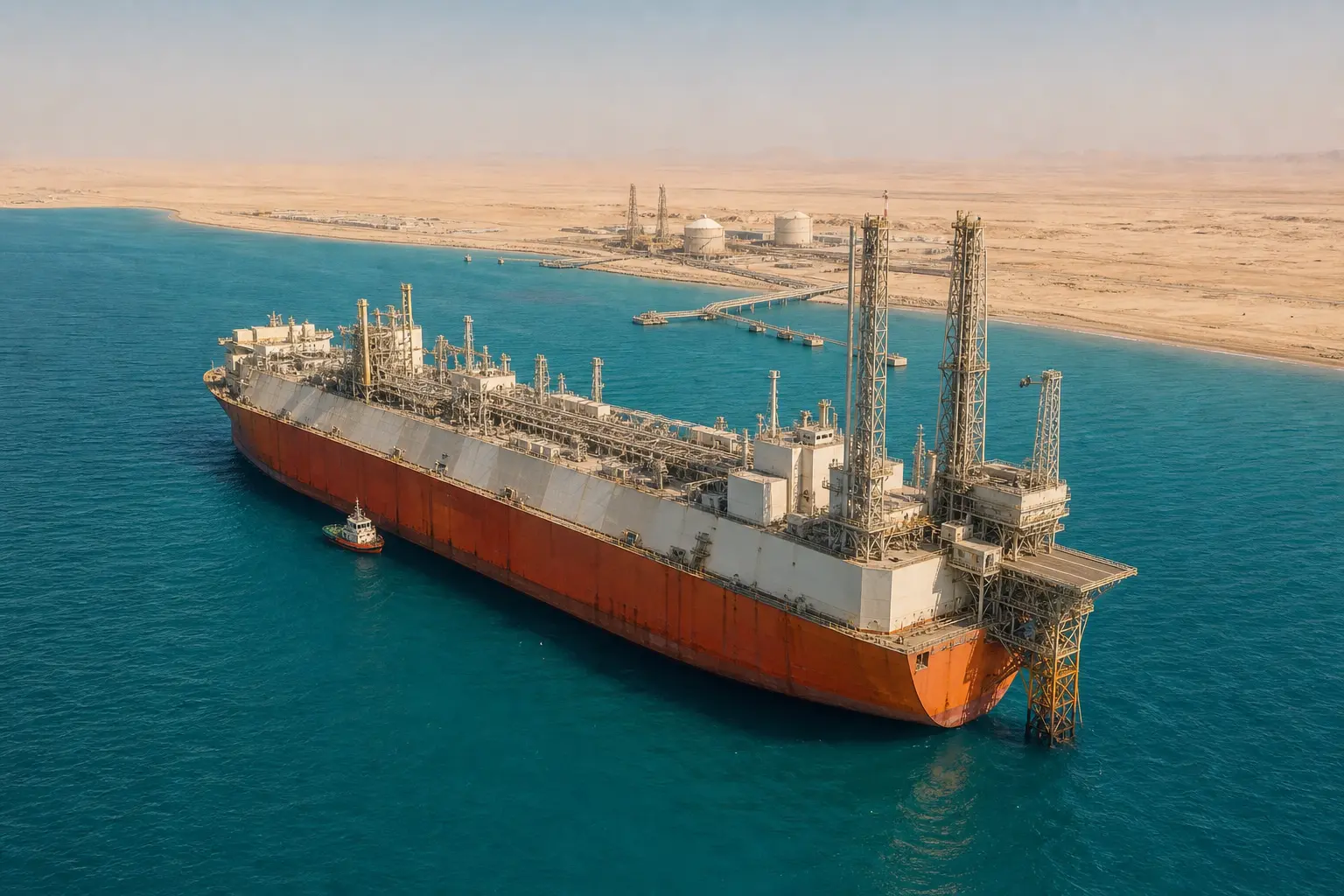
To fill the gap, Egypt has spent the past two years quietly assembling a fleet of floating storage and regasification units (FSRUs), ships that turn imported LNG back into gas for the grid. The buildout has been rapid, and it now anchors the country’s ability to keep the lights on through peak summer demand, when consumption can top 37 gigawatts.
| Vessel | Capacity | Port | Status |
|---|---|---|---|
| Hoegh Galleon | 750 million cubic feet a day | Ain Sokhna, Sumed Port | Operating since July 2024; due for replacement in late 2026 |
| Energos Eskimo | Up to 750 million cubic feet a day | Ain Sokhna, Sumed Port | 10-year charter with New Fortress Energy, running since mid-2025 |
| Energos Power | About 750 million cubic feet a day | Ain Sokhna | Operational since July 2025 |
| Energos Winter | 450 million cubic feet a day | Damietta | Fifth FSRU chartered by Egypt, added in 2025 |
| Hoegh Gandria | Up to 1,000 million cubic feet a day | Ain Sokhna, Sumed Port | 10-year charter; arrives fourth quarter of 2026 |
Egypt is, in effect, running two gas businesses out of the same two ports at once: exporting when it can, importing whenever it must. Idku still slipped out occasional cargoes this year even as the overall trend runs the other way.
The Bill Lands on an Already Stretched Budget
Egypt’s natural gas import bill has nearly tripled since the conflict began, rising from about $560 million before the fighting to roughly $1.65 billion for the same volumes in March. A finalized multi-year deal, priced at the reported premium over TTF, could cost Egypt between $8 billion and $11 billion annually, based on Reuters calculations from recent comparable deals.
Egypt’s ongoing negotiations for medium-term LNG supply, alongside the expansion of existing and planned pipeline gas agreements, reflect efforts to reduce exposure to volatile spot market procurement amid continued geopolitical uncertainty.
Aly Blakeway, head of Atlantic LNG at S&P Global Energy, the commodity data and analytics firm, made that point, adding that the Russia-Ukraine war and the standoff between the United States and Iran both feed the uncertainty he is describing.
The money has to come from somewhere. Egypt’s external debt-to-GDP ratio climbed to 44.5 percent by the end of March 2025, up from 38.8 percent less than a year earlier, and the Central Bank of Egypt has since raised its 2026 external debt service estimate to $29.18 billion. The International Monetary Fund’s own review of Egypt’s program flagged a wider current account deficit this spring tied to a heavier import bill, even as it said the impact of the war in the Middle East on the Egyptian economy has remained relatively contained.
Any relief on that front would matter for a pound that has already slid past 51 to the dollar even as reserves hit a record high. Every dollar spent on imported gas is a dollar not going toward debt service, reserves or the kind of spending that might eventually break the cycle.
Billions Chase a Comeback That Insiders Doubt
Egypt is not standing still. Eni has pledged roughly $8 billion in Egyptian investment running from 2026 to 2032, covering further work at Zohr along with the smaller Nargis and Nooros fields. “BP recently injected $3.5 billion of investment, and the UAE’s Arcius Energy has another program worth $3.7 billion,” Gamal El-Qalyoubi, a petroleum expert, told the outlet Al Manassa.
The government’s own target is to lift national output to 6.6 billion cubic feet a day by 2027, up from around 4.1 billion cubic feet a day now. Insiders quoted by Al Manassa were blunter about the odds: there is no new Zohr coming, and the field will not return to its old peak no matter how much money follows it. Nargis is expected to add about 600 million cubic feet a day and Nooros roughly 100 million, useful volumes but nowhere near enough on their own to close the gap.
Cairo has kept marketing itself as a future hub for eastern Mediterranean gas even while it imports more than ever, Euronews reported in May. The deals now under discussion would run three to five years. By the time they expire, Egypt will have spent the better part of a decade finding out whether its own gas ever comes back.
Frequently Asked Questions
Is Egypt still exporting any LNG in 2026?
Occasionally. Even as imports climb, shipping data show Idku still sent out cargoes this year, including one bound for Canada in January and another for Turkiye later that month, alongside its usual buyers Shell and Petronas.
How big is Egypt’s floating import fleet now?
Egypt has built up a small fleet of floating storage and regasification units. Three vessels at Ain Sokhna run near 750 million cubic feet a day each, and a fourth, Energos Winter, adds 450 million cubic feet a day at Damietta. A larger unit, Hoegh Gandria, is due at Ain Sokhna in the last quarter of 2026 with capacity up to 1,000 million cubic feet a day, replacing the Hoegh Galleon.
Could Egypt’s own gas production still turn around?
Maybe, but not on the old scale. Fitch Solutions expects Egypt’s gas output to climb 8 percent in 2026, to around 46.6 billion cubic meters, after an estimated 43.1 billion cubic meters in 2025. Officials’ own target of 6.6 billion cubic feet a day by 2027 leans on fields such as Nargis and Nooros that are far smaller than Zohr ever was.
