
A holographic projector inside Budapest’s Museum of Fine Arts is doing something no naked eye can manage anymore: painting an ancient Egyptian coffin mask back into color.
The museum’s new exhibition, “Capturing Eternity,” opened July 17 and runs through October 25 in the third floor temporary exhibition room at Heroes’ Square. It leans on pigment chemistry and digital imaging, not artistic guesswork, to show visitors what statues, coffins and reliefs actually looked like before time stripped their paint away.
For two centuries, museums have taught the public that ancient Egyptian art meant bare limestone, dark basalt and pale, sun bleached wood. The science behind this show argues that picture was never the real one.
A Coffin Comes Back to Life on the Third Floor
The exhibition’s full name, listed on the museum’s own ticket page, spells out its ambition: “Capturing Eternity, How Did Ancient Egyptian Artists Fashion Their Works?” Every ticket for the run also covers same day access to the permanent galleries.
László Baán, director general of the Museum of Fine Arts, told reporters at the press preview that the institution holds Hungary’s largest collection of Egyptian antiquities, roughly 5,000 pieces. He said presenting that much material keeps forcing curators to hunt for new angles, and that this is the first time the museum has built an entire show around a single question: how these objects were actually made.
Among the interactive pieces are a three dimensional animation walking through a coffin’s construction and a digital reconstruction of the presumed stages of carving a statue, ending in colors invisible to the naked eye today. Both run on the Egyptian Collection’s newly installed holographic projector, a tool the museum says can digitally recreate objects thousands of years old the way they looked when they left the workshop.
Collections are the heart and soul of museums; preserving them, making them visible, and managing them responsibly is our shared responsibility.
Zsolt Sári, Hungary’s state secretary for public collections and heritage protection, said that at the exhibition’s press preview.
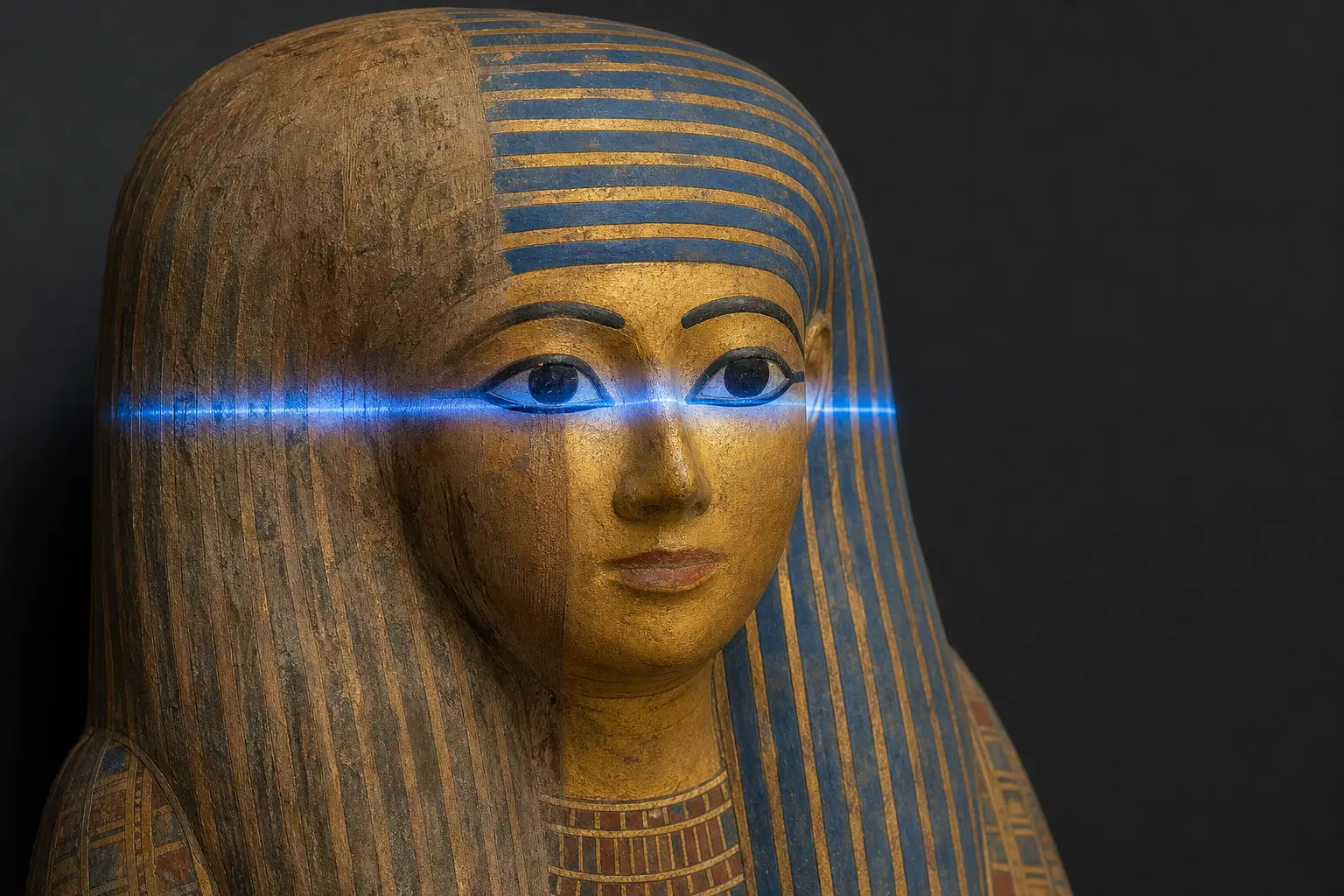
Pigments No Eye Can See
The tools behind Budapest’s reconstructions come out of conservation labs, not art studios. Researchers studying Egyptian polychromy lean on X-ray fluorescence, infrared photography and visible induced luminescence imaging, techniques that flag pigment grains too degraded for a human eye to register.
One clear example ties directly back to a lender in the Budapest show. A multi modal study of 54 shabti statuettes from Deir el-Medina, a workers’ village near Luxor, curated by the Egyptian Museum in Turin, used luminescence mapping to trace Egyptian blue pigment long after the paint layer itself had faded past visibility.
Separate research on painted limestone reliefs from the Palace of Apries, excavated in Lower Egypt between 1908 and 1910, turned up something new to the record entirely. Scientists there confirmed the earliest known use of lead-tin and lead-antimonate yellow in Egyptian painting.
Scholars decoding these building techniques are not confined to museum labs, either. Recent lectures on ancient Egyptian art techniques held in Portugal’s Algarve region walked through much of the same ground for a general audience.
Decades of this kind of testing have built out a working palette for ancient Egyptian artisans:
- Egyptian blue – a synthetic copper based pigment, one of the first man made colors in history
- Red and yellow ochre – iron rich earth pigments used for skin tones and backgrounds
- Lead-antimonate and lead-tin yellows – rarer compounds now confirmed on temple and palace reliefs
- Orpiment – an arsenic sulfide mineral prized for a bright, gold like yellow
- Gold leaf and madder – reserved for divine skin and the richest funerary details
Public fascination with Egypt produced plenty of invention long before any of this equipment existed. A 1909 story in the Arizona Gazette fabricated an entire Egyptian cave discovery inside the Grand Canyon, a hoax that still circulates online more than a century later. The lab work in Budapest sits at the opposite end of that spectrum.
How Hungary Ended Up With 5,000 Egyptian Objects
The Museum of Fine Arts did not build its Egyptian collection through one grand expedition. It grew in fits and starts across two centuries, and the museum’s own published history traces the pattern in detail.
The earliest pieces reached Hungary through nineteenth century aristocrats, diplomats and travelers who picked up souvenirs on pilgrimages to the Holy Land that routed them through the Nile Valley, according to the museum’s own history of the collection. Mummies, both human and animal, were the most sought after items, alongside small bronze statuettes and amulets. Collectors typically donated or sold what they brought home to the Hungarian National Museum, founded in 1802 as the country’s first repository for Egyptian material.
Organized fieldwork came later. Here is how the collection took its current shape:
- 1907: Cairo based Hungarian businessman Fülöp Back financed the country’s first archaeological excavations in Egypt, at Sharuna and Gamhud in Middle Egypt, led by Polish Egyptologist Tadeusz Smoleński. Back donated most of what the dig produced, including seven wall fragments from a Ptolemaic temple and 25 coffins holding mummies, to the Hungarian state that same year.
- 1934: The Museum of Fine Arts formally established its own Egyptian Collection, consolidating artifacts previously scattered across the National Museum, the Museum of Ethnography and the Museum of Applied Arts.
- 1964 to 1976: Archaeologist László Castiglione led a salvage excavation at Abdallah Nirqi in Nubia; finds from that campaign reached the Budapest collection in 1976.
- 2026: The Egyptian Collection installs its first holographic projector and opens “Capturing Eternity,” its first exhibition built entirely around the working methods of ancient artisans.
Each step added a different kind of object, from pilgrim souvenirs to systematic excavation finds, and the museum still describes the resulting collection as a living research project rather than a finished archive.
Turin and Copenhagen Fill In the Gaps
Two Egyptologists built the show’s narrative arc. Katalin Kóthay, head of the museum’s Egyptian Collection, and Flóra Kevély, the collection’s curator, structured the exhibition around the artist’s own perspective and the physical stages of production, backed by the imaging described above.
Neither curator relied solely on Budapest’s own holdings. The show pulls loan pieces from two of Europe’s more established Egyptology collections.
| Institution | Location | Role in Capturing Eternity |
|---|---|---|
| Museum of Fine Arts (Szépművészeti Múzeum) | Budapest, Hungary | Host institution; supplies most of the roughly 5,000 Egyptian pieces plus the new holographic projector |
| Ny Carlsberg Glyptotek | Copenhagen, Denmark | Loaned objects to round out the production-technique narrative |
| Museo Egizio | Turin, Italy | Loaned objects; its own Deir el-Medina shabti figures anchor published Egyptian blue pigment research |
The Turin loan carries extra weight for that reason. The workers’ village objects behind the Egyptian blue luminescence study sit only a few meters from artifacts that same science helped decode, giving Budapest visitors a rare side by side look at raw material and published result.
Why Does Recovering Lost Color Change Anything?
Recovering an object’s original color does more than sharpen a museum display. It resets the baseline scholars use to judge craftsmanship and religious intent, and it gives conservators a data backed map of pigment that ordinary gallery light would otherwise keep erasing.
The stakes reach past Egypt. Museums across Europe and North America have spent the past decade reconstructing the original polychromy of Greek and Roman marble sculpture, work that keeps turning up the same lesson: ancient viewers never saw the plain white stone that later centuries mistook for the original aesthetic.
In Egyptian art specifically, color carried coded meaning rather than plain decoration. Yellow stood in for gold and the skin of the gods, thought to be eternal. Red signified living male flesh, but also destruction, desert and the setting sun. The Nefertiti bust in Berlin’s Neues Museum, one of the most reproduced images of ancient Egypt, still shows its original reds, yellows, greens and blues in plain sight, proof that survives without any lab equipment at all.
Visitors who leave Budapest curious about the source material have somewhere to point that curiosity. A planning guide for Egypt holiday trips in 2026 covers the country’s major archaeological sites for anyone mapping an actual Nile itinerary after the exhibition.
The projector itself stays part of the Egyptian Collection’s permanent toolkit once the loan pieces travel home to Copenhagen and Turin, and “Capturing Eternity” keeps running at Heroes’ Square through October 25.
Frequently Asked Questions
How long does the Capturing Eternity exhibition run, and where in the museum?
The show runs from July 17 through October 25, 2026, in the museum’s third floor temporary exhibition room. A ticket for the show includes same day access to the permanent collections, according to the museum’s ticket page.
Can visitors compare the original artifacts with the digital reconstructions in person?
Yes. The gallery places physical originals, including the Copenhagen and Turin loans, next to the 3D coffin animation, the statue carving reconstruction and the holographic color projections, so visitors can move between an excavated object and its digitally restored appearance in the same room.
What does the Museum of Fine Arts show outside this temporary exhibition?
Outside “Capturing Eternity,” Budapest keeps a standing Egyptian collection on permanent view, including a discovery room built for children and adults covering material from the Predynastic period through the Graeco-Roman era.
How do scientists find paint colors that have vanished to the naked eye?
Conservators lean on non-invasive tools such as X-ray fluorescence, infrared photography and visible induced luminescence imaging, which pick up trace mineral signatures, like the copper in Egyptian blue, long after the visible paint layer has worn away.
Are discounted or free tickets available for the exhibition?
Free tickets apply only to citizens of the European Economic Area and Ukraine, covering visitors aged 6 to 26, those 62 to 70, and one or two adults accompanying family groups with two or more children under 18. Free tickets are available only on site at the time of the visit, not in advance.
