
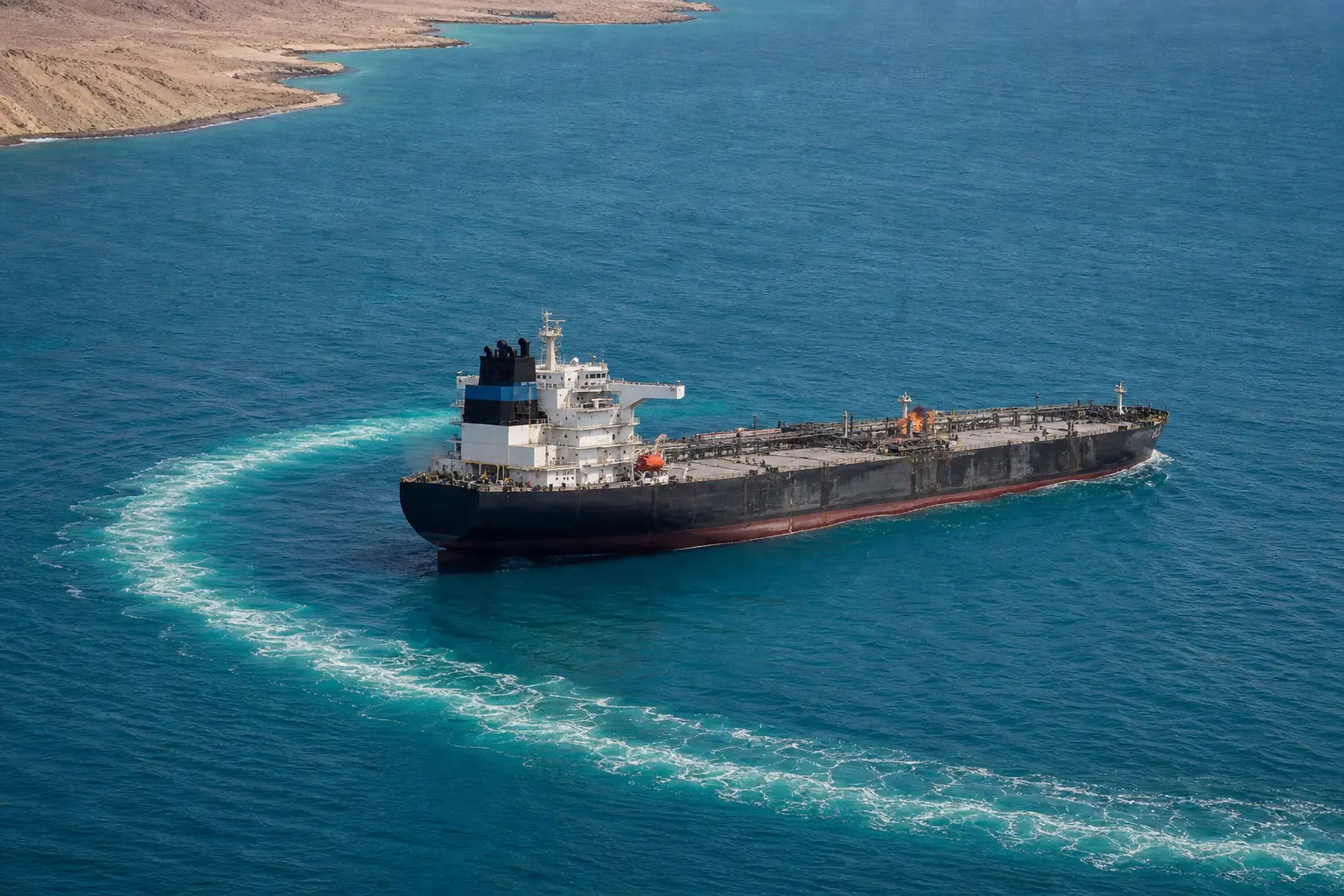
Two oil tankers loaded with Saudi crude spun around in the Red Sea on Tuesday rather than sail past Yemen’s coast. Brent crude settled at $91.01 a barrel, its highest close in five weeks, as traders priced in a second Gulf oil route joining the Strait of Hormuz on the list of routes now under threat.
Neither tanker was headed for Rotterdam or Houston. The Rodos was bound for India. The Xin Long Yang was headed to China. Both countries have no stake in the Iran-US war now in its tenth day, and both had been leaning on a Houthi safe-passage arrangement struck two years ago that may not survive this round.
Two Tankers Peel Away From Yemen’s Coast
The Rodos and the Xin Long Yang reversed course on Tuesday and turned toward the Suez Canal, according to shipping-tracking data reported by Reuters. The Houthis claimed six vessels had changed course. Only two reversals were independently confirmed.
Yemen’s Iranian-aligned Houthis had moved fast to enforce a blockade announced a day earlier. In an email sent to multiple shipping companies, the group warned that tankers risk being targeted “in any location” within its reach if they load or discharge cargo at Saudi ports. “We strongly recommend that your company exercise due diligence and the utmost care in all its dealings,” the email said.
Saudi Arabia’s Red Sea terminal at Yanbu was still operating normally on Tuesday, sources told Reuters, even as the threat rattled traders. Tim Waterer, an analyst at KCM Trade, said the blockade threat mattered because it raised the risk of disruption to another major oil exporter, not just Iran.
Why Did Saudi Arabia Bet on the Red Sea?
Saudi Arabia had leaned harder on its Red Sea coast because the Gulf side of its export map was already compromised. Analysts at ING Bank said the kingdom ramped up shipments from Yanbu to about 4.6 million barrels a day in June, up from roughly 1.3 million barrels a day at the start of the year, as fighting between the United States and Iran squeezed the Strait of Hormuz.
That pivot traces back to a ceasefire that unraveled fast. The US reinstated a naval blockade of Iranian ports after President Trump declared a June memorandum of understanding “over” at a NATO summit, arguing the two sides disputed who controlled strait traffic. With Hormuz compromised, Yanbu became Saudi Arabia’s main insurance policy.
That is why the new threat lands so hard. The naval blockade the Houthis announced a day earlier aims at the kingdom’s last open oil route out of the Gulf standoff. The hostility is not new, either. The Houthis and Riyadh had held an uneasy truce for years before a four-year truce with Saudi Arabia collapsed this spring, and Yemenis have again taken to the streets in Sanaa to protest Saudi military action in the country’s north.
| Chokepoint | Share of Global Trade | War Risk Premium | Status |
|---|---|---|---|
| Bab el-Mandeb, Red Sea | 7% of global maritime traffic | Rose to about 0.75% of vessel value, from 0.3% before Monday’s blockade announcement | Blockade threat active; two tankers rerouted |
| Strait of Hormuz | About a fifth of world oil and LNG supply | Reached roughly 2.5% in March before easing near 1% | Disrupted since US-Iran fighting escalated; navigation limited |
China and India Are the Ones Left Exposed
Allison Minor, a Middle East expert at the Atlantic Council, a Washington policy institute, described the logic of the threat plainly.
The Houthis have not yet clarified which ships they will target, but their intent to blockade Saudi ports implies that any ship visiting Saudi ports and carrying Saudi oil would be in the crosshairs.
Minor said in her analysis that the oil moving north through the strait is headed mostly to Asian buyers. During the Houthis’ 2023 to 2025 Red Sea campaign, the group cut separate arrangements with Russia and China so their ships could pass unmolested. This time, she suggested, Beijing’s old exemption may not travel with the cargo, since the Houthis may be far less willing to spare a Chinese vessel once it is carrying Saudi oil specifically.
Between 2023 and 2025, the Houthis used small boats, drones and missiles to attack more than 100 commercial ships, Minor said, rendering the strait too risky for most shippers even without a formal blockade.
Old Immunity, New Cargo
The safe-passage arrangement dates to early 2024, when Houthi officials began assuring Moscow and Beijing directly that their ships would be spared. Bloomberg reported that Russia and China secured assurances of safe passage through talks with a senior Houthi political figure, in exchange for political support in bodies such as the UN Security Council.
US Treasury sanctions later filled in the mechanics. Documents from the Treasury’s Office of Foreign Assets Control described how Mohamed Ali al-Houthi, a senior figure on the group’s Supreme Political Council, personally coordinated with Russian and Chinese officials so Houthi militants would not strike their vessels.
Even so, the guarantee had a hole in it from the start. In January 2024, Houthi forces fired five missiles at a Chinese-owned oil tanker, a day after the group had publicly promised Beijing safe passage. The tanker had sailed from Russia; its Chinese ownership and crew did not spare it. That history is the reason Minor’s warning carries weight now that Saudi oil, not just a flag, is the target.
Shippers Weigh Higher Premiums Against Longer Routes
Insurance underwriters moved within hours of the blockade announcement. Indicative war risk premiums for ships in the region rose to about 0.75% of a vessel’s value, from roughly 0.3% before Monday, sources told Insurance Journal. Even a small shift like that adds hundreds of thousands of dollars to a single seven-day voyage.
A separate assessment from reinsurance broker Howden Re had already flagged Gulf shipping as entering a new pricing regime, with premiums for Hormuz transits alone adding $250,000 to $375,000 per journey to insure a $100 million tanker.
A Saudi-led coalition has separately pledged to protect Red Sea shipping after the Houthi ban, though it has not detailed how it would counter drone or missile fire at the strait’s narrowest point. That leaves shipping companies with a narrow set of choices.
- Pay the higher premium and keep sailing the direct route past Yemen, absorbing costs that can add hundreds of thousands of dollars per voyage.
- Reroute around the Cape of Good Hope, avoiding Bab el-Mandeb entirely at the cost of well over a week of extra sailing time.
- Stop calling at Saudi ports, the option the Houthi email explicitly demanded companies consider.
- Wait out the ceasefire push that US and Iranian officials are quietly discussing, betting the threat eases before the next voyage.
Diplomats Race a Ceasefire Clock
President Trump said Tuesday the US would “just have to take care of business” if the Houthis follow through on their threats. “We’ve done that with the Houthis before, and we haven’t heard from them in a while since we did what we did originally,” he said, meeting Lebanese President Joseph Aoun at the White House.
Secretary of State Marco Rubio said Washington remained open to negotiating with Iran, “but it has to be real.”
Behind the public statements, Axios reported the Trump administration was weighing whether to escalate further or seek a 10-day ceasefire to open space for new talks. Iran has floated the same 10-day window, while the US has pushed for a longer truce that includes partial Hormuz navigation, according to separate reporting. Eskandar Momeni, Iran’s interior minister and a mediator in the conflict, flew to Islamabad this week to keep Pakistan’s channel open.
The fighting has not paused for the diplomacy. US Central Command said Tuesday it had struck “Iranian military command centres, maritime capabilities, missile and drone launch sites and air defence systems.” Iranian state media reported explosions in Fars, Hormozgan, Ilam, Kerman and Sistan and Baluchestan provinces.
Iran struck back at US allies across the region. Jordan’s military said it shot down five drones and three missiles fired at it. Kuwait’s government said Iranian strikes hit desalination and power plants for a fourth straight night, sparking fires and causing damage. The US State Department has warned Americans that Iran and its allies “may target other US interests overseas or at locations associated with the United States and Americans throughout the world.”
Frequently Asked Questions
What Is the Bab el-Mandeb Strait?
The Bab el-Mandeb is the strait separating Yemen from the Horn of Africa at the Red Sea’s southern mouth. It is roughly 20 miles wide at its narrowest point, according to the Atlantic Council’s Allison Minor, and sits entirely within reach of Houthi-controlled coastline in northern Yemen.
How Much Longer Is the Cape of Good Hope Reroute?
Diverting around Africa’s Cape of Good Hope instead of the Red Sea adds roughly 3,500 nautical miles and 10 to 14 days to a voyage. It avoids Suez Canal tolls entirely, saving an estimated $300,000 to $700,000 per vessel, even as fuel and time costs on the longer route climb.
How Badly Did the Earlier Houthi Campaign Hurt Suez Canal Revenue?
Suez Canal revenue collapsed from a record $10.25 billion in 2023 to roughly $4 billion in 2024 as container lines fled the Red Sea, Egyptian officials have said. The Suez Canal Authority has forecast a full recovery only by the end of 2026, as carriers such as Maersk resume transits.
How Many Tankers Have Been Damaged Since the Iran-US Conflict Began?
At least 9 to 15 tankers have sustained damage in the Gulf since fighting between the United States and Iran escalated in 2026, according to reinsurance broker Howden Re, whose analysts describe marine war risk as resetting to a permanently higher baseline.
