
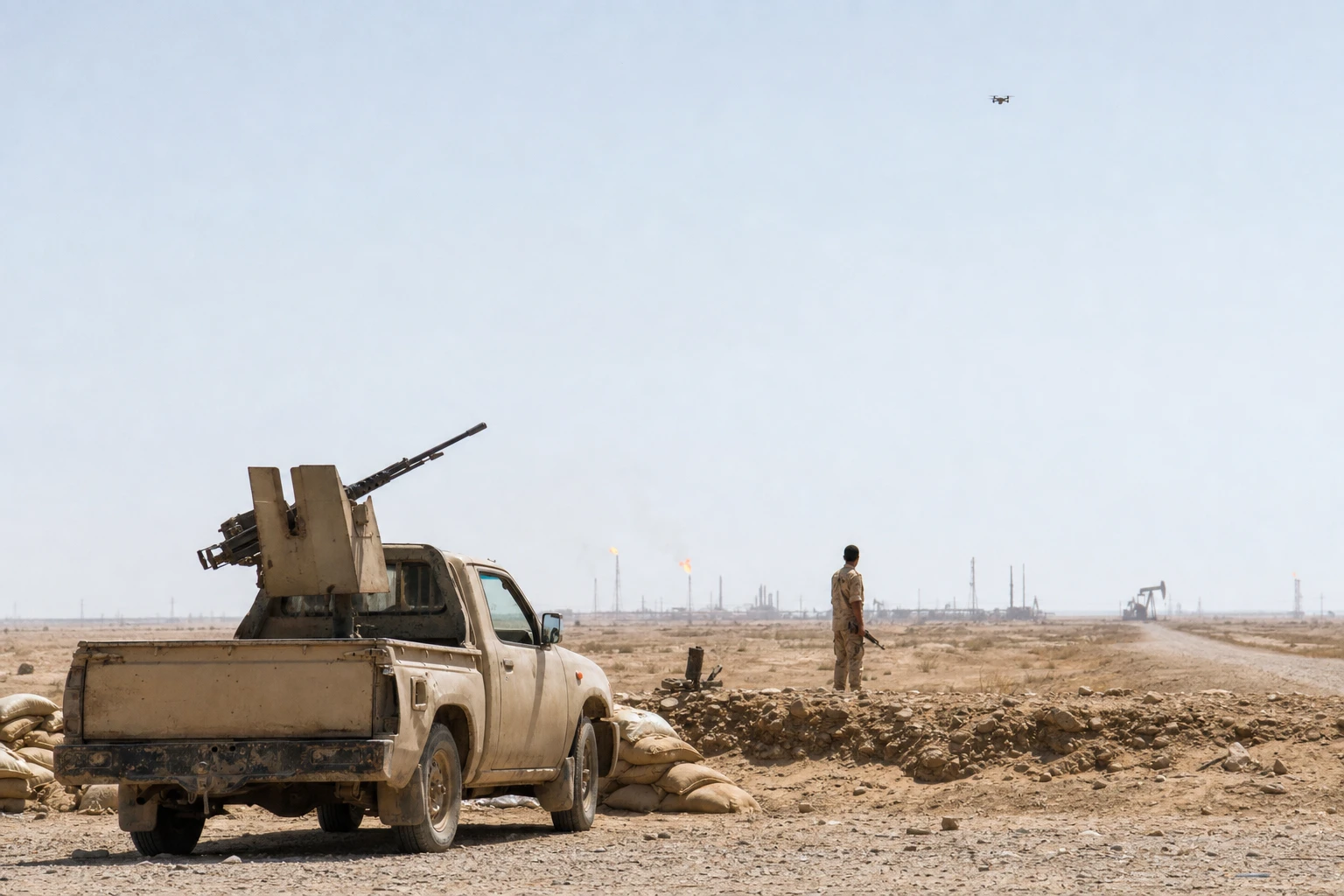
A Houthi drone slammed into a Yemeni government military post in Ma’rib province on Monday, killing or wounding at least 10 soldiers, according to local military sources. The strike hit the Al-Rasid area of Hareeb district, a front line that has anchored the government’s hold on northern Yemen for years.
The attack landed hours after the Houthis declared a naval blockade against Saudi Arabia’s Red Sea ports. Both moves trace back to a single spark exactly one week earlier: a runway strike on Sana’a’s airport that ended more than four years without a cross-border shot fired between Riyadh and the Houthis.
A Drone Hits One of Yemen’s Quietest Fronts
Local military sources told Al Bawaba the drone struck a government position in the Al-Rasid area on Monday morning. Hareeb district has stayed one of Ma’rib’s active front lines since government-aligned forces pushed Houthi fighters out of its center years earlier.
Yemeni journalist Fares Alhemyari posted the casualty count from Hareeb district within hours of the strike, matching the toll military sources later gave to Al Bawaba.
Ma’rib carries weight beyond this single attack. The governorate holds the government’s most valuable oil and gas fields, and its capital remains the largest city in the north still outside Houthi control.
What is confirmed:
- At least 10 government soldiers were killed or wounded in the Al-Rasid strike, per military sources cited by Al Bawaba.
- The drone hit a position in Hareeb district, one of Ma’rib’s still active front lines.
- The strike came the same day the Houthis announced their navigation ban on Saudi Red Sea ports.
What remains unconfirmed:
- Houthi military spokesman Yahya Saree had not claimed the Hareeb strike by name as of Monday evening.
- The exact split between soldiers killed and soldiers wounded had not been released.
- Whether Yemen’s government intends any retaliatory move on Houthi positions elsewhere in Ma’rib.
The uncertainty around Monday’s strike did not slow the week’s other escalation.
The Spark Was a Funeral Flight
The chain that produced Monday’s violence starts in Tehran. Ali Khamenei, Iran’s supreme leader for nearly 37 years, was killed in a joint US and Israeli strike on his compound on February 28, the first day of the US-Israel war on Iran.
His funeral, delayed for months by the fighting, finally began in Tehran in early July. Representatives from more than 100 countries attended the ceremonies.
A Houthi delegation flew home from the funeral aboard an Iranian jet. On July 13, Saudi-backed government forces struck the runway at Sana’a International Airport to stop that plane from landing, and it diverted to Hodeidah instead.
Yahya Saree, the Houthi military spokesman, said the strike ended what he called a de-escalation phase that had held since 2022.
This aggression will not go unanswered or unpunished.
Saree said in a statement carried on Telegram. Hours later, the Houthis fired missiles and drones at Saudi Arabia’s Abha International Airport, and the Saudi-led coalition said it intercepted them.
The Houthis’ newly formed General Mobilization Forces, modeled on Iran’s Basij militia, claim hundreds of thousands of reserve fighters ready to deploy at the leadership’s direction, according to the Foundation for Defense of Democracies, a Washington policy institute that tracks the group.
Three Fronts, One Week
Three separate fronts opened within days of each other: missiles at a Saudi airport, a naval blockade, and now a drone over Ma’rib. Each pressures a different part of the coalition’s position.
| Front | Date | Houthi Action | Stated Trigger |
|---|---|---|---|
| Air and missile | July 13, 2026 | Missiles and drones fired at Abha International Airport | Retaliation for the Sana’a runway strike |
| Maritime | July 20, 2026 | Navigation ban declared on Saudi Red Sea ports | Response to the coalition’s blockade on Yemen |
| Ground | July 20, 2026 | Drone strike on the Al-Rasid position in Hareeb district | Pressure on the government’s Ma’rib front |
The group has kept a fourth front alive against Israel, too. Houthi missile fire at Israeli targets resumed in March, and Israeli jets have answered with strikes that hit three Yemeni ports and a power plant.
Conflict researchers say the Houthis announced their entry into the Iran conflict on March 27, months before Monday’s strikes in Ma’rib and the Red Sea.
Why Ma’rib Still Decides Yemen’s War
The province’s importance has not changed since the war began in 2014. Government-aligned forces pushed Houthi fighters out of the center of Hareeb district in February 2022, and front lines there saw little change for years afterward.
The pattern repeated in February 2021, when a Houthi offensive to seize the province was followed within weeks by missile strikes on Saudi oil facilities and airports and Saudi air raids on Sana’a.
A nearly identical drone strike hit the Harib front in April, arriving just as the government swapped in the Shabwa Defense Forces to replace Southern Giants Brigade units, the same conflict researchers found.
- Oil and gas – Ma’rib hosts the government’s most productive fields, the economic backbone of the territory it still controls.
- Last northern stronghold – the provincial capital remains the largest city in the north still outside Houthi rule.
- Shelter for the displaced – Yemenis fleeing fighting elsewhere have sheltered in Ma’rib since 2015, raising the stakes of any renewed offensive.
- A short memory for truces – Houthi attacks resumed on this front within weeks of the last major UN ceasefire announcement in 2022.
Little has closed the gap the Royal United Services Institute identified years ago, when the London defense think tank called the Ma’rib and Shabwa front decisive for the overall balance of the war.
What Would a Red Sea Ban Actually Cost?
The Houthis say the Bab al-Mandeb Strait, the narrow chokepoint linking the Red Sea to the Gulf of Aden, is now closed to Saudi-bound and Saudi-flagged vessels. Rerouting around Africa’s Cape of Good Hope instead would add thousands of miles to any voyage, driving up fuel and insurance costs on every diverted ship.
The strait is only about 20 kilometers wide at its narrowest point. Saudi Arabia’s Yanbu and Jeddah export terminals sit on the Red Sea side of that gate.
Diverting around the Cape of Good Hope adds roughly 2,700 miles, about 4,345 kilometers, to a voyage from Saudi Arabia to the United States, based on past US government estimates.
The threat lands on top of a separate risk to Saudi Arabia’s overland options. A previous blockade warning threatened to cut off the kingdom’s last route around Hormuz, leaving few alternatives if both chokepoints tighten at once.
The Saudi-led coalition has pushed back. It has vowed to protect vessels moving through Red Sea ports despite the new ban, and it intercepted the missiles fired at Abha days earlier.
Oman’s Narrowing Room to Mediate
Oman has spent years trying to convert its friendly ties with Riyadh, Tehran and the Houthis into a lasting truce. Capturing Ma’rib would strengthen the Houthis’ hand in any future negotiation, a Washington research center has argued.
Hans Grundberg, the UN’s special envoy for Yemen, said his office is monitoring the new airspace and maritime disputes and pressed all sides toward dialogue that preserves what he called the “relative calm Yemen has experienced since 2022.”
That calm is what broke on July 13. Grundberg’s office has not announced a new round of Ma’rib-specific talks. Government forces still held the Al-Rasid position as of Monday evening, with no public Houthi statement claiming the strike.
Frequently Asked Questions
Why was Khamenei’s funeral delayed for months after his death?
Iran’s supreme leader was killed on February 28, but the multi-city funeral did not begin until early July. A Middle East historian told CNN the war’s destruction and displacement made an earlier ceremony unsafe to hold.
Has the Houthi movement disrupted Red Sea shipping before?
Yes. Houthi attacks tied to the Gaza war disrupted Red Sea shipping for more than a year, killing at least nine sailors and sinking four vessels before a truce with the United States took hold in 2025.
What is Yemen’s Presidential Leadership Council?
It is the body that has led Yemen’s internationally recognized government from Aden since 2022, replacing the exiled presidency. Rashad al-Alimi chairs the council and has defended the Sana’a airport strike as a matter of sovereignty.
Did Saudi Arabia’s coalition partners stay unified against the Houthis?
Not entirely. Tensions between Saudi Arabia and the United Arab Emirates over Yemen strategy grew earlier this year, and the UAE pulled its forces out, leaving Riyadh to carry more of the coalition’s weight alone.
