
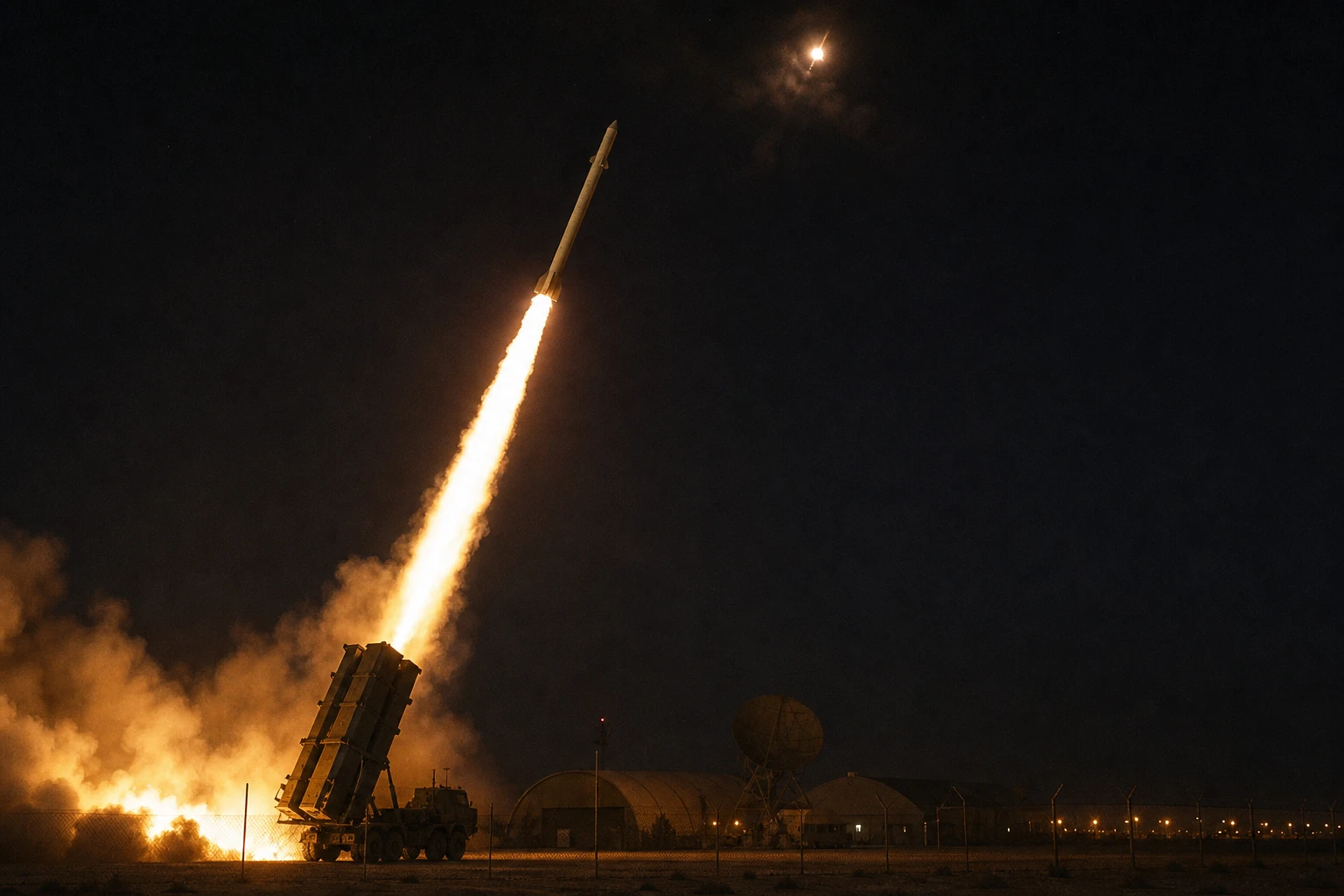
Iran’s Islamic Revolutionary Guard Corps says its navy struck three US linked military sites in Bahrain and Kuwait in a single night, a claim no government involved has independently confirmed. The announcement came hours after US Central Command marked a ninth consecutive night of American strikes on Iran, and after President Trump said the latest wave had hit Tehran “very hard.”
Trump said the strikes honored three US soldiers killed in recent days, two in Jordan and one in Iraq. Behind both claims sits a ceasefire that collapsed weeks ago, a Lebanon peace framework that just hit its first real test, and a handful of Gulf host nations absorbing a fight that was never supposed to reach their soil.
Three Sites, One Night, No Independent Confirmation
The IRGC statement, carried by Iran’s Fars and IRNA news agencies, described a coordinated three stage naval operation under the 23rd wave of what Iran calls Operation Nasr 2. It named drone maintenance hangars at Al Sakhir Air Base in Bahrain, preparation sheds for the US Navy’s Task Force 59 vessels at Salman Port in Bahrain, and naval special forces facilities at Camp Arifjan in Kuwait.
| Claimed Target | Location | Iran’s Claim | Independent Status |
|---|---|---|---|
| Drone maintenance hangars | Al Sakhir Air Base, Bahrain | Destroyed | Unconfirmed by Bahrain or the US |
| Task Force 59 preparation sheds | Salman Port, Bahrain | Destroyed, vessels heavily damaged | Unconfirmed |
| Naval special forces facilities | Camp Arifjan, Kuwait | Set ablaze, completely destroyed | Unconfirmed |
Bahrain’s foreign ministry condemned the barrage as a strike on “vital civilian infrastructure,” and the kingdom’s civil aviation authority said drones had targeted air navigation systems serving the Bahrain flight information region, though it said air traffic was unaffected. Kuwait’s defense ministry said its air defenses were confronting rocket and drone fire the same night. Neither government confirmed the destruction Iran described.
The gap between claim and confirmation has become routine. Coverage across the region has repeatedly run with one side’s tallies hours before any government verifies them, part of a familiar script for covering the Iran war that has held since the fighting reopened.
Why Did the US Iran Ceasefire Collapse So Fast?
A Memorandum of Understanding signed by Washington and Tehran in mid June was meant to freeze the fighting for 60 days while negotiators worked through Iran’s nuclear program, sanctions relief and the reopening of the Strait of Hormuz. It lasted barely three weeks before both sides accused each other of violations and resumed strikes.
Iranian officials referred to the deal as the Islamabad declaration of intent. It banked on a pause in attacks on commercial shipping through the strait, a waterway that normally carries close to a fifth of the world’s oil and gas trade. Continued attacks on tankers and a resumption of US strikes eroded the arrangement within weeks. By early July, senior US officials were calling the ceasefire effectively dead, and within days the toll turned fatal. A CENTCOM statement on the fallen and missing confirmed two service members killed in Jordan on July 17, with a third missing, a detail examined in the CENTCOM statement on recently fallen and missing troops. Iran’s deputy foreign minister, Kazem Gharibabadi, said on state television that Washington had violated its obligations and that Tehran was suspending its own commitments.
The deal never touched the disputes that caused the war in the first place. Long term sanctions relief, the scope of Iran’s nuclear program, the role of Tehran’s regional allies and permanent security guarantees were all pushed to future talks that never happened.
The Base Jordan Thought Was Safe
Jordan’s exposure shows how far the reckoning has spread. The Pentagon had relocated troops there from Bahrain, Qatar and the UAE earlier in the war, treating Jordan as a comparatively secure rear position. The kingdom’s diplomatic standing seemed to support that bet. The EU’s top diplomat had just called it the EU’s most trusted Middle East partner.
That bet did not survive Iran’s attrition strategy. On July 17, Iranian ballistic missiles and drones struck Muwaffaq Salti Air Base in Azraq, killing two US service members and leaving a third missing. Four more troops were medically evacuated to Jordanian hospitals and later discharged. It was the fourth Iranian strike on US forces in Jordan in four times in five days.
Word of the deaths drew a swift reaction from the Pentagon’s top civilian leader.
Godspeed, heroes. Their sacrifice only stiffens our resolve.
US Defense Secretary Pete Hegseth posted the message on X within hours of the CENTCOM statement confirming the deaths.
The Jordan deaths are the latest entry in a five month casualty count that began within days of the war’s reopening.
- March 1: Six US Army Reserve soldiers are killed when an Iranian strike hits a command post at Kuwait’s Shuaiba port, the war’s first American fatalities.
- March 12: Six more service members die when a US Air Force refueling aircraft crashes in western Iraq, an incident attributed to mechanical failure rather than enemy fire.
- Mid June: The United States and Iran sign a Memorandum of Understanding meant to halt attacks for 60 days.
- Early July: Senior US officials call the ceasefire dead after renewed attacks on shipping in the Strait of Hormuz.
- July 17: Two service members are killed and a third goes missing in the strike on Jordan’s Muwaffaq Salti Air Base.
- July 18: A third service member dies in Iraq during ordnance disposal, and Iran’s deputy foreign minister announces Tehran is suspending its ceasefire commitments.
The combat death toll from the war now stands at 17, with hundreds more troops injured. Inside Iran, officials report a far heavier toll, with more than 50 people killed and upward of 500 injured since the strikes resumed.
Bahrain and Kuwait Absorb a War They Did Not Start
Bahrain and Kuwait have no combat role in the war between Washington and Tehran, yet both have taken direct fire for hosting American forces. Bahrain is home to the US Fifth Fleet and to Task Force 59. The unit specializes in the integration of unmanned systems and artificial intelligence across the Fifth Fleet’s area of operations.
That area of operations is enormous. It runs about 5,000 miles from the Suez Canal to Kuwait, crossing the Red Sea, the Arabian Peninsula’s coastline and the Persian Gulf.
Kuwait hosts Camp Arifjan, a major Army logistics hub, and Ali Al Salem Air Base, both named in Iranian strike claims this month. Kuwait’s defense ministry has reported its air defenses repeatedly intercepting drones and rockets aimed at the country, including one incident that injured a person hit by falling debris.
Since the ceasefire broke down, Iran has struck or targeted US linked sites in several countries that hold no direct stake in its dispute with Washington.
- Jordan: Muwaffaq Salti Air Base has been hit repeatedly in a single week, with two US troops killed.
- Bahrain: home to the Fifth Fleet and Task Force 59, hit with drones aimed at air navigation systems and claimed strikes on two facilities.
- Kuwait: Camp Arifjan and Ali Al Salem Air Base named in Iranian strike claims, with air defenses reporting repeated interceptions.
- Saudi Arabia: the site of a fatal attack on a US Army sergeant in the war’s opening days.
- Iraq: scene of a US service member’s death during ordnance disposal, and of separate Iranian strikes reported in the Kurdistan region.
None of these governments asked for a seat at the table where the war started. All of them are paying rent on the bases they lease to Washington.
Washington’s Two-Front War Problem
The war carries its own political cost at home. The Trump administration faces midterm elections in a matter of months, and renewed fighting comes as voters already contend with higher fuel and living costs tied to the conflict’s disruption of Gulf shipping.
Iran has closed the Strait of Hormuz to shipping again, and the US has restored a blockade on Iranian ports in response. The strait normally carries close to a fifth of global oil and gas shipments, and reports of renewed closures have pushed crude prices higher for a second time this year.
Democratic lawmakers have pushed for an end to the fighting since the latest deaths were announced. Even inside Washington there is no consensus on the Middle East’s power paradox after the war, or which side actually comes out ahead once the strikes stop.
Iran’s leadership shows no sign it wants a diplomatic exit. Its supreme leader vowed on Saturday to teach the United States “unforgettable lessons,” and the IRGC’s own statement called Trump “foolish” and “ignorant” while promising its missiles and drones would keep firing until the last day of the conflict, however long it lasts.
Lebanon’s Pilot Zones Open Into the Same Storm
While the Gulf war widens, Washington is also trying to bank a separate peace next door. The State Department said pilot zone operations began Monday in the Lebanese villages of Froun, Srifa and Zawtar al-Gharbiya, the first test of a Trilateral Framework that Lebanon, Israel and the United States signed on June 26. Operations began in accordance with the Trilateral Framework and under a joint military coordination group, State Department spokesman Tommy Pigott said.
Under the plan, Israeli forces are meant to withdraw in stages from southern Lebanon while the Lebanese army takes over security and certifies the area clear of Hezbollah weapons. The framework sets no timetable for that withdrawal, and Israel has said it will keep a 10 kilometer security zone for as long as Hezbollah stays armed.
On the ground, the milestone looked thinner than the announcement. Froun’s mayor told Al Jazeera there had been no real change in the town, saying “the situation remains unchanged, and talk is just talk.” Srifa’s mayor said he had not even been told the pilot zone had launched.
Hezbollah has rejected the framework outright, insisting any arrangement covering its weapons be tied to broader negotiations between Washington and Tehran, the same negotiations that just collapsed in the Gulf. It has not said whether it will resist the plan by force. That linkage means the Lebanon experiment is riding on the same diplomacy that just failed a few hundred miles away.
Lebanese President Joseph Aoun is due at the White House on Tuesday to meet Trump, the first Lebanese president to visit since Michel Sleiman in 2009. He arrives with a peace framework that local mayors call largely symbolic, and a neighboring war that Iran’s Revolutionary Guard says it intends to keep fighting until the last day.
