
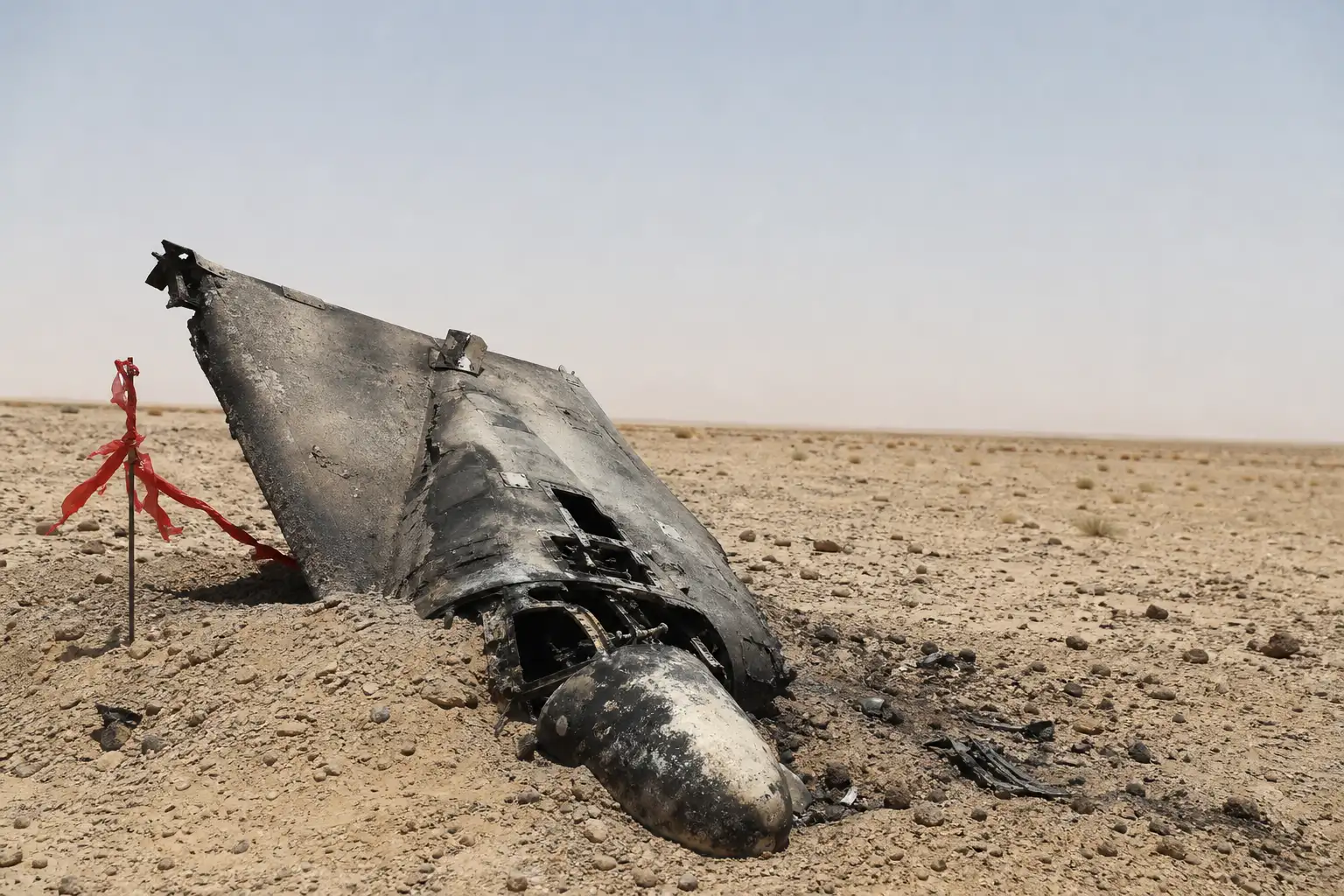
A US service member died in northern Iraq on July 18 while a bomb disposal team worked to destroy the unexploded ordnance of a downed Iranian drone. It was the third American combat death in three days, and the first one that Iranian fire did not directly cause.
For the roughly 50,000 American troops still moving through the region, that distinction is becoming its own hazard. The wreckage a drone leaves behind is now a danger of its own, one that keeps killing after the shooting has already stopped.
CENTCOM Confirms a Third Fatality in Three Days
US Central Command (CENTCOM), the military headquarters led by Admiral Brad Cooper that runs American operations across the Middle East, announced the Iraq death in a statement Sunday. A second service member was wounded in the same incident and is being treated for what the command called a minor injury.
“A US service member in northern Iraq was killed in action July 18 during a controlled detonation of unexploded ordnance from a downed Iranian one-way attack drone,” CENTCOM said in a post on X. The command did not name the soldier, saying it was withholding identities of the fallen and missing out of respect for their families during the notification process.
The same statement updated an earlier, grimmer story out of Jordan. Two US service members were killed there on July 17 when Iranian missiles and drones struck the Muwaffaq Salti Air Base, and a third was reported missing. CENTCOM said Sunday that unidentified remains had since been found at the site, with identification underway. Four other troops hurt in that attack were medevaced to Jordanian hospitals and have since been discharged.
| Date | Location | What Happened |
|---|---|---|
| July 17 | Muwaffaq Salti Air Base, Jordan | Killed in an Iranian ballistic missile and drone attack |
| July 17 | Muwaffaq Salti Air Base, Jordan | Reported missing; unidentified remains later recovered at the site |
| July 18 | Northern Iraq | Killed detonating unexploded ordnance from a downed Iranian drone |
The Danger That Survives the Strike
Seventeen American troops have now died since the war with Iran began on February 28, according to the Pentagon’s own count. Fourteen of those deaths trace back to the original campaign that killed Iran’s Supreme Leader Ali Khamenei and the eight-day exchange of strikes that followed. The other three came this week, after a ceasefire collapsed and the fighting resumed.
Two of this week’s three were killed by direct Iranian fire in Jordan. The third died clearing away a drone’s leftovers, after the attack itself was already over.
That is becoming its own recognizable category of risk in this war: the debris field each drone leaves behind, sitting quietly until someone has to deal with it. Iran’s one-way attack drones, built on the same template as Russia’s Shahed design, reportedly cost around $30,000 apiece, cheap enough for Tehran to launch in large batches. The interceptors used to shoot them down can run into the millions of dollars and still miss.
Even a downed drone still carries a cost. Someone has to find the wreckage, then disarm or destroy whatever explosive charge rode out the crash intact. Explosive ordnance teams routinely detonate unstable munitions where they lie rather than risk moving them, a standard procedure that stays dangerous no matter how carefully it is handled. That job is what killed the American service member in northern Iraq on Saturday.
Why Did the Truce Collapse?
A 14-point memorandum of understanding was supposed to have ended this. Trump signed it in mid-June, and CENTCOM lifted its naval blockade of the Strait of Hormuz soon after. The deal held for a few weeks.
It broke down in early July after Iran attacked tankers transiting the strait. Trump said on July 7 that he considered the truce over, and strikes resumed within days. Mojtaba Khamenei, who became Iran’s supreme leader after his father was killed in the war’s opening strikes, warned of what he called unforgettable lessons if the United States kept attacking.
Here is how the collapse unfolded:
- February 28, 2026: The US and Israel launch Operation Epic Fury, opening strikes that kill Supreme Leader Ali Khamenei.
- Mid-June 2026: Trump signs a 14-point memorandum of understanding aimed at ending the war and reopening the Strait of Hormuz.
- Early July 2026: Iran attacks tankers in the strait; Trump declares the truce over.
- July 17, 2026: Iranian missiles hit Muwaffaq Salti Air Base in Jordan, killing two US service members.
- July 18, 2026: A US service member dies in northern Iraq disposing of a downed drone’s ordnance, and Iran claims strikes on two US-linked bases in Kuwait.
CENTCOM said the strikes that concluded at 11:30 p.m. Saturday marked the eighth consecutive night of the renewed campaign, aimed at forces it said were responsible for the Jordan attack. By Sunday evening, US aircraft were already flying a ninth. Iranian officials say at least 50 people have been killed and roughly 500 injured in the country since strikes resumed on July 6.
Kuwait’s Bases Absorb the Retaliation
Iran answered the latest round of American strikes by turning to Kuwait, home to some of the largest US logistics hubs in the Gulf. Iran’s army described the operation as the sixteenth phase of a campaign against US positions in the region, and hit ammunition depots and radar systems with what it called heavy volleys of drones.
The targets included a mix of military and civilian infrastructure:
- Camp Buehring, also known as Camp Udairi, where Iran said it struck a US ammunition depot.
- Ali Al Salem Air Base, where drones targeted Patriot radar and air defense systems.
- A Kuwaiti power and desalination plant, set on fire for the second time in two days.
- The Mina al-Ahmadi refinery complex, where Kuwait’s national oil company reported a blaze at its crude export terminal.
Kuwait’s military said its air defenses were confronting what it called hostile missile and drone attacks and warned residents that explosions they heard were interceptions, not impacts. No American or Kuwaiti casualties were reported in the latest round, though Kuwait’s electricity ministry said the country had to disconnect several generating units to protect workers after the desalination plant fire.
Fifty Thousand Troops in a Widening War
CENTCOM said more than 50,000 American troops remain deployed across the Middle East, describing them as highly vigilant, focused, lethal and ready. That deployment, the largest in the region since the 2003 Iraq invasion, is now absorbing casualties on two separate tracks: direct fire from missiles and drones, and the aftermath those weapons leave scattered across bases and border zones.
The wounded toll from the Jordan attack alone pushed the war’s total past 430 troops injured, on top of the 17 dead. President Trump, asked by NewsNation whether he planned further retaliation for the deaths, called the losses a very sad thing.
We hate to see it happen. It’s in service to our country.
Trump told NewsNation, adding that his goal remained never allowing Iran to have a nuclear weapon.
Tehran’s Billboards and a Senator’s Death
Alongside the drones and missiles, Iran has been running a second, quieter campaign built on billboards. A red sign in Tehran’s Valiasr Square this week asked in English who was next, tagged with the late Senator Lindsey Graham’s name and an unusual capitalization pattern that appeared to nod at Trump’s initials. In Enghelab Square, a corner billboard showed Trump’s body emerging from an open coffin, with graffiti-style text in Persian and English reading that Trump would be killed. A mural in Palestine Square had already set framed images of Trump, his children and Melania above flag-draped coffins days earlier.
Graham, the South Carolina Republican and a close Trump ally, died on July 11 at age 71, hours after returning from his tenth trip to Ukraine. He had met President Volodymyr Zelensky in Kyiv on July 10 to discuss air defense and a Russia sanctions bill. The Iranian billboards have fed speculation online that Tehran had a hand in his death, timed to a week when American missiles were also striking Iranian bridges, railways and water facilities.
The medical record tells a plainer story. Graham’s office said he died of an aortic dissection, a tear in the body’s main artery linked to hardened arteries, according to preliminary findings from the District of Columbia medical examiner.
What We Know:
- Graham died July 11 of an aortic dissection tied to arteriosclerosis, per the DC medical examiner’s preliminary finding.
- He had just returned from Ukraine, where he met Zelensky the day before falling ill.
What’s Unconfirmed:
- Any link between Iran and Graham’s death; no evidence has surfaced tying Tehran to it.
- Whether the Tehran billboards reflect an organized regime campaign or the work of individual sign operators.
A War Now Past Its 140th Day
Sunday marked roughly the 142nd day since Operation Epic Fury began. What started as a strike meant to end quickly with a decapitated Iranian leadership has instead settled into a grinding cycle: strikes, retaliation, a truce, its collapse, and now a resumption that keeps generating casualties nobody quite expected, from soldiers handling wreckage nobody quite planned for.
The identities of all three American troops lost this week remain undisclosed, pending notification of their families.
Frequently Asked Questions
What Is a One-Way Attack Drone?
A one-way attack drone, sometimes called a kamikaze drone or loitering munition, is built to fly toward a target and detonate on impact rather than return to base. Iran’s version is modeled on Russia’s Shahed design, a slow, propeller-driven aircraft that trades speed for low cost and the ability to be launched in large numbers.
Has Congress Authorized the War With Iran?
Congress has not passed a formal declaration of war. Trump ordered the opening strikes under his own authority as commander in chief, and lawmakers in both parties have pressed the administration on its strategy and endgame during Senate floor debate, according to Associated Press reporting.
What Happens to a Drone’s Wreckage After It Is Shot Down?
Military ordnance teams typically inspect downed drones for unexploded munitions and destroy unstable material in place through a controlled detonation, rather than risk moving it. The procedure is standard practice in active war zones, but it remains inherently dangerous, since the exact condition of a crashed warhead is never fully known until crews are already working next to it.
Did Iran Have Any Connection to Senator Lindsey Graham’s Death?
No evidence has emerged linking Iran to Graham’s death. His office and preliminary medical examiner findings attributed it to an aortic dissection. Graham’s Senate seat was subsequently filled by his sister, Darline Graham Nordone, for the remainder of his term.
