
Air raid sirens rang out over Amman and the Red Sea port of Aqaba on Sunday, moments after Israeli and Jordanian forces shot down an Iranian missile streaking toward Jordan’s southern coastline. It was one of four missiles Iran fired at the kingdom that day, the same weekend a Kuwaiti power and desalination plant caught fire for the second time in two days.
Washington and Tehran are trading the strikes that make headlines. Neither country asked for this war, and both Kuwait and Jordan are now absorbing its bills, a pattern that has held for five months and shows no sign of easing.
Eight Nights of Strikes and a Widening Blast Radius
The US Central Command (CENTCOM) carried out its eighth consecutive night of strikes on Iran on Sunday, aiming to punish Tehran after two American soldiers died in Jordan two days earlier. CENTCOM said the raids were meant to “swiftly punish Islamic Revolutionary Guard Corps forces who launched attacks against American service members in Jordan last night.”
Footage released by the military showed fighter jets and Tomahawk cruise missiles hitting coastal surveillance posts, air defense batteries and missile storage sites. Also on the target list was the Darkhovin nuclear power plant, still under construction on Iran’s southern coast. Iran’s Atomic Energy Organisation called the strike on the plant “an aggressive and brutal act contrary to international law.”
Iran responded within hours, spreading fire across four fronts at once.
- Kuwait: Iran’s army said drones hit an ammunition depot at Camp Udairi and Patriot radar systems at Ali Al Salem Air Base.
- Bahrain: the military said it confronted, intercepted and destroyed a number of what it called treacherous Iranian aerial attacks, accusing Tehran of targeting civilians.
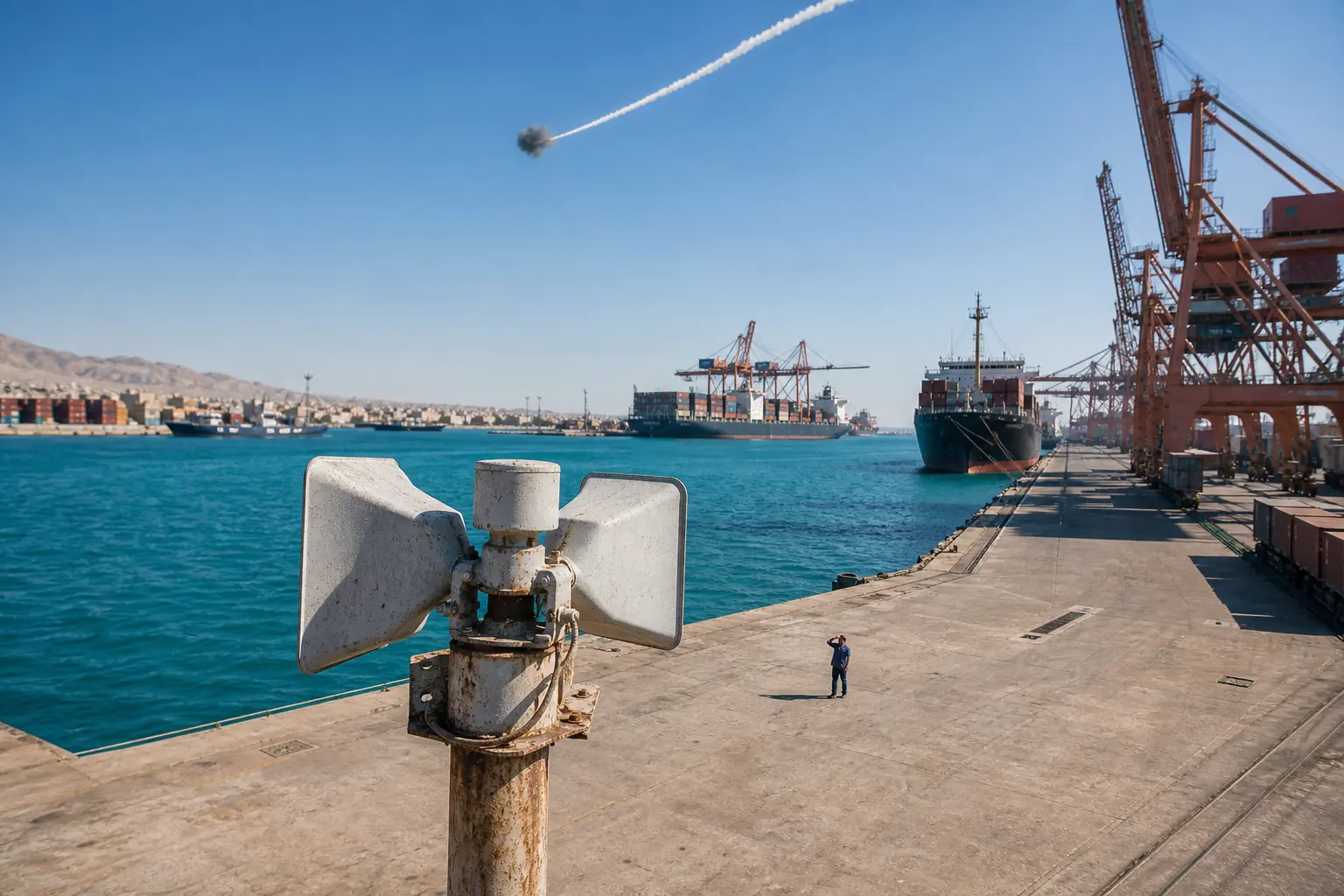
- Jordan: sirens sounded as Israeli and Jordanian forces intercepted an Iranian missile heading toward the port city of Aqaba.
- The Strait of Hormuz: Iran’s Revolutionary Guards said four ships tried to transit without permission; two, they said, “had an accident and were stopped in place,” while the other two turned back.
Kuwait’s electricity ministry separately reported a fire at a power and desalination plant, struck for the second consecutive day. Around 90 per cent of the country’s drinking water depends on plants just like it.
Trump’s Deal Is Now “Worthless and Invalid,” Iran Says
Behind the latest wave of strikes sits a peace effort that collapsed by midsummer. Both sides were deadlocked over the Strait of Hormuz, and on July 8 President Donald Trump declared the interim agreement dead after what he said were new Iranian strikes on shipping in the waterway. An Iranian negotiator said Tehran was suspending its commitments to the deal, closing the door on a political settlement for now.
Iran’s Supreme Leader Mojtaba Khamenei, who took the role after his father was killed in the war’s opening strike and who has not appeared publicly since, said Saturday that the US would face an “unforgettable lesson” if the strikes continued. He dismissed the agreement bearing Trump’s signature as “worthless and invalid.” Iran’s joint military command added its own warning, saying US “covetousness, bullying, totalitarianism or brutality” would meet a “devastating response.”
Before the war, oil flow through the passage between Oman and Iran averaged 20 million barrels a day, about a fifth of global petroleum liquids consumption, according to the US Energy Information Administration (EIA). That is the scale of what both sides are gambling with every time talks break down.
Kuwait’s Water Supply Becomes a Front Line
Kuwait’s Ministry of Electricity, Water and Renewable Energy said its plant was hit again Sunday, sparking a fire that damaged several generation units. Firefighters contained the blaze, and the ministry said technical teams were working around the clock to keep the wider grid stable.
About 90% of Kuwait’s drinking water comes from desalination, removing salt from seawater by forcing it through fine membranes in a process called reverse osmosis. Oman relies on the same technology for roughly 86 per cent of its water, and Saudi Arabia for about 70 per cent.
| Country | Share of Drinking Water From Desalination | Recent Exposure |
|---|---|---|
| Kuwait | About 90% | Power and desalination plant hit twice in two days, July 17 and 19 |
| Oman | About 86% | Draws from the same Gulf coastline as Kuwait’s damaged plant |
| Saudi Arabia | About 70% | Desalination sites previously targeted by Yemen’s Houthi rebels |
| Iran | About 3% | Plants on Qeshm Island reportedly hit by US strikes in March, cutting water to 30 villages |
A 2010 analysis by the Central Intelligence Agency (CIA), cited by the Associated Press, warned that strikes on Gulf desalination plants could trigger national crises. More than 90 per cent of the region’s desalinated water comes from just 56 plants, and each one, the analysis found, is “extremely vulnerable to sabotage or military action.”
Kuwait’s Doha West plant was already damaged earlier in the war by debris from intercepted drones, according to Kuwaiti officials. Many Gulf desalination sites double as power stations, so an attack on the electrical grid can choke off water production even without a direct hit on the intake pipes.
Sirens Over Aqaba, and a Dispute About What Happened Next
In Jordan, sirens sounded across Amman and the south on Sunday after Israel’s military detected missiles launched from Iran toward Aqaba, warning of possible debris spillover into its own territory. Jordan’s army said it shot down three of the four missiles; the fourth landed in a remote southern area, causing no casualties or damage.
Hours earlier, the US embassy in Amman had warned of a “specific and credible threat” to Aqaba’s international airport and seaport, the kingdom’s only sea outlet, and said local authorities had evacuated both sites.
- Confirmed: Iran fired four missiles toward Jordan on Sunday; three were intercepted and one landed in a remote area with no casualties.
- Confirmed: Air raid sirens sounded in Amman, and Israel’s military said it intercepted interceptor debris that threatened to drift into its own territory.
- Disputed: The US embassy said Aqaba’s airport and seaport were evacuated over the threat. Jordan’s government spokesman, Mohammad al Momani, said no evacuation order was ever issued and that both facilities were operating normally.
- Disputed: Whether Iran aimed at Aqaba specifically because of its closeness to the Israeli city of Eilat, something some analysts read as a signal meant for Israel rather than Jordan.
The chief executive of Aqaba Ports Company told Reuters the port continued operating as usual through the alert.
Five Months From Assassination to Stalemate
The war that produced Sunday’s sirens began nearly five months earlier with the killing of Iran’s supreme leader.
- February 28, 2026: Joint US and Israeli strikes killed Iran’s supreme leader, Ali Khamenei, at his compound in Tehran along with dozens of senior officials, opening the war.
- Early March 2026: Iran’s Assembly of Experts named his son, Mojtaba Khamenei, injured in the same opening strike, as the new supreme leader. Fighting spread into the Gulf states and Lebanon.
- April 2026: A brief ceasefire reopened the Strait of Hormuz to shipping before Iran shut it again over the continuing US naval blockade.
- July 8, 2026: Trump declared the interim agreement “over” after what he said were new Iranian strikes on shipping in the strait.
- July 14, 2026: The US reinstated its naval blockade of Iranian ports and said it would charge a 20 per cent fee on cargo shipped through the strait.
- July 17 and 19, 2026: Iran struck the same class of Kuwaiti power and desalination plant twice in two days and fired missiles toward Jordan’s Aqaba.
The World Bank called the resulting disruption the largest oil market shock in history, with Brent crude rising about 65 per cent by the end of March alone. Global oil supply crashed by 10.1 million barrels a day that month, the bank’s Commodity Markets Outlook found, and output is projected to run a 3.7 million barrel daily deficit this quarter.
By mid-July, Brent had climbed back above $83 a barrel and US crude above $78, both roughly a month’s high, after Trump’s blockade announcement. Iran’s health ministry said at least 50 people were killed and more than 500 wounded in the latest wave of US strikes alone. The war overall has killed thousands and displaced several million people, mostly in Iran and in Lebanon, where fighting between Israel and the Iran-backed group Hezbollah reignited. On the American side, Friday’s attack in Jordan brought the confirmed US military death toll to 16 since the war began, with more than 430 wounded; a third soldier remains missing.
Israel’s Refuelling Jets Hint at What Comes Next
Israel has not joined this wave of US strikes, but it is positioning to. An Israeli military official said Sunday that the country is preparing to receive additional American refuelling aircraft, on top of the dozens already stationed there. The US had “decided to adjust its force posture in the region” and would “reinforce the existing fleet of aerial refuelling aircraft stationed in Israel with additional refuelling aircraft,” the official said.
Israel’s defense minister, Israel Katz, said his country would respond in kind to any direct Iranian attack. “If Iran fires missiles at Israel, we will attack them with full force,” he said Sunday during a visit to a rescue service facility. Israel’s military chief, Lieutenant General Eyal Zamir, told commanders that the country’s “Aerial Defence Array remains on alert to protect Israeli civilians” after monitoring the launch toward Aqaba.
The Strait of Hormuz is the primary export route not just for Iran but for Saudi Arabia, the UAE, Kuwait, Qatar, Iraq and Bahrain, and Saudi Arabia alone holds most of the world’s spare oil production capacity, according to the International Energy Agency (IEA). A wider war would strain all of it at once, not just the two combatants trading strikes over Iranian soil.
Kuwait’s ministry said late Sunday its technical teams were still working to restore the damaged units and stabilize the grid. In Aqaba, Jordanian officials maintained the port and airport never stopped operating at all.
Frequently Asked Questions
Who Is Mojtaba Khamenei?
Mojtaba Khamenei is Iran’s supreme leader, named to the post by the Assembly of Experts in early March after his father, Ali Khamenei, was killed in the war’s opening US-Israeli strike on February 28. Mojtaba was injured in that same attack. He has not been seen publicly since the war began and has rejected the US-brokered interim deal as invalid.
Is the Strait of Hormuz Open or Closed Right Now?
It depends who is asked. Iran’s Persian Gulf Strait Authority has said passage through the waterway is currently unfeasible because of US naval action, while Washington insists the strait remains open behind its blockade and new 20 per cent transit fee. Ship-tracking data showed only 57 transits over one recent weekend, more than 50 per cent below the previous week and far under the roughly 130 daily transits recorded before the war.
Which Countries Have Reported Strikes Since the War Began?
Beyond Iran, the US and Israel, strikes or interceptions have been reported in Saudi Arabia, the United Arab Emirates, Qatar, Bahrain, Kuwait, Jordan and Lebanon at various points since February. Kuwait and Jordan have seen the most sustained hits in the current wave, largely because of their US military hosting arrangements.
Is It Safe to Travel to Aqaba Right Now?
The US embassy in Amman has advised Americans to avoid Aqaba’s airport, seaport and military bases in Jordan generally, citing a specific threat. Jordanian officials and the Aqaba Ports Company’s own chief executive say the facilities have continued operating normally throughout. Travelers should treat the conflicting accounts as a reason to monitor official Jordanian and embassy channels directly rather than assume either version settles the question.
Why Does the Gulf Depend So Heavily on Desalination?
Most Gulf states have little natural fresh groundwater, so cities rely on desalination plants that convert seawater through reverse osmosis. Many of these plants are built as combined power and water stations, meaning an attack on the electrical side of a facility can cut freshwater output even when the water treatment equipment itself is untouched.
