
Egypt’s foreign trade in gold has climbed to nearly $20 billion since the start of 2022. Exports of gold, jewelry and precious stones totaled $16.3 billion between January 2022 and the end of May 2026, while imports of raw unwrought gold added another $3.65 billion, according to Marsad Al Dahab for Economic Studies (Arabic for Gold Observatory), a research group that tracks the sector using data from Egypt’s Central Agency for Public Mobilization and Statistics (CAPMAS) and the Export Council for Building Materials, Refractories and Metallurgical Industries.
Behind that headline number sits a country where households have been converting pound savings into gold bars during the biggest global bullion rally in decades, even as its jewelry-manufacturing industry still captures only a sliver of the trade’s value.
Lines Outside Cairo’s Gold Shops
At gold-trading counters across Cairo, queues have formed this year as savers rushed to convert maturing bank certificates back into bullion, Mada Masr reported from inside a Cairo bullion branch. Total gold purchases in Egypt fell over 2025, but jewelry absorbed almost all of that decline.
Jewelry sales dropped 18% compared with 2024, while sales of bars and coins slipped just 2%, per World Gold Council figures cited in that reporting. Bar and coin sales then surged 27% year on year in the final quarter of 2025, a sign of savers pivoting hard toward gold as an investment rather than an ornament.
Gold pricing in Egypt is generally tied to global prices
Hany Milad, head of the Gold Division at the Federation of Egyptian Chambers of Commerce, said that, adding that local supply and demand typically add no more than a five percent premium on top of the world price.
Real estate, once Egypt’s other favored inflation hedge, has grown too expensive for many buyers, pushing more savings toward gold instead. In Cairo, a gram of 21-karat gold, the standard weight for everyday jewelry, went from about 3,720 Egyptian pounds at the start of 2025 to nearly 5,000 pounds by year’s end, roughly $74 to $100 at prevailing exchange rates.
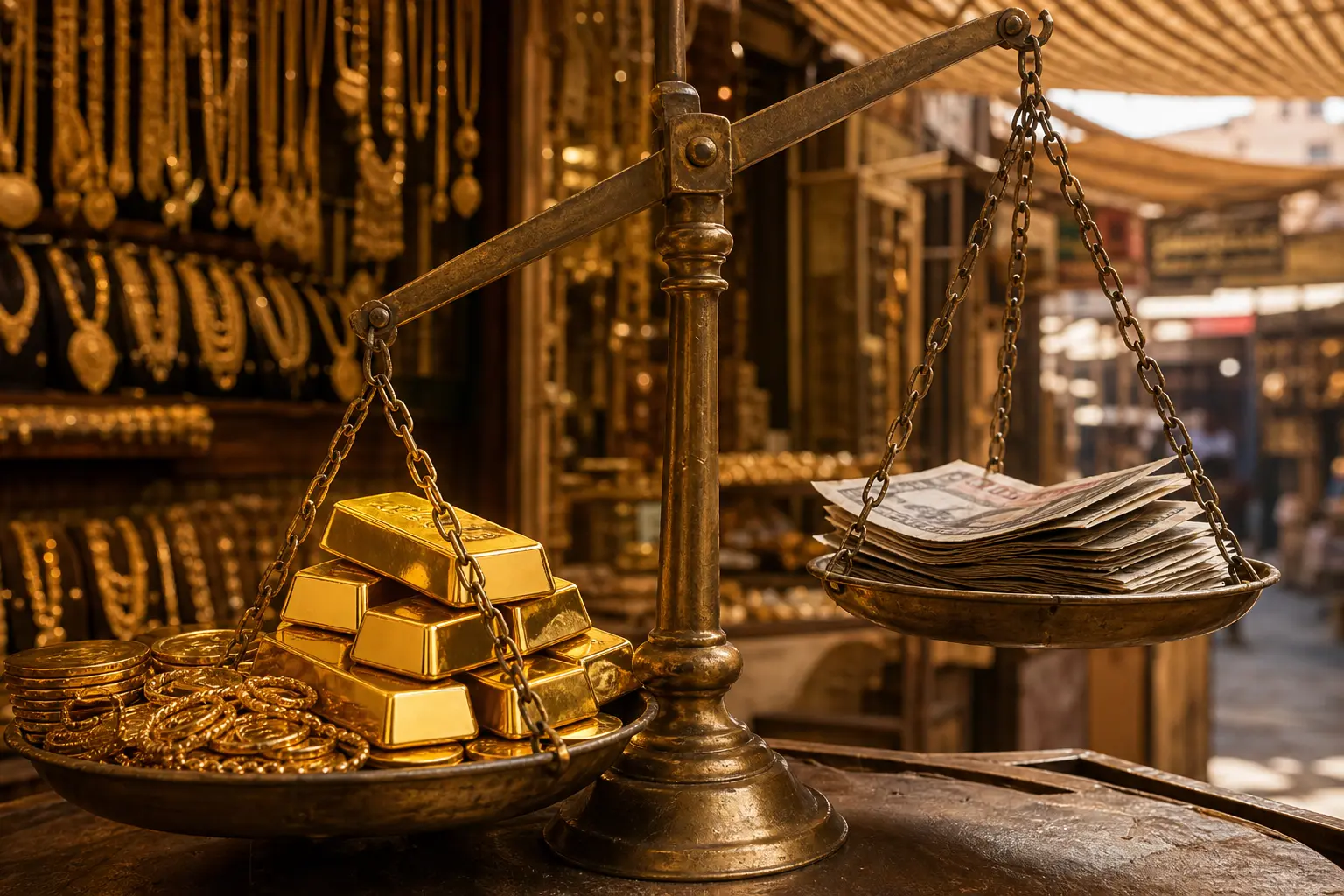
A Pound That Has Lost Most of Its Value Since 2022
The Egyptian pound has lost more than 70% of its value against the dollar since early 2022, worn down by repeated devaluations tied to the country’s International Monetary Fund program. Annual inflation topped 25% for most of 2023 and peaked at 38% that September, according to Central Bank of Egypt data.
It has since eased. Inflation fell to 14.6% in May 2026 from 14.9% in April, though housing, electricity and transport costs still run well above the national average.
- 70%+ – the share of its dollar value the Egyptian pound has lost since early 2022.
- 38% – Egypt’s peak annual inflation rate, hit in September 2023.
- $3,431 – gold’s average price per ounce in 2025, up 44% from 2024.
- $5,589 – the record price per ounce gold reached in January 2026.
Global gold prices supplied the other half of the story. The metal set 53 new all-time highs in 2025 alone, then pushed further to a record near $5,600 an ounce in January 2026. For Egyptian savers already fleeing a weak currency, that rally turned gold bars into one of the few assets that reliably outran inflation.
Egypt’s Gold Trade by the Numbers
The scale of the shift shows up once the figures are laid out year by year.
| Year | Gold, Jewelry and Precious Stone Exports | Unwrought Gold Imports |
|---|---|---|
| 2022 | $1.633 billion | $317 million |
| 2023 | $1.859 billion | $139.2 million |
| 2024 | $3.26 billion | $166.2 million |
| 2025 | $7.6 billion (record) | $996.1 million |
| 2026 (partial year) | $1.941 billion (Jan-May) | $2.028 billion (Jan-Apr) |
Exports hit a record $7.6 billion in 2025, more than double 2024’s $3.26 billion. Imports of unwrought gold followed an even steeper curve, climbing from $166.2 million in 2024 to $996.1 million in 2025, then to $2.028 billion in just the first four months of 2026, compared with only $62.6 million in the same months of 2025.
Exports, meanwhile, cooled. Egypt shipped about $1.941 billion in gold, jewelry and precious stones between January and May 2026, nearly half the $3.6 billion it exported over the same months a year earlier. Marsad Al Dahab attributes that drop mainly to the unusually high base set by 2025’s record year.
Egypt’s Exports Are 97 Percent Raw Bullion
Marsad Al Dahab’s data point to a structural feature that headline totals tend to obscure. Around 97% of Egypt’s gold, jewelry and precious stone exports by value consists of unwrought or semi-manufactured gold. Finished jewelry accounts for roughly 3%.
That split matters because finished jewelry carries the higher profit margins and manufacturing jobs. Separate United Nations trade data compiled by the Observatory of Economic Complexity show Egypt’s gold exports concentrated in the United Arab Emirates and Switzerland, both major bullion-trading and refining centers, rather than in markets that primarily buy finished jewelry.
Globally, the reward for finished product was obvious in 2025. The value of worldwide jewelry demand climbed 18% to a record $172 billion even as the tonnage sold fell, since higher prices let manufacturers earn more per piece.
Marsad Al Dahab points to three forces behind Egypt’s shift, distinct from any simple growth in jewelry manufacturing:
- Savings shift – record prices turned bars and coins into Egypt’s preferred way to preserve savings, ahead of traditional jewelry buying.
- New entrants – additional companies moved into producing and trading gold bars and coins, and established firms expanded that side of the business.
- Liquidity exports – the market has sold gold abroad at times to raise cash and rebalance local supply, not to expand jewelry output.
The research group says Egypt’s gold industry still has room to raise its own value added by building out finished-jewelry production instead of leaning on exports of raw and semi-processed metal.
Can Egypt Turn Its Gold Trade Into a Jewelry Hub?
Egypt’s industry says it intends to. The Federation of Egyptian Industries formed a new export committee in June 2026 to grow gold and jewelry sales abroad, building on a 2023 decision to scrap valuation fees on jewelry exports. Trade data so far still shows most of what Egypt sells abroad arriving unfinished.
Ehab Wassef, head of the Federation’s Gold and Precious Metals Division, said the committee would focus on market research, participation in international exhibitions and closer coordination with the Chamber of Metallurgical Industries. The division announced its new board for the 2025-2029 term alongside the committee’s launch.
“The division aims to increase the sector’s contribution to Egypt’s export revenues and strengthen its role in generating foreign currency earnings,” he said.
Egypt’s government has separately been developing a second tax facilities package easing foreign trade more broadly, part of a wider push to modernize customs and export procedures, though officials have not detailed how it applies to gold specifically.
Even Egypt’s Central Bank Is Stockpiling Gold
Ordinary savers are not the only ones hedging with gold. Egypt’s central bank saw the value of its own gold reserves jump almost three-quarters to $18.2 billion in 2025, adding about 79,600 ounces over the year.
Gold contributed $914 million to reserve growth in December 2025 alone, helping push Egypt’s total international reserves to a record $51.5 billion. Central bank officials describe the metal as a buffer against global volatility, alongside foreign-currency holdings and special drawing rights at the International Monetary Fund.
From household savers queueing at bullion counters to the state itself, gold has become Egypt’s default hedge against a currency under sustained pressure.
Frequently Asked Questions
What does “unwrought gold” mean in Egypt’s trade data?
Unwrought gold refers to raw or semi-processed bullion, doré bars, ingots or granules that have not yet been shaped into jewelry or finished products. Marsad Al Dahab’s figures show this raw category, not finished jewelry, driving almost all of the recent import growth.
Why are Egyptians buying so much gold right now?
Inflation and a weak pound have pushed savers toward gold since 2022. Some state banks issued savings certificates paying up to 27% annual interest in 2024, but as those matured and gold’s price kept climbing, many savers rushed to convert cash back into bars and coins.
Is this trade data the same as the size of Egypt’s domestic gold market?
No. Marsad Al Dahab has stressed that its export and import totals measure cross-border trade flows only, not the value of transactions inside Egypt’s domestic market, and they do not directly capture how much value Egyptian manufacturing adds to the metal.
Does Egypt mine its own gold?
Yes. The Sukari mine in Egypt’s Eastern Desert, run by AngloGold Ashanti after it acquired longtime operator Centamin in November 2024, produced 500,000 ounces in 2025, up from 481,000 ounces in 2024. At 2025’s average price of $3,431 an ounce, that output alone was worth well over $1.7 billion, though it has not kept pace with the surge in bar and coin buying.
Why did Egypt’s gold exports fall in early 2026 despite the broader boom?
Exports of gold, jewelry and precious stones totaled about $1.941 billion between January and May 2026, down from roughly $3.6 billion in the same months of 2025. Marsad Al Dahab attributes the drop mainly to the unusually high comparison base set by 2025’s record year, not a slowdown in underlying demand.
