
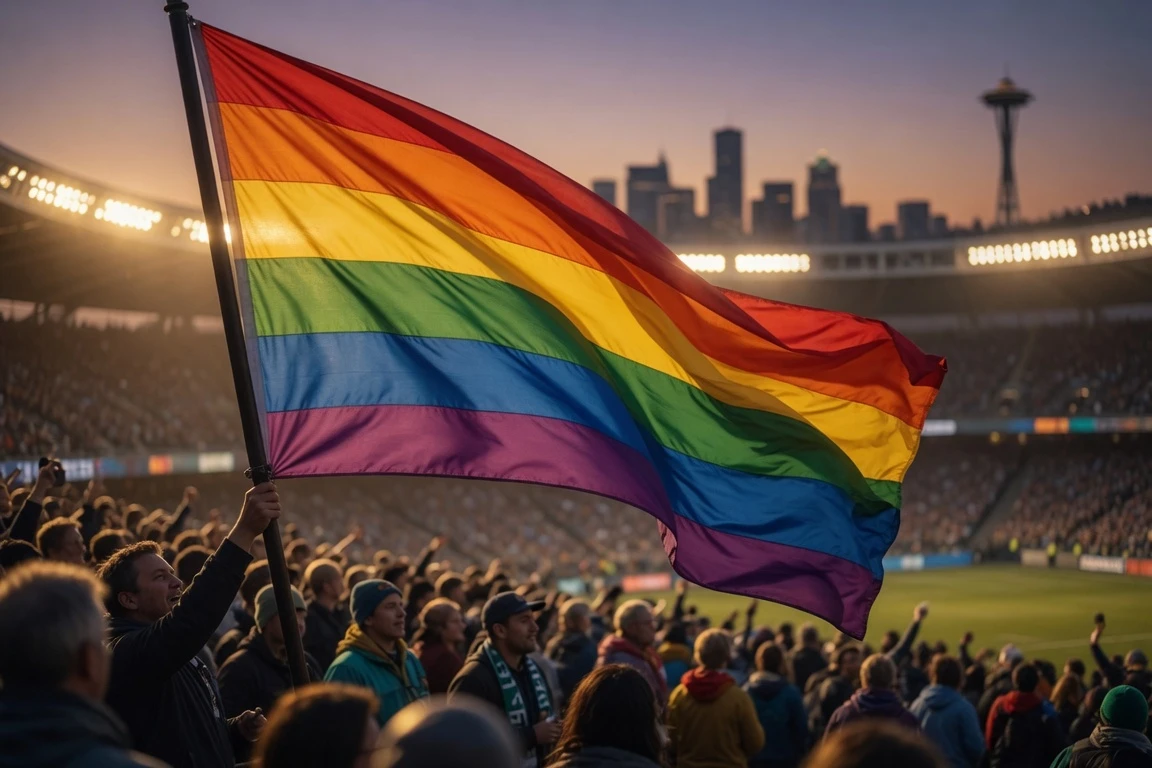
FIFA said Thursday that rainbow flags will be permitted at Friday’s Egypt-Iran World Cup match in Seattle, rejecting requests from both football federations to ban Pride-related displays at the game. The Group G fixture was designated a “Pride Match” by Seattle PrideFest before FIFA finalised last December’s tournament draw.
That draw paired two Muslim-majority countries whose own laws treat same-sex relations as criminal offenses. Iran allows the death penalty. Egypt carries a maximum of three years in prison. The match will play out under a stadium-code policy FIFA has spent the past six months describing as inclusive, even as its president has gone to lengths to distance the body from the “Pride Match” label.
FIFA Clears the Flags, Again
FIFA’s statement on Thursday was direct. “The FIFA World Cup 2026 is an inclusive event that welcomes people from all backgrounds,” the governing body said. “Fans of all sexual orientations and gender identities are welcome at matches and events.”
The body paired that message with an explicit reference to the FIFA World Cup 2026 Stadium Code of Conduct, which it said permits rainbow flags and other flags representing sexual orientation and gender identity inside stadiums, provided they are used in a manner consistent with the code. The code limits flag and banner size and prohibits items deemed political, and the 2026 World Cup stadium code of conduct is published on FIFA’s digital hub.
The decision confirmed what FIFA had told reporters a day earlier, when it said it was permitting rainbow flags at all of its World Cup matches this summer. It also controls only stadiums and official fan zones in host cities, with no formal authority over community events like Seattle PrideFest, a jurisdictional split the body has leaned on throughout the dispute. The carve-out lets FIFA defend inclusive rules inside the gates while letting Seattle’s Pride programming run on its own terms outside them. The committee’s broader Pride programming is planned outside the stadium perimeter throughout the weekend.
Infantino had set the framing back in January, telling the Swiss magazine Weltwoche there would be no “Pride Match” at the World Cup. There would be, he said, “a FIFA World Cup match in Seattle, and, on the same day, events organised by external organizations will be taking place in the city. But that has nothing to do with the match itself.” FIFA has repeatedly pointed reporters back to that interview throughout the dispute.
Why Both Federations Objected
Egypt and Iran had pressed FIFA to halt any LGBTQ+-themed activity around the fixture since the draw placed the two teams together. After last year’s draw, the Egyptian Football Association sent a letter to FIFA Secretary General Mattias Grafstrom objecting to Pride-related activity around the match on cultural and religious grounds.
The Iranian Football Federation sharpened the demand in a statement on Wednesday. “Iran and Egypt are two Muslim countries with deep cultural and religious commonalities,” the federation said, without naming the LGBTQ+ community. Its position, the statement read, was that “no ceremonies, or promotional activities associated with this movement should be present inside the stadium or as part of the match environment.”
Iranian federation president Mehdi Taj earlier described the original Pride Match branding as “an irrational move that supports a certain group,” according to comments to local news agency ISNA reported by Al Jazeera. Iran limited its pre-match press conference to football questions on Thursday, with a FIFA official telling the media the national team was “only willing to answer questions in relation to the game.”
The Laws Behind the Rainbow
Both federations spoke in the language of cultural and religious values. The two countries also maintain formal criminal prohibitions on same-sex relations. According to the Human Dignity Trust, a UK-based charity that tracks such laws globally, those prohibitions have been enforced in recent years.
In Iran, the 2013 Penal Code criminalises penetrative anal intercourse between men under “livat,” with a maximum death penalty. The law applies to both men and women. In Egypt, the 1937 Penal Code and Law 10/1961 criminalise acts of “indecency,” “scandalous acts,” and “debauchery,” with a maximum of three years in prison and a fine. The law on same-sex relations in Egypt and the law on same-sex relations in Iran are documented on the trust’s country profiles.
| Country | Maximum penalty | Penal code | Who is criminalised |
|---|---|---|---|
| Iran | Death | 2013 Penal Code | Men and women |
| Egypt | Three years in prison and a fine | 1937 Penal Code and Law 10/1961 | Men |
Seattle Organizers Refuse to Step Back
Seattle’s local World Cup organizing committee has refused to soften the Pride Match branding. Hedda McLendon, the committee’s senior vice president of legacy, told Reuters the city had been celebrating Pride on the last weekend of June for more than 50-plus years and would continue to do so after the tournament. She told Kiro 7 News the matchup offered “an opportunity for everybody to do better when it comes to LGBTQ inclusion.”
Chief Legacy Officer Leo Flor said the local committee’s posture did not shift after the draw. “We are excited to show the world, to welcome the world, to celebrate as a community,” he said.
Bookda Gheisar, a senior director of equity, diversity and inclusion for the Port of Seattle who emigrated from Iran in 1981, offered a counterweight to broad-brush framing of Iranian society. “There are many of us who do want that, but also our country is right now in the middle of a crisis and these players are facing tremendous challenges,” Gheisar said. People inside Iran, she added, are “organizing and advocating for change.”
You can see how much joy and camaraderie and excitement there is for watching this beautiful game together and that kind of excitement you will also see at the Pride Parade on Sunday.
Patti Hearn, executive director of Seattle Pride, ahead of Friday’s match at Lumen Field.
From Qatar 2022 to Seattle 2026
The posture from Zurich is a sharp turn from four years ago. At the 2022 World Cup in Qatar, FIFA fiercely defended the host nation’s cultural norms against visiting teams whose captains wanted to wear the OneLove armband with rainbow elements. Qatari officials viewed the armband, in part, as criticism of the emirate’s criminalization of same-sex relations.
Some Wales fans had rainbow hats removed before entering stadiums. The episode became the public face of FIFA’s willingness to align with host-country restrictions.
In Seattle, the in-stadium programming remains narrow. The body controls only stadiums and official fan zones; community events like Seattle PrideFest sit beyond FIFA’s reach. The Seattle host committee’s main Pride Match activations are planned outside the stadium perimeter. FIFA’s central headquarters has no authority over those outside events.
Inside the bowl, the body’s rules govern. Items must be used in a manner consistent with the Stadium Code of Conduct, which limits flag and banner size and prohibits items deemed political. The code is the reference point FIFA pointed to in its Thursday statement.
Hedda McLendon, of Seattle FWC26, told Kiro 7 News that Egypt and Iran are “just two of 65 countries around the world that criminalizes homosexuality” and that the moment offered “an opportunity for everybody to do better when it comes to LGBTQ inclusion.” The governing body has settled on a posture that holds the line on inclusivity inside the gates while keeping the Pride Match label at arm’s length.
What Friday’s Match Will Look Like
The Group G match kicks off Friday at Lumen Field in Seattle. It is a decisive Group G fixture. Designated demonstration zones have been set up near the stadium in anticipation of protests. The Seattle Police Department has said safety is its biggest priority.
The arc from the December draw to Friday’s kickoff:
- December 2025: FIFA’s World Cup draw pairs Egypt and Iran at Lumen Field on June 26, 2026.
- December 2025: The Seattle host committee’s Pride Match branding draws immediate objections from both federations.
- January 2026: FIFA President Gianni Infantino tells Weltwoche there will be no “Pride Match” at the World Cup.
- June 24-25, 2026: FIFA confirms rainbow flags will be permitted inside the stadium.
- Friday, June 26, 2026: The Group G match kicks off in Seattle.
Inside the gates, FIFA’s stadium code governs what fans bring in. Outside, the host committee’s Pride Match activations run on city streets and at the parade route, beyond FIFA’s jurisdiction. The body’s statement made one final point plainly: the World Cup, it said, is open to “fans of all sexual orientations and gender identities.”
For more on the lead-up, see Egypt and Iran urging FIFA to block Pride events at the same match.
Frequently Asked Questions
When is the Egypt-Iran World Cup match?
Egypt faces Iran on Friday, June 26, at Seattle’s Lumen Field in a decisive Group G match at the 2026 FIFA World Cup.
Why did Egypt and Iran object to Pride events at the match?
Both national federations asked FIFA to halt “ceremonies or promotional activities” tied to the LGBTQ+ community, citing cultural and religious values. The Egyptian Football Association sent a letter to FIFA Secretary General Mattias Grafstrom objecting to Pride-related activity around the match.
What did FIFA President Gianni Infantino say about the Pride Match branding?
In a January interview with the Swiss magazine Weltwoche, Infantino said there would be no “Pride Match” at the World Cup, characterising the Seattle Pride activities as events “organised by external organizations” that had nothing to do with the match itself.
What are the laws on same-sex relations in Egypt and Iran?
Egypt criminalises same-sex activity between men under its 1937 Penal Code and Law 10/1961, with a maximum penalty of three years in prison and a fine, according to the Human Dignity Trust. Iran criminalises same-sex activity between both men and women under its 2013 Penal Code, with a maximum penalty of death.
Will rainbow flags be allowed at other World Cup 2026 matches?
FIFA told reporters on Wednesday that it is permitting rainbow flags at all of its World Cup matches this summer. FIFA’s reference to the Stadium Code of Conduct applies across all venues.
