
Thirteen countries have completed national procedures and signed the charter of Saudi Arabia’s Multinational Maritime Defense Alliance, moving the coalition from declaration to institutional and operational activation after its third meeting in Jeddah on August 13.
The Saudi Ministry of Defence said 15 states signed the joint statement while 13 finished accession. More applications remain open. The step lands as Iran-backed Houthi forces hit Saudi-flagged vessels and the wider Iran war keeps the Strait of Hormuz under heavy pressure.
Jeddah Meeting Turns Declaration Into Launch
On July 30 the founding states met in Riyadh and issued a joint declaration establishing the alliance as a defensive framework. Forty-three countries and an EU delegation attended that session. Saudi Arabia was named founding and leading state with permanent headquarters in the kingdom.
The August 13 Jeddah gathering at Western Fleet Command, with representatives from 39 countries, completed the shift. Rear Admiral Abdullah bin Salem Al-Shehri was already named commander. He oversees the joint naval defence command, coordinates with member states and other coalitions, and executes missions under the charter.
Member states will share intelligence, develop operational plans, run joint exercises and drills, build capabilities and conduct joint naval operations. Details of day-to-day working arrangements are still being written.
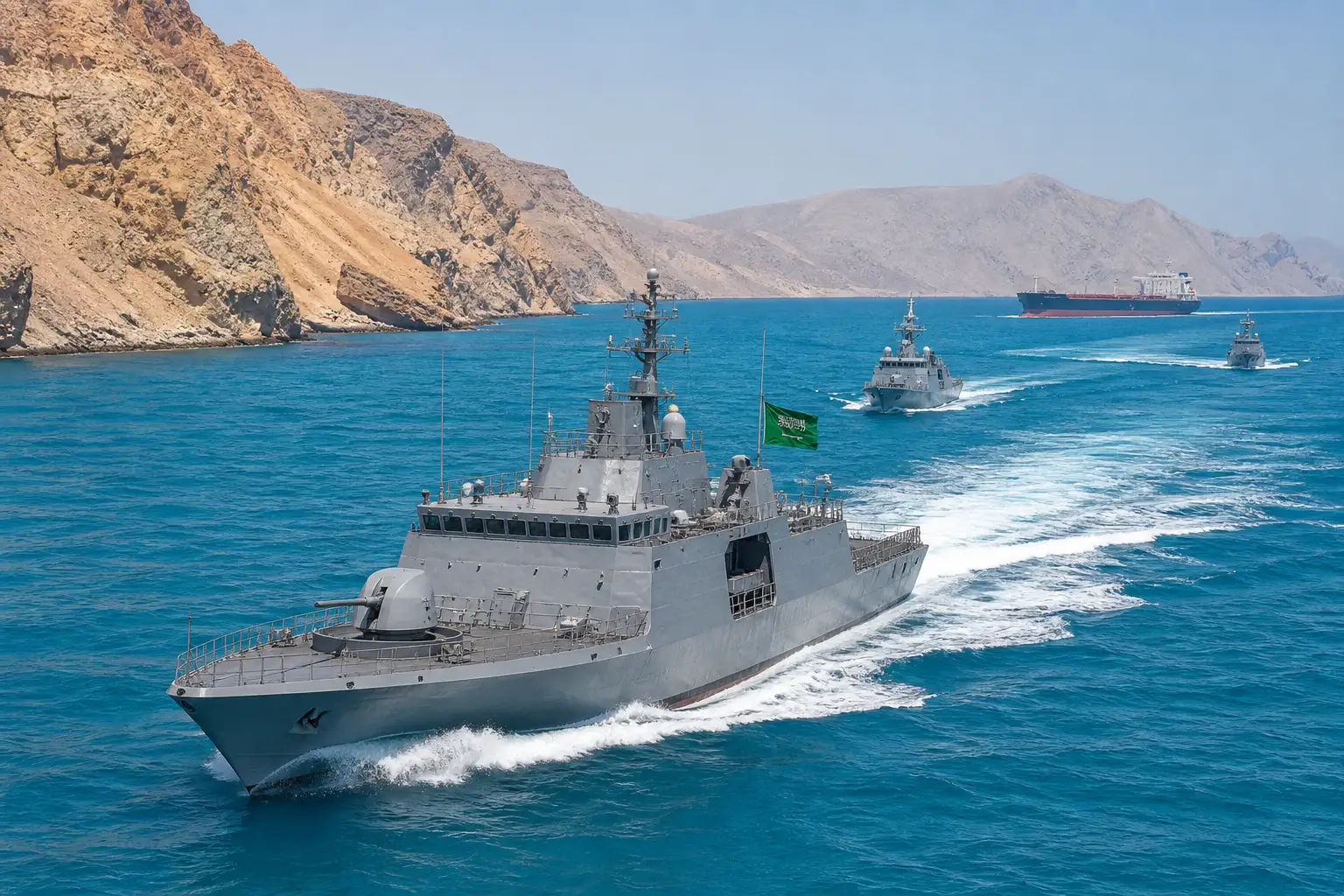
The Thirteen That Signed On
Full members so far are Bahrain, Bangladesh, the Comoros, Djibouti, Egypt, Jordan, Kuwait, Pakistan, Qatar, Saudi Arabia, Somalia, Sudan, Türkiye and Yemen (the internationally recognised government). Early lists also referenced Nigeria among initial signatories of the declaration.
| Country | Region | Notable role |
|---|---|---|
| Saudi Arabia | Gulf | Lead state, permanent HQ, Joint Command |
| Egypt | North Africa / Red Sea | Naval partner, prior CTF 153 command experience |
| Türkiye | NATO / Eurasia | Major navy, expanded defence ties with Riyadh |
| Pakistan | South Asia | Naval capacity, long Saudi security partnership |
| Yemen (PLC) | Red Sea | Host-state government facing Houthis |
| Djibouti / Somalia / Sudan | Horn / Red Sea | Coastal states on key lanes |
The UAE and Oman did not join the founding group despite shared waterways and Iran concerns. That gap remains one of the clearest signals of incomplete Gulf alignment on the new structure.
Hormuz Pressure Makes the Red Sea the Relief Valve
The alliance arrives while the US-Israel war on Iran has disrupted Gulf energy infrastructure and focused attention on the Strait of Hormuz. That route once carried roughly 20 percent of global oil and natural gas exports. Its virtual closure has pushed more traffic onto the Red Sea corridor.
According to the US Energy Information Administration, 4.2 million barrels per day through Bab el-Mandeb moved in the first half of 2025, down sharply from earlier peaks near 9 million. Hormuz still moved 20.9 million barrels per day in the same window. Together the Suez-SUMED-Bab routes accounted for about 6 percent of seaborne oil trade.
- Houthi blockade: On July 20 the group declared a maritime embargo on Saudi ports and ships, framing it as retaliation for Yemen operations.
- Direct hits: Claimed strikes on Saudi tankers including Encelia and Layla, plus oil facilities at Yanbu and Jizan, forced some vessels to turn back.
- Traffic collapse: One day in late July saw only 11 ships transit Bab al-Mandeb, the lowest in months; many operators rerouted around the Cape of Good Hope.
- Price spike: Brent crude pushed above $100 per barrel on supply fears.
For Riyadh the Red Sea is no longer a secondary lane. It is the remaining outlet for large volumes of crude when Hormuz is contested.
Earlier Coalitions Left a Leadership Gap
The Red Sea has seen repeated multinational efforts. Combined Maritime Forces established CTF 153 Red Sea maritime security mission in April 2022 to deter illicit actors and build capacity across the Red Sea, Bab al-Mandeb and Gulf of Aden. Command has rotated through the United States, Egypt, Italy and Australia.
Operation Prosperity Guardian (US-led, late 2023) and the EU’s Operation Aspides followed the first major Houthi shipping campaign. Both focused on escort and deterrence. Analysts and former officers have noted the inefficiency of parallel task groups running separate intelligence pictures; one incident saw a German warship fire on a US Reaper drone.
Ahmed Nagi, senior Yemen analyst at the International Crisis Group, told Al Jazeera that earlier initiatives, including those from the piracy years, often carried political weight yet struggled to deliver lasting results on the water. The same test now faces the new alliance: whether political commitments become concrete action.
What Riyadh Gains Beyond Escort Duty
The second-order effect sits in the architecture itself. Saudi Arabia has locked in a permanent Joint Command, Combined Maritime Operations Center and General Secretariat on its soil. Participation in any given operation remains a sovereign choice for each member, yet the framework exists for rapid coordination.
The message Saudi Arabia is trying to send is that these attacks are not just targeting Saudi interests. They affect international shipping and global trade, so they should be seen as a concern for the wider international community as well.
Nagi made that assessment to Al Jazeera. He described the alliance as largely defensive so far, with no public plan for offensive strikes into Houthi territory. At the same time he noted that if Riyadh later decides it must respond more directly, the coalition supplies a ready multinational frame and political cover.
That cover matters after a period when Saudi faced Houthi fire alone following shifts among southern Yemen partners. Framing the threat as global also spreads the burden and the diplomatic cost.
- July 30, 2026: Riyadh founding meeting, joint declaration signed, 43 nations present.
- Early August: Al-Shehri appointed commander; institutional build-out begins.
- August 12-13: Jeddah planning meeting; 13 states complete accession and charter signature.
- Ongoing: Remaining signatories finish national procedures; joint exercises and information-sharing protocols under design.
Who Stands to Gain and Who Stays Outside
Saudi Arabia gains the clearest leadership stake. It hosts the command, sets the agenda and converts a bilateral Houthi problem into a multinational one. Egypt, Türkiye and Pakistan bring naval weight and political reach that earlier Western-centric task forces sometimes lacked in the region.
The recognised Yemeni government gains a formal seat at the table on its own coastline. Coastal African members (Djibouti, Somalia, Sudan, Comoros) secure a voice on traffic that directly affects their ports and economies.
Western navies remain active through existing missions. The EU has said Operation Aspides continues. Britain has confirmed it received a joining proposal and is reviewing it with partners. Yet the new alliance is Saudi-run. High-engagement commentary on X framed the move as Riyadh acting “without waiting on Washington,” noting that for years those coalitions carried a US lead. The absence of the UAE and Oman underscores that Gulf consensus is incomplete even as the threat is shared.
Shipping operators and insurers face the practical test. Earlier coverage of earlier activation steps and insurer posture already showed markets watching whether premiums and routing decisions ease once joint patrols begin.
Activation Now Turns on Ships and Shared Pictures
Al-Shehri has stressed the coalition is purely defensive, targets no state or organisation, and operates under the UN Charter and international law. The founding declaration repeats that language and invites any country sharing the goals to accede.
The next months will show whether member navies assign hulls, whether intelligence actually fuses, and whether joint exercises produce a common operating picture. Coordination with CTF 153, Prosperity Guardian remnants and Aspides will decide if the new structure reduces friction or adds another layer.
If the alliance can raise the cost of attacks enough to restore reliable transit, Riyadh will have converted a defensive club into a working deterrent. If it remains a political statement with limited sea time, it will join the list of earlier Red Sea initiatives that mattered more in communiqués than on the water. The charter and the command structure are already in place. The test is operational.
Similar tests of regional power without full US lead have already drawn scrutiny; this launch simply makes the architecture permanent.
