
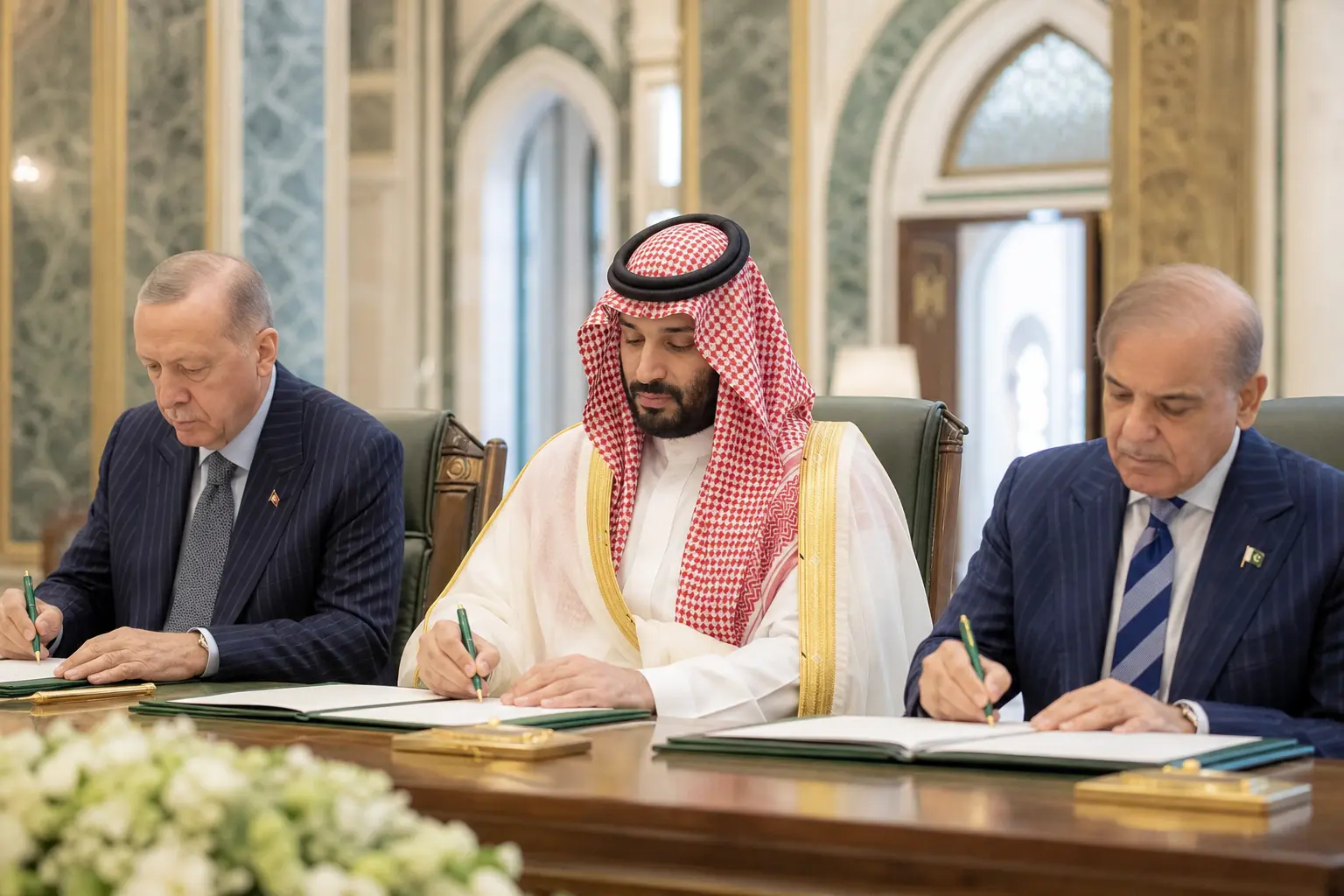
Saudi Arabia, Turkey and Pakistan signed the Mecca Joint Defence Agreement on 7 August 2026, declaring that an armed attack on any one of them counts as an attack on all three. The deal was inked in Mecca by Crown Prince Mohammed bin Salman, President Recep Tayyip Erdoğan and Prime Minister Shehbaz Sharif after Iranian strikes had already hit Gulf facilities during the US-Israeli campaign against Iran that began in late February.
Officials call it purely defensive and open to others. The second-order effects run deeper: Riyadh has now tied itself more tightly to two capitals openly hostile to Israel, raising the political cost of any future Abraham Accords step while buying multipolar insurance that still leaves American power central.
The Clause They Signed in Mecca
The core language appears in the joint statement from the Makkah summit. It states the agreement is intended to strengthen collective deterrence against any act of aggression and stipulates that any armed attack against any one of the three states shall be regarded as an attack against them all. It also calls for deeper defence cooperation across the board.
Guided by the longstanding historical ties among the three states, based on the enduring bonds of brotherhood and Islamic solidarity that unite them, and building upon their shared strategic interests and longstanding defence co-operation, HRH the Crown Prince, the President of Türkiye, and the Prime Minister of Pakistan signed the Makkah Joint Defence Agreement.
The Saudi Press Agency carried that full text. Turkish Foreign Minister Hakan Fidan later described the commitment as technically the same as NATO’s Article 5, while stressing that the form and degree of assistance would be decided by consultation. No joint command, no automatic troop numbers and no published operational annexes have appeared.
- Core pledge: attack on one equals attack on all
- No published list of specific military obligations or response timelines
- Does not abrogate existing bilateral or multilateral deals with other states
- Open in principle to additional “brotherly” countries once technical issues clear
- Planned political and military committees plus a general secretariat expected in Saudi Arabia
Pakistani Foreign Minister Ishaq Dar told reporters the pact is purely defensive and not directed against any country. Rayed Krimly, a Saudi deputy minister, posted that it is neither a military axis nor a sectarian bloc and carries no nuclear ambitions.
Why the Timing Hit After Iranian Fire
The US-Israeli war on Iran that opened on 28 February 2026 produced waves of Iranian missiles and drones against Gulf targets. Saudi and Emirati facilities were hit even with American bases nearby. Washington’s response looked hesitant to many regional officials. Energy exports and shipping faced repeated disruption.
That sequence revived an old private question: how reliable is the American umbrella when it fails to prevent direct fire? The Mecca signing arrived after nearly a year of talks that Reuters first reported in January. It also followed Israel’s earlier strike on Hamas figures in Doha and years of wider regional fighting since October 2023.
Turkey fields NATO’s second-largest army and a mature drone industry. Saudi Arabia holds the Gulf’s deepest capital reserves and the Two Holy Mosques. Pakistan brings a large combat-experienced force and the only nuclear arsenal in the Muslim world. Analysts have long noted the complementary fit: Turkish technology seeking markets, Pakistani manpower seeking finance, Saudi wealth seeking reliable partners.
| Country | Key military asset | Notable recent role |
|---|---|---|
| Turkey | NATO’s second-largest army; advanced drones | Deepened ship and aircraft exchanges with Pakistan; major Saudi drone supplier |
| Saudi Arabia | Capital depth; strategic basing; oil leverage | Host of existing Pakistani deployments; pursues defence-industrial self-reliance |
| Pakistan | Nuclear weapons; large experienced army | Deployed roughly 8,000 troops, jets, drones and air defence to Saudi Arabia during the Iran war |
The combination looks formidable on paper. In practice the three still lack integrated command structures and a track record of joint wartime response.
Complementary Assets Without a Joint Command
Fidan has sketched ministerial committees, political-military bodies and a permanent secretariat. Interoperability exercises, joint production and common logistics would decide whether the pact becomes more than a political statement. Trilateral defence-industry talks already date to 2023. Saudi officials have framed the goal as building sustainable self-capabilities rather than forming a new axis.
Pakistan’s nuclear status draws the most attention and the most careful hedging. After the 2025 bilateral deal, Defence Minister Khawaja Asif first said nuclear capabilities would “absolutely be available,” then walked it back within days, saying nuclear weapons were “not on the radar.” None of the three governments has clarified extended deterrence under the new trilateral text. Turkey already hosts US nuclear weapons as a NATO member. Saudi Arabia continues civilian nuclear talks with Washington. Pakistan’s arsenal remains oriented toward India.
The implicit weight still matters. Ambiguity itself can complicate an adversary’s calculations even without a formal guarantee.
Pakistan’s Prestige Comes With New Exposure
For Islamabad the pact elevates it from longtime recipient of Gulf support to a recognised security provider. Public celebrations lit buildings in Islamabad, Lahore and Karachi with the three flags. The industrial and diplomatic prestige is real.
So is the risk. A collective-defence clause is an obligation. Pakistan already balances pressures on its eastern border with India and western frontier with Afghanistan. Gulf quarrels could pull it into distant fights. The same government has also cultivated a mediating role between Washington and Tehran, including a June memorandum that helped stabilise parts of the conflict. Binding itself more tightly to Saudi defence needs could complicate that balancing act.
Earlier this year Pakistan did deploy forces and systems to the kingdom, but only after the war had already begun and around the time a ceasefire window opened. The bilateral 2025 treaty itself was never invoked as a formal Article-5 style call. Iranian strike that tested the bilateral pact produced no automatic Pakistani combat response. That history hangs over the new promise.
- Prestige gain: status upgrade from client to security partner with nuclear-adjacent weight
- Operational load: potential pull into Gulf contingencies far from core theatres
- Diplomatic tension: mediation role between US and Iran becomes harder to sustain
- Domestic signal: public celebrations show the leadership’s desire to own the narrative at home
Abraham Accords Price Tag Rises
Successive US administrations have treated Saudi-Israel normalisation as the linchpin of a wider regional architecture. Binding Riyadh to Ankara and Islamabad, two governments that maintain openly hostile postures toward Israel, raises the domestic and regional price of any such move.
The self-inflicted US element is visible. After Washington and Riyadh agreed in July on a path for Saudi civilian nuclear development, President Donald Trump attached a condition linking progress to Saudi entry into the Abraham Accords. Analysts noted the move sounded alarms across the Gulf by casting the accords as a coercive tool rather than a voluntary strategic choice. A lever intended to pull Saudi Arabia toward Israel instead coincided with Riyadh’s tighter turn toward Pakistan and Turkey.
Israel’s government has treated the pact as a worrying consolidation. Prime Minister Benjamin Netanyahu’s office declined immediate comment at the signing, yet the nuclear-adjacent pairing and the Mecca setting feed long-standing Israeli concerns about a hostile front. Turkey’s own tensions with Israel over Syria and the eastern Mediterranean add another layer. Some Israeli voices already describe a potential two-bloc Middle East: one still anchored in the Abraham Accords and another organised around the Mecca framework.
The US-Saudi civilian nuclear arrangement remains on the table, but the political atmosphere around it has cooled. Normalisation now looks less likely, not more.
What Earlier Pacts Delivered
History supplies caution. Saudi Arabia’s 2000 border deal with Yemen and the 2025 Strategic Mutual Defence Agreement with Pakistan produced no NATO-style activations. The Arab League’s old joint defence treaty and the GCC’s own collective arrangements likewise failed to generate automatic collective military responses in successive crises.
- 17 September 2025: Saudi Arabia and Pakistan sign the Strategic Mutual Defence Agreement in Riyadh; nuclear language quickly hedged
- 28 February 2026: US-Israeli campaign against Iran begins; Iranian retaliation strikes Gulf targets
- Spring 2026: Pakistan deploys roughly 8,000 troops plus air assets to Saudi Arabia; no formal invocation of the bilateral clause
- July 2026: US-Saudi civilian nuclear understanding announced with reported Abraham Accords linkage
- 7 August 2026: Mecca trilateral signed; Fidan sketches committee and secretariat structures
An IISS assessment of the new defence pact notes that previous regional defence pacts have struggled to deliver and that institutional depth will decide whether this one differs. Egypt’s absence is telling. Cairo belongs to a looser quadrilateral consultative group with the three but has so far stayed outside binding mutual-defence language, wary of entangling itself with Israel tensions, Iranian pressure and its own large US military-aid relationship.
Erdoğan has said the alliance remains open to other friendly nations. Fidan has suggested Egypt could join once technical issues are resolved. That expansion is not automatic.
Diversification Still Leaves the US Central
Every official statement stresses that the Mecca pact supplants no existing agreement. All three signatories remain US partners in different degrees: Turkey inside NATO, Saudi Arabia and Pakistan long-standing security clients. The arrangement is insurance and leverage, not divorce.
Washington has issued no formal high-level response in the days since the signing. Analysts describe the silence as recognition that the deal is multi-layered. Some European NATO members have pursued similar intra-European insurance while remaining inside the alliance. The parallel is imperfect but real.
Iran’s public line has been mixed. Foreign Ministry spokesman Esmaeil Baghaei said Tehran saw no reason for concern and framed the pact as evidence of a change in perception toward the United States and a turn toward regional self-reliance. Other Iranian voices welcomed Muslim unity while quietly treating the grouping as a potential constraint. A few Iranian commentators even cast it as a positive step away from external security guarantees.
India’s External Affairs Ministry said it values its strategic partnership with Saudi Arabia and expects Riyadh to keep Indian interests and sensitivities in view. New Delhi is watching closely because any deeper Pakistani security role in the Gulf carries South Asian implications.
On X and in regional commentary the pact is often read as the birth of a more assertive Islamic security core or as a quiet vote of no confidence in sole reliance on American guarantees. That crowd reading outruns the sparse operational text, yet it shapes the political environment the three governments now inhabit. Earlier reporting on Mecca pact risks already flagged the nuclear-adjacent optics and the untested obligations.
The teeth remain unproven. The message is clearer. Gulf and regional partners are assembling parallel insurance while they still treat the United States as the principal external power. The next stage Washington has reason to watch is any further drift in which partners stop treating American guarantees as primary and rebuild their core security around other poles. For now the Mecca pact sits in the middle ground: real political cost for normalisation dreams, limited immediate military change, and a standing reminder that reliability questions, once raised, do not vanish.
Frequently Asked Questions
What exactly does the Mecca Joint Defence Agreement’s core clause say?
The joint statement declares that any armed attack against any one of the three states shall be regarded as an attack against them all and that the pact aims to strengthen collective deterrence. No public annex lists automatic troop commitments, response timelines or command arrangements; those details, if they exist, remain unpublished.
Does the pact replace existing treaties the three countries hold with the United States or others?
No. Pakistani, Turkish and Saudi officials have all stated that the agreement does not abrogate or replace any existing bilateral or multilateral arrangements. It is presented as additional, not substitutional, insurance.
Is Pakistan offering a nuclear umbrella to Saudi Arabia and Turkey under the new deal?
No government has confirmed extended nuclear deterrence. After the 2025 bilateral, Pakistan’s defence minister first suggested nuclear capabilities would be available then quickly said nuclear weapons were “not on the radar.” The trilateral text has not clarified the point; Pakistan’s arsenal remains focused on India while Turkey already hosts US nuclear weapons.
Can other countries join the Mecca defence arrangement?
Yes in principle. President Erdoğan and Foreign Minister Fidan have said the pact is open to other friendly or brotherly nations. Egypt has been mentioned as a possible future member once technical issues are resolved, but Cairo has not joined and has historically avoided binding mutual-defence commitments that could entangle it with multiple fronts.
How does the agreement build on the September 2025 Saudi-Pakistan deal?
The 2025 Strategic Mutual Defence Agreement created a bilateral mutual-defence commitment between Riyadh and Islamabad. The Mecca pact expands that framework to include Turkey, adds the same attack-on-one language at the trilateral level, and sketches new institutional bodies such as committees and a secretariat while retaining the earlier bilateral relationship.
