
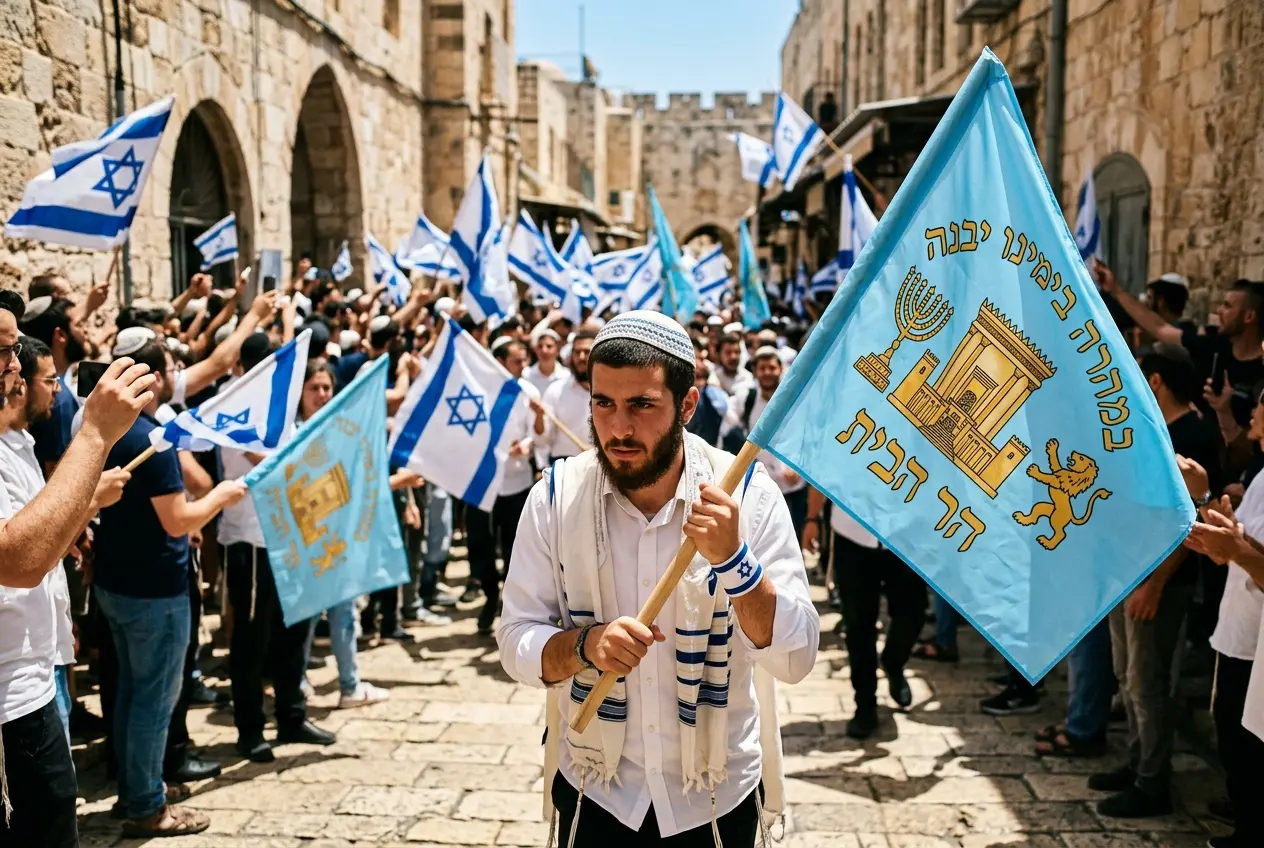
The Jerusalem Day Flag March on May 14, 2026 drew roughly 70,000 marchers through Jerusalem’s Old City. Among the Israeli flags flew a different symbol: a light-blue Temple Mount banner that the Israeli political scientist Menachem Klein, writing in +972 Magazine, said he had seen “again and again” at this year’s procession. The same banner appears on cars, signposts, and bus stops across the city, often paired with the slogan “We face the Temple.”
The Temple Mount movement has long since moved beyond the streets. Israel Police have begun recruiting its activists for the unit that polices the Al-Aqsa Mosque compound. The Israeli Cabinet confirmed Maj. Gen. David Zini as head of the Shin Bet in 2025. Prime Minister Benjamin Netanyahu has empowered National Security Minister Itamar Ben Gvir to oversee arrangements at the site.
A Flag With Two Meanings
The light-blue Temple Mount banner shows the compound known in Hebrew as Har HaBayit and in Arabic as Al-Haram Al-Sharif. The same compound is the holiest site in Judaism, where the First and Second Temples once stood, and the third-holiest in Islam, home to the Al-Aqsa Mosque and the Dome of the Rock. Both communities treat the site as central to their faith, and both have claimed it as their own.
For most of the 70,000 marchers, the flag carries a vague attachment to Jewish sovereignty and national revival. For a radical current within the religious-nationalist camp, the same banner signals a much larger ambition. That current emerged with particular force after the 2005 disengagement from Gaza, when many religious-nationalist activists concluded that the state had betrayed its sacred purpose. In their view, Israel can no longer be redeemed from within and must be replaced by a different political order, one centered on the construction of a Third Temple and a Jewish theocratic state. The Temple icon, in this reading, is not a religious ornament but a declaration of political intent.
The Temple icon cannot be understood merely as an expression of religious devotion. It is a declaration of political intent, a statement about the future that significant sectors of Israeli society now imagine and seek to build.
Klein, a professor of political science at Bar-Ilan University and a former advisor to the Israeli delegation in the 2000 negotiations with the PLO, has been tracking the banner’s spread across Jerusalem for years, in Klein’s June 2026 analysis of the Temple flag.
How the March Became Central
The first Jerusalem Day Flag March took place in 1968, soon after Israel’s occupation of the West Bank, Gaza Strip, Golan Heights, and East Jerusalem began. For decades the procession remained a peripheral event within the religious-Zionist sector. In the early 2000s, however, a new dimension of the march became central to public discourse around it, with violent attacks on Palestinians and their property in Jerusalem’s Old City a recurring feature.
That shift coincided with a wider collapse of the Israeli-Palestinian peace process. In September 2000, Ariel Sharon, then leader of the opposition Likud party, visited the Temple Mount compound in what Palestinians read as a deliberate provocation. The visit helped trigger the Second Intifada, a Palestinian uprising that ran from 2000 to 2005. Sharon became prime minister in January 2001 and, by 2002, had led the military campaign that dismantled much of the Palestinian Authority’s governing and security infrastructure.
Since then, the Israeli right in general and the national-religious camp in particular have made the Temple Mount the center of a political project. The aim has been to alter the status quo established in June 1967, one of whose central principles is the prohibition on Jewish prayer at the site. The longer-term goal, in Klein’s reading, is to divide the compound into separate Muslim and Jewish areas of worship, following the model Israel applies at Hebron’s Cave of the Patriarchs, also known to Muslims as the Ibrahimi Mosque. On the Temple Mount, partition would mean overturning an arrangement that has endured for roughly 1,300 years, in which the compound has functioned as an exclusively Muslim place of worship.
The 2005 Break and the Radical Turn
The decisive break came in 2005, when Israel withdrew its soldiers and settlers from the Gaza Strip in what became known as the disengagement. Many religious-nationalist activists concluded that the state had betrayed its sacred purpose by giving up any part of the biblical Land of Israel.
Out of that conclusion, Klein wrote, a more radical current emerged, one that no longer sought to redeem the existing Israeli state from within. Its ambition was to replace it with a different political order, anchored in the rebuilding of the Third Temple. The current’s symbols have since spread well beyond the Gaza disengagement camps where the movement first organized.
Activists have placed mock road signs along a major West Bank highway directing travelers toward Jerusalem. The Temple icon now flies on settlement outposts, often alongside and sometimes in place of the blue-and-white Israeli flag. At the Jerusalem Day march, the icon appeared among the crowd alongside other banners documented in photographs. Some of the placards visible at the march show how the same political language has spread.
- “This is not Al-Aqsa, it’s the Temple Mount”
- “You wanted a massacre? You’ll get a Nakba!”
- “A bullet in the head for every terrorist,” carried with the orange flag of the former Gush Katif settlement bloc
The slogan’s reach also explains why Ben Gvir, the national security minister, toured the Al-Aqsa compound on Jerusalem Day waving an Israeli flag, a visit that drew sharp criticism from Jordan and from the Palestinian Authority. The visit was photographed by Flash90, an Israeli photo agency, and documented in Klein’s piece. Ben Gvir’s repeated presence on the Mount has become a regular feature of Jerusalem Day. His oversight of arrangements at the site, first reported in mid-2026, was authorized by Netanyahu himself. The arrangement, Klein wrote, is sanctioned from the highest levels of government.
Marching in Uniform
The Flag March now feeds a pipeline into the Israeli army. Pre-military academies and yeshivot have grown into a parallel track that combines military preparation with intensive ideological education, sending national-religious youths into elite combat units.
The religious-nationalist sector is now the dominant social force in the Israeli army’s ground forces, Klein wrote, and its influence is increasingly visible in the air force, navy, and intelligence services. Many of those who take part in the Flag March each year go on to become combat soldiers. The war the Israeli military is waging in the Gaza Strip has been carried out in part by soldiers who, only a few years earlier, had been marchers. The shift is also visible at the senior ranks, including the rank of major general, the second-highest in the Israeli army.
The chant “May your village burn,” a fixture of the march for years, is now also commonly heard among soldiers in Gaza. Its message, Klein wrote, is regularly put into practice in the West Bank. Biblical language has been deployed across Israeli media, politics, and the military to justify the killing, displacement, and dehumanization of Palestinians. Soldiers on the ground have openly described the rebuilding of the Temple as a motivation behind their actions. The same vocabulary now circulates between the Old City streets and the units operating in Gaza.
The religious-nationalist markers are not confined to one denomination. Chabad Hasidim now contribute a yellow Messiah-and-crown flag that has become a popular patch on the uniforms of soldiers with no direct connection to the movement itself. The practice of wearing four long tzitzit visibly outside one’s trousers has likewise moved from a signal of religious observance into a marker of a wider political and cultural camp.
Those ascending the Temple Mount itself increasingly include ultra-Orthodox Jews praying alongside religious nationalists, despite opposition from their own rabbinic authorities. The pattern cuts across older religious and social boundaries. Klein wrote that the Temple icon has become a shared symbol for a broad political camp, stretching from committed Orthodox activists to national-religious communities, conservative traditionalists, and many secular members of the Israeli right. The breadth of the coalition, Klein wrote, is visible in any photograph of Mount visitors. The same breadth shows up in the Jerusalem Day march and on the roads of the West Bank. The shared symbols now appear at settlement outposts and on cars, signposts, and bus stops across Jerusalem.
Inside the State
The pipeline now runs from the Flag March into the security leadership of the state. Maj. Gen. David Zini, a former Golani Infantry Brigade commander, was appointed in 2025 as the new head of the Shin Bet, Israel’s domestic intelligence agency. His selection followed a months-long standoff between Prime Minister Benjamin Netanyahu and Attorney General Gali Baharav-Miara.
The Shin Bet chief’s formative years were shaped by institutions associated with Rabbi Zvi Yisrael Thau, the spiritual leader of the far-right Noam party, a party that has been characterized in Israeli media as extremist even by the standards of Smotrich’s Religious Zionism party. He later studied at Yeshivat Shavei Hebron in the Kiryat Arba settlement, an institution that emphasizes leadership roles in the army. He lives in the religious community of Keshet in the occupied Syrian Golan Heights, established after the 1973 war to block an Israeli withdrawal. He has called Palestinians a “divine existential threat” and said that “our enemies are the enemies of the Holy One,” according to a profile of David Zini’s background and views. Haaretz reported that two nicknames stuck with the future Shin Bet chief from his Golani service: “Ahmazinijad,” after the former Iranian president, and “Zinitiocus,” after the Greek king Antiochus.
The Temple Mount movement has also entered the Israel Police. Recent Haaretz reporting described an active recruitment campaign targeting religious-nationalist activists for the Temple Mount Unit, the force that polices the Al-Aqsa compound.
Over the years, the Flag March has served as a barometer of a broader radicalization whose assumptions have moved steadily into the mainstream.
Klein wrote in +972 Magazine that the Flag March has long served as a barometer of broader radicalization. The Haaretz report described recruitment messages circulated in right-wing and settler social media and WhatsApp groups. The messages advertised favorable employment conditions and invited applicants to participate in what the unit commander described as “implementing sovereignty” on the Mount. The recruitment marks a shift from earlier Israeli practice, in which the unit was staffed by officers whose politics were not their defining credential. Netanyahu has empowered Ben Gvir, who has made repeated visits to the compound, to oversee arrangements at the site. The arrangement, Klein wrote, is sanctioned from the highest levels of government.
Beyond Jerusalem
The Temple icon and the slogans that travel with it are no longer confined to the Old City. The chant “May your village burn” is now heard in Gaza, where Israeli forces have displaced much of the population. The same chant appears in the West Bank, where settler violence and military operations have run in parallel. The same biblical language, used in Israeli media and politics, has been deployed to justify the killing and displacement of Palestinians.
The reach of the Flag March’s violence, as the +972 article framed it, now extends into Gaza, the West Bank, and southern Lebanon. Through Israeli air power, that reach extends to Beirut and Iran. Soldiers and politicians, Klein wrote, are using the same language of biblical mandate to describe operations thousands of kilometers from Jerusalem.
For Palestinians, the stakes are concrete. The escalating violence in the West Bank, and the forced displacement of rural communities there, is a state-backed policy of directed expulsion, not the work of a marginal extremist fringe, Klein wrote. In Gaza, the war that began on October 7, 2023 has been accompanied by tens of thousands of Palestinian deaths according to local health authorities. The Temple Mount movement’s symbols appear at the outposts where that displacement is implemented, alongside and sometimes in place of the Israeli flag. The shift tracks alongside cases such as the killing of a Palestinian baby near Hebron in the same period. Klein framed the war as the continuation of the same political dynamics visible at the march.
Frequently Asked Questions
What is the Jerusalem Day Flag March?
The Jerusalem Day Flag March is an annual Israeli procession through the Old City of Jerusalem, held on the Hebrew calendar date corresponding to Israel’s capture of East Jerusalem in the 1967 war. The first march took place in 1968, and recent marches have drawn roughly 70,000 participants. The march has become a focal point of the religious-nationalist right and a recurring site of violence against Palestinians in the Old City.
What is the Temple Mount movement?
The Temple Mount movement is a loose coalition of Israeli religious-nationalist activists who advocate for Jewish prayer and ultimately Jewish sovereignty over the Temple Mount compound in Jerusalem, the third-holiest site in Islam. The movement emerged with particular force after the 2005 Israeli disengagement from Gaza. Its more radical current envisions the construction of a Third Temple and the replacement of the existing Israeli state with a Jewish theocratic order.
Who is David Zini?
Maj. Gen. David Zini is a former Golani Infantry Brigade commander who was appointed in 2025 as head of the Shin Bet, Israel’s domestic intelligence agency. His formative years were shaped by institutions associated with Rabbi Zvi Yisrael Thau, the spiritual leader of the far-right Noam party, and Yeshivat Shavei Hebron in the Kiryat Arba settlement. He has called Palestinians a “divine existential threat.”
Why is the status quo at Al-Aqsa contested?
The status quo at the Temple Mount, established after Israel’s capture of East Jerusalem in June 1967, prohibits Jewish prayer at the compound and treats the site as an exclusively Muslim place of worship, an arrangement that has endured for roughly 1,300 years. Temple Mount activists and Israeli politicians have increasingly challenged that arrangement. The longer-term project, in Klein’s reading, is to divide the compound into separate Muslim and Jewish areas of worship, following the model Israel applies at the Cave of the Patriarchs in Hebron.
How has the Temple Mount movement entered Israeli state institutions?
The movement’s reach now extends to the Israel Police, which has begun recruiting religious-nationalist Temple activists for the unit that polices the Al-Aqsa compound. In 2025, Maj. Gen. David Zini, a product of the religious-nationalist education system, was appointed head of the Shin Bet. Prime Minister Benjamin Netanyahu has empowered National Security Minister Itamar Ben Gvir, who has made repeated visits to the Mount, to oversee arrangements at the site.
