
Egyptian paratroopers and Turkish special forces spent early July storming a mock hostage compound at an Egyptian military training ground, the finale of a joint drill called Golden Eagle 2026. An Egyptian scholar of Chinese politics says Beijing is quietly cheering the exercise as insurance for its Belt and Road shipping lanes.
Suez Canal revenue numbers point to a very different threat, and it has nothing to do with the Muslim Brotherhood.
Egyptian Paratroopers Storm a Mock Hostage Compound
Egypt’s Ministry of Defense announced the launch of Golden Eagle 2026 on July 8, pairing Egyptian Airborne Forces and Thunderbolt (Sa’aka) commandos with Turkish Special Forces at Egyptian combat training grounds. The opening days covered theoretical lectures meant to align the two militaries’ tactics, followed by a weapons exhibition.
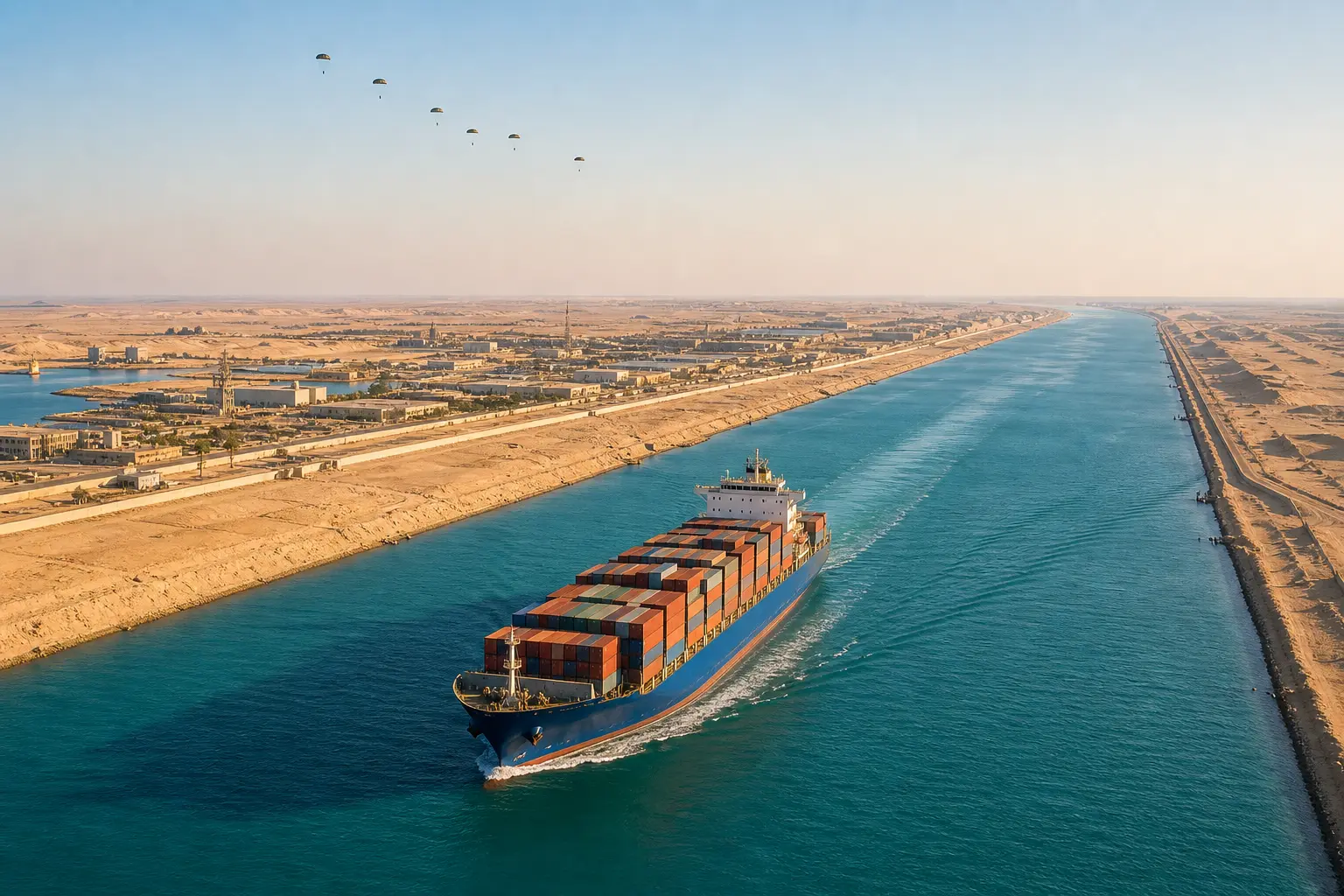
The finale, according to Egyptian state media, was a helicopter-borne assault on a mock urban “terrorist stronghold,” with simulated hostages freed and gunmen captured. Troops from both countries closed out the drill with a joint free-fall parachute jump, each carrying the other nation’s flag.
The full training menu covered a specific set of skills:
- Helicopter-borne assault on an urban compound, with simulated hostages rescued and gunmen apprehended
- Room-clearing and live-fire drills inside confined spaces
- Vertical assault training on an aircraft simulator and free-fall jumps from a wind tunnel
- Improvised explosive device response and battlefield first aid
- Drone deployment and counter-drone tactics
Golden Eagle did not happen in a vacuum. Egyptian and Turkish jets had just wrapped Anatolian Eagle 2026, a separate air exercise held at a Turkish air base in Konya from late June into early July, flying alongside Azerbaijan’s air force and a NATO airborne early warning aircraft. That drill practiced strikes on simulated targets, drone interception and close air support. A joint Egyptian-Turkish air force exercise across several Egyptian bases had wrapped just days before that.
An Egyptian Academic’s Case for Why Beijing Should Applaud
Dr. Nadia Helmy, an associate professor of political science at Beni Suef University in Egypt who studies Chinese Communist Party politics, laid out the pro-Beijing reading in an essay published by Modern Diplomacy. Her argument: Cairo and Ankara burying a decade-old fight over the Muslim Brotherhood removes a source of instability that China has long worried could reach its own investments.
Helmy’s case rests on geography as much as ideology. Egypt anchors the Suez end of China’s Maritime Silk Road; Turkey anchors the Middle Corridor running toward Europe. Both, in her telling, are pillars of what she calls China’s Military Silk Road, the security layer wrapped around Belt and Road trade routes. A Turkey that stops sheltering Brotherhood-linked media and exiled leaders, she writes, closes off a channel Beijing fears could eventually link Middle Eastern Islamist networks to separatist movements in China’s own Xinjiang region.
It is a coherent argument, built around a real diplomatic shift. It is also one made entirely from Cairo, without a single Chinese ministry, state broadcaster or embassy statement cited anywhere in it to back the claim that Beijing is watching, let alone cheering.
The Ships That Stopped Coming
Whatever is actually threatening Chinese trade through Egypt already has a name, and it is not the Brotherhood. It is the Houthi movement in Yemen, which has spent more than two and a half years firing missiles and drones at ships in the Red Sea and the Bab al-Mandab Strait.
The financial damage is large and well documented across multiple outlets. Cumulative Suez Canal receipts have fallen by $10 billion since the start of the decade, President Abdel Fattah el-Sisi said in a speech reported in April.
Since 2020 onwards, Egypt has faced crises and negative developments that were difficult to avoid.
El-Sisi called it a historic crossroads for an economy that leans on canal tolls for foreign currency. The annual numbers explain the alarm.
| Year | Suez Canal Revenue | Vessel Transits |
|---|---|---|
| 2023 (record year) | $10.3 billion | 26,434 ships |
| 2024 | About $4 billion, down nearly two thirds | 13,213 ships |
| 2025 (SCA estimate) | Just above $4 billion | Daily transits near 30 to 35 vessels, versus 65 in normal conditions |
Container ship traffic specifically collapsed 90% in 2024, according to trade credit insurer Coface, as shipping lines rerouted around the Cape of Good Hope, stretching Asia-to-Europe voyages to 40 or 50 days. None of that decline traces back to a Brotherhood cell. It traces to missiles fired from Yemen.
China Already Found Its Own Way Through the Red Sea
Here is the detail that complicates the idea that Egyptian-Turkish commando drills are what stands between China and a shipping catastrophe: Chinese vessels appear to have kept sailing through the danger zone largely unbothered anyway.
Maritime trade publication AJOT reported that Chinese-linked ships have enjoyed safe passage through the Red Sea even as rivals diverted around Africa, attributing the pattern to direct back-channel contacts between Beijing and the Houthis. In exchange, the reporting says, China is suspected of supplying the Houthis with military equipment, a claim neither government has confirmed.
If that account holds even partly, Beijing solved its own Red Sea exposure through direct contact with the group doing the damage, not through Egyptian paratroopers rehearsing a hostage rescue on dry land.
Three Very Different Readings of the Same Drill
Golden Eagle has produced sharply different reactions depending on who is watching it.
- Dr. Nadia Helmy reads the drill from Cairo as insurance for Chinese investment and a setback for Brotherhood networks based in Turkey.
- Ynetnews, in an Israeli analysis, called the cooperation a strategic nightmare for Israel, warning that Turkish forces are gaining ground near Israeli waters behind the cover of an accepted Arab partnership.
- Sinan Ciddi and Mariam Wahba of the Foundation for Defense of Democracies described the wider Egypt-Turkey thaw as a marriage of convenience built on unresolved rifts that could still come apart.
All three readings can be true at once, and none of them requires Beijing to have said a word.
Why Hasn’t Turkey Fully Cut Ties With the Brotherhood?
Turkey has curbed the loudest anti-Sisi voices among exiled Brotherhood members since 2021, revoking at least one leader’s citizenship and muting hostile television channels. But Turkish President Recep Tayyip Erdogan kept meeting Brotherhood-linked figures well after his rapprochement with Cairo began, complicating any claim that the movement’s Turkish safe haven has fully closed.
Ankara revoked the Turkish citizenship of Mahmoud Hussein, interim leader of the Brotherhood’s Istanbul faction, in December 2023, a move Turkish officials attributed to a procedural error, according to investigative outlet Nordic Monitor. Hussein had taken over after the November 2022 death of longtime Brotherhood figure Ibrahim Mounir.
Yet on September 12, 2024, days after President Sisi’s landmark visit to Ankara, a delegation from Erdogan’s Justice and Development Party met with Oussama Jammal, secretary general of the US Council of Muslim Organizations and a prominent Brotherhood-linked figure, in Washington. Nordic Monitor reported that Turkish authorities had separately assured Brotherhood leaders the Egypt rapprochement would not touch them.
What Beijing Has Riding on the Canal
China’s stake in Egyptian and Turkish stability keeps growing, concentrated far from anything Golden Eagle’s commandos trained for.
The China-Egypt TEDA Suez Economic and Trade Cooperation Zone, built from 2008 near the port of Ain Sokhna, now hosts 185 enterprises with roughly $3 billion invested and more than $5.3 billion in cumulative sales, China’s State Council Information Office reported last July. Xi Jinping and Sisi personally opened the zone’s expansion together back in January 2016.
The wider Suez Canal Economic Zone surrounding it is bigger still. Chinese investment there reached $5.1 billion in the first half of the 2025 to 2026 fiscal year, spread across more than 160 Chinese companies, zone officials said in December, with three new industrial projects worth $1.15 billion signed that same month.
That is what Beijing is actually protecting: factories and an industrial park sitting in the desert, nowhere near a Brotherhood cell, and fully exposed to whatever happens next in the Red Sea. Rabie expects canal revenue to edge above $4 billion this year. A full return to the old $10 billion peak still depends on what happens next between the Houthis and Israel, hundreds of miles from where Golden Eagle’s commandos trained.
Frequently Asked Questions
Has China’s government officially commented on the Golden Eagle exercises?
No Chinese ministry or state outlet has issued a public statement about Golden Eagle 2026. The claim that Beijing welcomes the drills comes from an Egyptian academic’s essay in Modern Diplomacy, not from any Chinese government source, though it echoes themes Beijing has voiced elsewhere about Belt and Road security.
What is the difference between Golden Eagle and Anatolian Eagle 2026?
Golden Eagle is a ground exercise between Egyptian paratroopers, Thunderbolt commandos and Turkish special forces held on Egyptian soil in July. Anatolian Eagle 2026 is a separate air force exercise held at a Turkish air base in Konya in late June and early July, involving Egyptian, Turkish and Azerbaijani jets plus a NATO early warning aircraft.
Is the Muslim Brotherhood banned in every country?
No. Egypt outlawed the Brotherhood after the 2013 coup that removed President Mohamed Morsi, and Saudi Arabia, the United Arab Emirates and Bahrain followed with their own terrorism designations. Turkey and Qatar never applied one, which is why exiled leaders and media outlets settled in Istanbul and Doha.
How much Chinese investment is inside Egypt’s Suez Canal Economic Zone?
More than 160 Chinese companies operate inside the Suez Canal Economic Zone, and Chinese investment there topped $4 billion over the past three years. Total investment in the zone reached $5.1 billion in the first half of the 2025 to 2026 fiscal year alone, according to zone officials.
