
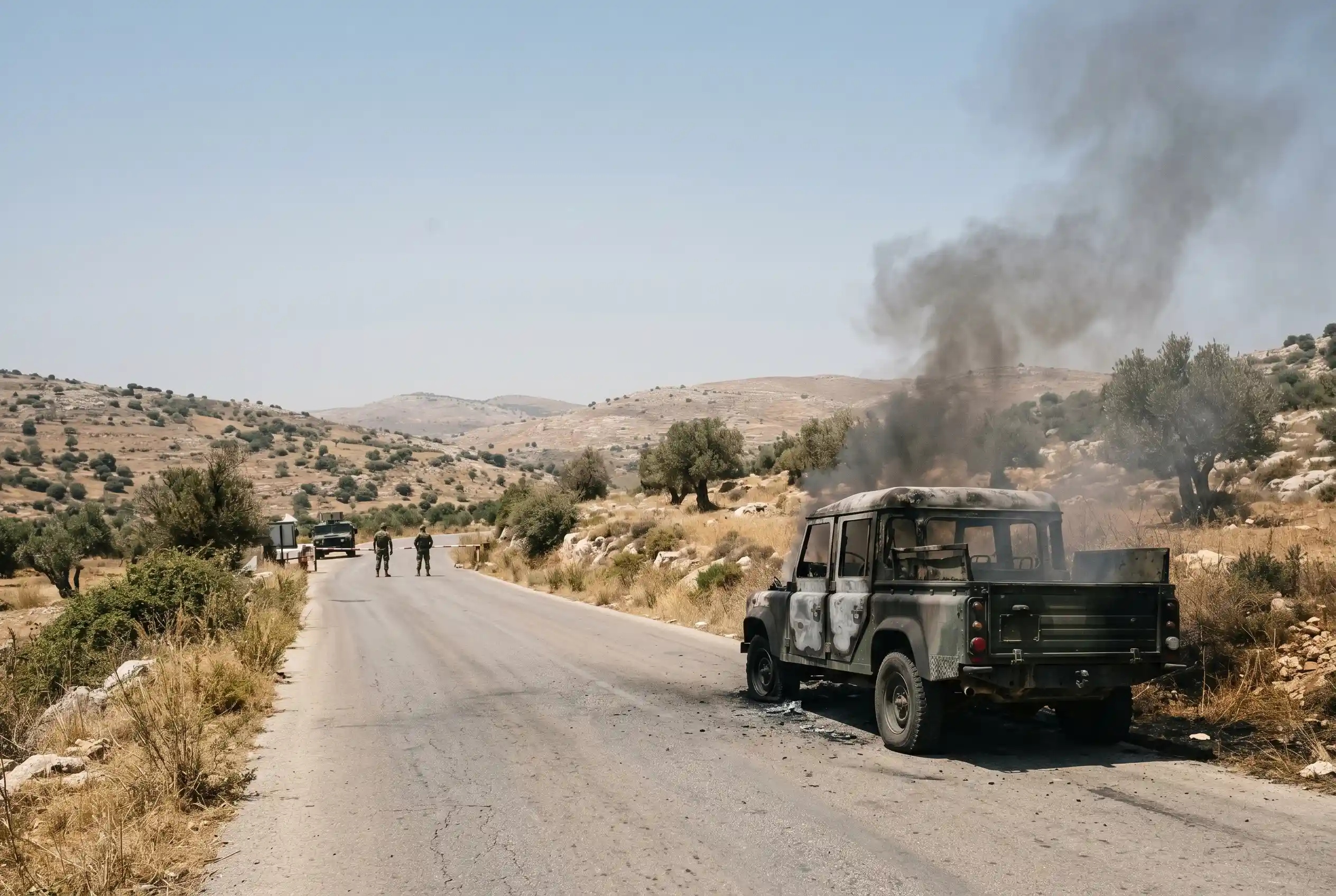
A Lebanese army brigadier general, a captain, and a soldier died Saturday when an Israeli airstrike hit their military vehicle on the road between Kfar Tebnit and Khardali in the Nabatieh area of southern Lebanon, two days after Jerusalem and Beirut agreed to a renewed ceasefire and designated the Lebanese Armed Forces (LAF) as the sole security authority in newly created “pilot zones” across the south. The army confirmed the deaths and called the attack a “barbaric Israeli raid.” By the end of Saturday, Israeli fire had killed at least nine people across southern Lebanon.
The Lebanese army has not taken part in the fighting between Israel and Hezbollah since the conflict resumed in March. Saturday’s strike killed three of its officers in a marked military vehicle.
The Strike on the Khardali Road
Lebanon’s state-run National News Agency (NNA) identified the senior officer killed as a brigadier general, his four-wheel-drive struck on the Khardali-Jarmaq road in the Nabatieh governorate. The Lebanese Armed Forces confirmed in a statement that a brigadier general, a captain, and a soldier had been killed, condemning “the continued, deliberate, and repeated Israeli aggression against Lebanon, its people and its army.” The army added that Israel’s strikes aim to thwart all efforts “to reach a solution that would restore stability, establish a comprehensive ceasefire and lead to the Israeli withdrawal from the occupied Lebanese territories.”
The IDF confirmed the strike later that morning, acknowledging the vehicle carried two Lebanese army officers and a soldier. Its account of nearly every other detail diverged from the army’s.
| Lebanese Armed Forces | IDF | |
|---|---|---|
| Vehicle | Marked military four-wheel-drive on a routine route | Moving “suspiciously” toward Israeli forces near Kfar Tebnit |
| Area status | Under ceasefire; army conducting standard operations | “Active combat and evacuated area”; all movement requires prior coordination with Israeli forces |
| Context | Standard military road in regular use | Troops on “heightened alert” due to intelligence that “Hezbollah operates extensively in this area” |
| Outcome | Called it a “barbaric raid” targeting a known army vehicle | Incident “under further review”; forces operating against Hezbollah, not the Lebanese army |
Also on Saturday, an Israeli strike on the village of Saksakiyah killed six people and wounded four, according to NNA. On Friday evening, five others were killed in Zebdine in the Nabatieh district, including a woman and a paramedic affiliated with the Amal movement’s Risala emergency group. The IDF simultaneously ordered residents of five southern localities (Aaramta, Machghara, Kafr Houna, Sejoud, and Ansariyeh) to evacuate north of the Zahrani River ahead of planned operations. IDF spokesman Col. Avichay Adraee said the military was “forced to act forcefully in the area due to the presence of Hezbollah operatives and infrastructure,” which he said violated the ceasefire agreement.
Hezbollah drones continued to cross through the morning. One unmanned aerial vehicle crashed in southern Lebanon and two others impacted in areas where Israeli troops were deployed. No Israeli casualties were reported from those incidents.
Assigned to Police the South
The June 3 Washington talks produced a joint statement by the US, Israel, and Lebanon that placed the Lebanese army at the center of every mechanism designed to keep the ceasefire together. The three governments agreed to create “pilot zones” in southern Lebanon from which Hezbollah operatives and Israeli forces would both be eventually absent, with the LAF taking “exclusive control of the territory to the exclusion of all non-state actors.” Lebanese Prime Minister Nawaf Salam announced the army would deploy into those zones immediately, calling it “the next step” that was “practical and tangible.”
Washington committed to continue strengthening the LAF to enable it to “exercise full sovereignty throughout the country.” Within 24 hours of the Washington agreement, the European Union signed off on a 100 million euro ($116 million) support package for the army. EU foreign policy chief Kaja Kallas called the ceasefire “a chance to prevent a return to full-scale hostilities.” Lebanese President Joseph Aoun had proposed Beaufort Castle (Qalaat al-Shaqif) and nearby Zawtar villages as the first candidate zones; Defense Minister Israel Katz responded that the IDF would remain “in the security zone in Lebanon up to the yellow line, including the Shaqif area,” and would prevent the return of residents. The gap between what the agreement describes and what exists on the ground was measurable before Saturday morning.
What the Washington deal specifically assigned to the Lebanese army:
- Take exclusive control of designated pilot zones, barring Hezbollah and all other non-state forces
- Accept US and EU capacity-building support to enforce that control on the ground
- Expand state military authority progressively as additional zones are established
- Work with the Lebanese government to prevent armed militia return to areas placed under army responsibility
- Serve as Lebanon’s sole recognized security force in all zones where the deal takes hold
The architecture echoes United Nations Security Council Resolution 1701, the agreement that ended the 2006 Lebanon War and first mandated LAF deployment south of the Litani River. That resolution has been cited in every subsequent Lebanon ceasefire framework and violated to varying degrees in every subsequent round of fighting. The current deal is, in structure, a third attempt at the same assignment.
A Record of Hits on State Forces
Saturday’s deaths were the most senior military casualties the Lebanese army has suffered from Israeli fire since the conflict resumed in March, but the Nabatieh area had already seen the pattern. Two strikes in the same area earlier in the week killed a Lebanese soldier and wounded two others. Each produced a formal protest from Beirut, without changing Israeli operational tempo in the south.
The incidents go further back. An Israeli strike in Nabatieh earlier in the 2026 conflict killed 19 people, including 13 Lebanese State Security personnel, and wounded nearly 15 others, according to contemporaneous wartime reporting. In each case the IDF’s explanation tracked the same logic as Saturday’s: Hezbollah uses these areas, making unapproved movement a potential target for anyone present. The Lebanese army does not publicly accept that Israeli forces have the authority to require it to seek clearance before moving on its own country’s territory.
Saturday’s strike also came one day after a Serbian sergeant serving with the UN Interim Force in Lebanon (UNIFIL) was killed and two Spanish soldiers were wounded when a mortar shell hit their position in southern Lebanon near Marjayoun, adding another non-Hezbollah institution to the list of forces struck in territory the IDF considers active combat terrain.
Research from the Alma Research and Education Center, an Israeli security institute, documented 44 IDF airstrikes across Lebanon in February 2026 alone, before the fighting formally resumed in March. The geographic scope had been expanding steadily northward through the ceasefire period that began in November 2024, meaning Lebanese state forces were already operating in terrain the IDF treated as active well before the current escalation began.
How Jerusalem Reads the Problem
Israel’s internal debate over the ceasefire framework has created its own pressure on the ground. Defense Minister Israel Katz said, the day after the June 3 deal, that the IDF would continue “its fire and operations on the ground at this stage” and would remain in its security zone in Lebanon without the return of the local population. National Security Minister Itamar Ben-Gvir called the deal “a serious mistake,” expressing doubt that the LAF could enforce a Hezbollah withdrawal if the group chose not to comply.
Katz went further in characterizing the Lebanese state itself. “The state of Lebanon is a partner of Hezbollah,” he said. “There are ministers in its government representing Hezbollah, and the families of Hezbollah members serve in the Lebanese army.” Applied as targeting logic, that argument collapses the distinction the IDF officially maintains. Saturday’s military statement said its forces were “operating against the Hezbollah terror organization and not against the Lebanese army,” a stated policy that Katz’s own characterization of the Lebanese state does not support.
The IDF’s standing position is that all movement in active combat areas requires prior coordination with Israeli forces. The Lebanese army did not specify Saturday whether its vehicle had attempted such coordination, and the IDF did not address that question in its statement. The coordination requirement has no basis in the Washington ceasefire text, which assigns the LAF “exclusive control” of the south rather than placing it under Israeli operational supervision.
Behind closed doors, the IDF had also presented Prime Minister Benjamin Netanyahu with a proposal for a large-scale ground maneuver in Lebanon before the Washington talks concluded. Netanyahu expressed reservations; US President Donald Trump had already intervened earlier in the week to stop planned Israeli strikes on Hezbollah targets in Beirut. The proposal remained on the table with the backing of Katz and Ben-Gvir, meaning the formal ceasefire framework and Israeli operational appetite existed simultaneously as two competing realities within the same government.
Tehran Pushes Back on Aoun
The Saturday strikes arrived alongside a sharp public exchange between Beirut and Tehran. The day before, Lebanese President Joseph Aoun had delivered a searing rebuke to Iran in an exclusive CNN interview with anchor Christiane Amanpour, accusing Tehran of using Lebanon as a “bargaining chip” in its negotiations with Washington. “The people of Lebanon are paying the price for your interests,” Aoun told Iran directly. “Our interests do not coincide with your interests.” The comments came after Hezbollah rejected the Washington ceasefire deal, a rejection that aligned neatly with Iran’s position that any US-Iran agreement must include a halt to Israeli operations in Lebanon.
Iranian Foreign Minister Abbas Araghchi responded Saturday in a post on X.
Had Lebanon been a bargaining chip for Iran, we’d have a deal long ago. Save Lebanon from your real foe, Mr. President.
Araghchi posted those words in direct response to a clip of Aoun’s CNN interview. He also wrote that based on Aoun’s comments, “one would think it’s Iran that has occupied 1/5 of Lebanon, displaced 1/4 of Lebanese and is bombing his country on a daily basis.” The strategic interest here is clear enough: Tehran has consistently conditioned any US-Iran agreement on a halt to Israeli operations in Lebanon. Hezbollah’s refusal to accept the Washington framework serves that interest by keeping the conflict alive and making any ceasefire look provisional.
Hezbollah leader Naim Qassem had rejected the Washington deal as “surrender, defeat and achieving the enemy’s goals,” saying northern Israel would not be safe as long as Lebanese villages were being bombed. Israeli attacks since March have killed more than 3,500 people in Lebanon and displaced some 1.2 million, according to Lebanese authorities, a toll tracked by the UN refugee agency. The supporters of the US-brokered framework are counting on the pilot-zone architecture surviving Hezbollah’s non-participation long enough to build Lebanese state authority on the ground. Further US-mediated negotiations between Israeli and Lebanese delegations are scheduled to resume in Washington during the week of June 22.
