
Iran’s Islamic Revolutionary Guard Corps launched missile and drone strikes against US military bases in Jordan, Bahrain, Kuwait, Qatar, and the United Arab Emirates overnight July 8-9, 2026, in what the IRGC called the first phase of its retaliation for a third round of US strikes on Iranian territory. The attacks came hours after the US military’s Central Command hit approximately 90 targets along Iran’s coastline, deepening a regional war that had briefly paused under a three-week-old ceasefire. At the NATO summit in Ankara, US President Donald Trump told reporters the June 17 memorandum of understanding with Iran was over.
Iran’s foreign ministry accused Washington of violating the agreement and invoked Article 51 of the United Nations Charter as the legal basis for further action. Arab host states reported air raid sirens across Bahrain and Kuwait. Trump’s remarks, delivered to reporters at the NATO summit in Ankara, Turkiye, marked the clearest sign yet that the three-week-old deal had collapsed.
Iran’s Multi-Front Reply
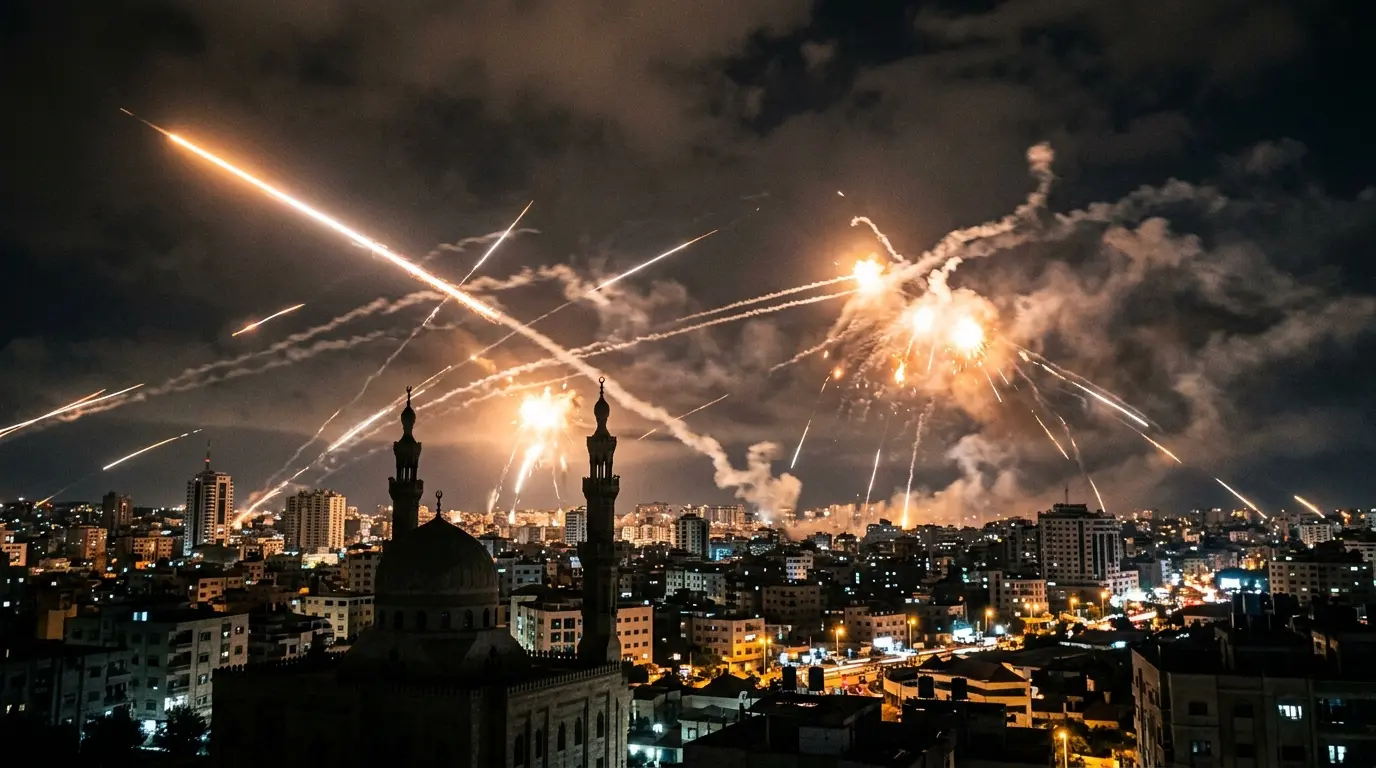
The IRGC said on Wednesday it had launched retaliatory strikes on 85 US military installations in Bahrain and Kuwait, including the US Fifth Fleet base at Port Salman and Kuwait’s Ali Salem Air Base, and claimed to have shot down an MQ-9 drone that attempted to interfere in the operation. Separately, IRGC statements carried by Iranian state media listed strikes on Sheikh Isa Air Base in Bahrain, two airbases in Kuwait, Jordan’s Prince Hassan Air Base, and Al-Azraq Air Base in Jordan.
The force described the operation as the opening phase of a continuing response. “If the aggression of the US terrorist army is repeated, other US bases in the region will not be spared from our heavy fire,” the IRGC said in a statement carried by Fars News Agency. Iran’s Foreign Ministry accused Washington of “violating nearly every provision” of the June agreement and of committing “war crimes” by targeting what it described as civilian and transport infrastructure, citing Article 51 of the UN Charter as the legal basis for further action.
Iran’s negotiator, Parliament Speaker Mohammad Bagher Ghalibaf, framed the response in personal terms. “The US has yet to learn that bullying and breaking its commitments no longer come without a cost. Let me be clear: If you strike, you will be struck back,” he wrote on X.
The Strike on Prince Hassan
The Jordanian strikes drew the most detailed claims from Tehran. The IRGC’s Aerospace Force said it fired 10 ballistic missiles at the US command-and-control center in West Asia and at Al-Azraq Air Base, asserting in its statement that the attack “destroyed” both facilities. Iranian state media reported that the strikes set fuel tanks and ammunition depots on fire at Prince Hassan and hit a hangar housing a P-8 maritime aircraft at Sheikh Isa. A separate IRGC statement claimed destruction of a command-and-control center and MQ-9 drone hangars at Prince Hassan.
Jordan’s armed forces offered a different account. The kingdom said it intercepted 8 missiles launched from Iran, with debris falling onto its territory but no injuries reported.
| Location targeted | Iran’s IRGC claim | Host state / documented result |
|---|---|---|
| Prince Hassan Air Base, Jordan | “Destroyed” US command-and-control center and MQ-9 drone hangars | Jordan reported 8 ballistic missiles intercepted in the overnight wave; debris fell on territory; no injuries |
| Al-Azraq Air Base, Jordan | 10 ballistic missiles “destroyed” the base | Jordan reported debris on territory, no casualties |
| Sheikh Isa Air Base, Bahrain | Hit helicopter maintenance facilities, P-8 hangar, drone command-and-control center | Bahrain said incoming fire was shot down; no damage figure given |
| Ali Salem Air Base, Kuwait | Combined with Bahrain in 85 “destroyed” claim | Kuwait intercepted three ballistic missiles, one cruise missile, and 10 drones; one injured by shrapnel |
What the US Hit First
CENTCOM said it struck approximately 90 Iranian military targets along the country’s coastline on July 8, including air defense systems, coastal surveillance assets, missile and drone storage sites, naval capabilities, and military logistics infrastructure. The command’s statement, posted July 8, said the strikes were launched to further degrade Iran’s ability to attack commercial shipping and innocent civilian mariners in the Strait of Hormuz. See the CENTCOM statement on the July 8 strikes for the full target list.
The night before, CENTCOM said, US forces had hit approximately 80 Iranian military targets, including more than 60 IRGC small boats, after Iran attacked three commercial vessels in the strait. Those ships were the Marshall Islands-flagged M/T Al Rekayyat, the Saudi Arabia-flagged M/T Wedyan, and the Liberian-flagged M/T Cyprus Prosperity, all thought to have been sailing close to the coast of Oman. The strait is a trade choke point through which an estimated 20% of the world’s oil passes. Iran’s state media reported that the US strikes hit the southern port city of Sirik, the strategically important Qeshm Island, areas near Bandar Abbas, and two military bases in Bushehr province. Iran said 14 people were killed and 78 wounded across five provinces.
By the numbers
- ~90 Iranian military targets struck July 8
- ~80 Iranian military targets struck July 7
- 60+ IRGC small boats destroyed in the July 7 round
- 14 killed and 78 wounded across five Iranian provinces, per Iran
- 3 commercial tankers targeted in the Strait of Hormuz
The Arab Host States Caught in the Middle
The retaliation put five Arab governments on the front line of a war they had been trying to stay out of. Kuwait’s military said its forces intercepted a cruise missile, three ballistic missiles, and 10 drones in the overnight barrage; at least one person was injured by falling shrapnel from the interceptions, Kuwaiti officials said. Bahrain said it had shot down incoming fire without elaborating, while Qatar reported no immediate word of damage. The UAE said it intercepted and responded to Iranian missile and drone strikes.
Iran’s strikes also hit the US Fifth Fleet’s headquarters at Juffair in Bahrain, according to Iranian reporting, expanding the geography of the response. Gulf states had spent the past three weeks hedging between Washington and Tehran under the June deal, wary of being pulled into the open war that the agreement had temporarily paused. Read how Arab Gulf states read the June deal for the regional calculus that shaped that hedging.
The escalation overlapped with the final day of a six-day funeral for Ayatollah Ali Khamenei, the Iranian Supreme Leader killed on February 28, 2026, in a US-Israeli strike on his Tehran compound. Iran’s foreign ministry said US strikes hit two railway bridges on the route to Mashhad, where Khamenei was due to be buried on Thursday.
How the round unfolded
- July 7, 2026: Iran attacks three commercial tankers in the Strait of Hormuz.
- Late July 7 / early July 8: CENTCOM strikes ~80 Iranian military targets, including 60+ IRGC small boats.
- July 8: CENTCOM strikes ~90 more Iranian targets along the coastline; US reimposes oil sanctions.
- July 8-9 overnight: IRGC fires ballistic missiles and drones at Prince Hassan, Al-Azraq, Sheikh Isa, Ali Salem, and the 5th Fleet base at Juffair; Arab host states activate air defenses.
- July 9 morning: Trump at the NATO summit in Ankara calls the June 17 MoU “over.”
A Three-Week-Old Deal Dies in Ankara
Trump appeared at the NATO summit in Ankara, Turkiye, hours after the strikes began. He told reporters the memorandum of understanding with Iran had collapsed, referring to Iran’s leadership as “scum.” Trump added that he “might” let US negotiators keep talking but signaled that any further Iranian attacks would draw a heavier US response.
We attacked very powerfully last night, the very dangerous people from Iran.
The June 17 memorandum of understanding had started a 60-day clock during which Iran agreed to allow free passage through the Strait of Hormuz and the US lifted sanctions on Iranian oil sales, with both sides committing to negotiate over Iran’s nuclear program. See the urgent congressional questions on the Iran deal for the unresolved elements of the original framework. The US Treasury reimposed oil sanctions on July 7 for new sales, a step that Iran’s foreign ministry called a separate violation. Trump’s announcement at NATO hardened the line. Iran’s Foreign Minister Abbas Araghchi responded on Telegram that the US strikes had “rendered key, fundamental elements of the war-ending agreement ineffective.”
Verified Damage vs. Iranian Claims
Across the four days of tit-for-tat strikes, the gap between Iranian claims and what host-state governments and CENTCOM have documented has widened. Iran asserts 85 US military installations destroyed across Bahrain and Kuwait combined; host-state reports describe multiple ballistic missiles and drones intercepted, with only minor injuries from falling debris.
The IRGC said the retaliation is continuing and warned that future operations would target any remaining US bases in the region. The IRGC Navy, in a separate statement, said it had restored traffic through the Strait of Hormuz to about 50% of pre-war levels for vessels using Iranian-designated routes. Only three fuel tankers were transiting the strait on Thursday, according to vessel-tracking data cited by CBS News.
Where the two accounts diverge
- 85 US targets Iran claims destroyed; Arab host states report multiple interceptions of incoming fire.
- 3 fuel tankers in the Strait of Hormuz on Thursday; 50% of pre-war traffic restored per IRGC Navy.
- Brent crude rose 6% to $78 a barrel; European stocks fell 1.6% after Trump’s remarks.
- Iran says 14 killed and 78 wounded across five provinces from US strikes.
Iran’s IRGC has said the retaliation is continuing, and it has warned that other US bases in the region will not be spared if US strikes are repeated.
