
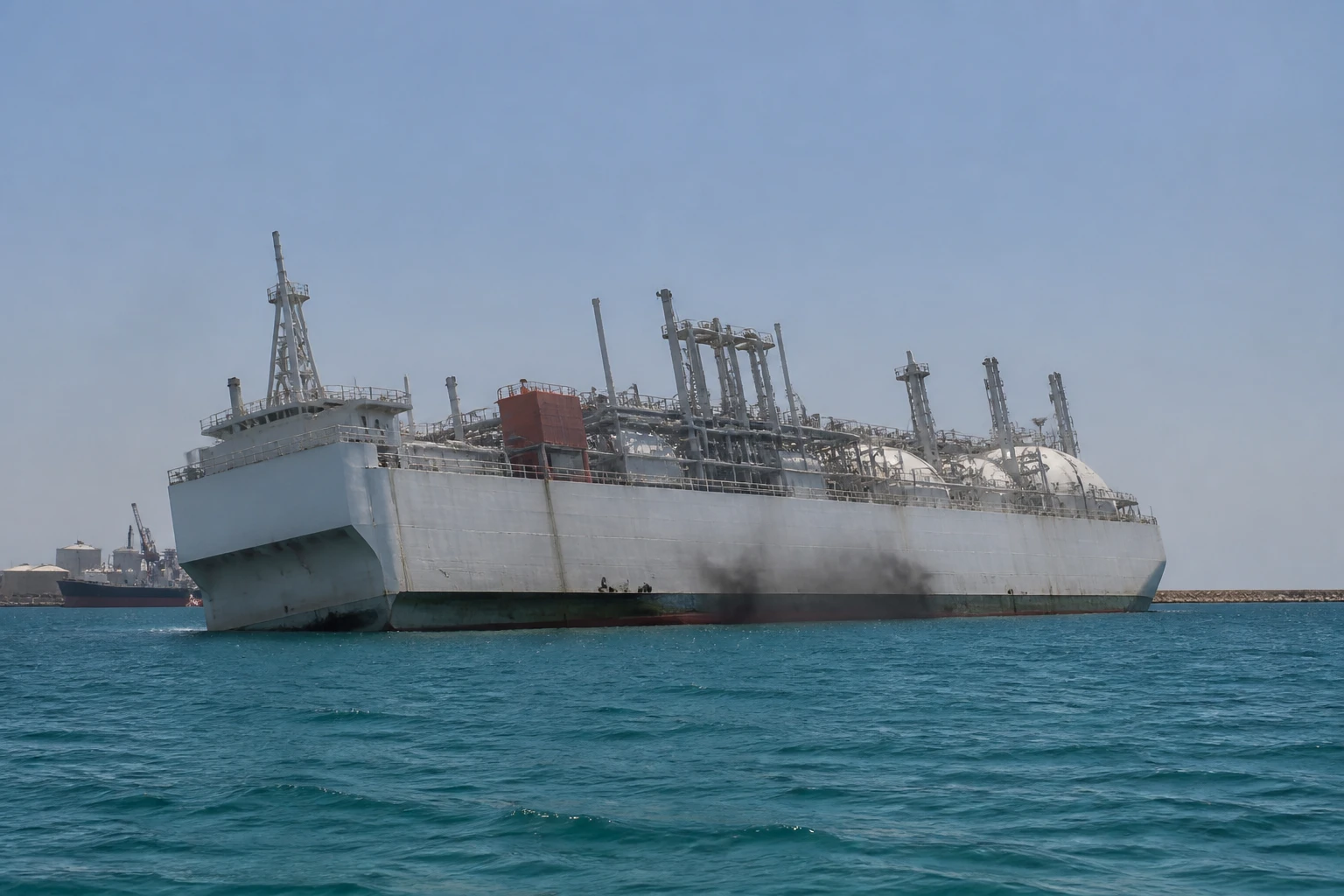
A drone struck the US-owned Energos Winter floating storage and regasification unit at Egypt’s Damietta port on Wednesday, sparking a fire that spread to the Greek LNG tanker GasLog Salem. Egypt’s cabinet confirmed the attack Thursday. No injuries occurred. The vessels left the berth and sat offshore.
President Trump called the incident “Iran-related.” The strike places a major non-NATO ally and its American energy assets inside the widening US-Iran war for the first time.
What Egyptian Officials Confirmed at Damietta
Egyptian petroleum ministry teams extinguished the blazes the same day. Petroleum Minister Karim Badawi visited the site. The cabinet statement said preliminary investigations found a drone caused the fire on the two vessels. Authorities continue to probe and protect national security. No group claimed responsibility.
British firm Ambrey first assessed a drone hit on the US-owned storage tanker. Trading sources and Kpler data matched the vessels: Energos Winter, storage capacity about 138,250 cubic metres, and GasLog Salem. both vessels moved offshore idling in the Mediterranean hours later. An LNG tanker, HL Fortuna, also sailed away without discharging.
- Energos Winter: US-owned FSRU by Energos Infrastructure, managed by Wilhelmsen Ship Management, Marshall Islands flag
- GasLog Salem: Greek-owned, due to start short-term floating storage for Egypt’s Egas around August 1
- Location: Damietta LNG hub on the Mediterranean, near the Suez Canal
- Outcome: fires controlled, zero casualties, possible tank breach on the FSRU
Ship-tracking firms reported the vessels under Egyptian jurisdiction when hit.
Who Gets Blamed and Who Denies It
Attribution remains open. Trump linked it to Iran. Hany El-Aasar, executive director of the National Center for Studies, ruled out direct Iranian execution. He told The Washington Times Tehran has no interest in widening its enemies or damaging recent diplomatic gains with Cairo. Egypt and Iran restored full ties in February; foreign ministers spoke four days before the strike.
El-Aasar named the Houthis as likeliest, reading Cairo’s stance on the group’s Saudi conflict and Red Sea shipping. Iranian state media had aired a map of possible targets that included Damietta’s LNG facility, described as a 5.2-million-ton gateway for Europe gas exports. A drone arrived four days later.
Iran’s foreign minister Abbas Araghchi called Egypt “an important friend” whose security matters and warned of Israeli “false-flag operations.” The Houthi foreign ministry denied any link, saying its targets stay limited to Saudi Arabia and Red Sea navigation remains safe. Some voices floated retaliation for a Ukrainian strike on an Iranian-linked ship in the Caspian, with Iranian media hinting at Europe-bound energy shipments.
Brenda Shaffer of the US Naval Postgraduate School blamed Iran directly. She said the target aimed to lift oil prices and worsen LNG shortages ahead of US midterms. OSINT accounts on X examined strike footage and described a V-tail kamikaze pattern consistent with prior proxy designs. Crowd analysis already treats the Mediterranean coast as newly priced risk, similar to earlier Red Sea patterns.
How Much Gas Capacity Egypt Just Lost
Egypt shifted from exporter to net importer after 2024 as domestic output fell and demand rose. Damietta last loaded an export cargo in 2023. The hit struck an import asset, one of four floating regasification units Cairo relies on for summer peaks.
| Asset / Metric | Figure | Share of Egypt System |
|---|---|---|
| Energos Winter regas capacity | 450 million cubic feet per day | ~7% of daily gas consumption |
| Share of total LNG regas capacity | – | ~16% |
| Storage volume | ~138,250 cubic metres | – |
| Egypt gas stance since 2024 | Net importer | Peak summer demand now |
ElAdl Studies, cited by Reuters, said the outage creates no immediate supply gap. Egypt can maximise other FSRUs, burn more fuel oil, tap renewables, or cut industrial gas as last resort. Yet spare capacity shrinks exactly when air-conditioning load peaks. Two sources told Reuters the vessels will stay out of service for some time; one noted a possible tank breach that lengthens repairs. Egypt ramped LNG imports and FSRUs through 2025-2026 precisely to cover the deficit, adding units at Damietta and Ain Sokhna.
US companies supply the bulk of Egypt’s LNG. American energy investment reached roughly $3.3 billion this fiscal year.
Suez Becomes the Last Safe Corridor
Damietta sits near the Suez Canal. Iran’s earlier closure of the Strait of Hormuz removed roughly a fifth of global LNG supply. Asian and European buyers already compete on the spot market. Saudi oil now depends on Suez as the remaining reliable export path to world markets.
A strike this close raises insurance premiums, diversion costs and war-risk clauses for every tanker using the canal. Elai Rettig of Bar-Ilan University called the Damietta hit “mainly symbolic” because it damaged an import unit rather than an export terminal. Symbolism still moves markets. The same drone waves that previously struck Saudi facilities and broader regional targets now reach Egyptian infrastructure that hosts US assets. That pattern matches earlier Iran-backed strikes on Saudi oil and the wider set of drone waves that hit Israel Jordan Iraq.
An Abu Dhabi security source told The Washington Times that Damietta resets the regional threat map. Targeting now follows US-linked economic and energy assets “regardless of the host nation’s political posture.”
Cairo’s Preference for Calculated Deterrence
Egypt has stayed on the sidelines longer than any other Arab state. That choice is now political preference, not operational reality. Talaat Taha, Arab affairs specialist and editor at state-owned Al-Gomhuria, said Egypt will answer without entering full war.
Calculated deterrence is Egypt’s policy. Egypt will not enter a war, but there may be painful strikes against the party that is implicated.
Taha left room for smugglers or error but did not rule out a militia. If Houthis, he expected a strike on the launch site, citing Egypt’s 2017 raids on Derna in Libya as precedent. President Abdel Fattah el-Sisi warned of the danger of regional escalation.
Egypt’s foreign minister met UAE counterpart Sheikh Abdullah bin Zayed in Abu Dhabi on July 21. Cairo publicised a military presence in the Emirates. The Abu Dhabi source called both moves signals rather than substance. Gulf capitals have long wanted deeper Egyptian integration; high-visibility exercises no longer suffice once Egyptian infrastructure burns.
American Molecules and Midterm Pressure
The US is Egypt’s largest LNG supplier and largest energy investor. In April the Export-Import Bank approved more than $2 billion in export credit insurance for shipments through 2027 under contracts between Hartree Partners and Egyptian General Petroleum Corp. Exim Chairman John Jovanovic said the deal puts US energy molecules to work in a critical market.
Shaffer argued Iran chose the target with Washington in mind, aiming to raise prices and worsen shortages as midterms approach. She expects the next target chosen by opportunity and urged energy facilities worldwide to raise alert levels. The same logic that produced pipeline risks from Saudi drone warnings now applies to any host of US-flagged or US-owned floating units.
Energos Infrastructure said all crew were accounted for and uninjured. The company could not immediately confirm a drone. Wilhelmsen continues technical management. The FSRU flew a Marshall Islands flag under Egyptian control, a legal grey that no longer provides cover.
What Neutrality No Longer Buys
The fires are out. The vessels sit idle. Egyptian investigators examine wreckage. Iran and the Houthis deny. Trump points at Iran. Analysts split between proxy, direct action and false-flag theories.
What is settled is simpler. Hosting American LNG hardware near a chokepoint now carries wartime risk even for a country that restored ties with Tehran and stayed out of every previous round. Egypt’s summer gas buffer is thinner. The Suez corridor carries higher risk premiums. Calculated deterrence is the only remaining menu item. The next move belongs to whoever launched the drone and to Cairo’s response.
