
The Israel Innovation Authority is putting NIS 100 million ($33 million) behind a bet that hedging beats picking a winner in quantum computing. The agency opened a request for proposals on Monday for a national research and development hub required to run at least three competing quantum hardware technologies side by side, not one.
Proposals are due October 8. Whoever wins will effectively decide which slices of the global quantum race Israel is actually placing its chips on.
Bidders Have Until October 8 to Build the Hub
The call for proposals targets industrial corporations, not universities, though the center they build is meant to serve both. Winning bidders will establish and operate a facility offering Israeli companies and researchers access to hardware testing, cloud based software development, and algorithm evaluation across multiple quantum platforms.
Israel Innovation Authority CEO Dror Bin framed the goal in institutional terms. “We aim to provide Israeli industry and academia with a state of the art R&D infrastructure that will enable them to evaluate, integrate, and adopt quantum computing technologies, transforming scientific and technological knowledge into a competitive advantage for Israeli high tech while strengthening Israel’s position as a global leader in this field,” he said.
Gila Gamliel, Israel’s minister of innovation, science and technology, put it more bluntly. “Israel must think one generation ahead. Our responsibility is to invest today in the technologies that will reshape the world in the decades to come,” she said in the authority’s statement.
The authority has run this playbook before. Earlier this year it backed a NIS 70 million consortium pairing NVIDIA and Teva on biological AI, another bet on shared national infrastructure rather than single company grants. Once a bidder is chosen, the center must begin offering at least some R&D services within a year and reach full operation within 18 months.
Why Won’t Israel Just Pick One Quantum Technology?
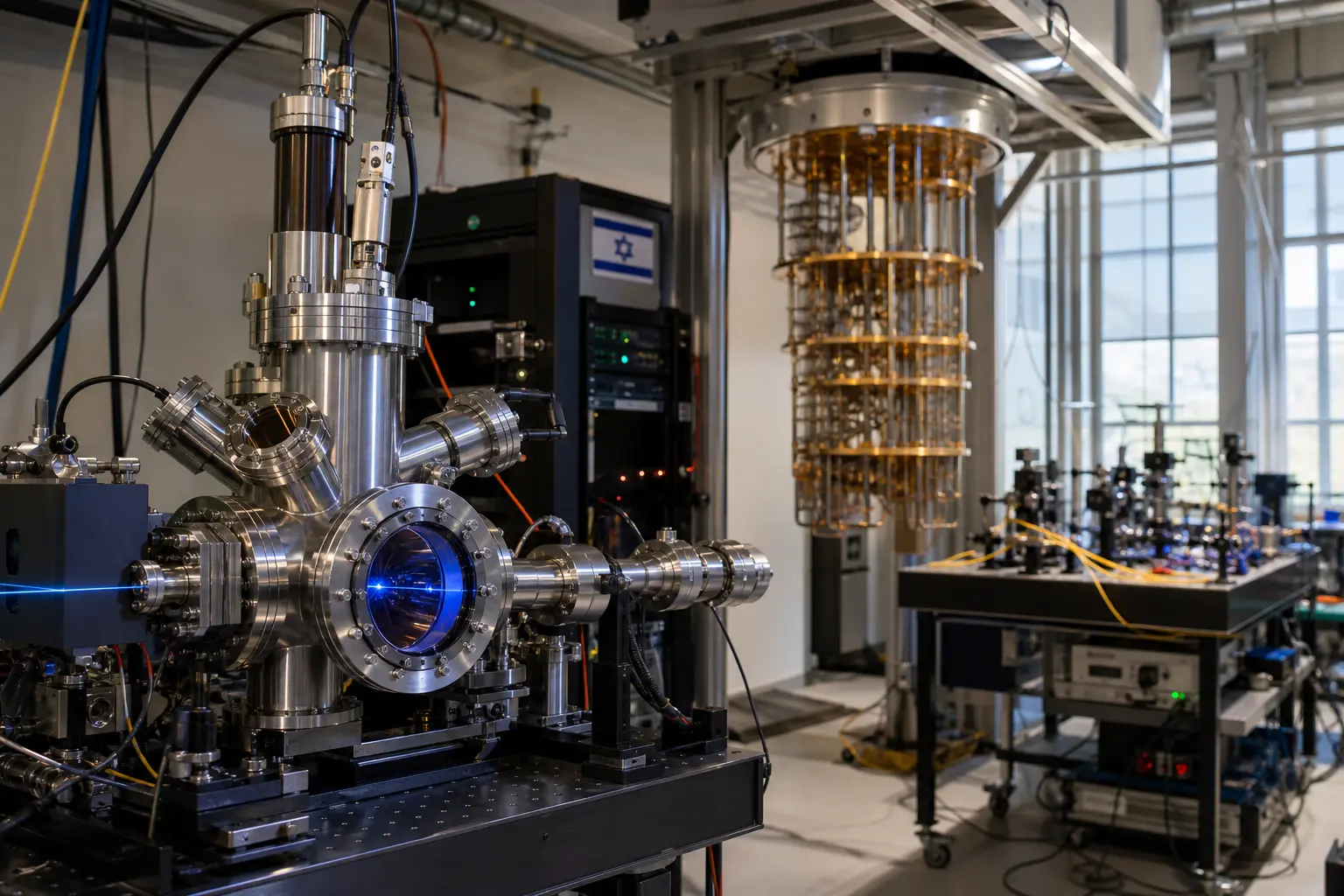
Because nobody else has picked one either. Four rival hardware families, superconducting circuits, trapped ions, neutral atoms, and photonics, are all still racing for dominance, and despite billions in global investment no single approach has pulled clear of the pack. Israel’s tender mirrors that uncertainty by requiring at least three of them under one roof.
The four approaches work in fundamentally different ways, and each has serious institutional and commercial backing:
- Superconducting circuits – chilled to near absolute zero inside dilution refrigerators, the approach behind Google and IBM’s largest processors.
- Trapped ions – qubits held in place with electromagnetic fields, the technology underlying IonQ, Quantinuum, and Israel’s own Quantum Art.
- Neutral atoms – arrays of atoms controlled with lasers, pursued by QuEra and the newly public Infleqtion.
- Photonics – encoding information in particles of light, the long bet of PsiQuantum.
The same hedge is playing out at government scale elsewhere. The Pentagon’s Defense Advanced Research Projects Agency selected eleven companies, including IBM, IonQ, Quantinuum, and QuEra, for the latest stage of its Quantum Benchmarking Initiative, spreading its own wager across nearly every architecture rather than committing to one. The quantum computing market is projected to grow from about $2 billion to $18.33 billion by 2034, and nobody building the underlying hardware wants to be left holding the losing architecture when that growth arrives.
Israel Already Tried This Once, in 2022
This is not Israel’s first NIS 100 million quantum wager. Four years ago, the Defense Ministry’s Directorate of Defense Research and Development, known as DDR&D, opened a parallel tender of the same size to build an indigenous quantum processor and a complete quantum computer for military use, while the Innovation Authority’s own track was explicitly allowed to lean on technology from abroad.
That earlier split explains why Israel’s current flagship center still depends on outside hardware. The Israeli Quantum Computing Center opened at Tel Aviv University in June 2024, run with help from Quantum Machines. As the authority itself put it, the center “was launched at a time when Israeli quantum processors were not yet available and therefore relied on foreign processors.”
The new tender is an explicit correction. “The current call for proposals is intended to establish an Israeli quantum computing technology and, on that basis, provide R&D services to Israeli academia and industry,” the authority said. The chronology shows the pattern plainly:
- 2018: Israel launches the National Quantum Initiative to coordinate research, talent development, and industrial projects.
- 2022: The Defense Ministry’s DDR&D opens its own NIS 100 million tender for a homegrown quantum processor and computer.
- June 2024: The Israeli Quantum Computing Center opens at Tel Aviv University, initially reliant on foreign processors.
- July 2026: The Innovation Authority opens this new NIS 100 million tender for indigenous infrastructure spanning three architectures.
- October 8, 2026: Proposals are due, with selection to follow and the center required within 18 months.
Each round has been the same size and the same instinct: fund shared infrastructure rather than bet on a single company or chip design.
Where $33 Million Sits Next to Washington and Beijing
The gap in scale is not subtle. Washington and Beijing are treating quantum computing as a strategic priority backed by national budgets; Israel is treating it as a shared lab bench.
| Program | Amount Committed | Timeframe |
|---|---|---|
| Israel, new IIA quantum R&D hub | $33 million (NIS 100M) | Operational within 18 months of selection |
| Israel, cumulative national quantum program | Roughly $330 million (about €0.3B) | Since 2018, per an industry tracker |
| United States, National Quantum Initiative | $1.2 billion (2019 to 2024) plus $1.8 billion reauthorized | 2025 through 2029, multi agency |
| China, quantum communication and computing | More than $15 billion | Cumulative, per industry estimates |
The reauthorized US law, moving through Congress as the National Quantum Initiative Reauthorization Act of 2026, extends federal funding through 2034 and adds new coordination requirements with allied nations. A companion summary from Senator Ben Ray Lujan’s office details specifics, including up to $18 million a year for each of three new NIST quantum centers through 2030. Israel’s entire tender would not fund two years of a single one of those centers.
Israeli Startups Placed Their Bets Years Ago
While the state was slow to build shared infrastructure, Israel’s private quantum sector did not wait around. The country counts about 20 quantum computing startups and, according to the Israel Innovation Authority, accounts for 9 percent of global private investment in the field.
CTech, the English language business site of Israeli financial daily Calcalist, puts fresher numbers on that lead. Israel ranks fifth globally in total investment raised by quantum companies and seventh in overall ecosystem strength, out of roughly 270 quantum computing companies worldwide. Israeli quantum firms have attracted about $800 million in private capital to date, including nearly $500 million raised by Quantum Art, Quantum Source, and Classiq in 2025 alone. On a per capita basis, roughly one in every 300 Israeli startups works in quantum computing, against about one in 2,000 in the United States.
Quantum Machines, which helps run the Tel Aviv University center, closed a $170 million round in early 2025 that valued the company at an estimated $700 million, and industry sources say it is already raising again. Classiq, the Tel Aviv software company also named among Israel’s quantum leaders, has crossed $200 million in cumulative funding and works with Comcast, BMW, Rolls Royce, Citi, and Toshiba.
We are building the Microsoft of quantum computing.
Nir Minerbi, Classiq’s chief executive and co-founder, said that when the company announced its $110 million Series C funding round last year. Quantum Art, a trapped ion spinout of the Weizmann Institute, is reportedly weighing a Wall Street listing at a valuation as high as $5 billion, potentially becoming the first Israeli quantum company to trade publicly before the end of 2026. Israeli tech talent remains a genuine edge, though it has also grown pricier than its American counterparts, adding cost pressure just as companies try to scale.
A Government Deadline Racing a Private Sector Clock
The tender’s own math sets up an odd race. Bidders have until October 8 to apply. Selection takes time after that. The center then gets 18 months to become fully operational, with only partial services required in year one.
Quantum Art, meanwhile, is reportedly aiming to list on Wall Street before 2026 is out. It is plausible that an Israeli quantum startup rings the opening bell on a US exchange before the government’s own quantum hub finishes construction.
The bet itself still looks sound on paper. Spreading $33 million across three unproven architectures costs Israel little if any one of them stalls, and it buys local companies a seat at the table no matter which technology eventually wins. What it does not buy is scale. Whoever wins the tender will still need 18 months to flip the switch, and the private sector’s clock is running faster than the government’s.
Frequently Asked Questions
When will quantum computers become commercially profitable?
Industry executives increasingly expect a commercial inflection point between 2027 and 2029, according to reporting on Israel’s SPAC bound quantum firms. Until then, most quantum revenue is expected to come from research contracts and cloud access fees rather than product sales, which is part of why several Israeli startups are racing toward public listings now.
How much have governments worldwide committed to quantum computing, and where do Gulf states fit in?
Global public investment in quantum technology surpassed 40 billion euros in 2025, led by the Asia Pacific region. The Middle East and Africa together account for only about 1 percent of that total, and within the region Israel is the leader in dedicated quantum funding; the UAE and Saudi Arabia invest in the technology but fold it into broader innovation budgets rather than standalone quantum programs. Saudi Arabia’s overall research and development spending hit $6.02 billion in a recent year, spread across many fields beyond quantum.
What is the Israel National Quantum Initiative?
Launched in 2018, it is the umbrella program under which this new tender sits. Its stated goals are to facilitate quantum research, develop human capital in the field, encourage industrial projects, and invite international cooperation on quantum R&D, according to the Israel Innovation Authority.
What other Israeli quantum companies exist beyond Classiq and Quantum Machines?
The cluster runs deeper than the two best known names. Industry trackers list Qedma, a Tel Aviv error mitigation startup that partners commercially with IBM, and QuamCore, which is building its own superconducting hardware out of Technion linked research. Most of Israel’s roughly 20 quantum firms trace back to the Weizmann Institute or the Technion.
