
NEWS
Hamas Emptied Gaza’s Squares After the Ceasefire Took Hold
The June 26 Revolution reached only a few hundred people because the ceasefire let Hamas retake hospitals, pulpits and local cameras before the marches began.

A few hundred Palestinians reached the street in Gaza City and Khan Younis on June 26, 2026, under the June 26 Revolution banner. They walked two years and eight months after Hamas’s October 7, 2023, attack on Israel, and eight months after the October 10, 2025, ceasefire.
Organizers had listed 18 gathering points across the Strip. Most of those corners never filled. The ceasefire that 2025’s crowds had begged for is what gave Hamas the idle gunmen, the hospital rooms and the local cameras to stop this one before noon.
The 18 Squares Were Mostly Empty
A Facebook page titled June 26 Revolution, live from June 8, 2026, had called people to 18 sites and asked for a peaceful turnout against hunger, wrecked housing and Hamas rule. One organizer, Abd al-Hamid Abd al-Ati, a Gazan living in Cairo, had spent weeks pushing the date. Hamas, which still runs the parts of the Strip the Israeli military does not hold, answered with threats as the Friday neared.
Footage posted from Khan Younis by activist Ihab Hassan appeared to show crowds in the hundreds, with handwritten signs and short chants. Hamza al-Masri posted other clips the same afternoon. None of it ran on the big Gaza stations, which are tied to Hamas. Those stations instead aired empty intersections and labelled the day the “Failure of the June 26 Revolution.”
A resident of central Gaza, who asked not to be named, said masked men tied to Hamas stood in the streets of Deir al-Balah to stop anyone gathering. He said a small number of people came out in Gaza City and other parts of the north, and that people in the centre stayed home after warnings on social media. Samuel Ben-Ur, a research analyst at the Foundation for Defense of Democracies, later put the people who did organise in Gaza City and Khan Younis at a few hundred, far short of the 18-site plan.
Ahmed Fouad Alkhatib, a Gaza-born senior fellow at the Atlantic Council, said some clips circulating that Friday were from the 2025 protests, and that the gatherings he could confirm were small and broken up fast. That does not erase the Khan Younis pictures. It does mean the day’s count was never going to match the poster.
Ati wrote on Facebook that “perhaps the June 26 movement did not achieve all that we had hoped for, but the message was delivered, and the cause for which people took to the streets remains alive.” Hamas did not need to win an argument on the pavement. It needed the pavement empty enough for its own cameras to call the revolution a flop, and it got that.
Hospitals Doubled as Holding Cells
The roundup did not wait for the first chant. In the days before June 26, residents said Hamas detained people it suspected of joining and held many of them inside hospitals, the one network of buildings that still had rooms, generators and a reason for strangers to walk in.
THE FOUR HOSPITALS NAMED BY RESIDENTS
- Al-Shifa Hospital: Gaza City’s main complex, listed as a pickup and holding site for people accused of planning to march.
- Nasser Hospital: Khan Younis’s large medical centre, already the scene of a smaller protest on June 18, 2026, when several dozen people had gathered over care for the wounded.
- Al-Ahli Arab Hospital: Also called the Baptist Hospital, in Gaza City’s Zeitoun neighbourhood, where Alkhatib said friends were questioned and put on house arrest.
- Al-Aqsa Martyrs Hospital: In Deir al-Balah, named with the others as a place where suspected marchers were taken off the street.
Alkhatib said friends in Gaza City were told that a Facebook post in support of the marches, or any help to protesters, would be treated as collaboration with Israel and punished with death under “revolutionary conditions,” with no trial. He said those threats were delivered by Hamas police, internal security and al-Qassam Brigades men inside the hospital, and he asked UN and aid officials to go and look.
Hamas’s intelligence operatives, internal security, and al-Qassam fighters are using parts of the complex to interrogate and torture anyone they suspect of supporting the upcoming June 26 anti-Hamas protests. Medical facilities in Gaza are not meant to be sanctuaries for Hamas.
Ahmed Fouad Alkhatib, senior fellow at the Atlantic Council, on X
He later said the same pattern ran through Al-Aqsa Hospital in Deir al-Balah and Nasser Hospital in the south, and he described interrogations inside Al-Ahli Hospital as part of a Strip-wide security push, not a one-room excess. Other residents described armed men on planned routes, limits on movement in displacement camps, and phones taken from people tied to the call. Fake journalists, Alkhatib said, were sent to sites to spot anyone who still showed up.
A Fatwa Closed the Mosques and the Cameras
The street work had a religious wrapper. The Fatwa Committee of the Association of Palestinian Scholars issued a ruling that joining the June 26 marches was forbidden. It framed participants as betrayers of Islam and as collaborators with Israel, a charge that under Hamas rule can mean death. Friday sermons in many Gaza mosques, according to people who heard them, called the protests fitna, internal strife, without always naming the date. The message was still clear: stay home.
Journalists inside Gaza had already been told not to cover the day. Several residents said that warning went out early in the week. Independent reporters described surveillance and intimidation. Hadeel Oueiss, editor-in-chief of Jusoor News, said her reporters and several well-known anti-Hamas activists had been watched for days. When Friday came, the local record of the marches was Hamas’s own empty-corner reels.
That split is what the online fight actually turned on. One camp treated any march against Hamas as a civic fact. The other treated it as treason while ruins still smoked. Hamas only needed the second frame to stick inside Gaza. Once the pulpits, the clan elders and the news desks repeated collaborator, the rifles on the corners were backup.
Some residents who did come out chanted “our voices are not acts of betrayal.” Others held signs against division itself, reading “No to destruction, no to division. Yes to living in peace.” Fear of a second war among Palestinians sat beside anger at Hamas. Exhaustion did as much work as the fatwa. People who have spent years in tents do not automatically walk toward a gun, even when they want the gunmen gone.
The 2025 Crowds Were Larger While the War Was On
This was the first organized anti-Hamas protest in Gaza since the wave that ran through the spring and summer of 2025. That earlier street was bigger, and it opened under fire, not under a ceasefire.
From March 25, 2025, residents of Beit Lahia marched against the war, against displacement orders, and then against Hamas. Amnesty International said those marches drew hundreds, if not thousands. Smaller protests spread to Jabalia, Shuja’iya and Khan Younis. The slogan was the same one painted again on June 26: we want to live. For a short stretch Hamas did not smash the crowds in the open the way it had in 2019. Its fighters were busy. Its police were thin.
The pause did not last. Amnesty documented beatings after the Beit Lahia marches, interrogations with no paperwork, and threats to shoot protesters in the feet. It interviewed 12 people who had marched or organised, plus relatives of three others.
We are entitled to live with dignity. We started marching because we want a solution to our suffering. No one incited us or told us to protest. People are protesting because they cannot live, they wanted change. Security forces came threatening and beating us, accusing us of being traitors, simply for raising our voices.
Resident of al-Atatra, Beit Lahia, to Amnesty International, 2025
Erika Guevara-Rosas, Amnesty’s senior director for research, advocacy, policy and campaigns, said it was “abhorrent and shameful” that Hamas was “ramping up threats and intimidation against people simply for saying ‘we want to live’.” By late spring the beatings were routine. Uday Al-Rubaee, a young protester, was killed in early April 2025; his family said al-Qassam Brigades men tortured him. Agnes Callamard, Amnesty’s secretary general, called for an investigation and told the authorities in Gaza to stop using violence against people exercising the right to assemble.
HOW THE TWO WAVES COMPARE
| Point of comparison | 2025 wave | June 26, 2026 |
|---|---|---|
| When | Spring and summer 2025, from March 25 | June 26, 2026 |
| War or ceasefire | Active fighting after the first ceasefire collapsed | Eight months into the October 10, 2025, ceasefire |
| Where crowds formed | Beit Lahia first, then Jabalia, Gaza City, Khan Younis | Gaza City and Khan Younis; Deir al-Balah blocked |
| Scale | Hundreds, if not thousands, in Beit Lahia | A few hundred; 18 sites planned |
| Hamas method | Beatings and interrogations after people had already marched | Hospital roundups, a fatwa, a local news blackout and armed patrols before the hour |
The 2025 opening existed because Hamas was stretched by Israeli operations and could not put a policeman on every corner. June 26 existed in the opposite weather. The fighting had paused. The police could come back to work.
What the Signs Said Before the Streets Cleared
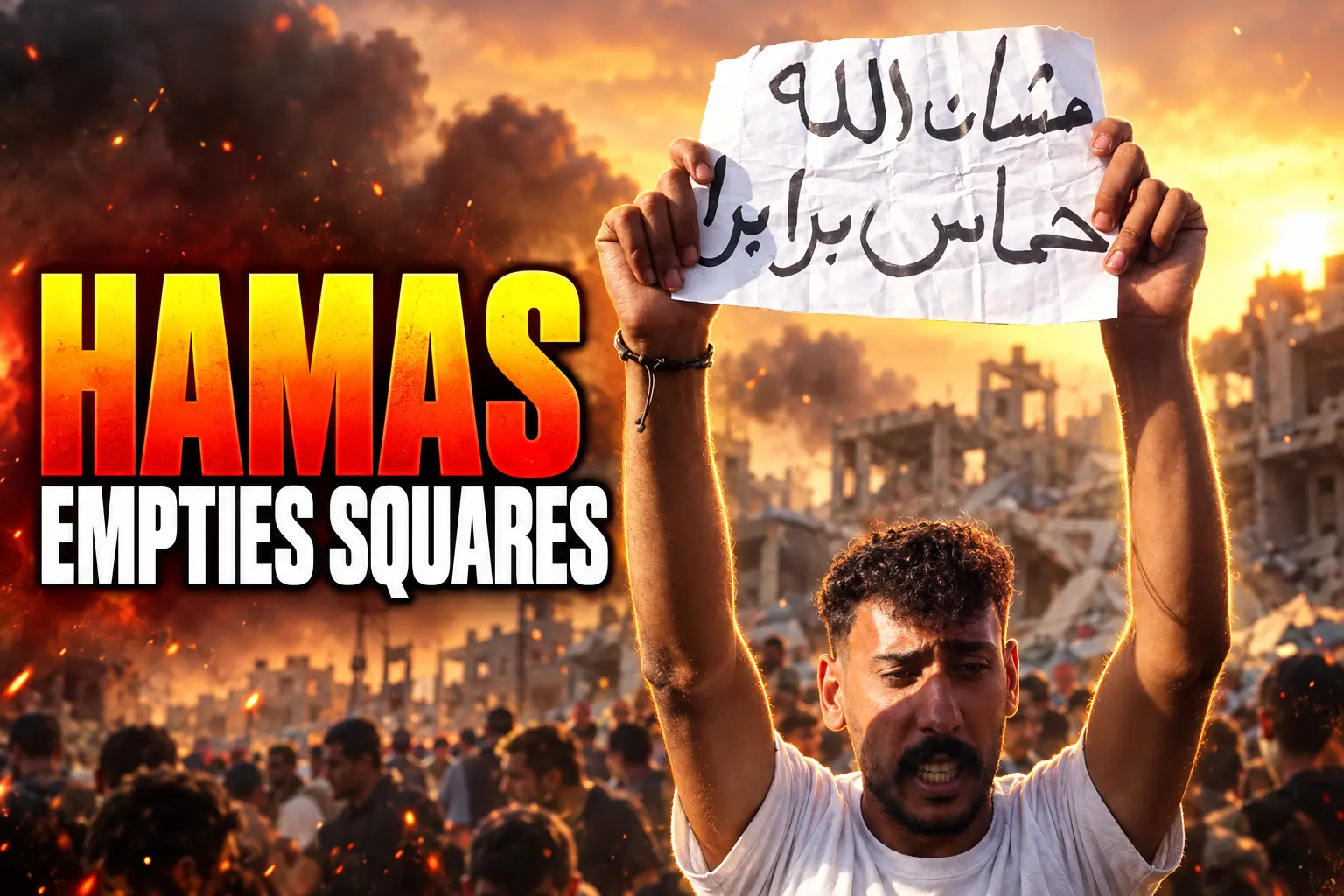
Where people did walk, the language was blunt and old. It was the 2025 vocabulary, written again on scrap board because that is still the demand.
WHAT THE CROWDS CARRIED
- God willing, Hamas out: The line that treats the group as a government to be removed, not as a resistance that cannot be questioned.
- We are not pawns: A refusal to be used in someone else’s war, including Hamas’s.
- We want to live: The Bidna Naish slogan from 2019, reused in 2025, reused again on June 26.
- Enough with the destruction: Heard on at least one video as a chant against the wreckage of the Strip.
Organizers had asked Hamas to disarm and to hand civil administration to a transitional authority, the step written into a US-brokered 20-point plan that has not moved past the first ceasefire. They wanted the National Committee for the Administration of Gaza, a technocratic body, to take the civilian file so reconstruction could start. Hamas has refused to give up its weapons. That refusal is why the same men who can still station patrols on a Friday can also sit in the way of rebuilding.
The marches that did form in Gaza City and Khan Younis lasted about an hour and then broke up. There was no second day. There was no spread to the other listed corners. Hamas had the pictures it wanted by evening.
The Ceasefire Gave Hamas Its Police Back
Hamas came into the ceasefire battered and still armed. It has used the pause to reassert control over the ground the Israeli army left, including by killing people it calls collaborators. A UN inquiry recorded 249 cases of extrajudicial executions and severe physical violence in Gaza between August 2024 and January 2026, with at least 108 deaths. At least 60 of those cases involved Hamas-affiliated forces. Some were filmed and posted on Telegram.
Amnesty International, in an August 20, 2026, file, documented nine extrajudicial executions after the ceasefire and one unlawful killing, almost all in the first days of the October 2025 truce. On October 13, 2025, eight unarmed men from the Dughmush family were shot in public in Gaza City after being promised a trial. On July 1, 2026, five days after the failed revolution, a Hamas-tied “Resistance Security” channel announced another public execution in Gaza City and called it the start of a large security campaign.
FROM THE FACEBOOK CALL TO THE NEXT EXECUTION
- June 8, 2026: The June 26 Revolution Facebook page starts posting and asking Gazans to take the street.
- June 18, 2026: Several dozen people gather outside Nasser Hospital in Khan Younis over care for the wounded.
- June 24, 2026: Alkhatib says friends have already been summoned to Al-Ahli Arab Hospital and threatened with death if they help the marches.
- June 26, 2026: A few hundred people appear in Gaza City and Khan Younis; most of the 18 listed sites stay empty; Hamas stations air the empty corners.
- July 1, 2026: A Hamas-tied security channel announces a public execution in Gaza City and says more will follow.
Guevara-Rosas said restoring order “must never serve as a cover to commit grave human rights violations, carry out reprisals, or to collectively punish entire families.” Hamas has called its methods exceptional measures under a state of necessity. The June 26 toolbox (hospital rooms, a collaborator fatwa, a news blackout) is that policy applied to a protest, not a departure from it.
Khaled Meshaal, a senior Hamas political leader based outside Gaza, had said the right to demonstrate is “a fundamental right of the Palestinian people” and that the political leadership had told members not to trample on it. The men on the corners did not get that memo, or they ignored it. The political office can praise free speech from abroad. The police inside the hospitals write a different rule.
By early July, Reham Owda, a political scientist, said the June 26 movement had shown Hamas’s “ability to maintain effective security control over Gaza.” No later mass march has matched even that thin Friday. Ati’s line that the cause remains alive sits next to the pictures Hamas chose to keep: empty intersections, looping, until the date passed.
Frequently Asked Questions
How long has Hamas ruled the Gaza Strip?
Hamas seized Gaza in 2007 after fighting with Fatah and then built a separate police and security system that treats public criticism as a security offense. That apparatus, including the al-Qassam Brigades and a parallel “Resistance Security System,” is what residents say was deployed against the June 26 call, using the same collaborator charge it has used against dissidents for years.
What is the We Want to Live movement in Gaza?
We Want to Live, or Bidna Naish, began in 2019 as a youth campaign for work, electricity and an end to Hamas’s grip, and it was put down then with arrests and force. The same slogan came back in the 2025 Beit Lahia marches and on the June 26 signs, which is why the 2026 Friday read as a sequel rather than a new party.
Did Hamas’s political leaders say protest was allowed?
Khaled Meshaal, speaking to the Algerian newspaper Echorouk around the June 26 date, called demonstrating a fundamental Palestinian right and said Hamas’s political leadership had instructed members not to infringe on it. That line did not match the fatwa, the mosque sermons, or the armed patrols that residents described on the same Friday.
How long did the June 26 gatherings last?
Residents who saw the Gaza City and Khan Younis clusters said the people who did come out dispersed after about an hour, with no second-day march and no spread to the other listed squares. Organizers had aimed for a late-afternoon start, around 4 p.m., which left Hamas the morning and early afternoon to finish the roundups.

Cook Hands Democrats the House as Crypto’s Bill Stays Dead

Wicker’s Broken Bed Was the Short Story’s Punch Line

Nvidia’s $500 Billion Financing Plan Draws a $180 Sell

Maserati Bets the Grecale V6 Can Fill Porsche’s Gap

EV Cable Theft Follows the Old Railway Copper Playbook

Aramco Crash Kills 14 Two Days After Oil Restart

Salah Captained Egypt to Their First World Cup Win

Zelda’s 40th Switch 2 Ships Without a Zelda Game

Apple Labor Day Deals Hide June’s Memory Price Hike

Palworld 1.0.4 Adds Palpedia Search After the 1.0 Launch
-
 BUSINESS4 months ago
Aramco Crash Kills 14 Two Days After Oil Restart
-
 NEWS5 months ago
Salah Captained Egypt to Their First World Cup Win
-
 GAMING2 months ago
Zelda’s 40th Switch 2 Ships Without a Zelda Game
-
 NEWS2 months ago
Apple Labor Day Deals Hide June’s Memory Price Hike
-

 NEWS4 months ago
El Niño Puts Israel’s Needed Winter Rain on a Flood Clock
-
 GAMING2 months ago
Palworld 1.0.4 Adds Palpedia Search After the 1.0 Launch
-
 BUSINESS8 months ago
BAE’s 60-Year Saudi Franchise Now Runs Through Taif
-

 BUSINESS8 months ago
Egypt Bets EGP 638 Billion Can Open Sinai to Investors