
The EU asked Egypt to help enforce sanctions on Russian “ghost ships” in the Mediterranean on Monday at the 11th EU-Egypt Association Council in Luxembourg, and on the same day unveiled a €690 million renewable-energy package for the country. EU High Representative for Foreign Affairs and Security Policy Kaja Kallas framed “Russia’s fleet of ghost ships” as a threat to European and Egyptian waters, and said the two sides would “discuss how to jointly tighten the enforcement of sanctions in the Mediterranean.” Egyptian Foreign Minister Badr Abdelatty responded with language on trade and “tangible progress,” and said nothing about Russia. Egypt is a BRICS member, and Russia is a founding member of the bloc. Fifteen human rights groups had pressed Brussels, in a June 8 letter, to make Egypt’s €5 billion macro-financial package conditional on reform.
The Council is the formal review of the EU-Egypt Strategic and Comprehensive Partnership, launched in March 2024 and built on six pillars: political relations, economic stability, trade and investment, migration and mobility, security, and demography and human capital. It also follows the first EU-Egypt summit, held in Brussels in October 2025, which brought together European Council President António Costa, European Commission President Ursula von der Leyen, and Egyptian President Abdel Fattah al-Sisi, per the Council’s published agenda for the 15 June meeting.
The €690 Million Flagship Lands in Luxembourg
The flagship of the Luxembourg agenda was a financing package worth up to €690 million, presented on the meeting’s sidelines by the European Commission. It is the first concrete project under the Trans-Mediterranean Renewable Energy and Clean-Tech Cooperation Initiative, known as T-MED, a programme the EU describes as a flagship of the wider Pact for the Mediterranean. The package combines a €600 million loan from the European Investment Bank’s development arm, EIB Global, with up to €90 million in grants from the European Commission, and is intended to modernise and expand Egypt’s national electricity grid, according to the European Commission’s €690 million T-MED announcement. The state-owned Egyptian Electricity Transmission Company, or EETC, will lead implementation, with the Egyptian government acting as borrower through the Central Bank of Egypt. European Commissioner for the Mediterranean Dubravka Šuica called the package proof that “the Pact for the Mediterranean keeps delivering,” and EIB Vice-President Gelsomina Vigliotti described it as “a very concrete example of what the partnership between Egypt and the European Union can achieve.”
The work covers the construction of new substations and the installation of advanced transmission lines to bring solar and wind power from the Red Sea and Gulf of Suez regions into the national grid. The EIB-backed phase of the programme runs from 2027 to 2030, and is sized to integrate a total of 22 gigawatts of renewable-energy capacity into the Egyptian grid by 2030, capacity the EU says is enough to supply around 10 million Egyptian households.
- €600 million EIB Global loan to Egypt
- €90 million European Commission grant
- 22 GW of renewable energy to be integrated into Egypt’s grid by 2030
- 10 million Egyptian households the new capacity is sized to supply
- 44% of the programme’s total cost covered by the EU package
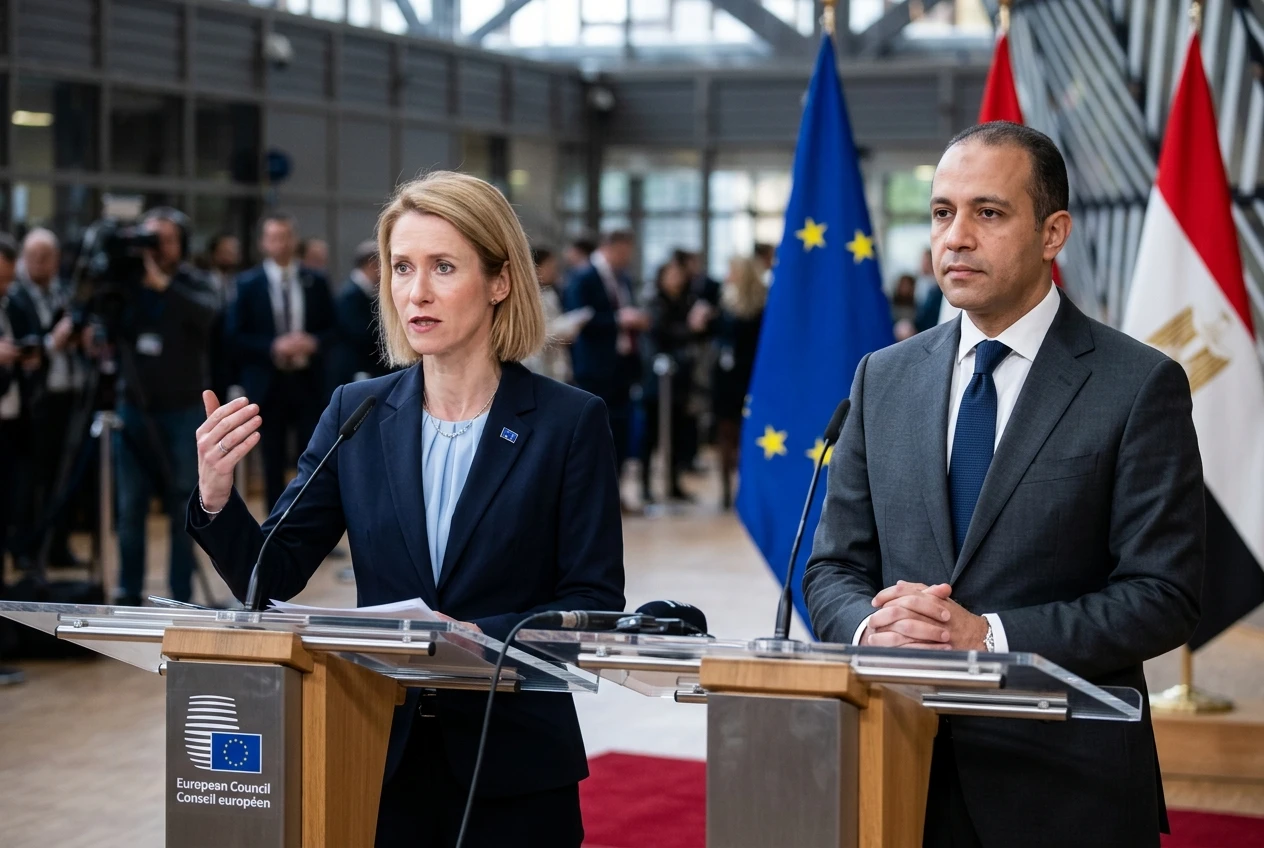
Kaja Kallas Names the Target
Kaja Kallas made the Russia question the political centre of the day. Standing alongside Abdelatty before the meeting started, she cast Russia’s so-called ghost-ship fleet as a shared Mediterranean problem, language she has been sharpening for two years. The phrase captures a category of tankers, often old, often opaque in ownership, that EU officials say carry sanctioned Russian oil and use the Mediterranean as a transit corridor, per Kallas’s comments on Russian ghost ships in the Mediterranean.
The Council is meant to turn that two-year effort into joint action. Kallas said the two sides would “discuss how to jointly tighten the enforcement of sanctions in the Mediterranean,” setting sanctions enforcement as a bilateral workstream between the EU and Egypt.
Kallas reached beyond sanctions to argue Egypt was a structural partner the EU needed on other files. She said the EU saw Cairo as a key player in resolving the Israeli-Palestinian conflict and the war in Iran. On Russia specifically, the EU position is that sanctions enforcement is now a Mediterranean-wide problem, and that Egypt’s geography makes it indispensable. The framing gives Egypt a structural seat on sanctions, migration, and Middle East files, alongside a multi-billion-euro investment track.
The financial ask, the operational ask, and the geographic framing arrived together, on a single day. The €690 million energy package, the T-MED pipeline that will follow, and the ghost-ships push were set out in sequence in Luxembourg. Foreign Minister Abdelatty and the EU ministers at the table did not produce a written outcome tying the three together. The Council’s own agenda describes it as a stocktake of the six pillars, not a negotiation. The energy file and the security file, the EU’s two main asks, will be tracked separately in the months that follow.
Russia’s fleet of ghost ships poses a threat to European and Egyptian waters.
Kaja Kallas, EU High Representative for Foreign Affairs and Security Policy, said the line in a press briefing alongside Egyptian Foreign Minister Badr Abdelatty on 15 June 2026 in Luxembourg, on the eve of the 11th EU-Egypt Association Council.
Cairo’s Public Silence, and the History Behind It
Abdelatty was careful in his own remarks. The Egyptian Foreign Minister said his country “appreciates the growing cooperation with the European Union” and pointed to “tangible progress in trade and investment” over the past year, with no reference to Russia.
Egypt’s hedging has its own history. President Abdel Fattah al-Sisi has, since the start of the Russian military campaign in Ukraine, declined to take sides in public between Brussels and Moscow. The most visible post in that balancing act is Egypt’s place in BRICS, which the country joined in 2024, with Russia a founding member of the bloc. On the most sensitive single file of the day, relations with Russia, Abdelatty stayed with generalities, acknowledging “major challenges” and “the significant repercussions of growing geopolitical tensions.”
His only specific regional reference was the United States-Iran peace agreement, which he framed as “a new chapter in reducing tensions in our region.” The reference and the silence, taken together, mark the diplomatic lane Cairo chose for the day. Egypt has had direct relations with Moscow since the Soviet Union era, and a separate defence and arms relationship with Russia since the early 2000s, a record the EU cannot put aside in a single Council meeting.
The Russia Ties the €690 Million Cannot Buy
Russia has been a key partner in Egyptian security and defence since the early 2000s, with imports of Russian-made arms and ammunition accounting for almost a third of Egyptian foreign orders. The two countries signed a Global Partnership and Strategic Cooperation Agreement in 2018, with a separate military cooperation protocol attached, and brought the partnership into force on 10 January 2021. The 2024 BRICS entry, the first time Egypt sat in the same formal bloc as Russia, was a structural commitment the two governments chose to make together. EU sanctions on Russian individuals, including bans on entry to European territory, have produced a quieter effect: a surge of Russian tourists into Egyptian resorts, with Sharm El-Sheikh and Hurghada the most visible beneficiaries. Tourism, arms, BRICS, and the bilateral agreement together make the EU’s anti-Russia ask more than a routine diplomatic favour.
The combination is the context in which the EU’s anti-Russia ask arrives in Luxembourg. The T-MED package, however large, is one project in a relationship that runs across arms, payments, and tourism. The rights groups’ June 8 letter, with its roster of Egyptian, regional, and European signatories, was a reminder that the same Council meeting is being asked to do two difficult things at once.
- 2018: Egypt and Russia sign a Global Partnership and Strategic Cooperation Agreement
- 10 January 2021: The bilateral partnership enters into force
- 2024: Egypt formally joins the BRICS group, with Russia a founding member
- 15 June 2026: The 11th EU-Egypt Association Council meets in Luxembourg
A Human Rights Letter That Traveled Faster Than the Ministers
A second constraint on the partnership arrived in Brussels a week before the ministers. On 8 June, fifteen press-freedom and human-rights organisations, led by the Committee to Protect Journalists and Front Line Defenders, sent a joint statement to the EU, and a copy to the European Parliament, warning that two years of the Strategic and Comprehensive Partnership had produced no meaningful progress on rights, democracy, or the rule of law, per the 15-organization letter on EU-Egypt rights and the €5 billion package.
The signatories are a roster of Egyptian, regional, and European groups, including the Cairo Institute for Human Rights Studies, the Egyptian Front for Human Rights, the Egyptian Human Rights Forum, CIVICUS, EuroMed Rights, the International Federation for Human Rights, ANKH Association, EgyptWide for Human Rights, the World Organisation Against Torture, PEN International, and the Sinai Foundation for Human Rights. The substance of their ask was that the EU use the Luxembourg meeting to press Egypt on enforced disappearance, arbitrary detention, the jailing of journalists, and the absence of any investigation into mass graves in North Sinai documented by the Sinai Foundation for Human Rights in a September 2025 report. They asked the European Commission to make those concerns visible in its first annual implementation report on the €5 billion macro-financial assistance operation, the report that informs whether further disbursements follow. Egypt held 18 journalists behind bars in 2025, the same figure the signatories cite, a count that keeps the country near the top of the world’s jailers of reporters. Around 6,000 individuals were referred to trial before terrorism court circuits in an eight-month window from late 2024 to May 2025, many after prolonged pretrial detention.
The €5 billion macro-financial assistance package, announced in March 2024 alongside the elevation of the EU-Egypt Partnership, is officially predicated on Egypt taking “concrete and credible steps” on democratic mechanisms, the rule of law, and human rights. The first instalment was disbursed in January 2026, on terms the signatories argue were not stringent enough. The 15 organisations want the second instalment, and the broader relationship, to read differently.
The signatories reminded readers of Neighborhood Commissioner Olivér Várhelyi’s 2024 description of the period as a “golden age” in EU-Egypt relations, and argued the phrase was already coming apart. Public expressions of support that ignore the reality of ongoing abuses, the letter says, “risk emboldening the authorities to commit further violations and may render the EU complicit in the serious abuses being committed in the country.” The statement is the second visible test the EU faces in Luxembourg, after the Russia ask, and a reminder that the partnership carries more than energy and security. Kallas, who is co-chairing the meeting, has not said how far the rights groups’ language will travel into the Council’s outcome.
The Build That Starts in 2027
The energy file has its own clock, and it is the most concrete one in the room. The T-MED package was presented on 15 June; the EIB-backed phase of the grid programme runs from 2027 to 2030, with the first flows of integrated renewable energy expected in 2028. By 2030, the EU is targeting integration of 22 GW of renewable capacity into the Egyptian grid, with the rest of the financing coming from the Egyptian Electricity Transmission Company’s own funds.
The Council itself runs along six pillars, from political relations to demography and human capital, and is the formal mid-cycle review of a partnership first elevated in March 2024. On the calendar between the two events sits a 2028 first flow both sides will be asked to point to when they next meet, and a 2030 target whose success or failure will be measured in gigawatts added to the Egyptian grid, not in statements read in Luxembourg.
