
Egypt will open five new applied technology schools this coming academic year to train technicians for pumping stations, irrigation canals and desalination plants, built with Italy’s ITSAgro Academy. The Ministry of Education and Technical Education says campuses in Sharqiya, Qalyubia, Alexandria, Assiut and Minya will admit their first students for the 2026/27 school year.
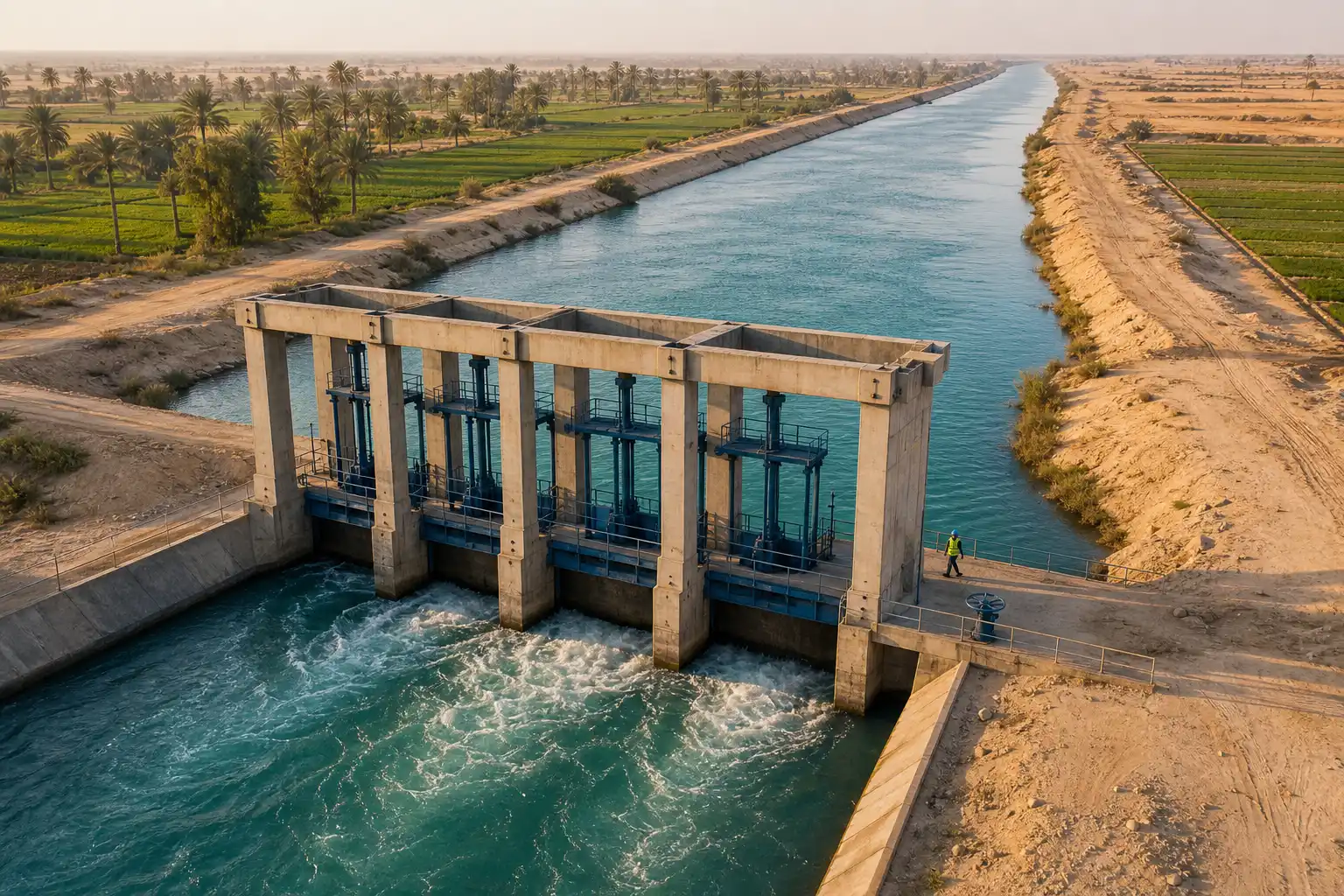
Egypt’s own water minister said earlier this year that per person water supply has already dropped under half the United Nations scarcity line. These five campuses are meant to staff what comes next: pumping stations, treatment plants and canals stretching a shrinking Nile share across more than 110 million people.
One New Kind of Classroom
The schools sit under a three way partnership between the education ministry, the Ministry of Water Resources and Irrigation, and Italy’s ITSAgro Academy. Lessons pair classroom instruction with practical training at facilities and worksites the water ministry already operates, rather than mock labs built solely for students.
Graduates will choose among four specializations:
- Water resources management
- Hydraulic structures
- Operation and maintenance of mechanical and electrical equipment at pumping stations
- Water treatment and desalination
The curriculum, developed jointly with ITSAgro, is built to certify graduates to international standards so they can work inside Egypt or abroad. On a sister program building 26 agricultural technology schools this year, Ahram Online reported that ITSAgro’s job includes training Egyptian teachers and building labs modeled on Italy’s own system, likely the same template it brings to the water campuses.
Both programs trace back to one bigger deal. In November 2025, Egypt and Italy signed protocols to build 89 applied technology schools spanning industrial, agricultural and service sectors. Education Minister Mohamed Abdel Latif called the agreement a “qualitative leap” for the country’s technical education system when Prime Minister Moustafa Madbouly witnessed the signing ceremony alongside Italy’s education minister, Giuseppe Valditara.
Egypt’s Water Supply Has Fallen Below the UN Scarcity Line
Hani Swelim, Egypt’s Minister of Water Resources and Irrigation, told a visiting United Nations official in February that per capita water availability has slipped to just 500 cubic meters a year, less than half the UN’s scarcity threshold. The Nile supplies 98% of the country’s water, he said, a dependence that leaves Egypt exposed to decisions made far upstream.
The figures behind that statement are blunt:
- 500 cubic meters is Egypt’s current per capita water share each year, against a UN scarcity line of 1,000.
- 98% of Egypt’s water resources come from the Nile River alone.
- 25 to 33 billion cubic meters is how much the Grand Ethiopian Renaissance Dam (GERD) could eventually cut from Egypt’s Nile quota, according to the U.S. International Trade Administration’s assessment of Egypt’s water sector.
- More than 110 million people now share that same shrinking supply, per Egyptian government figures.
Egypt has been sliding toward this line for decades, its population nearly quadrupling since the 1960s while the Nile’s yield has stayed essentially flat. The government’s response leans on workforce as much as concrete: training enough technicians to run the pumps, canals and treatment plants meant to close the gap.
Rome’s Classrooms Run on Decades-Old Debt Swaps
Italy’s role here did not start with the water schools, or even with last November’s 89 school framework. Since 2001, Italy has converted Egyptian debt repayments into development spending under a mechanism known as the Italian Egyptian Debt Swap. Rome’s development agency, AICS, describes it as one of the most significant cooperation tools between the two countries, built on local ownership of the projects it funds rather than top down aid.
One recent example ties directly into this year’s school building spree. Egypt’s State Information Service reported that a technology school expansion worth 40.8 million Egyptian pounds was financed under the third phase of that same debt swap agreement, which channels loan repayments into classrooms instead of cash sent back to Rome. Egypt and Italy’s diplomatic relationship dates to the 1970s, and Italian officials have said they want new cooperation aligned with Egypt’s own NWFE strategy, the water, food and energy planning framework Cairo uses to coordinate scarce resources.
The schools also sit inside Italy’s wider Mattei Plan for Africa, the strategy Prime Minister Giorgia Meloni’s government uses to blend aid, trade and migration policy into one package. Claudio Descalzi, chief executive of Italy’s energy major ENI, has said the company plans to invest eight billion euros each in Egypt, Libya and Algeria over four years, twenty four billion euros in total, under that same umbrella. Italy has used the plan to expand its oil and solar investments across Egypt, a parallel track running alongside the classrooms now opening in five governorates.
Is Italy Egypt’s Only Bidder for This Workforce?
No. Saudi Arabia’s ACWA Power is building its own training center for Egyptian desalination workers, and European lenders are financing separate coastal plants. Italy’s school network is one lane in a wider contest among foreign partners to shape who builds and operates Egypt’s water infrastructure over the next decade.
Prime Minister Mostafa Madbouly met ACWA Power executives in June to discuss new seawater desalination projects. Egypt currently produces 1.8 million cubic meters of desalinated water daily and is targeting 10 million, according to the meeting readout. ACWA Power’s chairman said the Saudi company’s total investments in Egypt have reached four billion dollars, and that a planned membrane factory will come with its own training center for local workers.
The European Bank for Reconstruction and Development has made a similar bet, approving a loan to expand coastal desalination capacity by up to 15,000 cubic meters a day, roughly 6.4 million euros routed through a subsidiary of Hassan Allam Utilities. Every one of these deals treats trained labor as part of the infrastructure, not an afterthought to it.
Ninety Schools Promised, Fewer than Half Built
Add up what Egypt and Italy have announced under the November framework so far and the count reaches 38 of the promised 89 schools. That leaves 51 still unannounced, with no public date beyond the same academic year stamped on every rollout to date.
| Program | Schools | Locations | Egyptian Partner | Italian Partner |
|---|---|---|---|---|
| Water Resources and Irrigation | 5 | Sharqiya, Qalyubia, Alexandria, Assiut, Minya | Ministry of Water Resources and Irrigation | ITSAgro Academy |
| Agricultural Technology | 26 | 14 governorates | Future of Egypt Authority for Sustainable Development | ITSAgro Academy |
| Steel and Mechatronics | 7 | Alexandria, Suez, Menoufia | Ezz Steel | Danieli |
Egypt’s State Information Service reported separately that seven steel and mechatronics schools with Ezz Steel and Italy’s Danieli will open the same year, adopting an education model built inside a working industrial site rather than a standalone campus.
The agricultural program’s Egyptian partner just gained new institutional weight. Parliament approved a law on July 14 giving the Future of Egypt Authority financial and administrative independence, shifting it from the Defense Ministry to the presidency. Lawmakers said the goal is to support food, water and energy security, according to reporting on the vote. Egypt’s broader modernization push has run alongside separate efforts too, including a Cairo pilot where a bank funded rooftop solar power for public classrooms.
These programs will not fix the water gap by themselves. Together, they are Egypt’s wager that trained workers, not just new pipes, will decide how the shortage plays out.
Frequently Asked Questions
What Is an Applied Technology School in Egypt?
It is a public vocational school model that pairs classroom study with hands on training at a partner company or ministry, aimed at certifying graduates for direct entry into skilled jobs. Italy’s aid agency AICS notes Egypt’s Ministry of Education already runs a unit overseeing more than 100 such schools nationwide, a network built up over two decades before this year’s water, agricultural and steel campuses were announced.
What Is Italy’s Mattei Plan?
It is Prime Minister Giorgia Meloni’s strategy for reshaping Italy’s relationship with Africa through aid, trade and energy deals rather than traditional grants alone. The plan piloted in nine countries, Egypt included, with six focus areas covering education and training, water, energy, agriculture, health and infrastructure, backed by an initial investment of 5.5 billion euros.
How Much Has Italy’s Debt Swap Program Spent in Egypt?
Three agreements signed since 2001 have converted roughly 350 million dollars of Egyptian debt into development projects, funding work from rural development and cultural heritage preservation to the technical school complexes now expanding into water and irrigation training.
Is Egypt’s Water Supply Falling Faster than Predicted?
It appears so. A 2023 academic projection using CAPMAS and UNICEF population data expected Egypt’s per capita share to fall to about 534 cubic meters by 2030. Egypt’s own water minister already reported a figure of 500 cubic meters in February 2026, suggesting the decline is arriving faster than that estimate anticipated.
