
Hot to extremely hot conditions are spreading across all of Egypt on Saturday, with wind gusts of 50 to 60 kilometers per hour expected to drive dense clouds of sand and dust across six geographic zones simultaneously. The Egyptian Meteorological Authority (EMA), the country’s national weather forecaster, confirmed the warning covers Greater Cairo, the Nile Delta, the northwestern coast, Sinai, the Red Sea governorate, and Upper Egypt. Mohamed Ali Fahim, head of the Climate Change Information Center at Egypt’s Agricultural Research Center, said rising humidity will make the air feel one to two degrees hotter than the thermometer records, and that the hot, dust-laden gusts carry risks for crops and people that temperature figures alone won’t show.
Fahim put the forecast highs at 37 to 39°C in Greater Cairo, 39 to 41°C in Northern Upper Egypt, and 41 to 42°C across the south.
The Compound Threat Across Six Regions
Saturday’s advisory covers six geographic zones simultaneously, placing each of Egypt’s major regions under the same compound warning at the same time. In each of them, high temperature arrives alongside two amplifiers that a simple forecast number won’t reflect: humidity pushing the felt air temperature above the recorded figure, and wind strong enough to lift sand and dust across hundreds of kilometers of cultivated and desert land.
Fahim’s projections, drawn from EMA weather maps, break the country into three temperature bands. Humidity adds one to two degrees to each range, so the body consistently feels above what any outdoor thermometer shows:
| Region | Forecast High | Humidity-Adjusted Range (Approx.) |
|---|---|---|
| Greater Cairo | 37 to 39°C | 38 to 41°C |
| Northern Upper Egypt | 39 to 41°C | 40 to 43°C |
| Southern Upper Egypt | 41 to 42°C | 42 to 44°C |
Humidity-adjusted range derived from the +1 to +2°C amplification stated in Saturday’s advisory.
The three temperature bands cover most of Egypt’s population and essentially all of the Nile Valley farmland. The Nile Delta, Sinai, the northwestern coast, and the Red Sea governorate fall under the same wind and dust advisory; specific temperature projections for those zones were not released in Saturday’s bulletin.
Cairo entered this weekend after a stretch of sustained heat, with the capital registering daily highs near 34°C for the past week, a pattern already testing Egypt’s power grid as cooling demand builds. Saturday’s 37 to 39°C projection sits 3 to 5°C above that recent baseline.
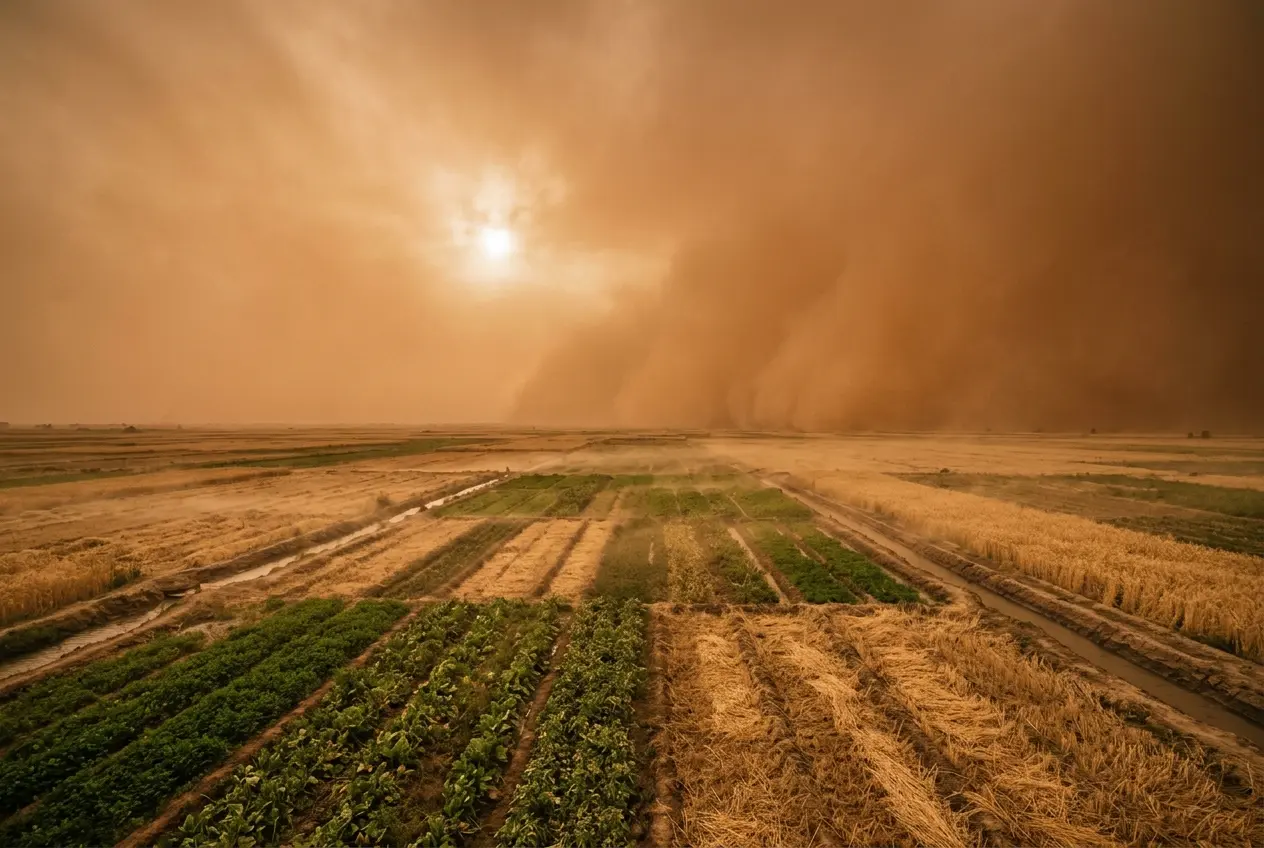
Dust-Laden Winds at 50 to 60 Kilometers per Hour
At those speeds, loose surface material goes airborne and stays there. Sand lifted from desert corridors, fine soil shaken from field margins, dry organic material from crop residue: all of it mixes into the same suspended mass moving across the country. Weather maps flag dust and sand activity across the Western Desert, Sinai, parts of the Red Sea region, and broad stretches of the Delta and Upper Egypt.
The event falls at the end of the Khamasin season. The Khamasin is a hot, dry, southwesterly wind system that blows across Egypt’s deserts from March through June, picking up fine sand particles as it crosses the Sahara and delivering them eastward into the Nile corridor and the populated Delta. In severe Khamasin events, wind speeds in desert corridors have exceeded 80 km/h; Saturday’s advisory range sits inside that hazard band without reaching the upper threshold.
Three specific wind-related effects converge this weekend:
- Visibility reduction across desert-adjacent zones, including roads connecting Cairo to Sinai and the Red Sea coast
- Suspended PM10 particles (airborne matter under 10 micrometers in diameter) that rise in concentration alongside temperature during heatwave conditions, according to peer-reviewed research on heatwave air quality in Greater Cairo
- Abrasion of plant surfaces, where dust particles at sustained speed strip the protective wax layer from leaves and reduce crops’ natural moisture retention
Driving between cities means navigating dust-reduced visibility on top of the heat. Farm workers moving through irrigation fields breathe air approaching the day’s peak temperature that their bodies process as two degrees warmer still. Anyone operating a greenhouse faces a different problem: whether cover sheets and frame anchors will hold against gusts at those speeds.
What Hot Wind Does to Open Fields
Fahim focused his warning on three specific impacts to the agricultural sector:
- Accelerated water loss in plants, as hot, dry, particle-laden wind pulls moisture from leaf surfaces faster than root systems and irrigation can replace it
- Increased heat stress on crops, which reduces photosynthesis efficiency and can trigger premature ripening, fruit drop, or cell damage in temperature-sensitive varieties
- Physical and mechanical damage to open-field crops and greenhouse structures, including torn cover sheets, broken frames, and direct abrasion from sustained particle impact
Egypt’s June agricultural calendar creates specific timing risks. Wheat, the country’s most important grain crop, is at the tail end of its harvest cycle in early June; physical damage to standing grain in the days before collection affects both quantity and quality. Summer vegetables planted from late spring, including tomatoes and cucumbers, are in early growth stages when heat stress can permanently stunt root development.
Among Egypt’s crops with documented sensitivity to khamaseen-type conditions, olives show particular vulnerability during critical flowering windows, with research on Egyptian harvest seasons identifying disrupted pollination and lower oil content as recurring consequences. A study on extreme weather events and Egyptian agriculture identifies the sector’s high sensitivity to the combination of heat and wind, which together accelerate soil moisture depletion and impose physical stress on plant structure.
For the country’s farm sector, the Food and Agriculture Organization’s climate-smart agriculture assessment for Egypt identifies the sector as highly sensitive to extreme weather events, with disrupted food availability and rising prices among the downstream consequences of crop damage episodes.
The Humidity Multiplier
The humidity-induced temperature gap that Saturday’s advisory estimated reflects a direct physiological mechanism. When atmospheric moisture is elevated, sweat evaporates more slowly from the skin. The body’s primary cooling process, perspiration, operates through evaporation; when the air is already carrying significant water vapor, the rate of heat transfer from body to environment drops, and the cardiovascular system compensates by pushing blood more aggressively to the skin surface without achieving equivalent cooling.
The effect intensifies above 37°C, roughly the point where effective perspiration becomes critical to prevent core temperature from climbing. The World Bank’s compound heat risk profile for Egypt shows that human health faces increased risks of heat-related illnesses when temperature and humidity combine, with labor productivity declining across all outdoor industries and agricultural workers specifically exposed.
Heat stress interacts with air quality as well. Research on heatwave periods in Greater Cairo found that PM10 and ozone concentrations rise in tandem with temperature during heat events. The combination of elevated particulate matter from Saturday’s dust-laden winds and heat-generated ozone creates a multi-pollutant burden for anyone breathing outdoor air in the capital or the agricultural zones.
High humidity and elevated nighttime temperatures are the two factors most consistently linked to heat-related illness in clinical research on Egyptian heatwave events. When there is no cooling at night, the body cannot complete the recovery cycle that limits cumulative heat exposure, and health consequences grow more severe over multi-day periods. In direct sunlight, the gap between shade temperature and what the body actually experiences can reach eight degrees Celsius above the recorded figure.
Egypt’s Accelerating Heat Calendar
A peer-reviewed analysis of Greater Cairo’s heatwave record counted 376 heatwave days across 190 distinct events, with frequency, intensity, and duration all increasing across the study period, and PM10 and ozone concentrations rising in step with temperature during those periods.
The World Meteorological Organization (WMO), the United Nations body responsible for global climate monitoring, ranked the Arab world’s 2024 heat season as the hottest on record in the region’s instrumental history, with persistent heatwaves affecting Egypt among other countries. Human-caused warming has increased atmospheric moisture because warmer air holds more water vapor; the frequency of extreme humid heat events more than doubled globally between 1979 and 2017, according to Climate Central’s analysis of humid heat trends.
An earlier severe weather event in March, a rare polar depression that battered the country with heavy rain, thunder, and sandstorms, forced EgyptAir to issue urgent travel advisories and extend airport processing times. The range of severe weather types arriving in Egypt within a single calendar year has widened perceptibly.
Egypt already carries an annual water deficit of approximately 7 billion cubic meters. Hotter conditions push that gap wider: higher temperatures accelerate evaporation from irrigation canals while simultaneously increasing the water demand of the crops those canals serve.
Cairo’s average June high runs at around 34°C. Saturday’s advisory sits 3 to 5 degrees above that baseline, before humidity adjustments.
