
The Egyptian Meteorological Authority (EMA), the country’s national weather forecaster, expects hot weather to hold across most of Egypt on Monday, with Cairo near 34°C, the North Coast staying moderately warm, and the south scorching past 40°C in Qena and Aswan. High humidity will push the heat index 2 to 4 degrees above the thermometer reading, so the air will feel hotter than the official figure suggests.
The daily numbers are the simple part of the story. Behind them sits a climate warming faster than the global average and a power grid pushing toward record summer demand, and that combination is what makes each Egyptian summer harder to get through than the last.
Monday’s Forecast From Cairo to Aswan
EMA’s bulletin splits the country into familiar bands. The Delta and Cairo sit in plain hot territory, the North Coast and Alexandria stay a touch cooler thanks to the sea, and Upper Egypt bakes. The widest gap on Monday runs between the Mediterranean shore and the far south, where the spread tops 13 degrees.
| City | Forecast high (°C) | Where it sits |
|---|---|---|
| Cairo | 34 | Capital, edge of the Nile Delta |
| Alexandria | 29 | Mediterranean coast |
| Marsa Matruh | 27 | Northwest coast |
| Sohag | 38 | Upper Egypt |
| Qena | 40 | Upper Egypt |
| Aswan | 40 | Far south |
Mist that thickens into fog is expected on farm roads and highways from the north down to Cairo, the Canal cities, central Sinai and the north of Upper Egypt, a hazard for early commuters. There is also a chance of light, on-and-off rain in Cairo, the northwest coast, the northern Delta, parts of Upper Egypt and the Matruh and Western Desert.
Winds of 30 to 40 kilometres per hour will gust at times, stirring sand and dust in South Sinai. At sea, the Red Sea turns moderate to rough with waves of 1.5 to 2.5 metres, the Gulf of Suez runs rougher still at 2 to 3 metres, and the Mediterranean stays calmer at 1 to 1.75 metres.
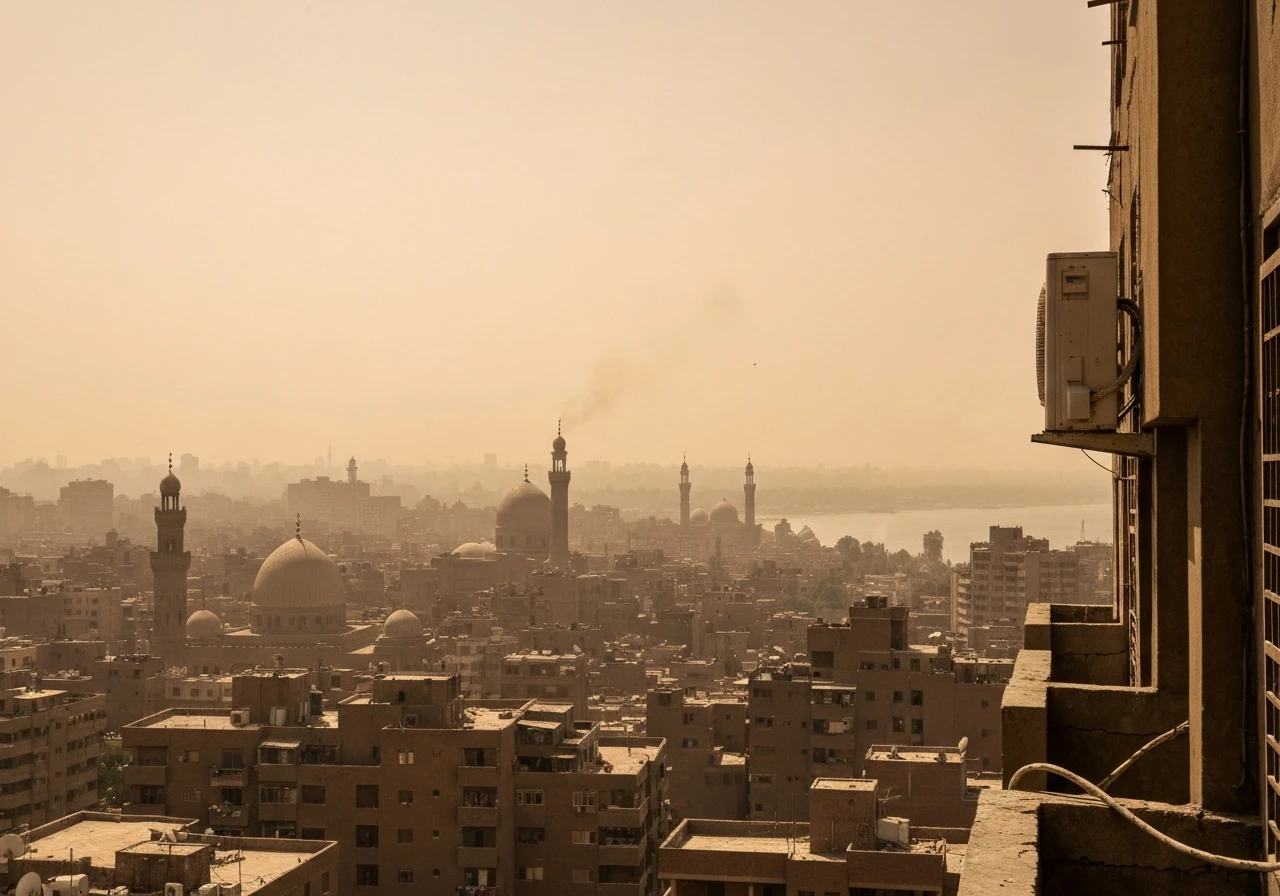
Why 34 Degrees Feels Hotter Than It Reads
Air temperature alone undersells how a day feels. The EMA flags a heat index, the “feels like” number that pairs temperature with humidity, running 2 to 4 degrees above the raw reading on Monday. In practical terms, a 34-degree afternoon in Cairo can feel closer to 37 or 38.
Humidity is the reason. Sweat is the body’s cooling system, and it only works when moisture evaporates off the skin. When the air is already damp, evaporation slows and the body holds onto heat it would otherwise shed. Coastal and Delta cities feel this most, because moist Mediterranean air sits over them.
Nights matter as much as afternoons. Forecasters expect moderate conditions overnight and in the early morning, which offers some relief, but warm, humid nights blunt the body’s chance to recover before the next day’s peak.
Then there is the dust. The same 30-to-40 kilometre winds that cool the skin slightly also carry sand in the south and along desert roads, which irritates eyes and lungs and adds a second reason to stay indoors during the hottest hours.
A Climate Nudging the Thermometer Up
One hot Monday is weather. The trend underneath it is climate, and Egypt’s is moving quickly. A peer-reviewed assessment of daily temperature extremes in Egypt found the country warmed by about 0.38 degrees Celsius per decade between 2000 and 2020, faster than the global average over the same span.
Researchers also see more heatwaves that last longer and bite harder, with the sharpest changes in the southeast around Aswan and the Red Sea. Warmer nights are part of the same picture, because they cut the cooling window that lets bodies, buildings and crops reset overnight.
- 0.38°C per decade: Egypt’s measured warming rate from 2000 to 2020, ahead of the global pace.
- Two decades of rising heatwave frequency, duration and intensity, concentrated in the southeast.
- 0.2 to 0.5°C per decade: the additional warming projected for the wider region this century.
The Grid Behind the Air Conditioners
When the south hits 40 and the Delta turns muggy, millions reach for the same switch at once. Air conditioning is now the swing factor in Egypt’s summer electricity bill, and the grid feels every degree.
Peak Load Keeps Climbing
Egypt’s peak system load reached roughly 31 gigawatts (GW), the unit measuring total power demand at a single moment, during 2025, driven hard by cooling needs in homes and offices. Building-sector demand has climbed for years on the back of population growth, urban expansion and wider use of air conditioning during hotter, longer summers.
That curve is steepest exactly when the weather is worst, in the afternoon hours when temperature and humidity both peak together.
Gas, Blackouts and Pricing
Most of that power still comes from natural gas. Summer spikes pull gas toward the domestic grid and away from Egypt’s electricity and energy market, and in recent years the government leaned on rolling blackouts and repeated electricity price increases to keep supply and demand in balance.
Each hot season therefore lands as both a comfort problem and a budget problem: for households paying higher tariffs, and for a state weighing power cuts against export earnings.
A New Link Across the Red Sea
One fix is now close to live. The Egypt-Saudi Arabia electricity interconnection, billed by the International Energy Agency’s interconnection policy file as the first large-scale high-voltage direct current (HVDC) link in the region, can move up to 3,000 megawatts between the two grids across about 1,350 kilometres of overhead line and subsea cable.
The idea is to share spare capacity across demand peaks, so Egypt can draw power when its afternoons spike and send some back at quieter hours. Renewable capacity, expected near 12 GW including storage, is meant to take more of the load over time, though gas is set to stay dominant for years.
Who Feels the Heat First
Heat is not felt evenly. A 40-degree afternoon is an inconvenience for an office worker in an air-conditioned tower and a genuine danger for someone working outside or living without reliable cooling.
The health toll is already measurable. An assessment published in The Lancet Planetary Health estimated Egypt carries the highest absolute heat-related death burden in the Middle East and North Africa (MENA) region, on the order of 2,591 deaths a year, and the World Health Organization (WHO) warns the at-risk group grows as average temperatures and heatwaves rise.
- Outdoor workers: construction crews, farmers and street vendors who cannot escape the midday sun.
- Older adults and the chronically ill, whose bodies regulate heat poorly and who may lack cooling at home.
- Farmers and crops: heat stress hits yields and water use across Egypt’s export-focused agriculture, from citrus to grapes.
- Tourists: visitors to Luxor and Aswan face 40-plus afternoons that demand early starts and constant hydration.
The calendar adds pressure. With the Eid Al Adha holiday bringing families outdoors in early June and the export harvest still moving, the heat arrives at a moment when the country cannot simply pause.
If the new cross-border link and added renewables come online before the worst of July and August, this summer may pass with fewer cuts than the last; if demand outruns them, the air conditioner and the power bill will keep telling the same story the thermometer started on Monday.
Frequently Asked Questions
How hot is it in Cairo today?
Cairo is forecast to reach about 34°C on Monday, June 1, 2026, but high humidity pushes the heat index 2 to 4 degrees higher, so it can feel closer to 37 or 38 degrees.
Where is the hottest place in Egypt this week?
The far south is hottest, with Qena and Aswan forecast near 40°C and Sohag around 38°C, while the Mediterranean coast stays cooler, with Alexandria near 29°C and Marsa Matruh around 27°C.
Will it rain in Egypt this week?
Yes, there is a chance of light, intermittent rain in Cairo, the northwest coast, the northern Delta, parts of Upper Egypt and the Western Desert, though most of the country stays dry.
Is Egypt getting hotter every year?
Measurements show Egypt warmed by about 0.38°C per decade between 2000 and 2020, faster than the global average, with heatwaves growing more frequent, longer and more intense, especially in the southeast.
How can I stay safe in Egypt’s summer heat?
Limit outdoor activity during midday hours, drink water regularly, wear light clothing and a hat, and check on older or vulnerable people; international agencies publish detailed guidance on extreme heat health risks.
Does the heat cause power cuts in Egypt?
Peak demand reached roughly 31 GW in 2025 as air-conditioning use surged, and the gas-fed grid has relied on rolling cuts and price rises in past summers; a new 3,000 MW link with Saudi Arabia is meant to ease the pressure.
Disclaimer: This article is for general informational purposes only and does not constitute medical, safety or travel advice. Extreme heat can pose serious health risks; anyone feeling unwell should seek guidance from a qualified medical professional, and travellers should follow official advisories. Forecast figures and data are accurate as of publication on June 1, 2026.
