
Egyptian prosecutors referred a Christian convert to a terrorism court on April 13. Three months later, a mob stoned a village church and a group of men beat a priest in South Sinai. The U.S. State Department is now pressing Cairo to protect a Christian minority that Washington’s own reporting describes as underrepresented at nearly every level of government, even though that community helps keep the current government in power.
Coptic Christians form a pillar of El-Sisi’s political coalition, according to Dalia Ziada, an Egyptian Middle East scholar and research fellow at the Institute for the Study of Global Antisemitism and Policy. That loyalty, she told Fox News Digital, earns Copts a presidential visit to a church every Christmas. Structural protection has not followed.
A Convert’s Case Reaches Terrorism Court
Said Mansour Rezk Abdelrazek, a 30-year-old Egyptian, converted from Islam to Christianity in 2016 and later tried to update the religion listed on his national identity card so he could marry his fiancee in a church. Raymond Ibrahim, an expert on Christians in the Muslim world, wrote on the Gatestone Institute’s website that Abdelrazek “has become one of Egypt’s most prominent religious freedom cases.”
On April 13, prosecutors referred him to a terrorism court on charges of joining a terrorist organization, among others, while his lawyers say they were denied access to his case file. He remains imprisoned at Cairo’s 10th of Ramadan Prison, where advocates report torture, physical abuse and denial of adequate medical care, along with repeated postponements of his trial.
The U.S. Commission on International Religious Freedom has recorded Abdelrazek as a religious prisoner of conscience. The Cairo Institute for Human Rights Studies filed an urgent appeal for his release and protection, citing a forced divorce and separation from his child on top of the criminal case. The Cairo-based group tracks human rights cases across Egypt and the wider region.
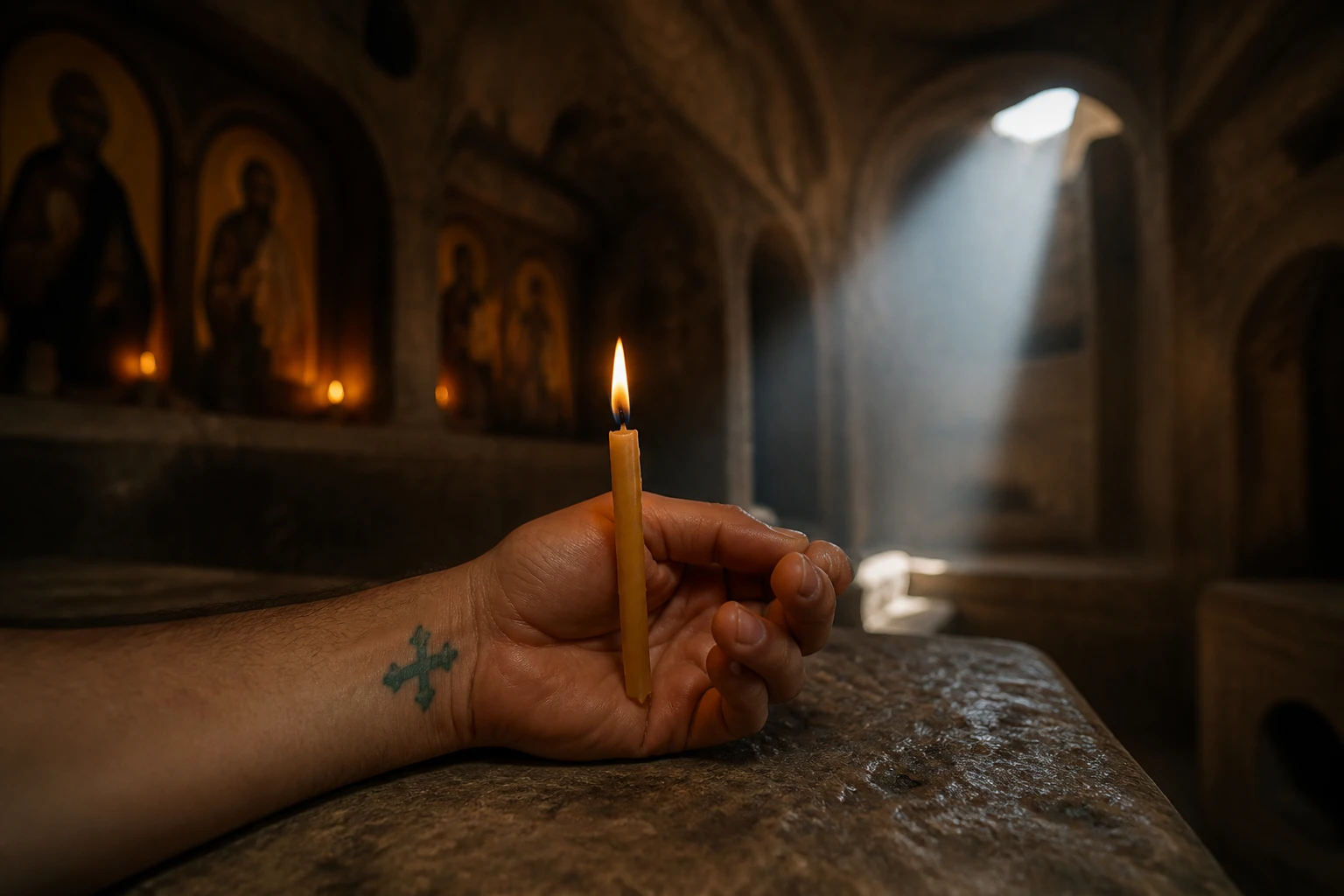
Violence Spreads From a Village Church to a Sinai Priest
Abdelrazek’s prosecution did not happen in a quiet year. Within weeks of each other, mobs and individuals targeted Christians and their clergy in separate governorates.
- 2016: Abdelrazek converts from Islam to Christianity and later seeks new identity documents to marry in a church.
- April 13, 2026: Prosecutors refer Abdelrazek to a terrorism court; his lawyers say they are denied the case file.
- April 29, 2026: Christian Today reports that Coptic YouTuber Augustinos Samaan was sentenced to five years in prison for videos defending the Christian faith.
- July 8, 2026: A mob throws stones at a church in Upper Egypt, injuring worshippers and damaging the building and a priest’s car, according to the Egyptian Initiative for Personal Rights, a Cairo-based rights monitor.
- Mid-July 2026: A group of men attacks the Rev. Matta Roushdy, a priest at the Virgin Mary and St. Abanoub Coptic Orthodox Church in Dahab, on Egypt’s South Sinai coast.
Roushdy is 49. Open Doors, a global organization that tracks persecution of Christians, said attacks like the one against him reflect “a broader anti-Christian sentiment, especially in rural and village societies across the country where weak law enforcement leaves Christians vulnerable to attack.” The group added that such violence has decreased over the last decade but “will continue until the state takes anti-Christian fanaticism as seriously as it deserves.”
Samaan’s five-year sentence fits the same pattern found in Abdelrazek’s case: authorities treating public expressions of Christian faith as threats to social order. Egyptian embassies in Washington and Tel Aviv did not respond to Fox News Digital’s emails and calls requesting comment on any of these cases.
Why Does El-Sisi Need Coptic Support?
Coptic Christians and women were the two groups that felt most threatened by the Muslim Brotherhood after Egypt’s 2011 uprising, and both backed El-Sisi’s rise to power in 2013 and have stayed loyal since, Ziada said. That history makes Copts a foundation of his coalition, not a fringe constituency he can ignore at election time.
Ziada said El-Sisi maintains the relationship mostly through appearance, visiting a Coptic church every Christmas to signal protection.
But beyond that, nothing is actually happening to make them less vulnerable.
Ziada made that assessment to Fox News Digital. She also put Egypt’s Christian population above 20 million, more than the State Department’s estimate of roughly 10% of the country’s 120 million people, near 12 million. The two figures have long been in tension, reflecting how differently Cairo’s statistics and Coptic advocates’ own counts treat the same community.
A State Department spokesperson pointed Fox News Digital to President Donald Trump’s own words on the subject: “America will always defend the right of every person to live out their faith openly, freely, and without fear.” The spokesperson added, “Religious freedom is a fundamental American value. We aspire for all others to enjoy the same freedom, protection, and benefits.”
The U.S. Commission on International Religious Freedom, a bipartisan federal body that monitors religious conditions worldwide, has gone further than that statement. It has recommended Egypt for placement on its Special Watch List, citing the government’s escalation against religious minorities.
Christians Hold Few Seats at Egypt’s Top Tables
The State Department’s 2025 report on Egypt lays out how thin Christian representation is across the government Copts help keep in place.
| Institution | Christian Representation |
|---|---|
| Cabinet (31 members) | 2 ministers, covering local development and parliamentary affairs |
| Appointed governors (27 posts) | 1 governor |
| Senate (300 seats) | 24 senators (17 elected, 7 appointed); one serves as deputy speaker |
| Constitutional Court | Headed by a Coptic Christian |
| Public universities (27 institutions) | Zero serving as president |
The same report found employment discrimination against Christians remains significant within the security services, judiciary and senior civil service. No Christian has ever headed one of the country’s public universities.
A Youth Trial Rejection Becomes a Test Case
A different kind of exclusion played out on a youth soccer pitch in Alexandria. Makari Younan, a junior player, was turned away from Al-Ittihad Club’s trials after a coach asked his name and told him it “would not work” at the club, according to his mother’s account. The boy left the field crying and stayed distressed for roughly half an hour.
Egypt’s Ministry of Youth and Sports investigated and found the coach, identified in Egyptian press reports as Ahmed Sari, had indeed excluded the boy over his Christian name. The ministry ordered disciplinary proceedings and referred the case to the Public Prosecution, calling discrimination in youth sports unacceptable.
Coptic Solidarity, an advocacy group, called the finding unprecedented: “The decision deserves recognition. Whether motivated by public pressure or a genuine policy shift, the Ministry’s response represents a notable departure from the longstanding official tendency to dismiss such allegations.” It called the finding “the first official acknowledgment that discrimination against Copts in Egyptian sport is not merely an allegation raised by disappointed families or human rights organizations, but a matter requiring government intervention.”
Days later, the same organization cautioned that the problem runs much deeper than one coach. Coptic Solidarity has separately campaigned on a starker statistic: only one Coptic Christian has played for Egypt’s national football team in the last 100 years. The exclusion echoes complaints Copts raised when advocates accused the federation of football apartheid around World Cup squad selections.
Washington’s Billion-Dollar Leverage Goes Unspent
Egypt receives $1.3 billion a year in U.S. military financing, a figure that has not changed since 1987. The relationship, rooted in the 1978 Camp David Accords, has survived multiple Egyptian governments and remains one of Washington’s largest foreign aid commitments, as the Congressional Research Service’s background report on ties with Cairo lays out.
- $1.3 billion: annual U.S. military financing for Egypt, unchanged since 1987.
- $130 million: the slice Washington withheld twice, in 2021 and 2022, over human rights conditions, before restoring the full amount.
- 2026: Egypt’s aid has flowed in full and without added human rights conditions as the Trump administration leans on Cairo to help stabilize Gaza.
The government’s approach to its Christian minority has followed a similar pattern of narrow, selective moves rather than broad change. Earlier action legalized 191 previously unlicensed churches while a broader Christian personal status law remained stalled. The football investigation and the church-legalization drive both register as real steps. Neither touches the cabinet seats, governorships or university presidencies still closed to Christians.
Abdelrazek’s trial date keeps slipping. Egypt’s embassies have stayed silent. And the $1.3 billion keeps arriving on schedule, no strings attached.
Frequently Asked Questions
What is the Coptic Orthodox Church?
The Coptic Orthodox Church traces its founding to Saint Mark the Evangelist in the first century A.D., making it one of Christianity’s oldest institutions. It operates independently of the Catholic and Eastern Orthodox churches as part of the Oriental Orthodox tradition, and it remains the spiritual home for the great majority of Egypt’s Christian population.
Why does the United States give Egypt $1.3 billion a year?
The aid dates back to the 1978 Camp David Accords, which produced Egypt’s peace treaty with Israel. U.S. officials have described the annual military financing as a way to preserve that peace, keep the Suez Canal open to American vessels and maintain counterterrorism cooperation in a strategically important part of the Middle East.
Is it illegal to convert from Islam to Christianity in Egypt?
Egyptian law does not formally criminalize religious conversion itself. In practice, converts like Abdelrazek have faced prosecution under other statutes, including charges tied to contempt of Islam and, in his case, terrorism, after trying to update the religion listed on national identity documents.
What does USCIRF’s Special Watch List recommendation mean?
The U.S. Commission on International Religious Freedom is a bipartisan federal body that advises Congress and the State Department but does not set policy itself. Its recommendation to place Egypt on the Special Watch List flags what it calls an escalation against religious minorities and pressures the State Department to consider tougher formal action.
