
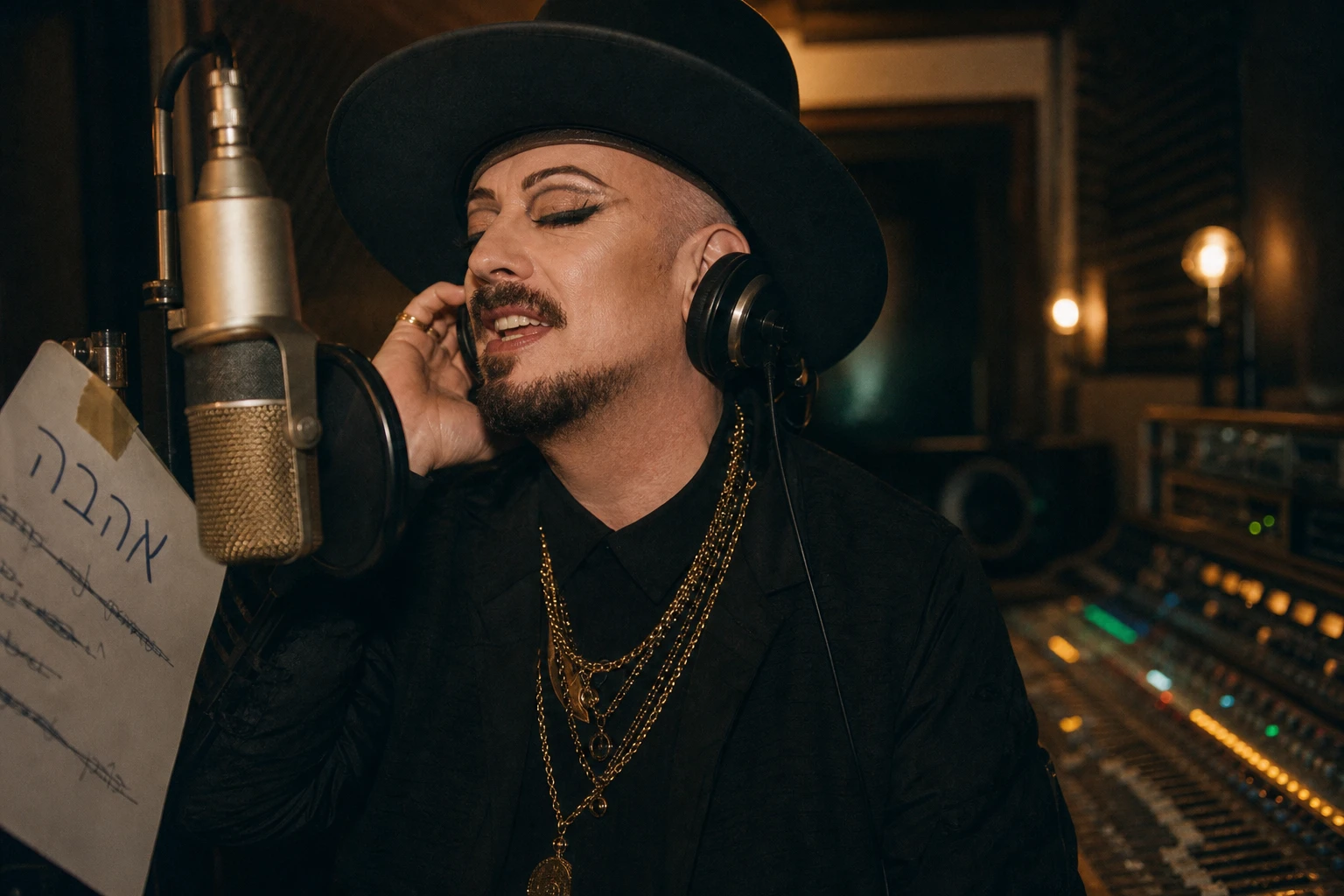
Boy George spent the spring watching Eurovision’s biggest recent names walk away from Israel. On July 26, 2026, the Culture Club frontman answered in the opposite direction, posting “We Will Dance Again,” a reggae-inflected single that opens with the line “You say genocide, I say war” and closes with its opening verse repeated in Hebrew.
He put it on Instagram and X under the hashtag “Shalom,” two months after his own run at the contest, as a backing vocalist for San Marino, ended in a semifinal exit. Where Eurovision’s most visible queer icons spent 2026 distancing themselves from Israel, its most famous one went the other way.
A Reggae Track for October 7
The song leans on the same reggae rhythm Boy George used across several Culture Club records, then drops straight into the fight. “You say genocide, I say war,” he sings in the opening line, framing Israel’s Gaza campaign as a response to Hamas’s October 7, 2023 attack rather than the term human rights groups have applied to it. NME reported that the framing runs counter to language both the United Nations and Amnesty International have used about the war.
He revisits the day itself midway through the track: “You never mention October 7, young girls raped against trees, murdered brutally for the crime of dancing.” The attack killed more than 1,200 people, about 364 of them at the Nova Music Festival, where the dancing was interrupted by rocket fire and then gunmen. Roughly 40 festivalgoers were dragged into Gaza that day; some died in captivity, others were held for more than two years.
But trust me, we will dance again, and there will be no war. But if you’re ever confused, I stand with the Jews. I don’t feel brave, I just need to behave like a human.
He also turns the song on his own industry, accusing musicians who have backed Palestinian causes of following a script: “You condemn the Jews with selective memory. Musicians holding flags, mouthing like sheep. Propaganda fueled by the internet feels so weak.” The track closes with its opening lines repeated in Hebrew.
San Marino’s Quiet Eurovision Exit
The timing traces back to Vienna. Boy George spent Eurovision 2026 as an uncredited backing vocalist on San Marino’s entry, “Superstar,” performed by Senhit, the singer who has fronted the microstate’s act before. He co-wrote the song with Anderz Wrethov, Julie Aagaard, John-Emil Johansson and Thomas Stengaard.
San Marino’s semifinal performance landed on May 12. It placed 14th and never reached the final. Boy George called the whole run fabulous even in defeat, posting that he was sad the act missed the final but proud of the experience.
Why Did Eurovision’s Stars Turn on Israel?
Israel’s participation split Eurovision 2026 months before the first semifinal. Five countries, Iceland, Ireland, the Netherlands, Slovenia and Spain, refused to compete at all, while two of the contest’s most recognized queer champions cut public ties with it over the war in Gaza, pushing the European Broadcasting Union (EBU), which runs the contest, toward reforms it had resisted.
- Ireland – the first major holdout; Euronews headlined its move “unconscionable” months ahead of the contest
- Spain and Iceland – confirmed their withdrawals in the same wave of announcements
- Slovenia – joined that same round of broadcaster pullouts
- The Netherlands – the fifth and last to confirm it would sit out, joining months later
The EBU refused to remove Israel, citing its neutrality rules. It added an expanded professional jury at the semifinal stage after broadcasters raised concerns about the previous year’s televoting results.
The One Icon Who Didn’t Look Away
Two names carried that boycott into pop culture. Nemo, the Swiss singer who won Eurovision 2024 and became the contest’s first openly non-binary champion, returned their trophy to the EBU in protest of Israel’s continued participation. Conchita Wurst, who won for Austria in 2014 and became one of Eurovision’s most recognized LGBT figures, withdrew from all involvement with the contest at the start of 2026.
Boy George, a gay icon since Culture Club’s earliest hits, chose the opposite path weeks after his own Eurovision run ended.
| Artist | Eurovision Milestone | 2026 Stance on Israel |
|---|---|---|
| Nemo | Won 2024 for Switzerland; first non-binary champion in contest history | Returned the trophy to the EBU |
| Conchita Wurst | Won 2014 for Austria | Withdrew from all Eurovision involvement |
| Boy George | Backing vocalist, San Marino’s 2026 entry “Superstar” | Released the pro-Israel single “We Will Dance Again” |
Among Eurovision’s marquee names in 2026, Boy George stands out for moving toward Israel instead of away from it.
Four Decades in Hebrew and on Tel Aviv Stages
This is not a new position for him. In the video for Culture Club’s “Do You Really Want to Hurt Me,” he wore a shirt reading “Tarbut Aguda,” Hebrew for culture association; Israeli fans embraced the gesture along with the song. He has toured Israel repeatedly, solo and with Culture Club, across four decades.
In 2020 he recorded “Rainbow in the Dark” with Israeli musician Asaf Goren, splitting the lyrics between English and Hebrew. Four years later he joined an open letter backing Israel’s Eurovision participation signed by more than 400 artists and celebrities.
Shalom, and the Backlash That Followed
The response split fast. Euronews reported Boy George facing a heated backlash it described as “nauseating.” One post on X read: “F*** off genocide apologist.”
Others treated the song as overdue solidarity. “You are a ray of light in great darkness,” Instagram user @tlvboy82 wrote. Fans shared photos from the Nova memorial site and said they hoped Boy George would perform there himself, in a country still finding its rhythm again through dance two and a half years after the attack.
A Bet at Sixty-Five
Boy George is 65, four decades into a career already built on outsider stances; Culture Club broke through in an industry uneasy with an openly gay frontman in gender-bending makeup. He has kept his position on October 7 consistent since it happened, delivered without hedging regardless of professional cost.
The song carries no label credit and no release date beyond the social media post. For now, “We Will Dance Again” exists only where he put it: on his own accounts, under a hashtag that reads Shalom.
