
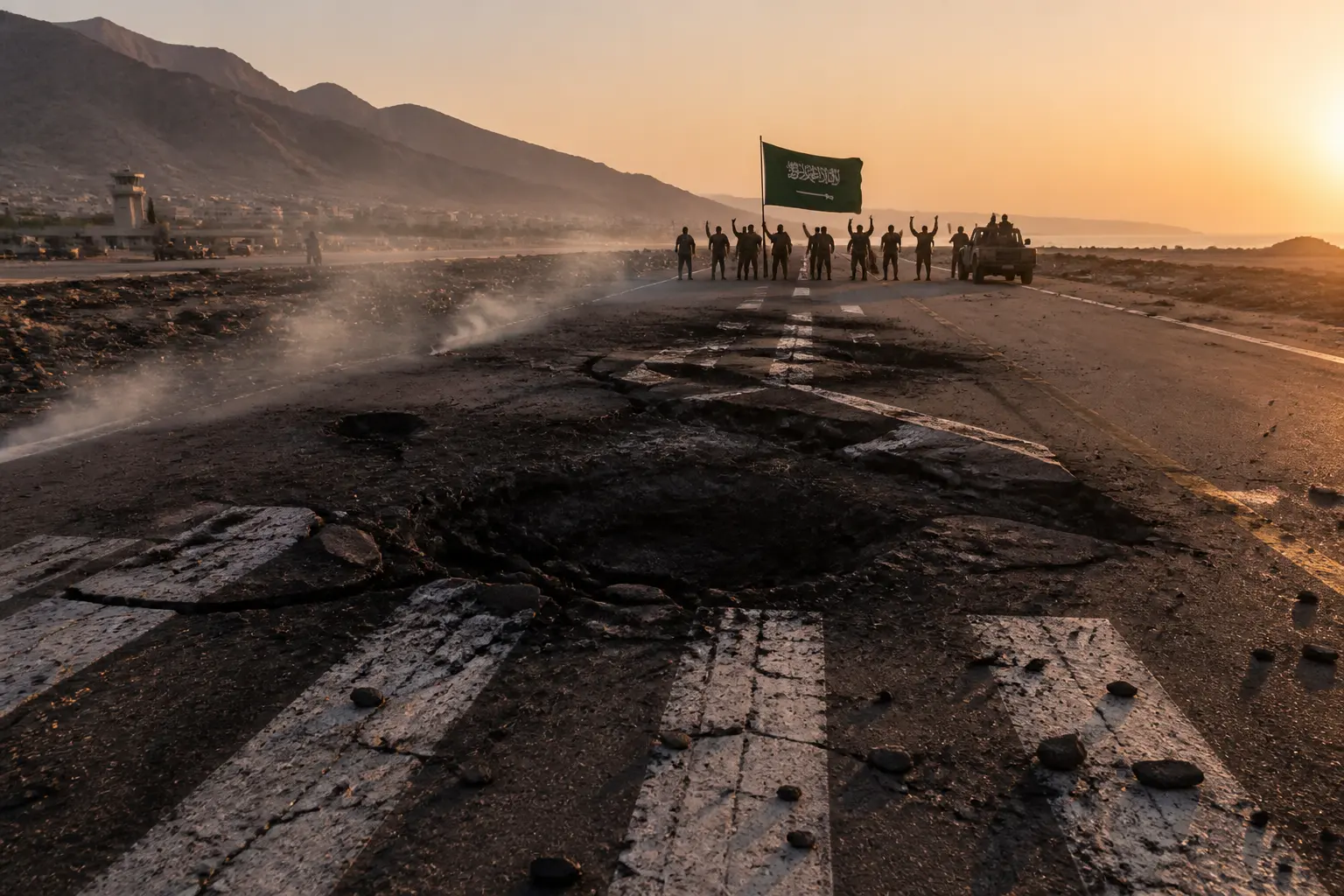
A Saudi-led airstrike disabled the runway at Sanaa International Airport on July 13, 2026, blocking an Iranian Mahan Air flight that carried a high-ranking Houthi delegation. The diversion to Hodeida, arranged through Omani mediation, did not stop the spiral. Within weeks missiles hit Abha airport in Saudi Arabia, Houthi forces declared a blockade on Saudi shipping in the Red Sea, tankers and oil facilities came under fire, and the port of Mokha suffered heavy damage.
UN Special Envoy Hans Grundberg has warned repeatedly that Yemen now faces a greater risk of renewed large-scale conflict than at any point since the April 2022 truce. The surface dispute over one landing has exposed a deeper change in how the Houthis define the fight. What began as an argument over a single aircraft now runs through airspace, sea lanes, energy sites and the front lines at once.
The Flight That Forced the Runway Strike
Direct commercial flights between Tehran and Sanaa had been frozen for more than a decade under Saudi-led coalition restrictions tied to the Yemen war. On July 3 a Mahan Air aircraft, operated by the US-sanctioned Iranian carrier, landed in Sanaa. Houthi media said it brought patients and stranded citizens; the internationally recognized Yemeni government claimed it carried Iranian military experts and prohibited materials. On the return leg it carried wounded fighters and officials headed to the funeral of Iran’s former Supreme Leader Ali Khamenei, killed in US-Israeli strikes in late February.
Houthi leaders then announced that regular Tehran-Sanaa flights would continue without outside approval. They framed the route as the end of an “air blockade.” Yemeni government and coalition officials warned against a second landing. The Houthis refused an offer to bring their delegation home on a non-Iranian airline. That refusal closed the narrowest off-ramp before the second aircraft ever approached Sanaa.
Once the runway strike forced the diversion, the dispute left the realm of flight clearances. Each side treated the episode as proof of the other’s bad faith, and the sequence that followed compressed weeks of escalation into a single chain of moves.
- July 3, 2026, First Mahan Air flight lands in Sanaa and returns to Tehran with Houthi figures.
- July 13, 2026, Second flight approaches; Saudi-backed forces strike the Sanaa runway; aircraft diverts to Hodeida under Omani facilitation.
- Hours later, Houthis fire missiles at Abha International Airport in southwestern Saudi Arabia; coalition intercepts reported.
- Mid-to-late July, Houthi announcement of Red Sea blockade on Saudi shipping; claimed strikes on tankers Encelia and Layla; attacks on oil facilities at Jizan and Yanbu.
- Late July-early August, Coalition strikes on Hodeida and Kamaran Island; Houthi missile and drone barrages on military camps; assault on Mokha port.
Yasmeen al-Eryani of the Sana’a Center for Strategic Studies described the episode as Iran activating the Yemeni front to show that pressure on Tehran produces costs for Saudi Arabia and the Gulf.
Retaliation Moves Faster Than Diplomacy
The exchange quickly left the airport. Houthi forces targeted Saudi vessels and energy infrastructure while the Saudi-led coalition hit coastal targets and reinforced front-line troops for a possible ground push. Dozens of Yemeni troops and civilians died in camp attacks, according to officials speaking to the Associated Press. Mokha’s port, held by the internationally recognized government, took severe damage.
| Date / Period | Action | Target / Result |
|---|---|---|
| July 13 | Runway strike | Sanaa airport disabled; flight to Hodeida |
| July 13 onward | Houthi missiles | Abha airport, Saudi Arabia |
| July 22 | Houthi drone/missile claims | Saudi tankers Encelia and Layla in Red Sea |
| July 26 | Houthi attacks | Oil facilities Jizan and Yanbu |
| Late July | Coalition response | Hodeida, Kamaran Island |
| Early August | Houthi assault | Mokha port damaged; 7-11 killed, 30+ wounded in related strikes |
Grundberg’s office has pressed all sides for restraint. Omani back-channel talks continue but have produced no public compromise that restores the earlier calm. On X, posts tracking the tanker fires and Mokha damage circulated widely among security accounts, underscoring how fast shipping fears returned once the airport line was crossed.
Speed itself became part of the problem. Missile claims, tanker reports and port damage arrived faster than mediators could lock in even temporary pauses. Each new strike narrowed the space in which a limited deal on flights alone might have contained the crisis.
Sovereignty Replaces Salary Talks
For years after the 2022 truce the Houthis pressed for confidence-building steps such as salary payments for civil servants in areas they control. That focus has changed. Ahmed Nagi, senior Yemen analyst at the International Crisis Group, said the group is now casting the fight as one over Yemen’s control of its airspace, ports and territorial waters.
By taking direct action to reassert this view, the Houthis have raised the political stakes and made future compromise considerably more difficult.
Nagi wrote that assessment in a July Crisis Group Q&A that detailed the broader shift in Houthi priorities. The movement presents itself, not the Aden-based government, as the defender of national sovereignty. That narrative plays well with domestic audiences facing economic hardship, yet it removes easy off-ramps.
- Earlier demands centered on economic relief and prisoner exchanges inside a frozen conflict.
- Current framing insists on unilateral flight rights and free use of Red Sea approaches.
- Public rallies in Sanaa have featured banners declaring Saudi oil facilities as targets.
- Leaders have warned that any further interference with air links will bring wider attacks on Saudi airports and shipping.
Salah Ali Salah, a Yemeni researcher, noted that a long “no war, no peace” stretch raised public expectations for better living conditions. Turning blame toward the Saudi blockade lets the Houthis convert internal frustration into external confrontation. Salary talks could be bargained item by item. Sovereignty claims over airspace and waters resist that kind of incremental deal.
Iran’s Lever and the Red Sea Chokepoint
The aircraft were Iranian. Tehran has publicly backed efforts to lift what it calls the blockade on Yemen. Iranian officials have highlighted their ambassador’s contacts in Sanaa. Analysts see a two-way dynamic: the Houthis pursue their own legitimacy goals while Iran gains a low-cost way to impose costs on Riyadh amid the wider US-Iran confrontation that followed the collapse of a fragile ceasefire.
Houthi control of long stretches of the Red Sea coast gives them reach over the Bab al-Mandab strait, a passage that funnels traffic toward the Suez Canal. Serious disruption forces ships around Africa, raising times and costs. The group had largely paused Red Sea shipping attacks during parts of 2025-early 2026; the July escalation revived them against Saudi-linked vessels. That pattern echoes earlier Houthi strikes on Saudi tankers and the period when Saudi tankers already turning back became routine.
In late July Saudi Arabia, Yemen and a dozen other states announced the Multinational Maritime Defence Alliance to protect navigation through the Red Sea, Bab al-Mandab and Gulf of Aden. The move signals that coastal states treat the threat as structural rather than temporary.
The pause of 2025 and early 2026 had shown that Houthi pressure on shipping could be dialed down when politics allowed. The July revival against Saudi-linked vessels showed the reverse: the same geography can be switched back on when the political frame shifts from salaries to sovereignty and when Tehran’s wider confrontation with the United States sharpens the incentive to impose costs on Riyadh.
Pressure Inside Houthi Areas
Areas under Houthi control have endured years of economic decline, tightened by US sanctions on the group. Food insecurity remains acute. Tribal dissatisfaction has grown. A prolonged new round of fighting could let Saudi-backed forces exploit those fractures, Nagi and other analysts have noted. At the same time, the sovereignty story helps the leadership argue that resistance, not negotiation, delivers results.
The 2022 truce had ended major cross-border attacks on Saudi Arabia and the UAE and halted large-scale fighting inside Yemen. Relative calm held even through earlier Red Sea campaigns and the wider regional war. That freeze is now fraying on multiple fronts at once: airspace, sea lanes, oil infrastructure and the internal front lines.
- Humanitarian baseline: Yemen remains one of the world’s worst crises; Houthi-held zones hold the largest share of hungry people.
- Economic lever lost: Salary and service improvements that might have eased domestic anger now sit behind harder political demands.
- Military risk raised: Reinforced Yemeni government troops along front lines increase the chance of ground combat the Houthis have avoided for years.
Domestic hardship and external confrontation now reinforce each other. Leaders can point to Saudi and coalition pressure to explain shortages. That message may steady loyalists in the short term, yet it also raises the cost of any later return to the narrower economic bargains that defined the first years after 2022.
Ground Offensive Threat and What Breaks
Yemeni officials say the coalition has reinforced troops for a possible offensive against Houthi positions. Anticipating that, the rebels have already hit camps in central and southern Yemen and the Mokha port. Any sustained ground campaign would reverse the main achievement of the 2022 arrangement: the near-end of large-scale combat that allowed limited economic activity and humanitarian access to continue.
Grundberg has engaged Yemeni parties and regional governments, including in Muscat. He has called for maximum restraint and concrete de-escalation steps. The detainee-release deal mediated earlier in 2026 has also stalled amid mutual accusations. The Security Council has extended reporting on Red Sea attacks and heard briefings that stress the danger of drawing Yemen fully into the wider regional fight.
The same period has seen wider US-Iran-Saudi military exchanges elsewhere, adding to the sense that separate files are fusing. For ordinary Yemenis the calculation is simpler. Four years of imperfect calm delivered imperfect gains. A return to full war would erase them under fresh displacement, higher prices and closed ports.
How the 2022 Gains Come Under Strain
The April 2022 truce did not settle the war, but it did freeze the most destructive patterns. Cross-border attacks on Saudi Arabia and the UAE largely stopped. Large-scale fighting inside Yemen eased. Limited economic activity and humanitarian access continued under that imperfect calm, even while earlier Red Sea campaigns and the wider regional war continued around it.
July and August tested each of those gains at once. The runway strike reopened the airspace file. The Red Sea blockade and claims against the tankers Encelia and Layla reopened the shipping file. Strikes on Jizan and Yanbu reopened the energy file. Camp attacks and the assault on Mokha reopened the internal front-line file.
| Truce-era gain | Pressure now visible |
|---|---|
| Major cross-border attacks largely stopped | Missiles toward Abha; threats to Saudi airports |
| Large-scale internal combat eased | Camp barrages; Mokha damaged; troops reinforced |
| Limited trade and aid access continued | Port damage; shipping fears; blockade claims |
| Room for economic confidence-building | Sovereignty framing replaces salary talks |
None of those pressures alone would have matched Grundberg’s warning about the highest risk since 2022. Together they explain why a quiet return to the old freeze now looks harder than a simple pause on flights would have been in early July.
Mediation Keeps Pace With Fewer Levers
Omani facilitation still moved the diverted Mahan Air flight to Hodeida. Back-channel talks continue. Grundberg’s office still presses every side for restraint and still engages parties in Muscat and beyond. Those channels have not vanished. What has changed is the list of issues they must hold at once.
- Flight rights and the Sanaa runway no longer stand alone.
- Red Sea navigation and the new Multinational Maritime Defence Alliance now sit on the same table.
- The stalled detainee-release deal from earlier in 2026 adds another unresolved track.
- Reinforced front-line troops raise the chance that talks race a ground push.
When the dispute centered on salaries and prisoner exchanges, mediators could trade concrete packages inside a frozen map. Sovereignty claims over airspace, ports and territorial waters leave fewer divisible items. Public rallies that name Saudi oil facilities as targets further shrink the political cover for incremental bargains.
The result is a mediation field that is busy and thin at the same time: active contacts, extended Security Council reporting, and no public compromise that restores the earlier calm.
The runway at Sanaa is still the scar that started the latest round. The sovereignty claim that followed is what makes a quiet return to the old freeze far harder to reach.
