
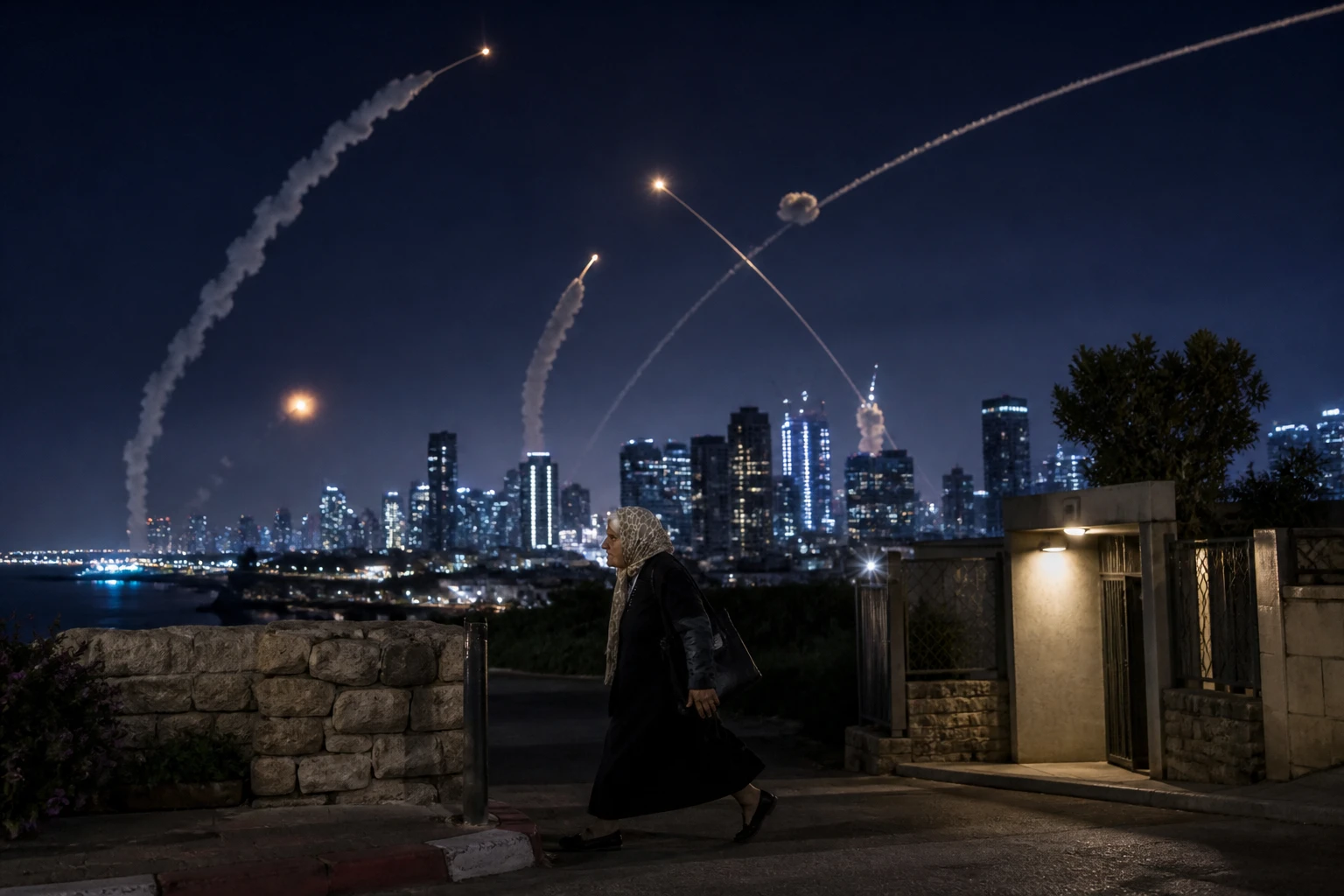
An AFP journalist heard three blasts over the Tel Aviv area on March 19, 2026, minutes after the Israeli military said it had detected missiles launched from Iran and that defensive systems were operating to intercept them.
The episode was one more night in a conflict that began February 28 when the United States and Israel launched Operation Epic Fury, killing Supreme Leader Ali Khamenei and triggering sustained Iranian retaliation. By then the pattern was already clear.
What the IDF Announced That Morning
The military’s statement was brief and familiar. “A short while ago, the Israeli army identified missiles launched from Iran toward the territory of the State of Israel. Defensive systems are operating to intercept the threat,” it said.
A short while ago, the IDF identified missiles launched from Iran toward the territory of the State of Israel. Defensive systems are operating to intercept the threat.
The IDF statement, carried by AFP and Arab News, gave no immediate casualty or damage figures for the specific salvo. Photographs released the same day showed the interior of a destroyed apartment with the Tel Aviv skyline visible beyond, attributed to an overnight Iranian missile strike. Separate reporting put the day’s total Iranian launches at 14 salvos, some directed at Jerusalem and northern Israel within a single hour. A BAZAN Group refinery in Haifa took a hit during broader fire on the area.
According to army data cited at the time, the launch toward central Israel was the sixth since midnight. The three blasts the AFP reporter heard were consistent with either interceptions high overhead or impacts and debris falling into the urban zone.
The Pattern Set on Day One
The March 19 activity followed the template established within hours of the opening US-Israeli strikes. Iran responded with ballistic missiles and drones aimed at Israel, Gulf states and American bases. Early waves killed civilians in Tel Aviv and Beit Shemesh. Subsequent days saw repeated sirens, multi-layer intercepts and occasional successful penetrations.
- 28 February 2026: Joint US-Israeli strikes kill Khamenei; Iran fires roughly 170 ballistic missiles; residential hit in Tel Aviv kills one woman and injures dozens.
- 1 March: Missile strikes Beit Shemesh residential area and synagogue shelter, killing nine civilians, the highest single toll.
- Early March: Daily salvos continue; interception rates remain high but cluster munitions begin spreading submunitions across neighborhoods.
- 19 March: Fourteen salvos recorded; three blasts heard over Tel Aviv; apartment damage photographed; Haifa refinery struck.
- Through 8 April: Cumulative 650 missile attacks from Iran on Israel before the first ceasefire window.
That sequence, drawn from contemporaneous reporting and later tallies, shows volume declining from the first-day peak yet never fully stopping. Launcher and storage strikes by the combined force degraded Iran’s output, yet enough missiles and cluster warheads remained to keep Israeli Home Front Command issuing alerts for weeks.
How the Defenses Performed Across the Waves
Israel’s multi-layer system (Arrow for long-range ballistic threats, David’s Sling for medium, Iron Dome for shorter-range and debris) intercepted the large majority of incoming missiles. Open-source and official estimates during the fighting put overall success in the mid-80s to low-90s percent range for attempted intercepts. US naval assets and partner systems added capacity on some nights.
| Metric | Figure | Period / Note |
|---|---|---|
| Missile attacks on Israel | 650 | 28 Feb to 8 April ceasefire |
| Israeli civilian deaths | 24-28 | All civilians; later updates slightly higher |
| Injuries | More than 7,000 | Includes military personnel in some counts |
| Missiles past defenses (conventional) | ~16 | Through early April window |
| Missiles past defenses (cluster) | ~50 | Majority of successful penetrations |
The numbers come from compiled tallies on the 650 missile attacks through early April and supporting contemporary accounts. High intercept rates did not prevent local damage or the psychological effect of repeated alarms. Reports of interceptor stock pressure surfaced by mid-March, with the Pentagon ordering additional munitions as inventories tightened.
Cluster Munitions Raised the Civilian Cost
Iran loaded a large share of its missiles with cluster warheads. These disperse smaller submunitions over wide areas, a method banned under the Convention on Cluster Munitions that neither Iran nor Israel has joined. Roughly 70 percent of missiles launched at Israel during peak periods carried such loads, according to Israeli assessments cited in daily updates.
- Submunitions struck construction sites, beauty salons and open streets, killing foreign workers and residents who had not reached protected rooms in time.
- On multiple nights bomblets landed in Bnei Brak, Petah Tikva, Ramat Gan and Tel Aviv neighborhoods, injuring dozens even when the main body was intercepted.
- Two of the Israeli civilian deaths occurred inside sheltered spaces; the rest were people caught outside or in less-protected structures.
- An ISW report noted Iran’s continued use of cluster loads “likely to maximize destruction and terrorize Israeli civilians,” with footage of dispersions over Haifa and central cities.
The cluster munitions and warhead details from mid-to-late March updates show warheads sometimes lighter than Iran’s typical 520-pound class, yet still effective at spreading risk. Amnesty International and arms-control groups condemned the residential targeting as indiscriminate.
Life Between the Sirens
Israeli civil defense rests on Mamad reinforced rooms built into apartments, communal shelters, and a smartphone alert system that can give several minutes of warning after launch detection. Sirens still demand movement within roughly 90 seconds in many zones. Schools and workplaces closed for stretches. Hospitals shifted operations underground. Public gatherings were canceled.
Residents described nights of continuous alerts, the sky lit by interceptor trails, and the routine of moving children into the Mamad at the first tone. Videos circulating on X showed both successful high-altitude intercepts over Tel Aviv and the rarer ground impacts or debris falls. Crowd conversation often treated every penetration as evidence that the Iron Dome had failed systemically, even while aggregate data showed most threats stopped. That gap between official tallies and lived anxiety became part of the war’s texture.
Foreign workers and West Bank communities also absorbed hits. Debris and submunitions killed Palestinians and Thai laborers on several dates. Aviation at Ben Gurion was repeatedly disrupted; passenger limits were cut after private jets were damaged on the tarmac.
The Broader Attrition Bill
By the first ceasefire window in early April the cumulative human and material cost was already substantial on both sides. Iranian casualties ran into the thousands according to multiple trackers. Gulf states recorded their own dead and injured from Iranian drones and missiles. The Strait of Hormuz saw severe shipping disruption, feeding global energy volatility.
For Israel the bill included 31 civilians killed in some overall war tallies (including later periods), thousands wounded, damaged residential blocks and industrial sites, and the steady expenditure of expensive interceptors. US support covered both offensive strikes and defensive reinforcement. The ISW analysis of strikes that day documented continued combined-force attacks on Iranian missile infrastructure and air defenses, claiming destruction of around 85 percent of Iran’s surface-to-air missiles by mid-March, yet Iranian launches persisted at reduced volume.
The same grinding logic appeared in parallel theaters. Hezbollah joined with rocket and drone fire from Lebanon, drawing Israeli ground operations south of the Litani. Those broader Middle East war strains kept multiple fronts active even as diplomacy flickered.
Why the Pattern Kept Repeating
Each new salvo, including the March 19 detection and the three blasts an AFP reporter registered over Tel Aviv, tested the same equation. Iran retained enough mobile launchers and stockpiled missiles to fire, even after heavy losses. Israel retained enough interceptors and sensors to stop most, even as stocks drew down. Civilians retained the Mamad rooms and alert apps that kept the death toll far lower than raw missile counts suggested, yet still absorbed deaths, injuries and the erosion of ordinary schedules.
Earlier debates over Iran policy, including the earlier regional debate over Iran policy, framed the choice between pressure and restraint. Once the February 28 strikes began, the operational reality became nightly arithmetic: detect, intercept, shelter, assess damage, repeat. The three blasts were neither the first nor the last entry in that ledger. They simply made the pattern audible again over the commercial capital.
By August 2026 the war had moved through ceasefire windows, Hormuz standoffs and renewed exchanges. The March nights of sirens and sky trails remained the clearest illustration of how a leadership strike and its retaliation settled into sustained attrition rather than a single decisive round.
