
Rosatom has begun returning Russian specialists to Iran’s Bushehr nuclear power plant, with five engineering staff already on site and the total now at 25. The move comes after months of US-Iran fighting that forced earlier evacuations and repeatedly brushed the facility.
CEO Alexey Likhachev said the next group of several dozen could follow within two weeks if no fresh escalation occurs, aiming for 100 project staff by autumn.
The return is staged rather than sudden. Each tranche depends on the quiet holding long enough for flights and site access to stay routine. Construction momentum and diplomatic breathing space are now tied to the same calendar.
Five Engineers and a Target of 100
Likhachev told reporters on August 9 that the first five engineering personnel already arriving had reached the residential compound and started work. That lifted the Russian contingent to 25.
He outlined a clear sequence. Rosatom wants to bring back all previously evacuated specialists as soon as possible. A return to full prewar levels, however, waits on final US-Iran agreements to end hostilities.
- Immediate: five engineers on site, total 25 Russians
- Next two weeks: several dozen more, contingent on quiet
- By autumn: 100 project staff if conditions hold
- Full prewar: only after lasting US-Iran deals
Construction of the main and auxiliary buildings for Units 2 and 3 continues. Preparatory work on hydraulic engineering facilities is also underway.
The sequence is deliberately reversible. Several dozen workers can board flights only if the next fortnight stays calm. The autumn target of 100 is a planning figure, not a guarantee. Full prewar headcount remains locked behind lasting political deals rather than a temporary pause.
Russian specialists handle specialised engineering tasks that local crews cannot fully replace. Their phased return therefore marks both a technical restart and a live test of the current diplomatic space.
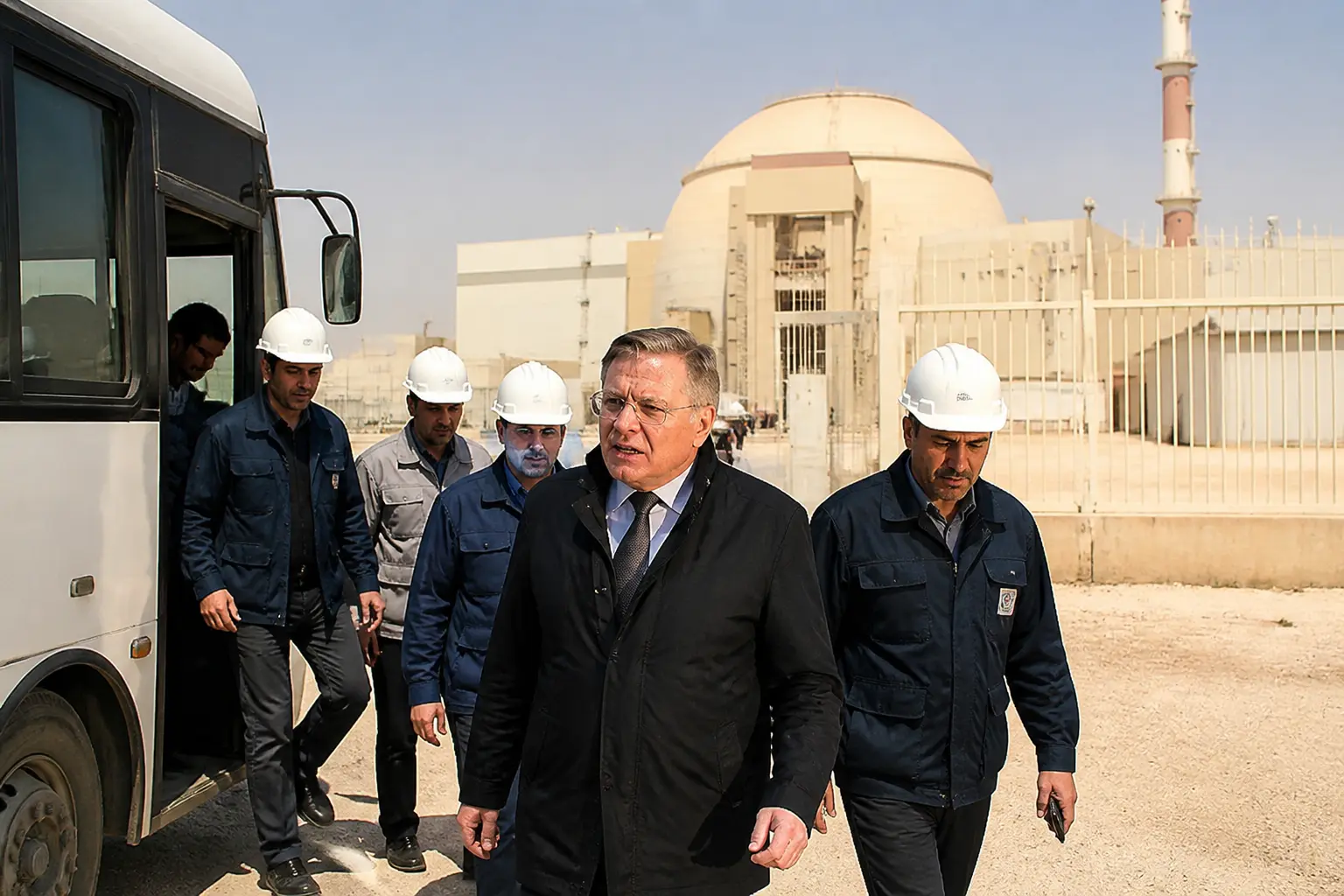
How the Fighting Reached the Gates
The broader conflict began on February 28, 2026, when the United States and Israel launched joint strikes on Iranian targets. Rosatom evacuated non-essential staff in March as fighting intensified near the Persian Gulf coast site.
Hundreds of Russians left in waves. At peak, more than 600 Russian citizens were still at the plant before larger groups exited via Armenia.
- February 28, 2026: US-Israel offensive opens
- March: Rosatom begins major evacuations; work on new units suspended
- March-April: Multiple projectiles hit premises or land as close as 75 metres from the perimeter; one security staff member killed by fragments; IAEA confirms no reactor damage and no radiation rise
- April: Cease-fire takes hold
- June: Framework deal signed
- July: Deal collapses; nearly two weeks of renewed exchanges; Trump administration halts bombardment amid fresh talks
- August 9: First returnees arrive
The IAEA repeatedly warned that military activity near an operating plant holding large amounts of nuclear fuel risked a severe radiological accident affecting Iran and beyond. Unit 1 kept running through the worst periods.
The evacuation route through Armenia showed how quickly a large expatriate workforce can be pulled out when the perimeter comes under fire. Work on the new units stopped almost at once once non-essential staff left. The later cease-fire and framework deal created the first opening for a limited reverse flow, only for the July collapse to freeze progress again until the latest halt.
Each near-miss tightened the link between battlefield events and construction schedules. Fragments that killed a guard and shattered windows proved the residential and support zones were inside the danger radius even when the reactor core itself stayed intact.
One Reactor Running, Two Rising
Bushehr sits on the Persian Gulf coast. Its first unit is a Russian-designed VVER with 915 MWe net capacity. It connected to the grid in 2011 and entered commercial operation in 2013. It has operated at full capacity even during the recent fighting.
Russia and Iran signed a 1994 agreement for the VVER-1000 reactor after the original German project stalled after the 1979 revolution and Iraq war damage. A 2014 contract added Units 2 and 3, also VVER-1000 designs.
| Unit | Status | Capacity | Notes |
|---|---|---|---|
| Unit 1 | Operating | 915 MWe | Grid 2011, commercial 2013; ran at 100% through conflict |
| Unit 2 | Under construction | ~1057 MWe | First concrete 2019; reactor earlier reported more than 60% complete; target around 2029 |
| Unit 3 | Under construction | ~1057 MWe | Equipment blanks in production; main buildings advancing |
Earlier this year Likhachev said the reactor for unit 2 more than 60 percent complete and steam generators at 50 percent, with key equipment shipping planned for the following year. Iranian contractor staff had already returned in larger numbers, reaching roughly 2,200 at one point.
Unit 1’s uninterrupted run supplied baseload power while the newer units absorbed the full impact of the staffing swings. The 1994 agreement and the later 2014 contract together turned Bushehr into a multi-decade Russian project rather than a single-reactor handover. Progress on Units 2 and 3 now hinges on whether specialised Russian teams can stay long enough to match the equipment already moving through Russian factories.
The contrast in workforce size is stark. Roughly 2,200 Iranian contractors kept site activity alive while the Russian contingent shrank and is only now climbing back from 25 toward the autumn goal of 100.
What Stays Exposed if Fighting Resumes
The site stores significant nuclear fuel. Earlier warnings noted roughly 70 tons of fresh fuel and 210 tons of spent fuel. A direct hit on the operating unit could produce a regional radiological event.
Strikes never destroyed the reactor. They did land close enough to shatter windows, scatter dust across residential areas and kill at least one guard. Operators kept volunteers on site during peak danger to maintain the running unit.
Iran’s electricity system relies on the plant for baseload power. Any prolonged outage would bite harder than a construction delay. Gulf neighbours watch the radiation risk with equal intensity.
| Material | Approximate quantity | Risk note |
|---|---|---|
| Fresh fuel | 70 tons | Stored on site for the operating unit |
| Spent fuel | 210 tons | Accumulated inventory under IAEA scrutiny |
The fuel figures explain why the IAEA warnings carried weight beyond Iran’s borders. A radiological release would not stop at the perimeter. Gulf states therefore track every projectile that lands inside or near the site with the same urgency that Iranian grid operators track Unit 1’s output.
Volunteers who stayed through the worst periods kept the operating unit stable when most expatriates had already left. That human layer remains the thinnest protection if fragments again reach the residential compound or support buildings.
Russia’s Project Bet and the Pause Test
Rosatom has treated Bushehr as a priority even while evacuating staff. Manufacturing of equipment for the new units continued inside Russia. The corporation frames the work as long-term cooperation that now includes talks on small modular reactors.
The staffing plan itself is the second-order signal. Sending dozens more workers in the next fortnight is a live wager that the current quiet will hold. If another round of US and Iran trade strikes near the Strait of Hormuz erupts, the flights reverse again.
Full prewar headcount waits on something more durable than a temporary halt. That condition links the nuclear construction schedule directly to diplomacy.
Equipment fabrication inside Russia never stopped. That continuity means the physical plant for Units 2 and 3 can still advance once the right engineers are back on site. Talks on small modular reactors extend the same long-term frame beyond the three large units already under contract.
The wager is therefore double-sided. Rosatom keeps factories busy on the assumption that diplomacy will eventually reopen the site. The workers themselves, however, move only when the immediate risk drops low enough for flights to resume.
Workers on the Ground Carry the Immediate Risk
The five engineers now at the residential compound restart tasks that sat idle for months. Iranian teams never fully left. Their numbers grew while Russians pulled back.
Any fresh escalation would hit these mixed crews first. Past near-misses showed the physical protection perimeter can be breached by fragments even when the reactor core stays intact.
The wider human toll of the conflict already includes military and civilian losses on multiple sides. Separate reporting has tracked the costs of the wider Iran conflict for US forces and others.
Mixed crews change the risk picture. Iranian contractors already number in the thousands and stayed through the evacuations. The smaller Russian group now rejoining them shares the same residential and work zones that earlier took fragment damage. A new round of strikes would therefore strike both nationalities at once.
The single security fatality from fragments remains the clearest marker of how close the fighting came. Windows and dust in living areas showed that even non-reactor buildings offered limited shelter once projectiles landed inside the wider premises.
Iranian Contractors Carry Daily Site Work
While Russian specialists return in careful stages, Iranian contractor numbers already reached roughly 2,200 at one point. Those crews kept main and auxiliary building work moving and maintained preparatory hydraulic engineering tasks after the major Russian evacuations.
The imbalance is practical. Local labour can pour concrete, advance structures and secure the site. Specialised Russian engineering and equipment installation still require the returning contingents. The autumn target of 100 Russian project staff is meant to restore that specialised layer without waiting for a full prewar headcount.
- Iranian contractors: roughly 2,200 at peak return, continuous presence
- Russian specialists now: 25 total after the first five arrivals
- Near-term Russian goal: several dozen more within two weeks if quiet holds
- Autumn Russian goal: 100 project staff
Construction of Units 2 and 3 therefore never went fully dark. It slowed on the specialised tasks and continued on the civil works that local teams could sustain. The current Russian return is an attempt to rebalance that split before the next diplomatic test arrives.
Equipment Production Keeps Moving in Russia
Manufacturing for the new units continued inside Russia even while staff left Bushehr. Reactor components for Unit 2 were earlier reported more than 60 percent complete and steam generators at 50 percent. Key equipment shipping had been planned for the following year.
That factory continuity gives Rosatom a buffer. Buildings on the Iranian coast can advance with local labour, and major components can keep moving through production lines regardless of short-term flight suspensions. The limiting factor remains the on-site engineering presence needed to install and commission what the factories deliver.
Unit 3 still sits earlier in the sequence, with equipment blanks in production and main buildings advancing. The same logic applies: hardware can progress in Russia while installation waits on stable access and the right specialists at the Gulf site.
Long-term cooperation framing, including talks on small modular reactors, rests on the same assumption. Factories and contracts outlast any single evacuation cycle, provided the political path eventually reopens for sustained staffing.
Autumn Target or Another Reversal
If the pause lasts, Rosatom expects 100 specialists by autumn and steady progress on the two new units. Equipment fabrication continues on schedule inside Russia. Unit 1 stays online.
If fighting returns, the next group of dozens stays home and the 25 already present may leave. Construction of main buildings can continue with local labour, but specialised Russian engineering work pauses again.
Likhachev left the decision explicit: the reverse flow depends on the situation between the United States and Iran. The plant that once symbolised nuclear cooperation now measures how far the latest diplomatic breathing space can stretch.
The autumn figure and the full prewar headcount therefore sit on opposite sides of the same diplomatic line. One is reachable under a lasting quiet. The other waits on final agreements that end hostilities rather than merely pause them. Until that line is crossed, every new flight of engineers remains provisional.
