
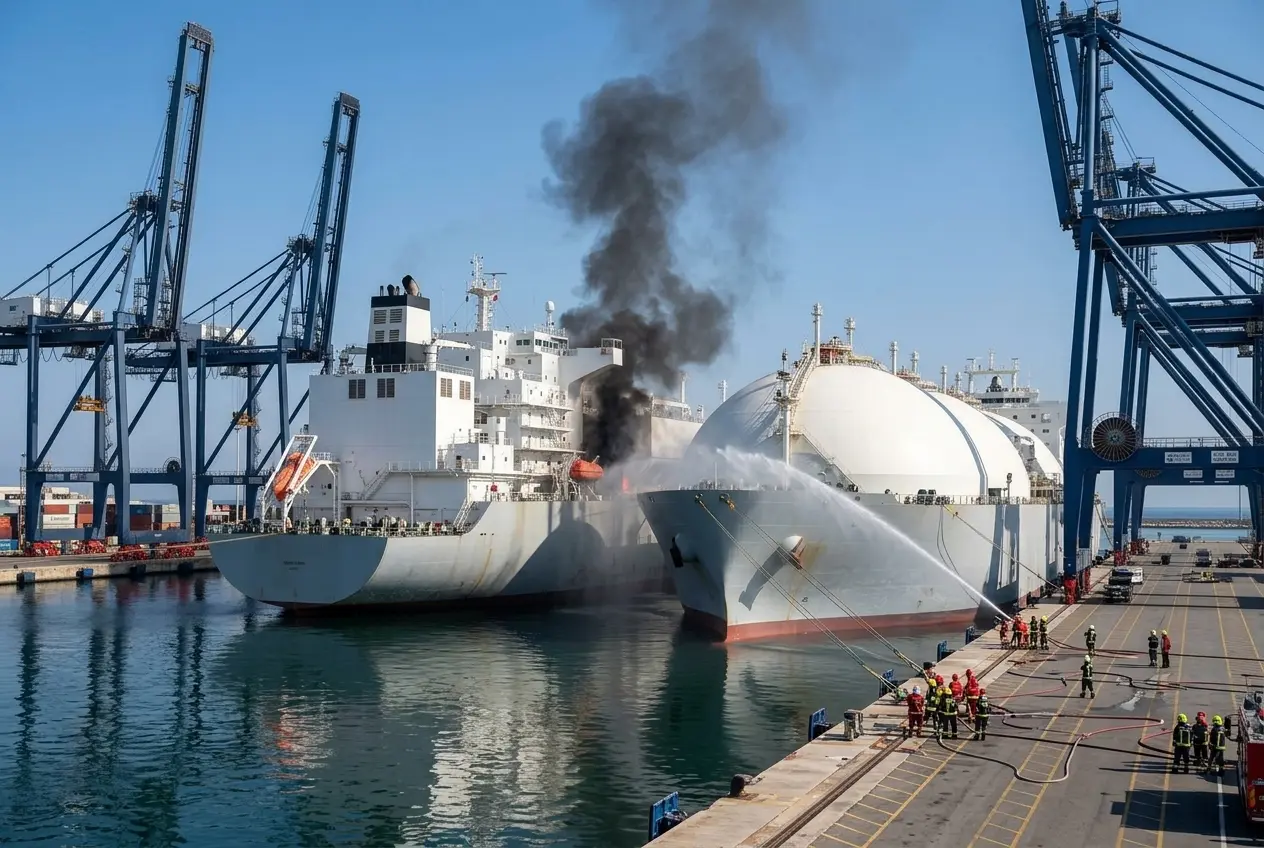
A drone struck the US-owned Energos Winter floating storage and regasification unit at Egypt’s Damietta port on the evening of 29 July 2026, sparking a fire that spread to the moored GasLog Salem LNG tanker. No one claimed the hit. Egypt confirmed the drone the next day. The first strike on Egyptian soil since the US-Iran war began now puts a price on Cairo’s neutrality and the Suez-Sumed corridor that has become the last major safe bypass for regional crude.
Fires were contained. Crews were safe. Port traffic kept moving. The second-order damage is already visible in shipping caution and diplomatic strain.
Two Gas Ships Burned at Damietta
The strike hit around 14:20 UTC on 29 July. The Marshall Islands-flagged Energos Winter, a US-managed FSRU of 277 meters, was discharging at the LNG hub when the drone struck. Fire spread to the Bermuda-flagged GasLog Salem of 285 meters alongside.
Both crews evacuated. Local teams and vessel firefighting brought the blazes under control. No injuries or fatalities were reported. Petroleum Minister Karim Badawi went to the site. The Ministry of Petroleum emergency response statement said the situation was handled under approved rapid-response plans.
- Energos Winter: US-owned and operated FSRU, 138,250 m³, IMO 9256614, managed by Energos Infrastructure
- GasLog Salem: Greek-linked LNG tanker, IMO 9638915, struck near No. 2 forward cargo tanks with a minor leak
- Distance: Damietta sits more than 1,300 km from Iran and 2,000 km from Yemen
- Outcome: Both vessels moved offshore; port remained operational
The Energos Winter FSRU 138,250 m3 capacity unit is one of several supporting Egypt’s LNG imports. Trade sources and Kpler identified the pair. Video showed smoke from adjacent berths. Windward tracking of vessels departing Damietta confirmed both left the port area northbound after the fire.
Egypt’s cabinet said on 30 July that preliminary investigations found a drone caused the blaze. Authorities continued looking for the source and said they would protect national security.
Distance Rules Out a Direct Iranian Launch
No group claimed the attack. Houthi-affiliated Saba agency called the rumors unfounded. That left analysts mapping launch options by range and politics.
- Iran itself: Unlikely for a direct flight from Iranian territory given the 1,300-plus km distance and overflight risks
- Houthis in Yemen: Denied it; their campaign has focused on Red Sea and Bab al-Mandeb shipping
- Iraq-based Iran-aligned militias: Possible, though range and coordination remain open questions
- Hezbollah in Lebanon: Closest at under 400 km; a drone could fly west over the eastern Mediterranean then turn south, avoiding Israeli and Egyptian airspace
King’s College London professor Andreas Krieg told AFP the attack may have been calibrated to damage a United States-linked asset without killing Egyptians. Cairo would not find that distinction reassuring. Royal United Services Institute analyst HA Hellyer said Iran’s regional allies could have executed it. Cairo University professor Mustapha Kamel Al-Sayyid argued Hezbollah is wiser than to pick a fight with the largest Arab military.
Iranian state television had named Damietta as a possible retaliation target two days earlier, citing a Ukraine strike on an Iranian vessel in the Caspian. That detail points some assessments toward an Iranian-directed operation separate from the Houthi Red Sea campaign.
Cairo’s Neutral Channel Takes a Hit
Egypt had stayed outside the direct firing line while energy sites across the Gulf and Red Sea took drone and missile hits. Cairo kept phone lines open with both Tehran and Washington. It helped secure a ceasefire earlier in the year and acted as one of the few remaining diplomatic bridges.
I would not automatically interpret this as an attack on Egypt itself. The purpose was to show that United States assets are vulnerable beyond the Gulf. For Egypt, this is a warning that neutrality does not guarantee immunity.
Andreas Krieg said that to AFP. Hellyer warned that an attack by any Iranian-aligned group on Egyptian territory would count as a formidable escalation. Cairo and others would not forget it in the medium to long term. Al-Sayyid noted Egypt remains the only major regional power still holding a near-neutral stance, and that only Israel benefits if Cairo hardens.
The strike arrived as the United States and Iran returned to open hostilities after a brief lull. Dragging Egypt off the sidelines would close one of the last quiet channels. That is the second-order cost: not the fire on two ships, but the narrowing of space for de-escalation.
Egypt has walked this line before. Egypt’s earlier support for Kuwait against Iran already carried diplomatic price tags. Neutrality was always conditional. Damietta makes the condition clearer.
Sumed Loadings Climb as Tankers Cluster
Egyptian ports have absorbed substantial rerouted Gulf trade this year. Shipping companies avoided the Strait of Hormuz and, more recently, parts of the Red Sea under Houthi pressure. The Suez Canal and the Sumed pipeline that crosses Egypt from the Red Sea to the Mediterranean became the expensive but safer path for crude.
That path depends on Egyptian lanes and the Mediterranean gateway remaining quiet.
| Metric | Earlier baseline | Recent reading |
|---|---|---|
| Sumed crude loadings | 19.52 million barrels in April | 28.79 million barrels in July |
| Port Said anchorage cluster | Around 20 ships earlier in the week | Around 30 ships on Thursday after the strike |
| Yanbu southbound share | 81% in June | Around 43% more recently |
| Sidi Kerir weekly liftings | Historical peak 2.1 million bpd | 1.4 million bpd last week (Sumed capacity 2.5 million bpd) |
George Morris of Vortexa told AFP he expects some vessel owners to adopt a wait-and-see approach while they assess risks around Suez’s northern gateway. Market behavior will turn on whether the attack looks isolated or the start of broader escalation. Kpler data showed a clear rise in crude and condensate tankers heading north after Red Sea loadings. MarineTraffic confirmed the Port Said cluster.
VLCCs cannot transit Suez fully laden. They must lighten via Sumed then reload on the Mediterranean side. That friction already raises costs. Higher war-risk premiums would compound it. Analysts noted the market had not yet priced full canal disruption, and oil prices eased on other news. Still, insurers watch the zone closely.
Similar drone risks to regional pipelines have already forced reroutes and contingency planning across the Gulf. Damietta extends that logic to the Mediterranean end of the Egyptian system.
The Mediterranean Message Reaches Past the Gulf
The port strike is the furthest afield from the Gulf since the war began. It crossed the Red Sea into the Mediterranean. Energy facilities elsewhere had been hit for months. Egypt had been spared.
Krieg framed the goal as demonstrating US-linked assets remain exposed beyond the traditional theater. Hellyer called an Iranian strategy of this kind high-risk with long downsides for Tehran’s security relationships. President Donald Trump, asked about the incident, said he had been briefed and described it as “a little more of the same.”
Egypt put out repeated statements that marine traffic was flowing normally and Damietta stayed open. The government treats the Suez Canal as a crucial foreign-currency earner. Any sustained perception of risk at the northern gateway would hit revenues already under pressure from earlier Red Sea disruptions.
On social media, regional voices quickly linked the strike to canal security and broader escalation fears. Some noted Egypt’s backup fuel stocks and multiple FSRUs as buffers for power generation. The dominant thread was simple: the last quiet corridor no longer feels quiet.
What the Corridor Now Carries
Hardly any tankers move through Hormuz. Houthi threats have cut Bab al-Mandeb volumes. Chinese vessels have negotiated safer passage in some cases. Saudi crude has shifted north toward Yanbu, Suez and Sumed. Up to five million barrels per day of supply that once bypassed Hormuz now depends on this longer, more expensive Egyptian route holding.
What We Know
- Drone strike confirmed by Egyptian cabinet on 30 July; fires on Energos Winter and GasLog Salem extinguished with no casualties
- Both vessels departed Damietta; port and canal traffic continued
- Sumed July loadings rose sharply; Port Said anchorage saw more ships clustering
- No claim of responsibility; Houthis denied involvement
What’s Unconfirmed
- Exact launch point and operator
- Whether the strike was a one-off demonstration or the opening of a Mediterranean front
- How quickly war-risk insurance rates for the Suez approaches will reprice
Egypt’s near-neutral stance gave it unique room to talk to both sides. That room just got smaller. The Suez-Sumed system still functions. Vessel owners are already pausing to reassess. The fires at Damietta were put out in hours. The premium attached to the last reliable bypass will last longer.
