
Egypt’s apparel exporters shipped $1.775bn worth of clothing in the first half of 2026, a 15% jump from the $1.548bn logged a year earlier, according to the Apparel Export Council (AEC), the industry body that tracks the sector’s trade performance. June alone brought in $355m, up 47% from June 2025 and the strongest single month of the year so far.
The council credits product quality, reliable delivery and, increasingly, a push to source materials at home. That last phrase, buried in the AEC’s own language about \u201cindustrial integration,\u201d points to a government mandate reshaping who actually supplies Egypt’s garment machines, and a wave of foreign-backed factories that opened in 2025 and are only now showing up in the export data.
Europe and the US Power a Record Half
Europe and the United States absorbed the overwhelming majority of Egypt’s apparel shipments in the first half. Exports to Europe rose 25% to $767m, up from $615m in H1 2025. Sales to the US climbed 13% to $693m, up from $616m. Combined, the two markets took in roughly 82% of everything Egypt’s garment sector shipped abroad.
| Market | H1 2026 | H1 2025 | Year-on-Year Change |
|---|---|---|---|
| Europe | $767m | $615m | +25% |
| United States | $693m | $616m | +13% |
| Total apparel exports | $1.775bn | $1.548bn | +15% |
June’s $355m take was itself worth one dollar in every five earned across the whole half. AEC chairperson Fadel Marzouk said the growth reflects the sector’s resilience against a backdrop of global trade disruption, pointing to buyers’ rising confidence in Egyptian factories’ ability to hold quality and meet deadlines even as demand wobbled elsewhere. Egypt’s garment exports had already climbed 15% to roughly $1.15bn over the first four months of the year, so the pace held steady before June’s spike pushed the half-year figure higher still.
The Local-Content Rule Behind the Language
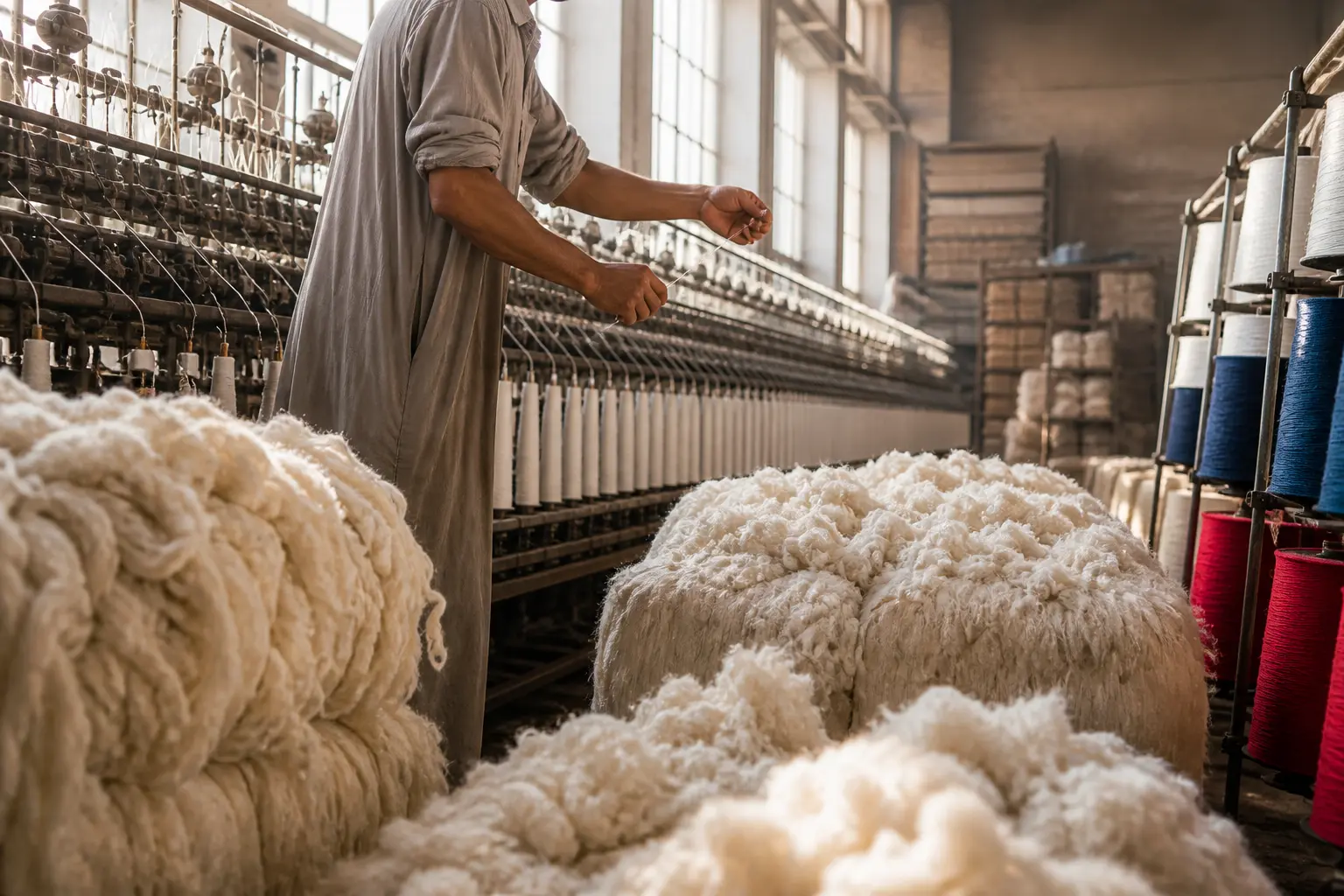
Egypt’s government has spent the past year rewriting the rules for anyone who wants to open a new garment factory. Egypt’s Industrial Development Authority now requires investors applying for ready-made-garment licenses to build in spinning and weaving capacity rather than simply cutting and sewing imported fabric, a shift first reported in December 2025 and echoed in the AEC’s own description of a sector \u201cstrengthening industrial integration.\u201d
- Local input floor – new factories must source at least 50% of production inputs domestically before they can operate.
- Vertical integration requirement – garment licenses now come bundled with obligations to add spinning, weaving, dyeing or finishing capacity.
- Cotton expansion – Egypt is growing more short-staple cotton domestically to cut reliance on imported fiber.
Cotton already accounts for about 75% of the natural fiber Egyptian mills use, and the country runs, per the largest, most integrated textile clusters in Africa, spanning cotton fields, spinning mills and finished garments under one roof. Egypt’s own government has laid out a national strategy for deepening every stage of that textile chain, from ginning through finishing, betting that less imported fabric means more of each export dollar stays inside the country.
Chinese and Turkish Capital Built the New Lines
The AEC’s July statement leans hard on words like coordination and integration. Its own chairperson told a different story earlier this year. In a forecast reported by Ecofin Agency in February, Marzouk linked Egypt’s 2026 export outlook directly to new industrial projects launched in 2025 by Chinese and Turkish investors, aimed at expanding production capacity rather than simply filling existing lines.
That timing lines up with a broader reshuffling in global apparel sourcing. A Supreme Court ruling in February struck down the legal basis for a set of US reciprocal tariffs, dropping duty rates on Vietnamese and Bangladeshi apparel from roughly 46% and 37% down toward 10%, while Chinese-origin clothing kept facing an effective rate near 34%. Bangladesh overtook China as a top US apparel supplier within weeks of the ruling. Manufacturers with Chinese ownership have strong incentive to build capacity outside China itself, and Egypt, with its own trade access into Europe and the US, is one of the places absorbing that capital.
Small Exporters Carry the Adjustment Cost
Vertical integration is expensive. A factory built from scratch with its own spinning and weaving lines, often backed by foreign capital from the start, can absorb the 50% local-input rule far more easily than an established Egyptian cutter-and-sewer that historically imported finished fabric and now has to find, or build, a domestic supplier.
The AEC seems aware of the gap. Marzouk said the council is running a strategy specifically aimed at expanding the export capabilities of small and medium-sized enterprises, alongside its efforts to diversify markets and raise the value added per garment. That a dedicated SME track exists at all suggests the council does not expect smaller firms to adjust to the new rules on their own. The strain shows up elsewhere in Egypt’s economy too, where private-sector business activity has kept contracting even as headline GDP growth holds up, a split between big-number growth and small-firm pressure that mirrors what is happening inside the garment trade specifically.
What Egypt Confirms and What It Does Not
- What we know: H1 2026 apparel exports hit $1.775bn, Europe and the US drove most of the gain, June alone brought in $355m, and new factory licenses now require local spinning and weaving capacity.
- What is unconfirmed: the exact share of new 2026 export capacity owned by foreign versus Egyptian investors, how much of the local-input mandate is already being enforced against existing factories rather than just new licenses, and whether June’s outsized jump reflects a genuine demand shift or one-off order timing.
Egypt’s own citrus exporters, by contrast, ran into real trouble from the same regional shipping disruptions Marzouk referenced only in passing. Red Sea disruptions squeezing Egyptian citrus shipments, tracked by the US Department of Agriculture’s Foreign Agricultural Service, show that not every Egyptian export sector weathered 2026’s shipping chaos as cleanly as apparel did.
The Path to a $4 Billion Finish Line
Marzouk wants full-year apparel exports above $3.5bn, with $4bn as the stated target for 2026, building on the first-half pace. That is a more conservative number than the $4.4bn some trade press floated back in February, when the new Chinese and Turkish-backed lines were framed as adding roughly 22% onto a 2025 total pegged near $3.6bn. The gap between the two figures is a matter of timing more than contradiction: the July target is the council’s own mid-year read, months after the more bullish early forecast.
Hitting $4bn would mean the second half needs to outpace the first, not just match it. Regional peers are moving on similar timelines. Jordan’s chamber-certified exports, for comparison, reached JD 768 million in the same first half of 2026, up 25.2%, a reminder that Egypt is not the only economy in the region posting double-digit export gains this year. Egypt’s own longer-range ambition reaches further still: government planning documents point toward roughly $12bn in combined textile and garment exports by 2031, which would mean tripling the sector within five years of its 2025 base.
Frequently Asked Questions
How does Egypt’s apparel export growth compare with Bangladesh and Vietnam?
Bangladesh briefly overtook China as a top US apparel supplier in early 2026 after a Supreme Court ruling cut Vietnamese and Bangladeshi tariff rates from the mid-40s and high-30s percent down near 10%, while Chinese-origin apparel kept facing an effective rate around 34%, a gap Egypt’s own exporters do not face in the same way since their competitiveness so far has been credited to product quality and delivery rather than a tariff arbitrage.
Why did Egypt’s apparel exports jump 47% in June 2026?
The AEC has not detailed a specific cause for June’s spike beyond citing overall demand and exporters’ delivery reliability. What is clear is scale: June’s $355m was the largest monthly total Egypt’s apparel sector had posted in 2026, arriving after four months of steady 15% annual growth.
What is Egypt’s long-term target for its textile and garment industry?
Government planning documents cited by Egyptian trade press point to roughly $12bn in combined textile and garment exports by 2031, an ambition officials have described as tripling the sector’s export base within five years, well beyond the $4bn single-year target Marzouk set for 2026 alone.
How much of Egypt’s cotton supply still comes from imports?
Cotton makes up about 75% of the natural fiber Egyptian mills use, and the government is expanding domestic short-staple cotton cultivation specifically to cut import dependence, a shift officials estimate could save the country roughly $2bn a year in fiber imports once fully scaled.
The AEC’s own target puts the next test on the calendar: whether the back half of 2026 can outrun the first, and whether the factories doing the outrunning are the small Egyptian exporters the council says it is trying to protect, or the newer, foreign-backed lines that got there first.
