
Riyadh’s driverless metro has carried roughly 190 million passengers since its first trains rolled out in December 2024, a real number that still lands far short of the capacity Saudi officials promised when construction began twelve years earlier. The $22.5 billion system opened five years behind its original schedule, after a corruption scandal, contractor payment disputes and a pandemic that stranded workers abroad.
None of that erases the scale of what got built: 176 kilometres of automated track, 85 stations, six colour coded lines. But the same slippage that stretched the metro’s construction into a twelve year saga is already showing up in the two rail projects lined up behind it, the King Abdullah Financial District (KAFD) Monorail and the Qiddiya High Speed Rail.
The Ridership Riyadh’s Metro Still Hasn’t Reached
Every retrospective on the Riyadh Metro repeats the same superlative: the longest fully automated driverless network in the world. Fewer mention what it was actually built to carry, or how far current traffic sits from that number.
Bechtel, the American engineering firm that led construction of two of the six lines, states on its own project page detailing planned daily ridership that the system was designed to initially serve 1.2 million passengers a day, scaling toward a maximum of 3.6 million once ridership matures. The numbers reported by Parsons, the lead delivery consultant on the programme, put the system well below that early target so far.
- 3.6 million: the daily passenger capacity the network was engineered to reach at full maturity.
- 1.2 million: the daily ridership Bechtel said the system was designed to serve at initial opening.
- 189.5 million: cumulative metro rides logged between December 1, 2024 and Parsons’ latest published count.
- $22.5 billion to $25 billion: the spread between the original 2013 construction contract value and the total cost Royal Commission for Riyadh City (RCRC) chief executive Ibrahim Al-Sultan has since cited publicly.
Averaged across roughly sixteen months of operation, 189.5 million metro rides work out to well under 400,000 boardings a day, a fraction of even the initial 1.2 million target and a tenth of the eventual 3.6 million ceiling. Al-Sultan has defended the price tag, telling Saudi broadcaster Rotana TV that the cost per kilometre, around $166 million, ranks among the lowest for a project of this size anywhere in the world.
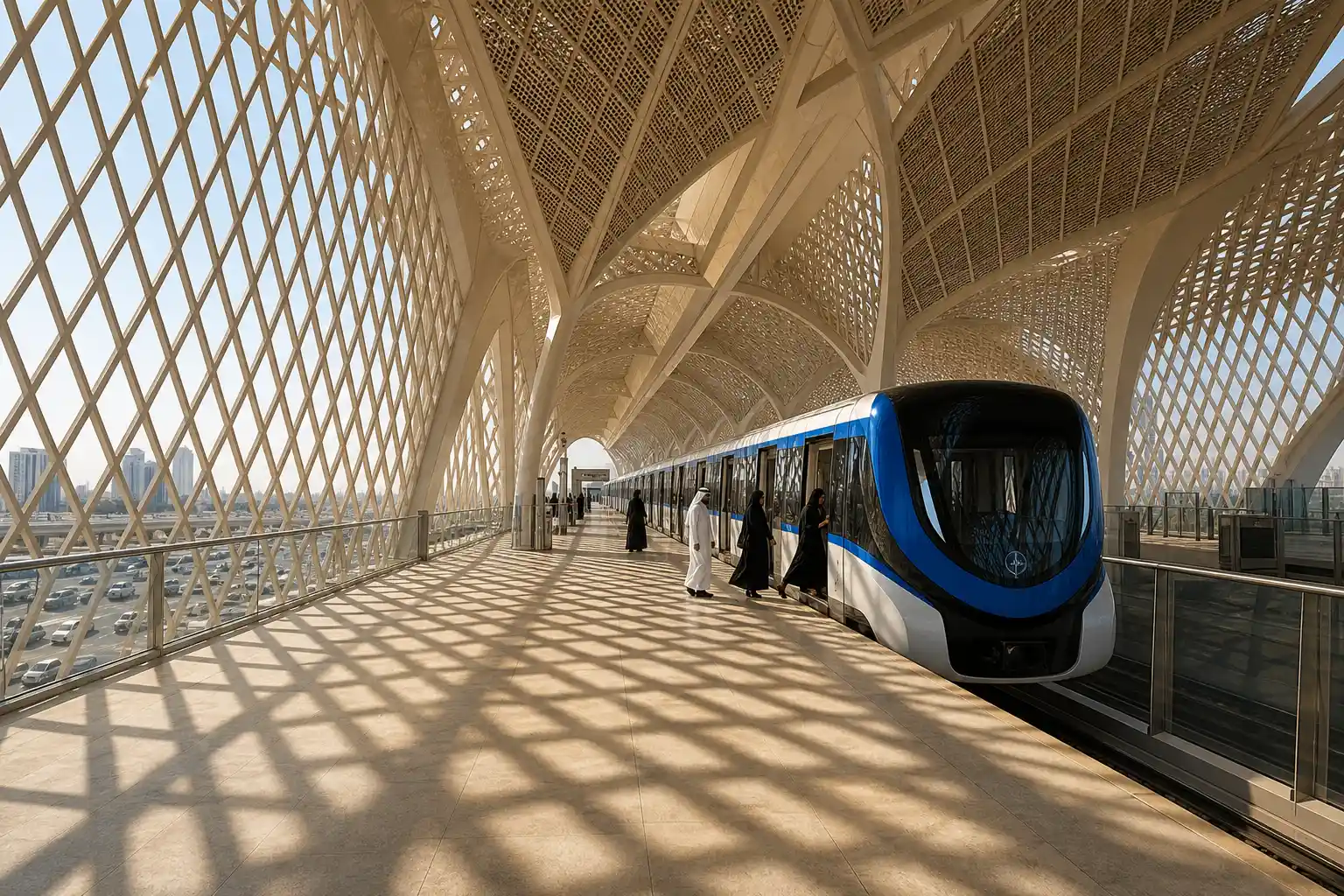
A Governor’s Arrest and a Five-Year Wait
The gap between promise and ridership traces back to how badly the original timeline slipped. Contracts were signed in 2013 with construction expected to take four years. Financing strain across Saudi Arabia’s giga project pipeline was still years away from becoming a public concern when work began, yet the metro’s own budget and calendar had already started drifting by the time crews broke ground.
By 2019, a senior Riyadh Development Authority official was still insisting the programme was on track. “The project is being delivered without major delays or budget overruns,” Alwalid Alekrish, the authority’s deputy chief executive for programmes and projects, told International Railway Journal that year, predicting a full launch by the end of 2020.
- 2013: Three international consortia sign $22.5 billion in contracts; construction is expected to take four years.
- 2014: Groundbreaking is held in April.
- 2017: Riyadh governor Prince Turki bin Abdullah is arrested in a nationwide anti corruption sweep, accused among other things of steering metro contracts toward companies he controlled.
- 2019: Officials publicly deny major delays and target a 2020 opening; unpaid contractor bills escalate into a diplomatic dispute involving the American, French and Spanish embassies.
- 2020 to 2021: The COVID-19 pandemic halts sites and strands construction workers abroad.
- November 2024 to January 2025: King Salman inaugurates the network and all six lines open in stages, five years later than first promised.
Saudi officials have not disputed that the pandemic and contractor disputes cost real time. What is less often repeated is that the same institutional strain, corruption risk on a single mega contract, foreign contractors waiting on payment, supply chains outside Saudi control, is structural to how the kingdom builds these systems, not a one off.
The Monorail That Already Failed Once
The KAFD Monorail is often described as Riyadh’s next mobility milestone. It is really that project’s second life. An earlier version of the same internal loop was studied for roughly a decade before being shelved in 2016, with the whole effort stopped and the contract void.
Planning quietly resumed in 2022, and the project was formally relaunched on October 30, 2024, when KAFD’s development company confirmed the reactivation of its transit system with a consortium of CRRC Hong Kong, CRRC Nanjing Puzhen and Hassan Allam Construction Saudi. The new design is modest next to the metro: a 3.6 kilometre elevated loop, six stations, six two car driverless trains, built to move up to 3,500 riders an hour.
Construction is expected to start in late 2025, with safety testing not beginning until 2027. That already runs a year past a target KAFD’s own chief executive floated when the relaunch was fresh. Even a small, single district monorail, it turns out, is following the same rhythm as its 176 kilometre sibling: announce, stall, relaunch, slip again.
Who Is Bidding on a Railway That Isn’t Built Yet
More than 140 companies have lined up to build a high speed line that has no construction date, no disclosed budget and no confirmed route length. The Qiddiya High Speed Rail would link King Salman International Airport, the King Abdullah Financial District and Qiddiya City at up to 250 kilometres an hour, cutting what is currently a lengthy drive to a 30 minute ride.
The Royal Commission for Riyadh City opened an expression of interest window in September 2025 for the project under a public private partnership model, alongside the Qiddiya Investment Company and the National Center for Privatization and PPP. Interested bidders can review the full list of firms that submitted expressions of interest on the commission’s own site.
What we know:
- 145 firms across contracting, design, investment, rail operations and rolling stock submitted interest by the October 2025 deadline.
- Prequalification packages for both construction and the PPP financing structure were submitted between mid and late April 2026.
- Joint ventures involving Hyundai, Alstom, Renfe, China State Construction and several Saudi contractors have already formed to chase the contract.
What’s unconfirmed:
- The formal construction tender, once expected earlier this year, is now understood to float around September 2026.
- No total project cost, financing structure or full route mileage has been made public.
The Royal Commission’s own announcement framed the project as a 30 minute connector between the airport, the financial district and the entertainment city. Qiddiya’s broader transport plan is already filling in around the future rail line: a separate contract handed to bus operations linking Qiddiya to surrounding districts is meant to cover the years before any train arrives.
Four Rail Systems, One Fifteen-Year Bet
Strip away the press release language and Riyadh is really running four separate bets on rail technology at once, each at a different stage of maturity.
| System | Status | Scale | Cost or Capacity |
|---|---|---|---|
| PNU Driverless Metro | Operating since August 2012 | 11.5 km, 14 stations, 22 trains | 60,000 riders a day design target |
| Riyadh Metro | Fully operating since January 2025 | 176 km, 85 stations, six lines | $22.5 billion; 189.5 million rides logged since opening |
| KAFD Monorail | Under construction, relaunched October 2024 | 3.6 km loop, 6 stations, 6 trains | 3,500 riders an hour; testing set for 2027 |
| Qiddiya High Speed Rail | In procurement, tender expected September 2026 | 5 planned stations, 250 km/h | 30 minute end to end trip once built |
Riyadh already runs a campus scale automated people mover and a citywide driverless metro. Once the monorail and high speed line clear procurement, the capital would join a very short list of metropolitan areas, alongside Tokyo, Osaka and Nagoya, operating all four rail formats within one urban region. That milestone still depends on two projects that have each already missed at least one internal deadline.
The Wins Riyadh’s Commuters Already Have
None of the delay history changes what the metro has already done for people using it. The New Arab collected rider accounts on opening day describing commutes to the financial district cut roughly in half once the metro replaced the drive.
Planning estimates tied to the project put the effect at scale: roughly 250,000 fewer car trips a day and about 400,000 fewer litres of petrol burned daily once ridership matures, alongside a projected rise in public transport’s share of trips from 2 percent to 18 percent by 2030. Parsons’ own tally of combined metro and bus ridership already stands at 315.6 million trips, including 126.1 million bus rides logged since March 2025 on routes feeding the rail network.
The system has not run without incident. A tampered emergency switch halted the Blue Line six days after its opening in December 2024, and a technical fault forced the closure of five eastern Red Line stations in November 2025, both handled with replacement shuttle buses. The Saudi Press Agency’s own account of the phased launch shows a network still being proven line by line, even as it carries hundreds of thousands of riders daily.
The next test of whether this pattern holds arrives with the Qiddiya High Speed Rail tender, whenever it actually floats.
Frequently Asked Questions
How much did the Riyadh Metro cost per kilometre?
RCRC chief executive Ibrahim Al-Sultan has put the figure at around $166 million per kilometre, a number he has said compares favourably to similar rail megaprojects built elsewhere in the world.
How many people ride Riyadh’s buses versus its metro?
Parsons’ published tally counts 189.5 million metro rides since December 2024 alongside 126.1 million bus rides since March 2025, for a combined 315.6 million trips across the integrated network.
Will the Qiddiya High Speed Rail be built in one phase?
No. The first phase connects Qiddiya City with the King Abdullah Financial District and King Khalid International Airport. A second phase would extend the line toward New Murabba, King Salman Park and Riyadh’s southern Industrial City.
What happened to the original KAFD monorail plan?
An earlier version had progressed far enough that Bombardier unveiled a monorail vehicle for it at the InnoTrans exhibition in 2014, only for the entire project to be shelved in 2016 after roughly a decade of studies. Planning did not restart until 2022.
Has the Riyadh Metro had service disruptions since it opened?
Yes. A tampered emergency switch stopped Blue Line trains six days after launch in December 2024, and a technical fault shut five eastern Red Line stations in November 2025. Both incidents were managed with temporary shuttle buses.
