
Iran accused the United States of bombing its unfinished Darkhovin nuclear plant in the country’s southwest before dawn on Sunday. Hours later, Jordan’s government contradicted the U.S. Embassy in Amman over whether Iranian missiles had forced the evacuation of Aqaba, the kingdom’s only port and airport.
Jordan is not a combatant in the war between Washington and Tehran. Iranian missiles have still hit its territory, and American troops have died on its soil this week. Now its only gateway to the sea sits at the center of a dispute over whether the war has already arrived.
Projectiles Hit an Unfinished Reactor Before Dawn
Iran’s Atomic Energy Organization (AEOI) said Sunday that U.S. forces struck the Darkhovin nuclear power plant at about 3:39 a.m. local time. The site, also known locally as Karun, lies on the Karun River in Khuzestan province, roughly 70 kilometers south of the city of Ahvaz and about 100 kilometers north of the Persian Gulf.
U.S. forces, “in an aggressive and brutal act contrary to international law, attacked the under-construction Darkhovin nuclear power plant… with a number of projectiles on Sunday,” the AEOI said. The statement was carried by Iranian state television.
Construction on the current reactor began in 2022. The AEOI called the site one of the symbols of Iran’s scientific self-sufficiency and said it sat under International Atomic Energy Agency safeguards, describing the strike as a violation of international law. It did not disclose the extent of any damage.
The International Atomic Energy Agency (IAEA), the United Nations’ nuclear watchdog, said later Sunday it was investigating reports of the strike. The facility was in the very early stages of construction and held no nuclear material when it was last inspected, the agency said. That detail rules out any radioactive release, unlike an attack on a fueled, operating reactor.
American officials had not confirmed carrying out the strike by Sunday night, a report from RedState said. The type of projectiles used remained unclear.
Eight Days Back to War
Sunday was the eighth consecutive day of U.S. strikes on Iran, part of a war that briefly seemed settled a month earlier. The current round traces back to a ceasefire that could not hold.
A surprise U.S.-Israeli attack opened the war on Feb. 28. Iran’s Supreme Leader, Ayatollah Ali Khamenei, was killed in strikes on Tehran in the war’s opening days. A preliminary deal to end the fighting, signed by President Trump and Iran’s president, Masoud Pezeshkian, in mid-June, unraveled within weeks.
- Feb. 28: A surprise U.S.-Israeli attack opens the war and Iran largely shuts down the Strait of Hormuz.
- Mid-June: Trump and Pezeshkian sign a preliminary deal to end the fighting and reopen the strait.
- June 25: An Iranian drone hits a cargo ship in the strait, breaking the calm a week after the deal.
- July 7: The interim truce collapses after Iran strikes three merchant ships; the U.S. hits multiple sites in Iran.
- July 11: Iran fires at Jordan, Qatar, Kuwait and Oman after a fresh round of U.S. strikes.
- July 18: Two U.S. service members are killed in Jordan and a third goes missing.
- July 19: The U.S. hits the Darkhovin site, and Jordan clashes publicly with its own ally over Aqaba.
The strait carries a fifth of the world’s traded oil and natural gas in peacetime. Trump was meeting NATO leaders in Turkey around the time the truce broke down. He ordered a fresh round of strikes and revoked the license that had allowed Iran to sell oil on the world market.
Iran’s parliament speaker, Mohammad Bagher Qalibaf, wrote that “the era of bullying and extortion is over” and that the country would not fold. Iran said Friday that U.S. strikes had killed at least 46 people and wounded more than 400 since hostilities resumed, a toll Washington has not confirmed.
Amman Contradicts Its Own Ally over Aqaba
Nowhere did Sunday’s confusion land harder than in Aqaba, Jordan’s only coastal city. The U.S. Embassy in Amman posted a security alert saying Jordanian authorities had evacuated Aqaba’s international airport and seaport because of a “specific and credible threat.” It urged Americans to avoid both sites and to keep following Jordanian security directives.
Jordan’s government said that never happened.
- U.S. Embassy in Amman: says Jordanian authorities evacuated Aqaba’s airport and seaport over a “specific and credible threat” and told Americans to stay away from both.
- Jordan’s government spokesperson Mohammad al-Momani: says no evacuation was ordered, no threats were detected, and both facilities are operating normally.
- Sources cited by Al-Mamlaka TV: told the Jordanian broadcaster that reports the airport or seaport had closed were false.
Al-Momani put it plainly to reporters.
Authorities have not issued any decisions to evacuate Aqaba Airport or the seaport, and both are operating normally.
Al-Momani, Jordan’s government spokesperson, told AFP, adding that no potential threats had been detected by Jordanian authorities in the preceding hours.
The dispute broke out hours after air raid sirens sounded across Jordan following Iranian missile fire aimed at the kingdom. Jordanian air defenses intercepted three of four missiles; the fourth landed in a remote southern area with no casualties or damage, a Jordanian military source said. Aqaba lies directly across the water from Eilat, Israel’s own Red Sea port.
Why Does Jordan Depend So Much on One Port?
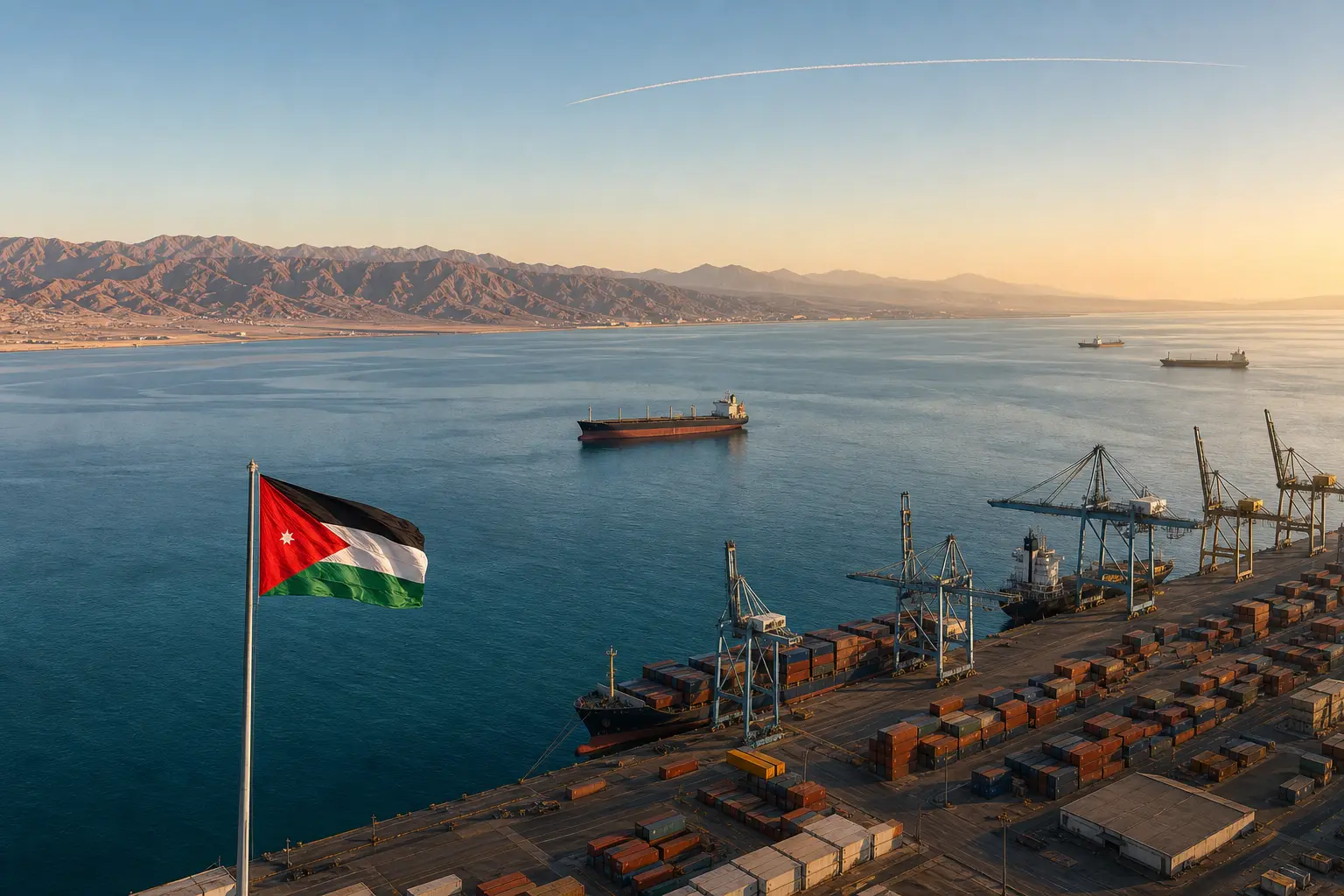
Aqaba is Jordan’s only seaport and only container terminal, the single route for nearly all the country’s seaborne trade and a share of its fuel imports. It also hosts King Hussein International Airport. Losing access to either, even briefly, would ripple through an economy with few alternatives.
- Jordan’s only seaport and only container terminal, handling virtually all the country’s maritime trade
- Home to King Hussein International Airport, developed alongside the port by the same state authority
- The kingdom’s dedicated entry point for crude oil, refined fuel and liquefied gas imports
- Gateway to Wadi Rum and Petra, anchoring a tourism industry inside the same economic zone
The port can handle more than 20 million tons of cargo annually, according to the Logistics Cluster, a UN-backed emergency logistics network. The cluster also treats Aqaba as an entry point for regional humanitarian aid. Its container terminal alone can move roughly 1.3 million containers a year.
Within its first 17 years, the surrounding special economic zone had already drawn close to $20 billion in investment, Site Selection Magazine reported. That growth turned the city from about 60,000 people into more than 190,000.
Missiles Keep Landing on a Country Not at War
Jordan’s exposure this week was not unique. Iran has now fired at multiple U.S.-aligned states that sit outside its direct fight with Washington over the Strait of Hormuz.
| Country | Date | What Happened |
|---|---|---|
| Jordan | July 11 and 19 | Struck by Iranian missiles twice; air defenses intercepted most of them; two U.S. troops killed and a third missing after a July 18 attack |
| Qatar | July 11 | Officials reported intercepting incoming Iranian missile fire |
| Kuwait | July 11 | Defense ministry said border posts and an offshore drilling platform were hit |
| Oman | Mid-July | State news agency reported Iranian drones struck sites days after Muscat hosted strait talks with Tehran |
Iran fired at Jordan, Qatar, Kuwait and Oman within a single day on July 11, responding to a fresh round of U.S. strikes. All four sit outside the direct fight over the strait. Each still absorbed Iranian fire within the same stretch of days.
Jordan has faced the most sustained exposure of the group. Over the past week, it has repeatedly reported intercepting Iranian missiles crossing its airspace. Saudi Arabia, not struck this weekend, had already condemned Iranian strikes on its own tankers days earlier, calling them “an assault on the security and safety of international navigation.”
An Inquiry Opens While Washington Stays Quiet
The IAEA’s inquiry into the Darkhovin strike remained open Sunday night, with no timeline for findings. Washington had not said whether it carried out the attack, let alone what prompted it.
President Trump had warned days earlier that the U.S. would “make a deal or we’re going to finish the job” with Iran. “I’d rather make a deal, because I don’t want to affect 91 million people,” he said, according to CBS News.
Iran’s foreign minister, Abbas Araghchi, has said the country’s Supreme Leader holds final authority over whether Iran goes to war or accepts a truce.
U.S. Central Command had not said by Sunday night whether a ninth night of strikes on Iran was coming.
