
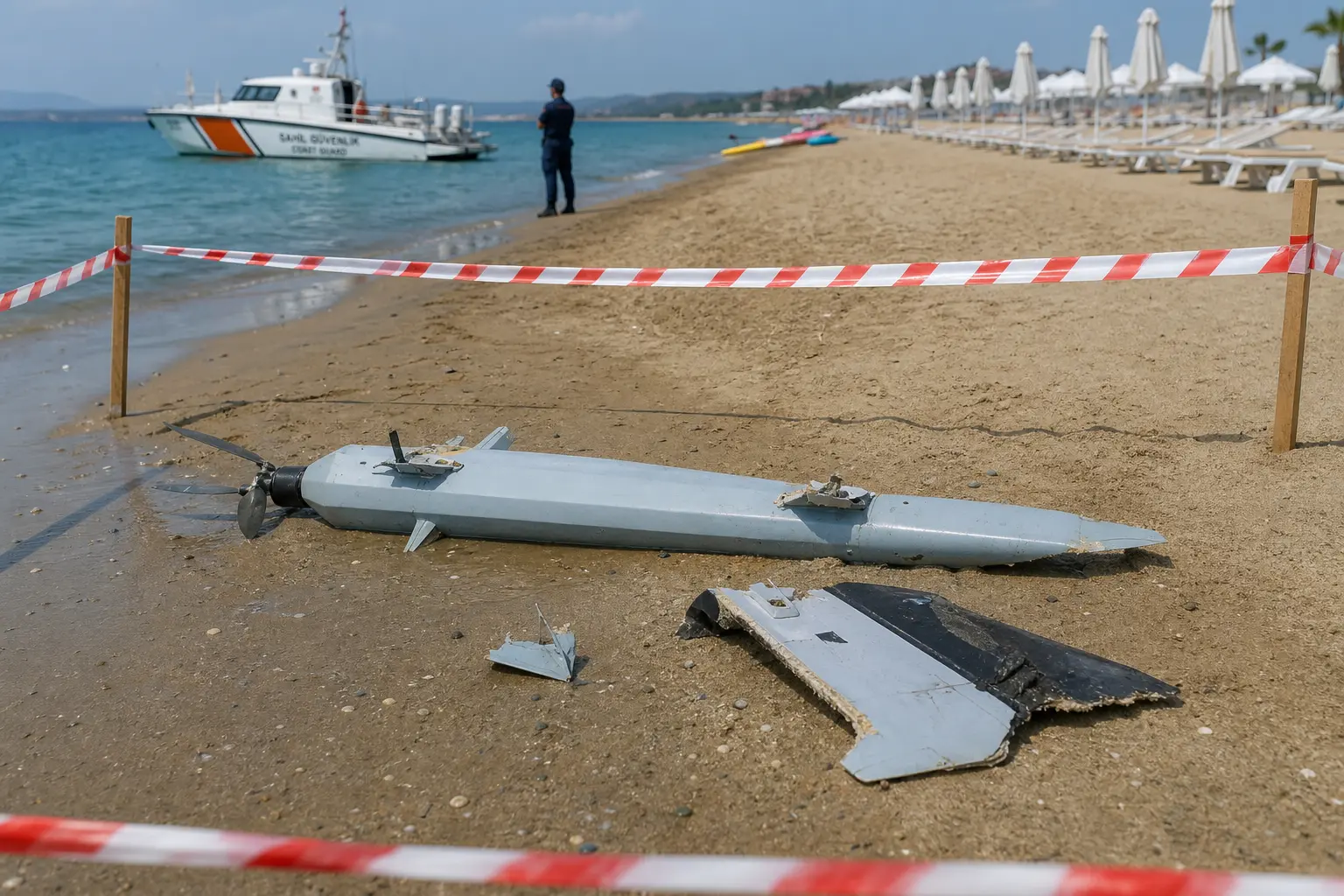
Turkish naval commandos blew up a fragmented kamikaze drone on an Istanbul beach on Monday after finding explosive material packed inside the wreckage. It is at least the dozenth time since September 2025 that a piece of Black Sea war debris has washed up on Turkey’s coast.
Beachgoers spotted the object between Karaburun and Ormanlı, two stretches of shoreline split between Istanbul’s Arnavutköy and Çatalca districts, and called it in. No government has claimed the drone. That silence has followed almost every comparable find since the Russia-Ukraine war’s drone campaigns started spilling into the Black Sea.
Commandos Detonate Wreckage Between Two Istanbul Beaches
Turkish outlet Bursa Saati first reported the discovery, and English-language coverage from Türkiye Today and Daily Sabah filled in the rest. Residents noticed the broken object along the shore between Karaburun beach in Arnavutköy and Ormanlı beach in Çatalca and flagged it down to authorities. Teams from the Coast Guard’s Marmara and Straits Regional Command and the Underwater Defense Group Command, a naval special forces unit known by its Turkish acronym SAS, were sent to the scene.
An initial look suggested the wreckage belonged to a kamikaze drone that broke apart after crashing. SAS commandos then ran a technical inspection and confirmed explosive material was still attached to the frame. After securing the beach, they carried out a controlled detonation right on the sand.
Nobody was hurt. Turkish officials have not said whose drone it was or where it launched from. That gap in the record has held through nearly every similar find over the past year.
Turkey’s Now Routine Beach Bomb Drill
The Karaburun operation followed a script Turkish forces have run often enough that it barely changes from one coastline to the next.
- A resident, fisherman or vacationer spots unusual wreckage on the sand or in the water and calls it in, exactly as happened at Karaburun.
- Coast guard or gendarmerie units reach the site first and cordon it off, keeping the public back while specialists are summoned.
- Underwater Defense Group Command commandos run a technical inspection to check for live explosives or an intact warhead.
- If explosives are confirmed, teams either detonate the device where it lies or tow it out to open water first, depending on how close it sits to homes or swimmers.
Every step of that routine has now played out on beaches, in orchards and inside residential streets stretched across roughly a thousand kilometers of Turkish coastline.
A Year of Black Sea Wreckage Piling Up on Turkish Sand
The Karaburun find did not arrive out of nowhere. Turkish and international outlets have tracked a steady run of similar incidents dating back to the previous autumn.
- September 2025: Fishermen recover Turkey’s first widely reported out-of-control naval drone, a Ukrainian Magura-type unmanned surface vessel, the case that opened what became a recurring problem along the coast.
- December 2025: Turkish F-16 jets shoot down a drone that crossed into Turkish airspace from the Black Sea using an AIM-9X Sidewinder missile. Within days, investigators also examine a suspected Russian Orlan-10 reconnaissance drone that crashed in Kocaeli province and debris from a Russian Merlin surveillance drone found in western Turkey.
- February 2026: Fishermen spot a suspected UAV off Karaburun on February 5. Days later, a drone washes ashore in Ünye, in Ordu province, and is assessed as likely Russian, though this one carries no explosives.
- March 2026: An AEGIR-W unmanned surface vessel built by U.S. defense contractor Sierra Nevada Corporation runs aground in Ordu province still carrying a live warhead. Turkish Navy teams tow it offshore and destroy it, the fifth out-of-control naval drone found on Turkish shores since September and the first confirmed to be Western-made.
- May 2026: A suspected Ukrainian drone crashes into homes in Samsun province, pushing the debris problem into a populated urban district for the first time.
- June 2026: An armed drone loaded with munitions crash-lands on Kapisuyu Beach in Bartin province on June 14, forcing an evacuation. Around June 23, a roughly 200 kilogram fixed-wing drone goes down in a hazelnut orchard in Kastamonu province and catches fire on impact, while a second suspected UAV turns up separately in Samsun province.
- July 2026: A drone carrying about five kilograms of explosives goes down in Trabzon province, according to Turkish news agency IHA. Another is found on the coast near Filyos days later, and the Karaburun wreckage turns up on July 20.
Add them up and Turkey has logged at least a dozen separate drone or naval-drone discoveries on or near its Black Sea coast in under a year, a run that shows no sign of slowing down heading into a second summer of the war.
The Wreckage Ranges From Cheap Drones to a US-Made Vessel
Not everything washing up is the same machine, and the differences matter for how Turkish forces respond.
| System Type | Typical Origin | Notable Turkish Incident | Outcome |
|---|---|---|---|
| Fixed-wing kamikaze drones | Ukrainian or Russian, rarely confirmed | Kapisuyu Beach, Bartin province, June 14, 2026 | Beach evacuated, munitions destroyed in controlled blast |
| Naval surface drones (USVs) | Mostly Ukrainian Magura-family craft, one U.S.-made exception | AEGIR-W washup in Ordu province, March 2026 | Towed offshore and destroyed by Navy explosive ordnance teams |
| Reconnaissance drones | Russian-made, typically unarmed | Suspected Orlan-10 crash in Kocaeli province, December 2025 | Recovered largely intact for technical examination |
| Heavy fixed-wing attack drones | Unconfirmed, roughly 200 kilogram class | Hazelnut orchard crash in Kastamonu province, June 2026 | Caught fire on impact, no injuries reported |
The AEGIR-W case stood out for a reason beyond its size. It marked the first time a system built by a Western defense contractor, rather than a Ukrainian or Russian one, had turned up armed on Turkish sand.
Why Does Turkey’s Coast Keep Catching the Overflow?
Turkey’s Black Sea coastline sits downstream of some of the war’s busiest drone and naval-drone corridors, where Ukraine has pushed long-range strikes against Russian ports and Crimea while Russia flies its own reconnaissance and strike drones over the same waters. Damaged or misdirected craft drift with the current until they hit Turkish sand, sometimes hundreds of kilometers from wherever they were launched or lost control.
Türkiye Today, reporting on the Karaburun find, noted that dozens of drones that missed their targets or malfunctioned during the war have previously washed up on Turkish coasts along the Black Sea, a pattern the outlet linked directly to the conflict’s spillover risk for neighboring countries. The geography does the rest of the work: currents and prevailing winds across the western Black Sea tend to push floating debris toward the Bosphorus approaches and the Turkish coast west and east of it, which is why finds cluster around Istanbul, Zonguldak, Bartin, Kastamonu, Samsun, Trabzon and Ordu rather than spreading evenly around the sea’s rim.
Ankara Warns Both Sides While Cleaning Up After Them
The Karaburun find landed just days after Turkish Foreign Minister Hakan Fidan stood beside his Ukrainian counterpart, Andrii Sybiha, in Kyiv and made the same point Ankara has repeated since the war began. “We do not want the war to spread to the Black Sea,” Fidan said at the July 16 news conference, adding that attacks on ports, tankers and fishing vessels that put civilians at risk were unacceptable and that all sides needed to act with restraint.
Fidan also confirmed that Turkey has agreed to lead the maritime component of any future international security guarantees for Ukraine, working alongside allied navies on the planning already under way. Sybiha, for his part, said Kyiv believed a summit between Ukrainian President Volodymyr Zelenskyy and Russian President Vladimir Putin could still take place on Turkish soil.
Turkey’s position gives that pledge some legal weight. As a NATO member that controls the Bosphorus and Dardanelles straits under the 1936 Montreux Convention, Ankara already regulates who can move naval vessels in and out of the Black Sea. It has also taken on a frontline counter-drone role at home, contributing to NATO’s mine countermeasures task group patrolling Black Sea shipping lanes and hosting this July’s NATO summit in Ankara, where the southern flank’s exposure to drone and missile threats was a headline topic. Some allies have floated extending the alliance’s Eastern Sentry counter-drone mission southward to cover exactly the kind of incursions Turkey keeps logging on its own coast.
Turkey’s navy is being asked to help police the Black Sea once a peace deal exists. Its coast guard is still detonating the war’s leftovers every few weeks in the meantime.
