
The US dollar pushed past EGP 51 at some Egyptian banks and exchange bureaus on Sunday, even as the country’s two biggest state lenders held just under that mark. The pound’s slide continued despite new central bank data showing remittances and reserves both climbing to records this year.
Both records are genuine. So is a quieter shift inside the reserve numbers: a slice of that cushion just lost value for a reason that has nothing to do with Egypt’s economy at all.
Dollar Clears EGP 51 at Egypt’s Two Biggest State Banks
At the National Bank of Egypt, the dollar traded at EGP 50.89 for buying and EGP 50.99 for selling at Sunday’s close. Banque Misr, the country’s other major state lender, quoted it at EGP 50.87 and EGP 50.97. The euro moved the same direction at both banks, trading at EGP 58.35 for buying and EGP 58.60 for selling.
| Bank | US Dollar (Buy / Sell) | Euro (Buy / Sell) |
|---|---|---|
| National Bank of Egypt | EGP 50.89 / 50.99 | EGP 58.35 / 58.60 |
| Banque Misr | EGP 50.87 / 50.97 | EGP 58.35 / 58.60 |
The gap between those quotes and the sub-51 headline, versus rates already above it elsewhere, comes down to how Egypt’s float actually works. Each bank sets its own competitive buy-sell spread rather than following one official number, so a few piastres can separate one counter from the next on any given day.
Remittances Hit a Record $43.1 Billion
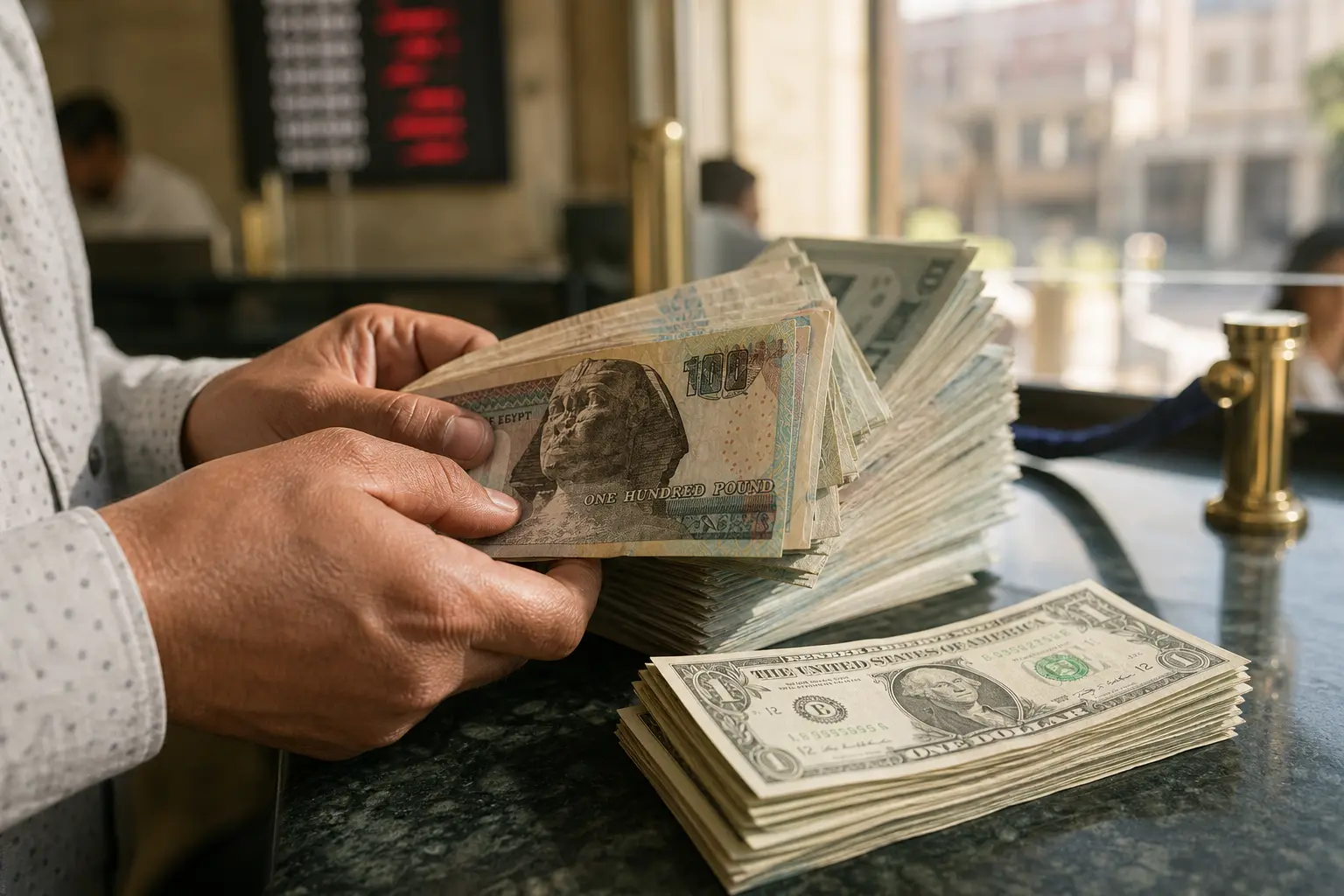
Central Bank of Egypt (CBE) data show remittances from Egyptians working abroad reached about $43.1 billion in the first eleven months of the 2025/26 fiscal year, running July through May. That is up 31.2% from $32.8 billion in the same stretch a year earlier. May alone brought in roughly $3.9 billion, a 13.5% jump from $3.4 billion in May 2025.
The surge looks odd next to a weakening currency until you remember how the last cycle worked. Egypt floated the pound in March 2024 partly to close the gap between the official rate and a black market rate that had ballooned during the 2022 to 2023 crisis. That earlier gap gave workers abroad a reason to route cash through informal channels instead of banks; remittances fell by roughly 30% in 2023 as the spread between official and street rates widened. With that gap closed, more of the money workers send home now shows up in the official figures, whether the pound is gaining or losing ground on any given week.
Six Months, One Sudden Jump in Reserves
CBE figures put net international reserves at $55.1 billion at the end of June 2026, a record, up from $53.13 billion in May. The climb to get there was not a straight line.
- December 2025: net international reserves at roughly $51.45 billion.
- January 2026: $52.59 billion.
- February 2026: $52.75 billion.
- March 2026: $52.83 billion.
- April 2026: $53,009.2 million reported by the central bank.
- May 2026: $53.13 billion.
- June 2026: $55.07 billion, a jump of nearly $2 billion in a single month.
That June move dwarfed the roughly $100 million to $200 million gains recorded in each of the five months before it. Something changed in June, and it was not just the exchange rate.
Why Did Egypt’s Gold Reserves Shrink Without a Single Sale?
Egypt’s gold holdings inside its reserves fell to $16.78 billion in June from $18.78 billion in May, not because the central bank sold bullion, but because global gold prices had their worst month in years, and central banks mark gold to market whether they trade an ounce or not.
Gold fell more than 12% in June 2026, its steepest monthly decline since October 2008, as a hawkish Federal Reserve and a strengthening dollar drained the safe haven premium that had built up during the Iran conflict. That single global move is large enough on its own to explain most of the roughly $2 billion drop in the dollar value of Egypt’s gold reserves. The metal itself almost certainly never left the vault.
It would not be the first time this exact mechanic showed up in Egypt’s books. Reviewing an earlier bout of reserve softness in April, Fitch Ratings found that about $2 billion of a $7 billion drop in the combined net foreign assets of the central bank and Egypt’s banking sector reflected lower gold prices rather than capital flight. Central bank officials cited by Egyptian financial media this month drew the same line for June, describing the roughly $2 billion rise in the foreign currency component as real inflows, mostly remittances and a partial return of foreign investment into government debt, while treating the gold decline as pure arithmetic.
Special Drawing Rights, an International Monetary Fund reserve asset known as SDRs, drifted lower too, dipping to $444 million from $448 million. That is a far smaller move, tied to the same kind of currency basket revaluation rather than any Egyptian decision.
The Pound’s Slide Traces Back to a $10 Billion Capital Exit
Fitch Ratings has tied much of this year’s pound weakness to a specific event. More than $10 billion in non-resident capital left Egyptian markets starting in late February, part of the fallout from regional tensions involving Iran, Israel and the United States. The pound had already lost about 10% of its dollar value in that stretch by mid-May.
What Fitch flagged as notable was not the outflow itself but Egypt’s response to it. The central bank let the rate move rather than spend down reserves defending it, a break from decades of propping up a fixed rate until the policy eventually broke under pressure. That restraint is what Fitch credits for keeping the sovereign rating steady through a regional war next door.
The rest of the balance sheet still shows some strain. Egypt’s current account deficit widened to $5.1 billion in the January to March quarter, more than double the $2.3 billion gap a year earlier, a reminder that the currency’s calm rests partly on capital inflows and Gulf support rather than trade alone.
Weaker pounds do not land on everyone the same way.
- Families receiving remittances now convert dollars sent from abroad into more pounds than they would have a year ago, part of why formal inflows keep setting records.
- Importers and manufacturers that rely on dollar-priced inputs face a higher pound cost for the same shipment, feeding into consumer prices.
- Outbound travelers and students paying tuition or expenses abroad need more pounds to cover the same dollar bill.
- The government’s dollar-denominated debt becomes more expensive to service in local currency terms even as its reserve cushion grows.
A Float Built to Slow the Fall, Not Stop It
A decade ago, one dollar cost about EGP 8.85 back in March 2016. By late December 2022, it cost close to EGP 24.75. By the time the central bank floated the pound on 6 March 2024, it cost just over EGP 50, settling near EGP 50.1 within days of the float.
That earlier run, from under EGP 25 to roughly EGP 50, took about fifteen months and cost the pound close to half its remaining value. The move from EGP 50.1 to today’s rate above EGP 51 has taken more than two years and amounts to a slide of roughly two percent. The float has slowed the descent to a crawl compared with the crisis-era freefall that preceded it, even if it has not reversed the underlying direction.
Fitch Holds Steady While IIF and IMF Pull in Different Directions
Fitch Ratings affirmed Egypt’s sovereign credit rating at ‘B’ with a stable outlook this month, crediting the flexible exchange rate regime for absorbing shocks tied to the Iran conflict without a defensive scramble for reserves. Where the picture splits is the pace of growth from here.
- IIF (Institute of International Finance) projects real GDP growth slowing to 3.5% in fiscal year 2026/27, down from an estimated 4.1% this year and 4.4% the year before that, though still well above the 2.4% Egypt posted in 2023/24.
- IMF (International Monetary Fund) raised its own fiscal year 2026/27 forecast to 4.6% in its July World Economic Outlook update, up from 4.4% in the fiscal year that just closed.
- Fitch Ratings separately clocked actual growth at 5.2% over the first nine months of fiscal year 2026, already running above what either forecaster expects for the year ahead.
The IMF’s reform program keeps disbursing in the background regardless of which forecast proves right. Egypt and the Fund reached a staff-level agreement this year on the seventh review of the $8 billion Extended Fund Facility, unlocking about $1.5 billion and pushing total disbursements toward $7.2 billion.
Egypt’s next reserve reading is due in early August. Whether June’s jump repeats or reverts to the slower, steadier climb of the five months before it will show whether the record is a new baseline or a one-month outlier.
Frequently Asked Questions
What is the difference between gross and net international reserves?
Net international reserves, the figure Egypt reports each month and the one behind the $55.1 billion headline, reflect what the central bank can draw on after certain short-term liabilities are subtracted. Gross reserves, a broader measure some data providers track separately, run higher because they include holdings that are not as readily available for immediate use.
How much of Egypt’s reserve cushion is held in gold?
Gold made up roughly 30% of Egypt’s $55.1 billion in net international reserves at the end of June 2026, based on the $16.78 billion gold component the central bank reported. That is a large enough share that swings in the global gold price, not just the pound’s exchange rate, can move Egypt’s reported reserve total by billions in a single month.
Has Egypt’s black market dollar rate returned?
Fitch Ratings’ most recent review found no significant gap between Egypt’s official and parallel exchange rates this year, unlike the wide spreads seen in 2022 and 2023. That suggests the floating regime is functioning as intended even as the official rate itself keeps drifting weaker.
What happens to Egypt’s IMF program if the pound keeps weakening?
The pound’s day-to-day moves do not by themselves trigger changes to Egypt’s International Monetary Fund program, which is built around a floating rate rather than any specific level. Egypt and the Fund reached a staff-level agreement this year on the seventh review of the $8 billion Extended Fund Facility, unlocking about $1.5 billion and pushing total disbursements toward $7.2 billion, with the program originally set to run through late 2026.
