
Factories across Egypt are calling Cairo’s informal plastic recyclers before dawn, begging for material, since a war over the Strait of Hormuz choked off their normal supply in February. In Manshiyet Nasser, the Cairo settlement known as Garbage City, that reversal has turned trash sorters into the people everyone suddenly needs.
The same war has a second bill attached. While recyclers see prices jump and orders pour in, Egypt’s government is absorbing billions in lost Suez Canal revenue and a politically painful fuel price hike from the identical conflict, a contrast the celebratory version of this story tends to skip.
Factories Start Calling Garbage City First
Peter Romany, a 25-year-old recycling specialist, spends his days now fielding calls from factories scrambling to plug supply gaps. He works out of Manshiyet Nasser, the sprawling eastern Cairo settlement built beneath the Mokattam hill, where generations of garbage collectors have built one of the world’s most sophisticated informal recycling systems.
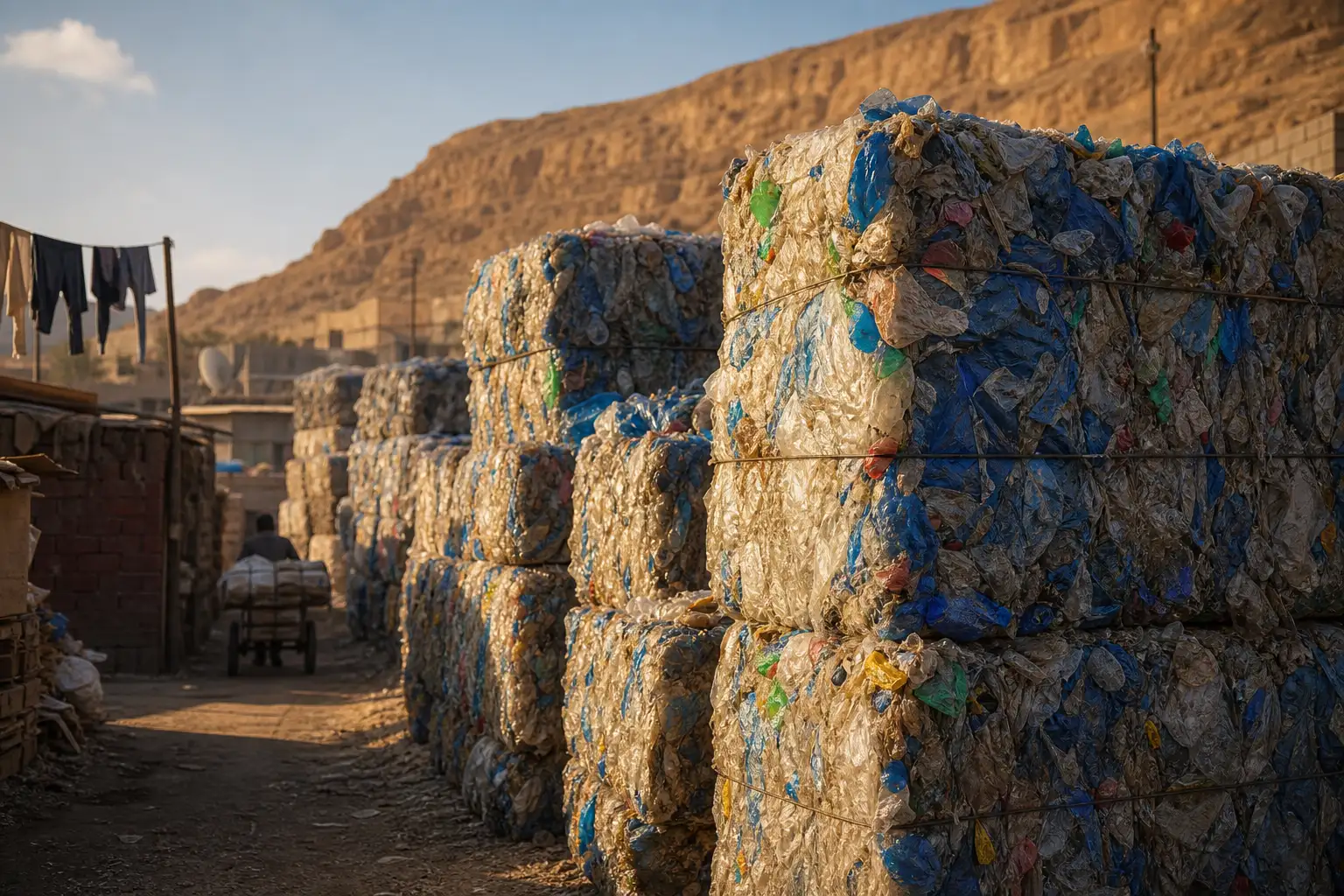
“Before the war, we were the ones calling factories, trying to sell our material,” Romany told Agence France-Presse, standing beside towering bales of compressed plastic.
“But after the war broke out, the factories started calling us. They’d ask: how much do you have? Can you deliver today? That never used to happen.”
Home to more than 115,000 residents, Manshiyet Nasser is a predominantly Coptic Christian neighborhood that handles more than a third of the Egyptian capital’s waste, according to government figures. Families live above mountains of sorted plastic, cardboard, paper, metal and glass, separated from the piles by little more than a staircase or a curtain. For decades, residents of this district were dismissed under a derogatory term for garbage people, a stigma only recently starting to fade as green industries discover the value of what they sort.
The Strait That Feeds Egypt’s Plastic Bales
The mechanics are simple once you trace them. Egypt imports around 40 percent of its raw plastic materials, mainly from Gulf countries, Europe, China and South Korea, according to the Chamber of Chemical Industries. A large share of that Gulf supply never left port once the fighting started.
Pricing agency Independent Commodity Intelligence Services, known as ICIS, says the Middle East supplies a major share of the world’s polyethylene, one of the most widely used plastics and a key ingredient in packaging, with around 85 percent of its exports passing through the Strait of Hormuz. Saudi Arabia’s main petrochemical hub, in Al Jubail, lies inside the Gulf itself, leaving it exposed to any slowdown in the strait.
Plastic is far from the only cargo caught in the squeeze.
- Crude oil and gas – about a fifth of the world’s daily seaborne oil and gas shipments pass through Hormuz, the route Iran has repeatedly restricted since February.
- Fertilizer inputs – roughly a third of global fertilizer trade, including nitrogen and ammonia, transits the strait, and aluminum smelters have also gone idle as alumina imports stall.
- Methanol – Iran’s single biggest chemical export, at well over 9 million tonnes a year, mostly bound for China.
Packaging and plastic prices have more than doubled for some products, three industry sources told AFP, pushing manufacturers toward locally recycled alternatives instead of waiting on tankers that might not come.
Triple Demand, Cash Up Front
Rizq Yousif mainly recycles polyethylene terephthalate, known as PET, the plastic behind most beverage and food bottles. He said demand had tripled since the war began, while prices for some recycled plastics rose by as much as 60 percent.
Factories that once delayed payment for weeks started putting cash down upfront, he said, “because they were so eager to secure the material.” Other companies up and down the supply chain describe the same shift.
| Recycler or Company | Material | Reported Change Since the War |
|---|---|---|
| Rizq Yousif, independent recycler | PET bottle plastic | Demand tripled; some prices up 60% |
| Uflex Egypt | Recycled packaging materials | Orders up to 40%, mostly food and beverage buyers |
| Sadat City Chemical Fibre Factory | Polyester fiber from PET bottles | New export buyers as far as Brazil |
| Sector-wide, per three sources | Packaging and plastic resin | Prices more than doubled for some products |
Nesma El-Areef, senior marketing and sales manager at Uflex Egypt, which converts plastic waste into new packaging, said the company saw a significant jump in orders from food and beverage manufacturers because it offered a more readily available alternative to imports.
Egypt’s Bigger Bill From the Same War
Scale matters here. The recycling windfall is real for the families of Manshiyet Nasser, but it sits next to a much larger loss on Egypt’s national ledger, one produced by the same regional turmoil.
- $10 billion – what President Abdel Fattah el-Sisi says Egypt’s Suez Canal has lost in revenue since 2023, largely because Houthi attacks in the Red Sea scared off shipping lines.
- 17 percent – the jump in Egypt’s domestic fuel prices this spring, which officials tied directly to exceptional geopolitical developments including the wars in Gaza and Iran.
- $8 billion – the International Monetary Fund’s pledged loan support to Egypt, raised from $3 billion in 2022 as the country’s foreign currency reserves stayed under pressure.
The canal is a separate front from Hormuz, but the two wars have landed on Egypt in the same stretch of years. Traffic through Suez has also taken a hit from Houthi missiles draining the waterway’s shipping traffic, a separate crisis running alongside the Hormuz standoff. Sisi told the Organisation for Economic Co-operation and Development earlier this year that Egypt has faced crises that were difficult to avoid, crises that have shaped the state’s ability to act.
Set against that, the extra revenue flowing into Manshiyet Nasser’s bales is a rounding error, even if it is the first good news some recyclers have had in years.
Will Cairo’s Recycling Rush Outlast the War?
Some of it might. Fayrouz El-Sayed, chief executive of Sadat City Chemical Fibre Factory, which has produced polyester fibers from used bottles for 16 years, said her company only cracked new markets as far as Brazil once the current crisis hit. Whether those buyers stick around once tankers start moving again is the open question.
Industry figures are split on how long the shock lasts. Yousif noticed prices and demand ease as soon as Trump signaled that talks with Iran were progressing. “Just one post dropped the market,” he said. “After the war, I am not sure this will last.”
Chemical industry analysts think the disruption outlives any single news cycle. Seth Goldstein, a chemical equity analyst at Morningstar, said of the Gulf supply shock that the bigger part has yet to really take hold, since cargoes that left Gulf ports before the fighting are only now arriving, with no reliable schedule behind them.
Blockade Back, and the Phone Rings Again
The timeline explains why nobody in Manshiyet Nasser is planning around a permanent peace.
- Feb. 28, 2026 – The United States and Israel launch a joint war against Iran, and Iran’s Revolutionary Guard effectively shuts the Strait of Hormuz to shipping.
- Mid-June 2026 – Trump and Iranian officials sign a memorandum of understanding at the Palace of Versailles, an apparent breakthrough after months of fighting.
- Early July 2026 – Iran’s Revolutionary Guard resumes attacks on commercial vessels, and Trump declares the agreement over, days after Iran abandoned its own ceasefire following a seventh night of strikes.
- July 14, 2026 – The US Navy reinstates its blockade of Iranian ports, and Trump says the United States will act as the strait’s guardian.
“We’ll become the guardian of the Strait,” Trump told Fox News, adding that Washington should be paid for the job after decades of providing security there for free.
Iran has not backed down either. Tehran says it has closed the strait again, and fresh US strikes have continued for a fourth consecutive night against Iranian missile sites and coastal defenses. Both Romany and Yousif say the pattern from February is repeating itself in real time.
“Whenever there’s trouble there, the customers start calling us,” Yousif said.
Frequently Asked Questions
What Does the Word Zabaleen Mean
Zabaleen is Arabic for garbage people, a term applied to Manshiyet Nasser’s residents after their families migrated from Upper Egypt in the 1940s and began collecting the city’s waste. The label was long used as an insult, though the community’s recycling skill is increasingly recognized as Egypt leans on it more.
How Much Plastic Waste Does Cairo Generate Each Day
Cairo produces roughly 15,000 tons of garbage daily, much of it collected, sorted and recycled by Zabaleen families working out of their own homes in districts like Manshiyet Nasser, according to research from Harvard’s Center for Middle Eastern Studies.
What Happens if Iran Fully Closes the Strait of Hormuz
Before the current war, about a fifth of the world’s daily oil and gas shipments moved through the strait. When the closure risk peaked earlier this year, the International Energy Agency took the unusual step of announcing it would release 400 million barrels of oil from reserves to steady global markets.
Why Did Trump Propose a Fee on Ships Using the Strait
Trump initially said Washington would charge commercial shippers a fee equal to 20 percent of cargo value to fund US protection of the strait, a plan the United Nations’ shipping agency called legally baseless. He dropped the fee a day later, saying Gulf states would instead offer investment deals in the United States.
