
Factories that used to haggle over Cairo recyclers’ scrap plastic are now calling first, wiring deposits to lock in supply before it runs out. The reversal has hit Manshiyet Nasser, the settlement known worldwide as Garbage City, since a US-Israel war on Iran choked off the Strait of Hormuz in February. Recyclers there say demand for their material has tripled, and prices for some recycled plastics have jumped by as much as 60 percent.
The same war that built this boom could end it just as fast. A single comment from President Donald Trump about progress in peace talks already crashed the market once, in June, before renewed attacks on Gulf shipping brought the buyers calling again.
Factories Now Call the Trash Pickers First
Peter Romany has worked the plastic trade in Manshiyet Nasser since he was a teenager. For most of that time, he told Agence France-Presse (AFP), his job was chasing buyers. That changed this year.
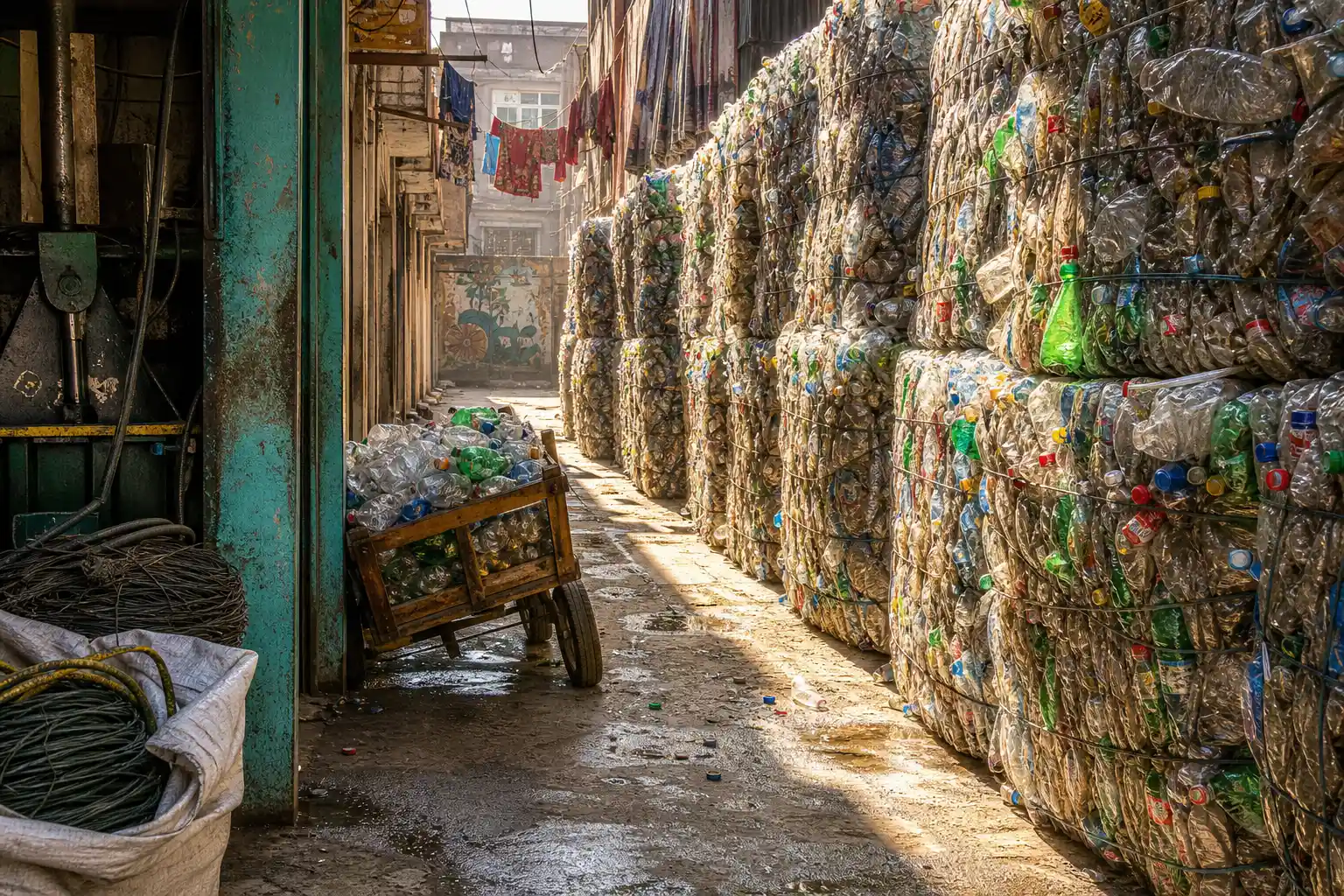
“Before the war, we were the ones calling factories, trying to sell our material,” Romany, 25, said, standing beside towering bales of compressed plastic. These days, he told the wire service, it is the factories that call him first, and they are willing to pay before the material even leaves his workshop.
He is not alone. Rizq Yousif, another Cairo recycler who mainly processes PET, the plastic used in bottles and food containers, told AFP that buyers who once delayed payment for weeks now hand over cash on delivery just to be sure of getting stock. Nesma El-Areef, a senior marketing and sales manager at Uflex Egypt, a Cairo packaging converter, told AFP that orders from food and beverage manufacturers have climbed by up to 40 percent since the shortage began, as those companies look for a domestic substitute for imported resin.
A Blockade Nobody Saw Coming
The scramble traces back to February 28, when the United States and Israel opened a bombing campaign against Iran that Congress’s own research service has called Operation Epic Fury, targeting nuclear sites, missile bases and naval forces. Iran’s supreme leader, Ali Khamenei, was killed in the opening strikes, and Iran responded by closing the Strait of Hormuz to ships tied to the US, Israel and their allies.
The strait is not a minor waterway. Around 20 percent of the world’s oil and gas normally moves through it every year, and roughly 3,000 vessels used to pass each month before the war. Traffic collapsed by more than 90 percent once Iran began mining the strait and firing on ships, and it has never fully recovered even after a ceasefire took hold in April.
Egypt felt that shock immediately, because its plastics industry runs on imported feedstock shipped through the same Gulf routes. The country has spent years trying to close that gap; national plans call for cutting about $8 billion a year in petrochemical input imports through new domestic production. Those plans have not caught up with demand.
| Period | Daily Vessel Crossings | Context |
|---|---|---|
| Before February 28, 2026 | 120 to 140 vessels, about half of them oil tankers moving 20 million barrels a day | Normal pre-war traffic |
| March to April 2026 | As few as two tankers a day | Height of the war, mines and attacks on shipping |
| July 3 to 5, 2026 | 31 to 43 crossings a day, 108 over the weekend | Kpler data showed partial recovery, still far below normal |
That gap between what Egyptian factories need and what they can import is exactly what Manshiyet Nasser now fills.
Who Are the Zabaleen?
The Zabaleen are the informal waste collectors and recyclers who built Garbage City from nothing over three generations, and they now handle a share of Cairo’s trash that most formal city systems in the world cannot match. Most are Coptic Christians whose families migrated from Upper Egypt decades ago looking for work.
- Origins – Families now known as the Zabbaleen arrived in Cairo from Upper Egypt in the 1940s, most of them Coptic Christian farmers looking for work.
- Turning point – Organized recycling did not begin until the 1980s, when the Association for the Protection of the Environment and World Bank linked microloans helped families buy their first shredders and balers.
- Efficiency – The district recycles up to 85 percent of what it collects, according to the head of the local Garbage Collectors Syndicate, well above the 20 to 25 percent typical of waste haulers in Western cities.
None of that efficiency mattered much to buyers a year ago. Recycled plastic sold for around 860 dollars a ton before the war, by industry estimates, and factories bought only when it suited them. The Hormuz shock flipped that arithmetic overnight.
Egypt’s Missing Forty Percent
Egypt imports around 40 percent of its raw plastic material, mainly from Gulf countries, Europe, China and South Korea, according to the country’s Chamber of Chemical Industries. When Gulf shipments slow, that gap has nowhere else to go except recycled supply.
Egypt is far from alone in feeling this. Roughly $733 billion in petrochemicals and related goods, about 22 percent of the world’s total supply, normally flows out of the Gulf, feeding everything from packaging to hospital gloves. “So much of the world is packaged and transported in various forms of plastic,” Jeff Krimmel, founder of the energy consultancy Krimmel Strategy Group, told CNBC.
The Gulf’s weight in one specific material makes Egypt’s exposure sharper still. The Middle East exported more than 12.5 million tons of polyethylene last year, according to ICIS data cited by the Institute of Materials, Minerals and Mining, out of nearly 17 million tons of polyolefins overall. Polyethylene is the exact plastic used to make the bottles and bags Manshiyet Nasser turns into pellets.
- 3x – the rise in demand some Cairo recyclers report for their material since the war began
- 60% – the increase in prices for certain recycled plastics over the same stretch
- Up to 40% – the rise in orders for recycled packaging material reported by Uflex Egypt
- About 40% – the share of Egypt’s raw plastic supply that comes from abroad
Not every part of the chemicals trade has been squeezed the same way. Iran carved out an exemption in March allowing fertilizer shipments through the strait to protect the spring planting season elsewhere in the region, while plastics feedstock got no such pass. Egypt’s own fertilizer sector shows how uneven the pressure has been regardless; one major producer just reported a profit drop even as sales rose in 2025. Companies making polyester fiber from recycled bottles have used the moment to push into new markets, including South America, while packaging makers report a jump in orders from food and beverage brands hunting for a locally available substitute.
How One Trump Comment Emptied the Order Book
The boom already proved how fragile it is. Industry figures across Egypt’s recycling sector acknowledge the current surge is tied directly to geopolitics, not to any lasting shift in how factories source material.
Just one post dropped the market.
Yousif said prices and demand eased almost immediately after Trump signaled last month that talks with Iran were making progress. He was not sure the current rebound would outlast the war either.
That whiplash lines up with the diplomacy. Mediators announced a memorandum of understanding on June 14, and the presidents of the United States and Iran signed it on June 17, aiming to end the war formally within 60 days. Shipping through the strait briefly firmed up in the weeks that followed. Then attacks resumed. A tanker caught fire off the coast of Oman in early July after what UK maritime authorities called a projectile strike, and Axios reported the Iranian Revolutionary Guard Corps fired at least two missiles at commercial ships the same night. Orders in Manshiyet Nasser picked back up within days.
Manshiyet Nasser Has Weathered Shocks Before
This is not the district’s first brush with a crisis it did not choose. In 2009, panic over the H1N1 swine flu outbreak led Egyptian authorities to order the culling of the pigs the Zabbaleen relied on to consume organic waste, gutting the informal system’s income and its integrated method of processing trash almost overnight.
That shock came from a health scare that had nothing to do with plastic or the Gulf. This one comes from a war that has nothing to do with Cairo. Both landed on the same alleys, for reasons the people living there did not control.
The memorandum that the US and Iranian presidents signed on June 17 gives the war until mid-August to end formally. In Manshiyet Nasser, recyclers are stacking fresh bales against that same clock.
