
Saudi Arabia signed more than 90 technology agreements with American companies in 2025, triple the year before. A new report from Microsoft and Accenture names the Kingdom a global leader in sovereign artificial intelligence, pointing to that deal pace and a quantum computer already running in Dhahran.
A separate Microsoft dataset, released in January, measures something closer to real-world behavior. It puts Saudi Arabia’s working-age AI usage rate near the bottom of the countries it tracked, behind Belgium and just ahead of the United States.
SDAIA’s Deals with US Firms Nearly Triple
The report, titled Securing Nations in the Intelligent Economy: Turning AI and Quantum Disruption into Strategic Advantage, credits the Saudi Data and Artificial Intelligence Authority, known as SDAIA, with building that momentum over six years of partnership with American technology firms.
In 2024, SDAIA signed 29 agreements with major US tech companies. In 2025, that count passed 90, covering technology localization, workforce training and knowledge exchange, according to the report. Sovereign AI means owning the data centers, cloud platforms and models that run a country’s AI, instead of renting all of it from foreign providers.
SDAIA has been at this since 2019, working with Accenture to build a national cloud and a country-wide data bank that now connects more than 200 government systems.
The 2025 agreements fall into three broad categories, based on the report and SDAIA’s own deal announcements:
- Technology localization – building servers, data centers and cloud capacity inside the Kingdom instead of routing workloads through offshore providers.
- Workforce training – scholarships and joint academies with partner universities, including a program spanning 40 top US schools such as Harvard and MIT.
- Knowledge exchange – joint research and public-sector pilot programs meant to transfer expertise, not just hardware.
Seven of those deals were signed in a single day in November, on the sidelines of the Saudi-US Investment Forum in Washington, spanning server manufacturing to public-sector data governance. SDAIA President Abdullah Alghamdi led the signing.
Where Does Saudi Arabia Rank First in Global AI?
Saudi Arabia holds the outright global No. 1 ranking in two categories of Stanford University’s 2026 AI Index, published by its Institute for Human-Centered Artificial Intelligence: security, privacy and cryptography, and women’s empowerment in artificial intelligence. It also posted the fastest AI talent growth rate of any country the index measured.
| Stanford AI Index Category | Saudi Arabia’s Global Rank | Supporting Figure |
|---|---|---|
| Security, privacy and cryptography | 1st | 15% of national AI inventors work in this field, the highest share of any country |
| Women’s empowerment in AI | 1st | 32.3% of AI inventors and authors are women |
| Growth in AI talent share, 2019 to 2025 | 1st (fastest) | More than 100% increase |
| University students using generative AI | 3rd | 89% adoption, versus 67% in the US and UK |
| Attracting specialized AI talent | 4th | Behind Luxembourg, Australia and the UAE |
Stanford’s 2026 AI Index, now in its seventh edition, draws on data from LinkedIn, Ipsos, Pew Research and the University of Melbourne, rather than government submissions. More than 80% of Saudi respondents said they use AI regularly at work, one of the highest rates Stanford recorded anywhere, alongside India and the UAE.
The Adoption Numbers the Report Leaves Out
Neither the Microsoft-Accenture report nor Stanford’s index measures how much of the population actually uses AI day to day. A third Microsoft study does, and Saudi Arabia comes out near the bottom of it.
Microsoft’s Global AI Adoption in 2025 report tracks working-age AI usage across dozens of countries, updating the figures twice a year. In the second half of 2025, Saudi Arabia’s rate was 26.2%, up from 23.7% six months earlier.
| Country | Working-Age Population Using AI, H2 2025 |
|---|---|
| United Arab Emirates | 64.0% |
| Singapore | 60.9% |
| Ireland | 44.6% |
| France | 44.0% |
| United Kingdom | 38.9% |
| Belgium | 36.0% |
| United States | 28.3% |
| Saudi Arabia | 26.2% |
The gap between Saudi Arabia and the UAE runs to nearly 38 percentage points, the widest split between any two Gulf neighbors in the dataset. The United States, which Microsoft says fell from 23rd to 24th place even while leading in AI infrastructure and model development, still edged out Saudi Arabia.
That is not necessarily a contradiction. Stanford’s 80% figure counted employed respondents answering a workplace survey. Microsoft’s diffusion number covers the entire working-age population, including people who are not yet online, employed or using AI tools at all.
The Microsoft-Accenture report itself reaches for a UAE example, not a Saudi one, to make its adoption case. It says Dubai’s Centre for Artificial Intelligence has cut government service processing times by up to 50% and customer response times by up to 80%. No comparable Saudi efficiency figure appears in the report.
Aramco’s Quantum Computer Is Already Running in Dhahran
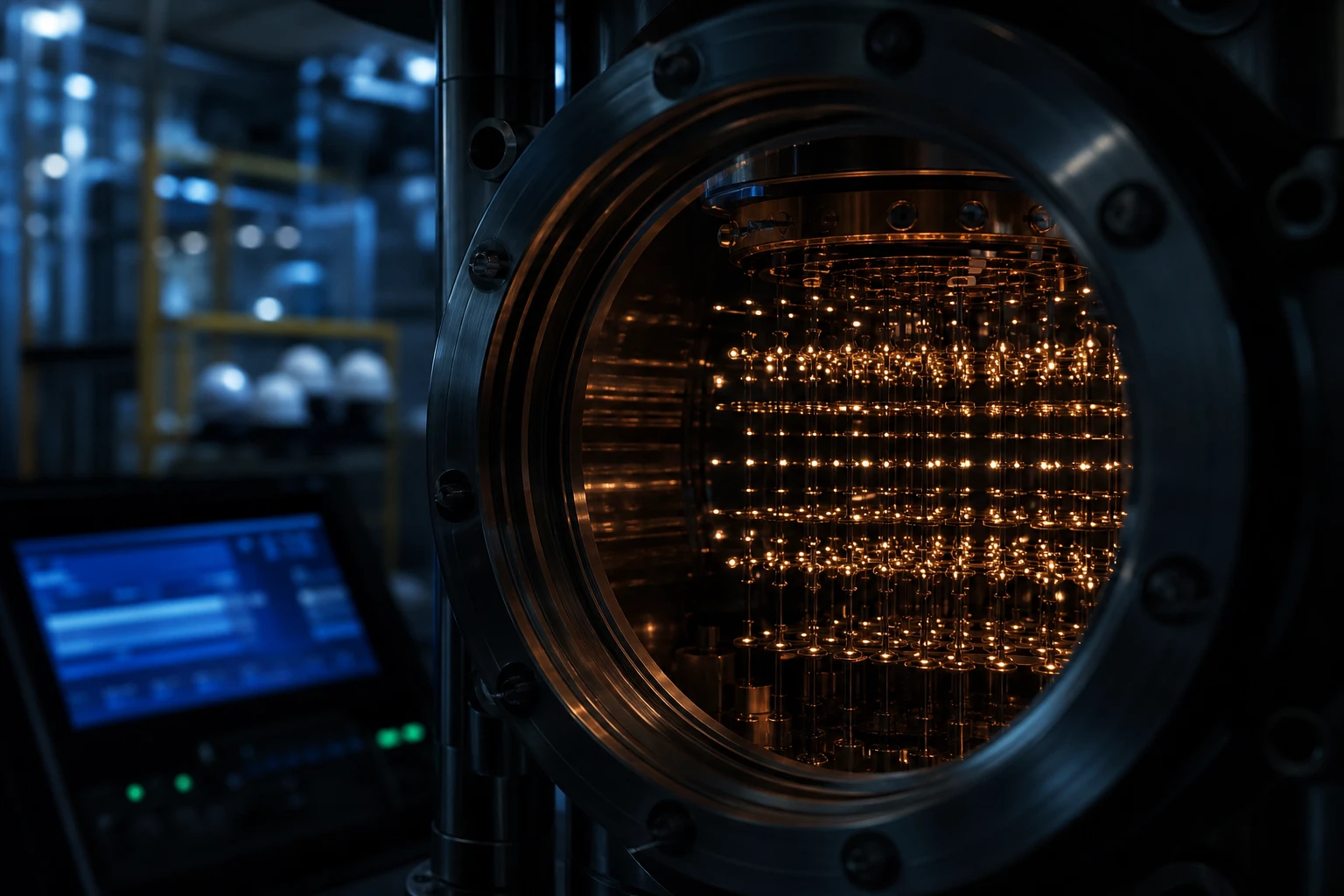
Saudi Aramco, the state oil giant, agreed in May 2024 to install a 200-qubit quantum computer with Pasqal, a French neutral-atom quantum computing company. The system, which controls 200 qubits arranged in programmable two-dimensional arrays, went live at Aramco’s Dhahran data center in November 2025.
Six months later, the partners opened it to outsiders. In May 2026, Aramco and Pasqal launched the Middle East’s first commercial quantum computing service, letting outside researchers and companies rent time on the machine remotely.
Aramco is not just waiting for quantum computing, it is helping to shape it as a global leader.
Wasiq Bokhari, Pasqal’s chief executive, said that at the Dhahran launch in May 2026. Aramco says the machine is now working through real problems: port logistics, carbon storage optimization, well placement and rig scheduling across its energy operations.
The Talent Gap Behind Saudi Arabia’s AI Sovereignty Push
Money and rankings are one measure. Execution is another, and outside analysts say that gap is where Saudi Arabia’s strategy will actually be tested.
The Center for Strategic and International Studies, a Washington policy institute, found that foreign direct investment is lagging Vision 2030’s own target. The Kingdom wants FDI’s contribution to GDP to rise from 3.8% to 5.7% by 2030. It has not been on pace.
Riyadh is aiming for $100 billion a year in foreign investment by 2030, roughly three times the record inflow it logged in 2024. AI and its supporting infrastructure are supposed to help close that gap.
A separate billion-dollar Canadian pivot toward the Kingdom has already run into regional missile risk, a reminder of how exposed Vision 2030-era investment can be to Houthi strikes elsewhere in the Gulf.
Three views of the same push do not fully line up:
- Microsoft and Accenture say 2025 was the year Saudi Arabia moved from AI ambition to execution, pointing to the SDAIA deal count and the Aramco quantum computer as evidence.
- CSIS analysts counter that state-directed investment cannot substitute for private and foreign capital, and that Vision 2030’s FDI targets remain behind schedule.
- Microsoft’s own usage data shows Saudi Arabia’s AI diffusion rate trailing the UAE by nearly 38 percentage points, the widest gap between any two Gulf states it measured.
SDAIA’s national strategy, published in 2020, set a target date that matches Vision 2030’s own deadline: rank among the world’s top 15 AI countries by 2030.
Frequently Asked Questions
What Does SDAIA Stand For?
SDAIA stands for the Saudi Data and Artificial Intelligence Authority, the government body established in 2019 to run the Kingdom’s data and AI strategy. Abdullah Alghamdi is its president and led the November 2025 signing ceremony in Washington.
Which US Companies Has SDAIA Signed AI Deals With?
In November 2025 alone, SDAIA signed seven agreements with Supermicro, Boomi, SambaNova, GitLab, Cisco and Accenture, covering server manufacturing, AI data centers, training programs and public-sector digital transformation, on the sidelines of the Saudi-US Investment Forum in Washington.
What Is Neutral-Atom Quantum Computing?
It is a form of quantum computing that traps individual atoms with laser light and arranges them into programmable two-dimensional grids. Pasqal, the French company behind Aramco’s machine, uses the approach to control 200 qubits at once inside a single processor.
How Does Saudi Arabia Rank in Global AI Investment?
Stanford’s 2026 index placed Saudi Arabia 10th globally for private AI investment in 2025, with $2.03 billion invested during the year, a solid showing for its population size but well behind the countries topping that category.
When Did Vision 2030 Launch?
Vision 2030 launched in April 2016 under Crown Prince Mohammed bin Salman, aiming to diversify the Saudi economy away from oil. SDAIA and the national AI strategy followed in 2019, as one of the plan’s technology pillars.
How Big Could Saudi Arabia’s AI Market Grow?
Market research firm MarketsandMarkets projects Saudi Arabia’s AI market growing at a 34.3% annual rate through 2032, from about $2.14 billion in 2025 to $16.90 billion by then.
