
Yemen’s Houthi leader threatened Saudi Arabia’s oil facilities and “all key oil and strategic infrastructure” on Thursday, days after the two sides struck each other’s airports for the first time since a 2022 truce took hold. Abdul Malik al-Houthi, who leads the Iran-backed movement controlling Sanaa, said in a nearly 90-minute televised address that his fighters were ready for a “different war” if Riyadh keeps up what he called a blockade of Yemen.
The shift matters because the new threat names energy infrastructure specifically, the same target set that once knocked out more than half of Saudi Arabia’s crude output overnight. It lands as Washington quietly clears new weapons for Riyadh and sends a senior general to the Saudi capital, a sign the four-year calm both governments have publicly wanted is already fraying.
Al-Houthi Vows a ‘Different War’ Over Saudi Oil Facilities
Speaking Thursday, al-Houthi warned that Saudi Arabia’s oil facilities and other strategic infrastructure would become targets for missile and drone attacks if the confrontation continued. He accused Riyadh of depriving Yemenis of their rights and said his movement remained prepared for a prolonged conflict.
Neither the Saudi nor his American, British, and Israeli masters will be able to enslave us.
Al-Houthi said that in the address, calling on supporters to hold mass demonstrations on Friday. He also described the group’s earlier missile and drone response to the Sanaa airport strike as “modest,” a word choice that reads differently now that oil facilities are on the table.
Airports for Airports, Ports for Ports
The immediate trigger came Monday. Saudi-led strikes hit the runway at Sanaa International Airport, and within hours the Houthis fired ballistic missiles and drones at Abha International Airport in southern Saudi Arabia. The barrage also targeted King Khalid Air Base and Prince Sultan Air Base, according to The Media Line’s reporting from the region. Saudi air defenses intercepted the incoming fire, and no casualties were reported on either side.
“The equation is airports for airports, ports for ports, and siege for siege,” al-Houthi said, describing what a full response would look like. Mohammed al-Bukhaiti, a member of the Houthi political bureau, told Al Jazeera the strike on Sanaa “gives Yemen the right to strike their airports.”
Hours after the Abha strike, Saudi-led coalition aircraft hit Yemen’s Saada province, al-Houthi’s home stronghold, The Media Line reported. By Tuesday, Houthi military spokesman Yahya Saree said the group had downed a Saudi reconnaissance drone, evidence the exchange did not end with the airports.
- What we know: Sanaa’s runway was struck Monday, Abha was hit hours later, no casualties resulted, and Saudi defenses say they intercepted the incoming missiles and drones.
- What we know: The diverted plane carrying the Houthi delegation landed safely at Hodeida airport instead of Sanaa.
- What’s unconfirmed: Who actually struck Sanaa. Yemen’s government claims its own forces did it, the Houthis blame Saudi Arabia directly, and the Foundation for Defense of Democracies argued the government’s limited capacity means Riyadh likely carried it out at Yemen’s request.
- What’s unconfirmed: Whether this stays a calibrated, contained exchange or becomes the opening round of a wider war.
The U.S. Maritime Administration has tallied more than 100 separate attacks on commercial vessels tied to the Houthis since November 2023, a reminder of how quickly this front can widen once it opens.
The Iranian Flight That Lit the Fuse
The spark traces back to July 3, when an Iranian aircraft landed in Sanaa, the first publicly announced flight from Tehran to the Houthi-held capital in more than a decade. It carried a Houthi delegation heading to the funeral of Iran’s Supreme Leader Ayatollah Ali Khamenei.
Rashad al-Alimi, who leads Yemen’s internationally recognized government, said his administration had rejected Iran’s request to send the plane back for the delegation, accusing the Houthis of receiving it “outside the legal and sovereign frameworks governing civil aviation.” Yemen’s defense minister, Gen. Taher al-Aqili, posted on social media that “our patience has run out” hours before the runway strike.
When the plane tried to return Monday, the strike on Sanaa’s runway forced it to divert. The Houthi-run broadcaster al-Masirah quoted the group’s transport minister saying the plane “landed on the homeland’s soil, carrying a number of medical patients and stranded citizens.” It touched down safely at Hodeida.
Why the 2019 Playbook Still Worries Riyadh
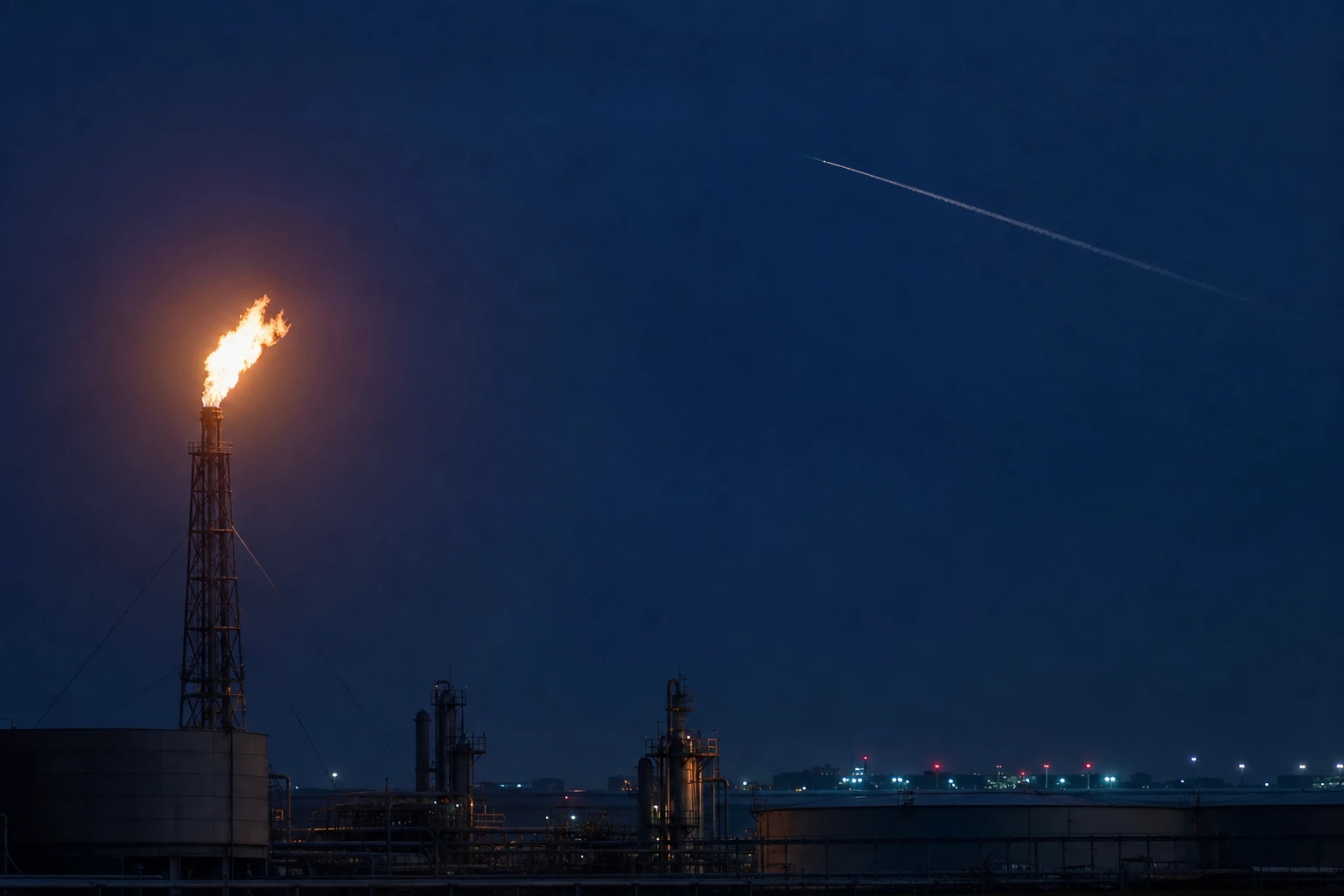
Oil facilities are not a new idea for the Houthis. They give Riyadh a reason to take the new rhetoric seriously.
| Year | Target | Method | Reported Effect |
|---|---|---|---|
| 2019 | Abqaiq and Khurais oil facilities | Drones and missiles | Temporarily knocked out more than half of Saudi crude output |
| 2022 | Aramco fuel depot, Jeddah | Missile or drone strike | Distribution station hit and caught fire |
| 2026 | Abha airport, King Khalid and Prince Sultan air bases | Ballistic missiles and drones | Intercepted, no casualties reported |
A renewed war would also collide with Saudi Arabia’s economic ambitions. The kingdom is trying to court outside capital for its diversification push, a backdrop that makes the timing of any new energy-facility threat awkward, much as it has been for Canada’s billion-dollar Saudi investment pivot since the missile exchange began. The Washington Institute has mapped a year of Houthi attack patterns and found that years of strikes, interceptions and sanctions have not deterred the group’s long-range arsenal.
Washington Quietly Backs Riyadh’s Next Move
The United States has stayed publicly quiet, but its actions this week say otherwise.
- Crown Prince Mohammed bin Salman reportedly briefed President Donald Trump ahead of the Sanaa strike and received Washington’s backing, according to US officials cited by Axios and reported by Al-Monitor.
- Lieutenant General Patrick Frank, deputy commander of U.S. Central Command, met Saudi chief of the general staff Fayyad al-Ruwaili in Riyadh this week.
- The State Department approved a new weapons package for Saudi Arabia, part of what Saudi Defense Minister Khalid bin Salman has suggested is Washington giving the kingdom leeway to strike the Houthis directly.
- Pakistan, which holds a mutual defense treaty with Riyadh, warned the Houthis against attacking the kingdom, Reuters reported Thursday.
Middle East Eye reported that discussions inside the Saudi royal court remain unsettled, with US and Western officials describing internal disagreement over how far to go. No decision has been made.
Red Sea Attacks Dropped 84% in a Year
The Red Sea shipping war that once disrupted roughly a trillion dollars in annual trade has quieted, though the capability behind it has not gone anywhere.
Houthi attacks on commercial vessels fell from 150 in 2024 to just seven in 2025, an 84% drop that the conflict-monitoring group ACLED recorded as a strategic recalibration, not a loss of capacity. Over the same period, the group fired 125 strikes at Israeli soil, a 120% jump from the year before, including at least one hypersonic missile aimed at Tel Aviv during the Gaza war.
Israel answered with its own campaign, including strikes on Hodeidah’s port facilities, one of several fronts that kept the wider Red Sea corridor tense even as vessel attacks eased. Bab el-Mandeb transits had already fallen to 28 ships a day during last year’s spike, S&P Global Commodity Insights found, down from more than 70 before the Gaza war began.
Ibrahim Jalal, an independent expert on Yemen and the Arab Gulf, told Middle East Eye the current standoff reflects a deeper problem. “The no war, no peace stalemate has not produced any outcome closer to a political settlement,” he said. Yemeni expert Basha, also speaking to Middle East Eye, played down the odds of a full shipping-lane closure, saying regional leaks pushing that narrative are aimed at dragging Washington deeper into the fight rather than reflecting Houthi intent.
Can Mediators Get Ahead of Friday’s Rallies?
Diplomats are racing to keep this contained, and so far both sides have avoided crossing into open war even as the rhetoric escalates. U.N. Special Envoy Hans Grundberg, working with Qatari and Omani mediators, is pressing both governments to step back before Friday’s demonstrations and any further military moves harden positions.
Nadwa Al Dawsari, an associate fellow at the Middle East Institute, said the arrangement that has held since 2022 was never a real settlement.
The truce is hanging by a thread.
Al Dawsari told The National that a renewed confrontation is inevitable given the Houthis’ long-term ambitions and their refusal to share power. The International Crisis Group has mapped the Houthis’ calculus for further escalation, noting Riyadh’s instinct will be to keep communication channels open rather than reignite a war it spent years trying to end.
Al-Houthi’s supporters were set to march across Houthi-held territory on Friday, the same day mediators are working to keep the exchange from becoming the war both sides say they do not want.
Frequently Asked Questions
What Is the Bab el-Mandeb Strait, and Why Does It Matter for Oil Prices?
The Bab el-Mandeb Strait is a 20-mile-wide passage between the Horn of Africa and the Arabian Peninsula that links the Red Sea to the Gulf of Aden. An average of 8.8 million barrels of oil passed through it daily before the shipping crisis began, according to the U.S. Energy Information Administration, a flow that had fallen to roughly 4 million barrels a day by August 2024 as tankers rerouted around Africa.
Has the U.S. Labeled the Houthis a Terrorist Organization?
Yes. Washington re-designated the Houthis as a foreign terrorist organization in 2025 after the group shifted its fire toward American warships, according to ACLED, a move that preceded a costly U.S. air campaign ending in a May ceasefire.
What Happened to the Formal 2022 Truce on Paper?
The UN-brokered truce technically expired on October 2, 2022, after two two-month extensions, though both sides kept observing its terms informally. A follow-up economic de-escalation agreement signed July 23, 2024 restored some flights out of Sanaa and eased banking restrictions Yemen’s government had placed on Houthi-run banks.
How Is Washington Backing Saudi Arabia Right Now?
Beyond this week’s Riyadh meeting between U.S. and Saudi generals, the State Department approved the sale of 20,000 Advanced Precision Kill Weapon Systems, a guided rocket system, to Saudi Arabia, according to Middle East Eye’s reporting citing U.S. and regional officials.
Are the Houthis Still Attacking Ships in the Red Sea?
Not since the Gaza ceasefire took hold in October 2025. The U.S. Maritime Administration says the group has not struck a commercial vessel since then, though it still treats Houthi forces as a threat to Israeli, American and British-linked shipping in the region.
Why Did the UAE Pull Out of the Saudi-Led Coalition?
The United Arab Emirates withdrew troops from Yemen after its partnership with Saudi Arabia frayed over rival influence in the country’s south, according to the Times of Israel, leaving Riyadh with a thinner coalition just as tensions with the Houthis resurfaced.
