
US airstrikes hit about 140 Iranian targets on Sunday after a container ship was set ablaze in the Strait of Hormuz, escalating the US-Iran conflict into a wider regional confrontation. Iran retaliated with missile and drone attacks against Bahrain, Kuwait, Qatar, Jordan and Oman, and declared the strategic waterway closed until further notice. Mediators from Pakistan, Qatar, Egypt and Oman were working to preserve a memorandum of understanding signed in mid-June, as oil prices climbed on renewed fighting.
Strikes, Retaliation, and a Reopened Strait Dispute
US Central Command said its Sunday strikes, launched at 5 p.m. ET, hit missile and drone sites, naval assets, ammunition storage, communications networks and coastal surveillance locations across southern Iran. The command called the operation the third round of strikes in a week and said it was designed to degrade Iran’s ability to attack commercial shipping in the strait. President Donald Trump defended the action in an interview with NBC’s Meet the Press: “We bombed the hell out of them last night.” He added, “It’s open. We bombed the hell out of them last night.”
Iran’s Islamic Revolutionary Guard Corps announced after the strikes that the Strait of Hormuz “will be closed until further notice and until the end of American interventions in this region,” according to state news agency IRNA. The US rejected the claim. “The strait remains an international waterway. US forces are positioned and prepared to keep it that way. Iran does not control the strait. Traffic is flowing,” US Central Command posted on X. The competing claims mark the sharpest collision yet between the two sides over who controls the narrow waterway that carries nearly a fifth of globally traded oil and natural gas.
The Ship and the Missing Sailor
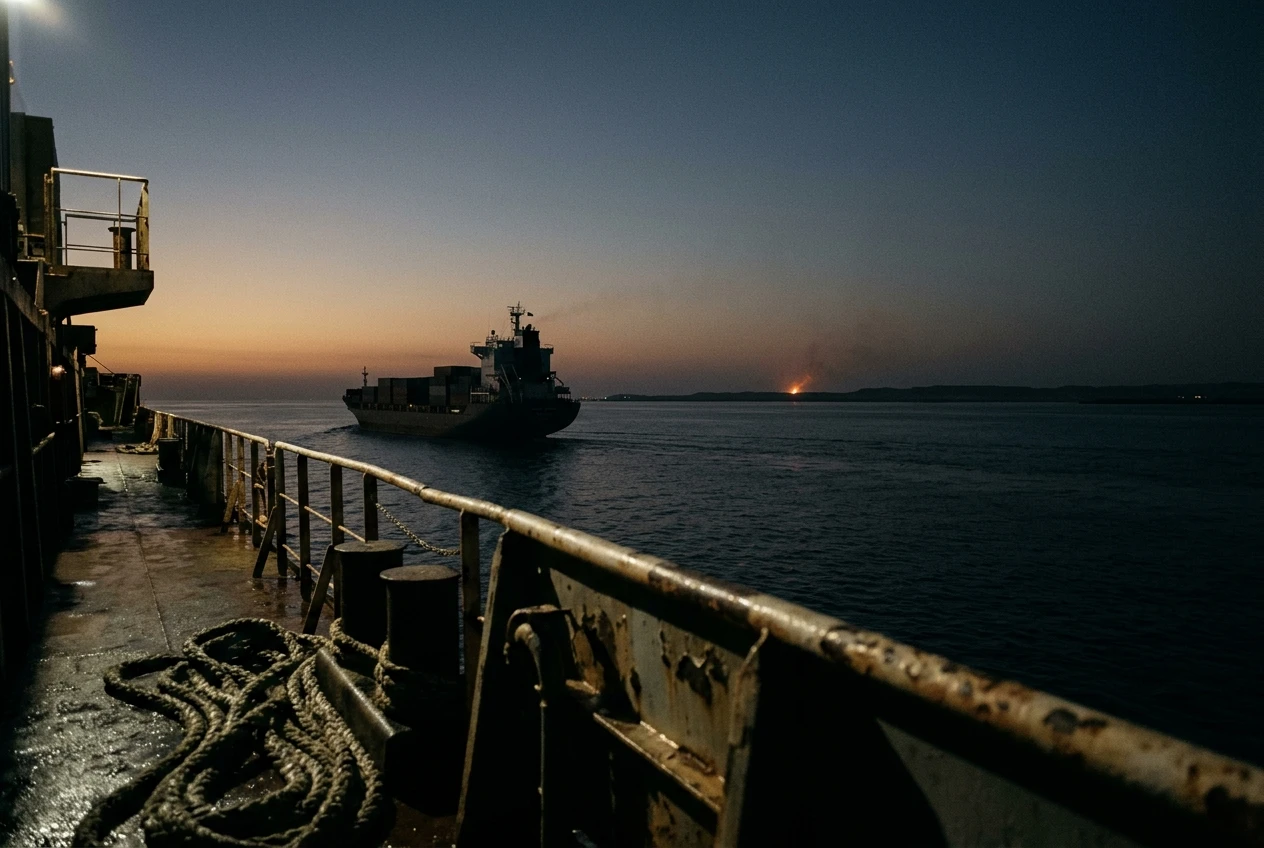
The latest exchange was triggered by an attack early Sunday on the Cyprus-flagged container ship GFS Galaxy as it transited the strait off the coast of Oman. The vessel suffered “significant engine room damage” and an onboard fire that forced the crew to abandon ship, according to US Central Command. Oman rescued 23 crew members, but one sailor, an Indian national, remained missing. The vessel had been hugging Oman’s shoreline on a route commonly used by commercial ships to avoid Iranian territorial waters, the United Kingdom Maritime Trade Operations center reported.
India’s Ministry of External Affairs condemned the attack and said 10 of the 11 Indian nationals on board had been rescued. “We condemn the attack on the commercial vessel GFS Galaxy off the coast of Oman,” the ministry said, calling the incident “deeply worrisome” and urging an immediate de-escalation. The search for the missing sailor continued Monday with coordination between the Indian Embassy in Oman and local authorities.
Iran’s Revolutionary Guard claimed the ship was among several vessels that “disregarded our warnings” and ignored instructions to follow what Tehran called an approved route. One “was struck by a warning shot and brought to a stop,” the Guard said. The version of events has not been corroborated by independent observers, and the strait has long been treated under international law as an international waterway rather than Iranian territorial waters.
Iran’s Reach Across Five Capitals
Within hours of the US strikes, sirens sounded across the Gulf as Iran fired missiles and drones at five countries hosting US military installations. Tehran described the wave as retaliation for the renewed American bombardment of cities along its southern coast.
| Country | Iranian attack reported | Local response | Casualties or damage reported |
|---|---|---|---|
| Bahrain | US communications system and radar site targeted | Air raid sirens activated; residents urged to shelter | None reported |
| Kuwait | Patriot air defence system, ammunition depot and radar site targeted | Air defences engaged “hostile aerial targets” | Three northern border posts damaged; offshore drilling platform hit; one worker injured |
| Qatar | Al Udeid airbase targeted with ballistic missiles | Missiles intercepted; Interior Ministry raised security level | Three people injured, including a child, by falling shrapnel |
| Jordan | Prince Hassan airbase targeted with ballistic missiles | Military said it intercepted four missiles from Iranian territory | Three missiles struck areas across Jordan; minor property damage, no injuries |
| Oman | Logistics support centres and refuelling platforms at Duqm port targeted | Iranian ambassador summoned in rare diplomatic protest | Drone strikes hit sites on the strait; shelter-in-place issued |
Oman’s summons of the Iranian ambassador was its first such move since the war began in late February. The sultanate condemned Iran’s acts as “irresponsible,” a pointed rebuke hours after hosting Iranian Foreign Minister Abbas Araghchi for talks on managing the strait. Sirens also sounded briefly in the United Arab Emirates, though the government said missiles did not cross into its territory.
Saudi Arabia’s foreign minister, Prince Faisal bin Farhan, held separate calls with his counterparts in Qatar, Oman, Bahrain, Jordan, Iraq and Ukraine on Sunday, in which the ministers “reaffirmed their condemnation of the repeated Iranian attacks against countries in the region,” according to the Saudi Press Agency. The Iraqi side separately reaffirmed that it would not allow its territory or airspace to be used as a launching point for attacks against Gulf states.
Why the Strait Matters More Than the Battlefield
About a fifth of globally traded oil and natural gas passed through the Strait of Hormuz before the war began in late February. Iran’s grip on the waterway has already triggered what the World Bank called the largest oil market disruption in history, with global supply crashing by 10.1 million barrels a day in March and the largest monthly price increase on record. Brent crude, which had tumbled from wartime highs near $120 a barrel toward pre-war levels after the mid-June understanding, jumped more than 4 percent on Monday to above $79 a barrel. The US benchmark WTI rose over 3.5 percent in Tokyo trade to above $74 a barrel.
An adviser to Iran’s supreme leader said on Sunday that control of the strait was more important than “dozens of atomic bombs,” underscoring how Tehran views the waterway as leverage rather than a battlefield. Iran has created a new Persian Gulf Strait Authority to collect tolls and coordinate transit, a structure the United States and Gulf states reject outright.
Disagreement over who controls the waterway lies at the heart of the renewed fighting. Iran believes the mid-June memorandum allows it to organise traffic, including the right to grant or deny permission to vessels. The United States believes Iran must step aside and allow free, unhindered transit. Trita Parsi, executive vice president of the Quincy Institute, said the ambiguity was the kind of gap that kept “the door to escalation ajar” from the moment the deal was struck. Maritime traffic has already thinned sharply, with the New York Times reporting that the number of ships moving through the strait halved on Wednesday as fighting resumed.
Kuwait’s confirmation that an offshore drilling platform was struck by an Iranian drone is a reminder that energy infrastructure beyond the waterway itself is now within reach. As long as the strait remains contested, both sides have reasons to keep the temperature high.
The Ceasefire That’s Already Fraying
The latest fighting follows a memorandum of understanding the United States and Iran signed on June 17, opening a 60-day interim period meant to lead to a permanent end to the war. The midway point of that window arrives this week, and fighting over the past three weekends has put the deal in danger of collapse. Trump said on Wednesday that the ceasefire was “over,” a position he has not retreated from since.
Iran’s lead negotiator, parliament speaker Mohammad Bagher Ghalibaf, posted on X on Sunday: “The era of one-sided deals is OVER. We told you: keep your word or pay the price. Reality is knocking.” Iran’s foreign ministry said the US attacks had “caused the return of insecurity in the Strait of Hormuz” and “rendered futile all efforts” at establishing peace. The new Iranian Supreme Leader, Ayatollah Mojtaba Khamenei, delivered his first public address on Saturday after the funeral of his father, Ayatollah Ali Khamenei, who was killed in US-Israeli strikes on February 28, vowing that revenge “is the will of our nation and must certainly be carried out.”
Trump has said any attempt to assassinate him would lead the United States to “completely decimate” Iran. The two sides have spent the past week trading threats without either side willing to be the first to walk away from the table.
Oil Markets and the Mediators’ Squeeze
Brent crude settled near $79 a barrel on Monday, the highest level since late June, while WTI pushed above $74. Saul Kavonic, head of energy research at MST Financial, told Al Jazeera that Iran intends to cement control over the strait, which could keep passage “below 50 percent of pre-war levels for many months, with periodic flare-ups in hostilities.” That outlook, combined with depleted strategic reserves, leaves little room for a long war, according to Trita Parsi: “All inventories have not been able to be replenished. We are at a much lower level globally.”
Mediators are scrambling to preserve what remains of the ceasefire. Pakistan’s Deputy Prime Minister and Foreign Minister Ishaq Dar told Iranian Foreign Minister Abbas Araghchi on Sunday that “dialogue and diplomacy remain the only viable path to resolving disputes and achieving lasting peace.” Egypt and Qatar have continued parallel contacts. United Nations Secretary-General António Guterres said he was “deeply concerned by the serious escalation and renewed military confrontations in the Gulf,” warning that “a return to full-scale hostilities would have catastrophic consequences” and that “these attacks must all stop.”
Frequently Asked Questions
What triggered the latest US strikes on Iran?
US Central Command said its strikes on Sunday, the third round in a week, were retaliation for an Iranian attack on the Cyprus-flagged container ship GFS Galaxy in the Strait of Hormuz that left one Indian crew member missing and caused significant engine room damage.
Is the Strait of Hormuz actually closed?
Iran’s Islamic Revolutionary Guard Corps declared the strait closed until further notice. The United States rejected the claim, with US Central Command posting that the waterway “remains an international waterway” and that traffic is flowing. Maritime data shows a sharp drop in transits but not a full halt.
Which Gulf countries were hit by Iranian retaliation?
Iran claimed missile and drone strikes on Bahrain, Kuwait, Qatar, Jordan and Oman, all of which host US military facilities. Qatar reported three injuries, including a child, from shrapnel, and Kuwait said an offshore drilling platform was hit.
What is the status of the US-Iran ceasefire?
President Trump declared the ceasefire “over” on July 8. The memorandum of understanding signed on June 17 set a 60-day interim period that reaches its midway point this week. Mediators from Pakistan, Qatar, Egypt and Oman are pushing to keep the framework alive.
For related coverage of the wider Iran conflict, see Iran’s earlier strikes on US bases in the Gulf and reporting on the US weighing whether to move Gulf bases to Israel. Additional reporting on the strikes and Iran’s retaliation is available from Al-Monitor’s account of the US response, Al Jazeera’s breakdown of the wave of Iranian attacks, Fortune’s report on the 140 targets hit, NPR’s coverage of Trump’s statements on the open strait, and the Indian response to the GFS Galaxy attack.
