
Egypt’s Ministry of Civil Aviation has launched the country’s first national feasibility study for sustainable aviation fuel (SAF) in Cairo, working with the International Civil Aviation Organization (ICAO) and the European Union. The two-day workshop, opened by Civil Aviation Minister Sameh El Hefny, kicks off a 10-day data mission in which ICAO experts will sit with national authorities to draft the technical study and a national SAF roadmap to follow.
Cairo Hears Two Days of Talks on Egypt’s First SAF Study
The workshop runs under ICAO’s ACT-SAF programme, a capacity-building track that helps member states design SAF industries and align with the Carbon Offsetting and Reduction Scheme for International Aviation, known as CORSIA. The roadmap El Hefny’s team is opening will track CORSIA’s compliance path and ICAO’s adopted goal of net-zero CO2 emissions in international aviation by 2050. Egypt’s second national action plan to ICAO, filed in 2025, already covered 25 measures spanning air traffic management, operational efficiency, and airport infrastructure, the operational layer any fuel plan must sit inside.
ACT-SAF launched on 1 June 2022 at the Stockholm+50 side event and has since funded feasibility studies, business cases, training sessions, and accreditation support for member states. Egypt’s feasibility study is now one of three ACT-SAF studies confirmed by mid-2026, alongside a feasibility study for Costa Rica funded by Spain and a business implementation study for Nigeria funded by the EU. The output the ministry wants from the workshop is a technical feasibility study plus a national roadmap, two documents that run in sequence. The roadmap will list investment opportunities, frame private-sector participation, and spell out how cooperating financial institutions can join the deal.
Why the Ministry Says Egypt Can Host a Regional Hub
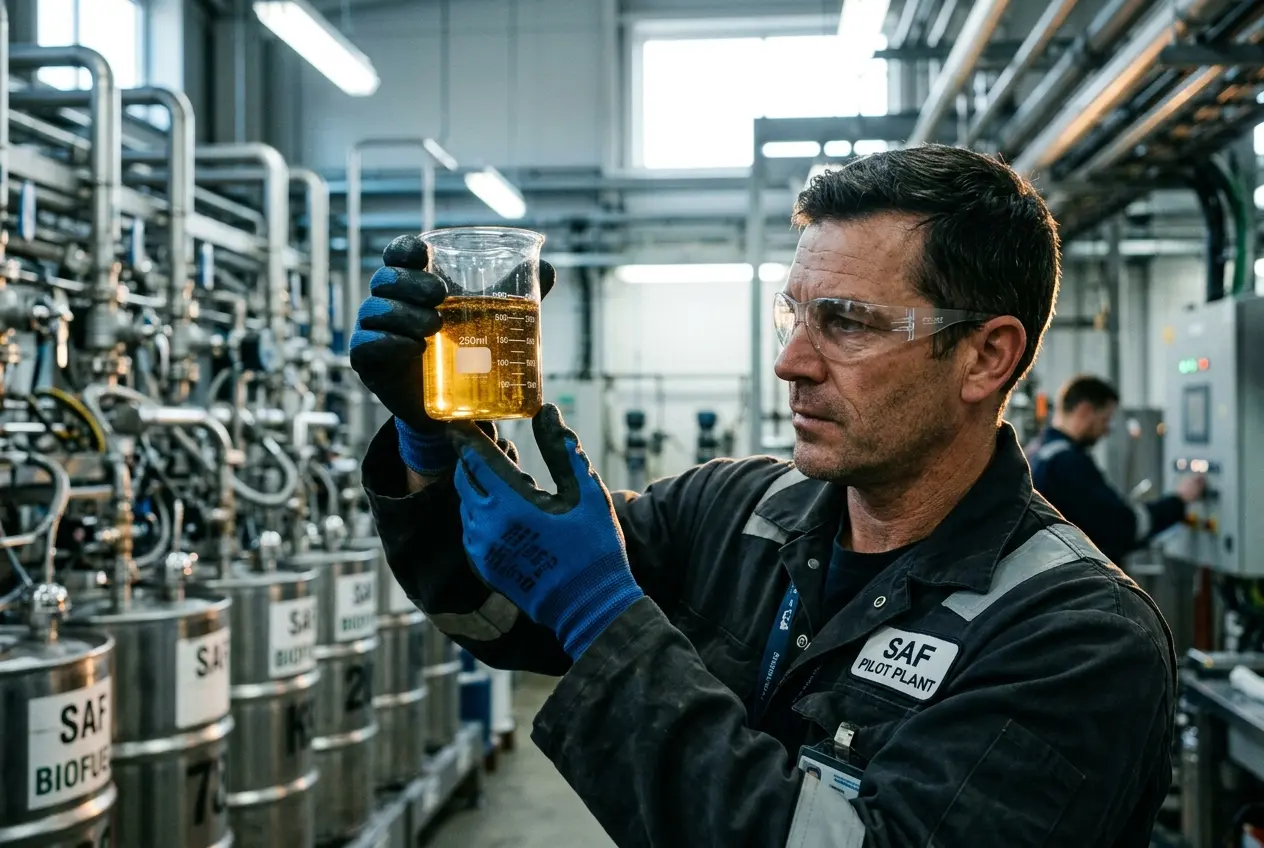
Opening the workshop, El Hefny told attendees he sees Egypt as a regional hub for SAF production, citing the country’s geography, expanding renewables and green hydrogen capacity, and upgraded aviation infrastructure. The pitch puts Egypt at the intersection of feedstock supply and aviation demand, two sides of a fuel chain global SAF projects still struggle to balance. The ministry’s framing for the study also names investment opportunities, private-sector participation, and financial-institution cooperation, the three rails any national roadmap must run on.
Two domestic pieces already back the pitch. The state-owned Egyptian Petrochemicals Holding Company, known as ECHEM, has been studying a domestic SAF plant with technical assistance from the European Bank for Reconstruction and Development, which was among the bodies in the workshop room. EgyptAir Holding and the Egyptian Holding Company for Airports and Air Navigation are at the table alongside the ministries of petroleum, industry, environment, agriculture, and tourism.
Those counterpart bodies matter because SAF touches more than aviation alone. The fuel chain pulls in agriculture (feedstock), waste management (used cooking oil and municipal waste), refining (industrial capacity), and finance (green hydrogen credit lines). The workshop drew all of them, plus the Suez Canal Economic Zone, the Agricultural Research Centre, Citadel Capital, ECARO, Biodiesel Misr, and the Egyptian Company for Sustainable Aviation Fuel and Biofuels (ESAF). Egypt is offering the workshop a venue, and the room reads like a credit committee on a future refinery.
At the same time, the hub pitch rests on claims, not capacity. Egypt has not yet produced SAF commercially at any scale. Domestic refining is configured for petroleum products, and ASTM-certified SAF pathways need new pretreatment and supply chains. The workshop itself is a feasibility study, which by definition means the hub case still sits in the modelling phase. El Hefny’s opening statement set the workshop’s goal as building a national industry, diversifying aviation energy sources, and lowering carbon emissions.
How the Study Slots Into a Broader EU-ICAO Push
Egypt is joining a pipeline that the EU and ICAO have been running for more than a year. On 25 September 2025, European Commissioner for Sustainable Transport and Tourism Apostolos Tzitzikostas and ICAO Secretary-General Juan Carlos Salazar marked the completion of three earlier ACT-SAF studies at the 42nd ICAO Assembly, a business implementation case for South Africa and feasibility studies for Ethiopia and India. Egypt’s study is among the next round inside that project envelope. Implemented jointly by ICAO and the European Union Aviation Safety Agency (EASA), the work covers 15 states across Africa and Asia and supports feasibility studies, business cases, and capacity-building.
The project carries a budget of €4 million, financed entirely by the EU. The 15-state design means Egypt’s outputs will sit side by side with peer countries at a comparable stage, and the EBRD’s parallel feasibility work for ECHEM runs as a separate channel.
ACT-SAF is more than feasibility work. With United Kingdom support, the programme ran in-person training sessions in Tanzania, Equatorial Guinea, and Cameroon between March and April 2024, and with Austrian support in Viet Nam in July 2025. France has funded the ACT-SAF Accelerator, a pilot focused on cassava and cashew feedstock analysis in Côte d’Ivoire, and has paid for the regulatory work needed to insert SAF into that country’s national bioenergy code. Egypt’s launch in mid-July finally brings the same pipeline to North African aviation, with project details on ICAO’s ACT-SAF programme page.
The SAF Plant Egypt Is Already Building Alongside
Egypt’s roadmap is not built from a blank page. The EBRD is running a parallel feasibility assignment for a project company under ECHEM that targets 120,000 tonnes of SAF per year, processed mainly from locally collected used cooking oil. The EBRD scope covers a Phase 1 scope-definition exercise and a Phase 2 feasibility study, with progression between phases decided by the bank and the stakeholders, per the EBRD’s published project description.
That is the fuel chain the workshop is meant to plug Egypt into. Used cooking oil, or UCO, is one of the simplest ASTM-certified SAF feedstocks today because it bypasses the food-versus-fuel debate and starts from a waste stream. Egypt imports most of the edible oil it consumes, which leaves the waste pool large and ties feedstock prices to global edible-oil markets. The ECHEM project, if it proceeds, would rank among the larger UCO-to-SAF plants announced in the MENA region, in the same feedstock family as used-cooking-oil projects under study in Asia and the Gulf. Capital is also flowing in from outside the workshop: a separate $200 million SAF plant in the Suez Canal Economic Zone is being financed outside the ACT-SAF track, signalling that Egypt’s SAF story now has at least two capital pipelines running in parallel.
The Numbers Behind Egypt’s SAF Push
- 10 days of ICAO expert data collection after the workshop closes.
- 25 measures in Egypt’s second national action plan to ICAO for 2025, covering air traffic management, operational efficiency, and airport infrastructure.
- €4 million EU budget for the 15-state ACT-SAF feasibility and capacity-building project.
- 120 ktpa SAF target for the ECHEM plant under the parallel EBRD feasibility assignment, fed mainly by used cooking oil.
- net-zero by 2050 ICAO long-term aspirational goal for international aviation, adopted at the 41st Assembly.
The Stakeholders Who Filled the Workshop
The opening session was small enough to be deliberate and broad enough to be revealing. ICAO’s side was led by Maria Gonzalez, the ACT-SAF project coordinator, with technical advisor Jacoba van Dijk. The International Air Transport Association (IATA) sent Farah Mismar, signalling that air carriers want a seat at the table before the rulebook is written.
Egypt’s delegation carried the regulatory weight. Reem Oraby, the alternate delegate to ICAO, anchored the policy side. Pilot Karim Gamil served as ACT-SAF national focal point and advisor to the Civil Aviation Authority President. Navigator Ahmed Sokkar covered airport safety and air navigation as vice president of the authority, while Dr Pilot Mohamed Salah brought aviation safety in the same vice-president tier. Salma El-Tahhan, head of the Central Administration for Air Transport, and Pilot Ahmed Matar, assistant president of the Egyptian Holding Company for Airports and Air Navigation, rounded out the regulator-and-operator stack.
On the Egyptian Side
- Reem Oraby, alternate delegate to ICAO.
- Pilot Karim Gamil, ACT-SAF national focal point and advisor to the Civil Aviation Authority President.
- Navigator Ahmed Sokkar, vice president of the Civil Aviation Authority for Airport Safety and Air Navigation.
- Dr Pilot Mohamed Salah, vice president for Aviation Safety at the Civil Aviation Authority.
- Salma El-Tahhan, head of the Central Administration for Air Transport.
- Pilot Ahmed Matar, assistant president of the Egyptian Holding Company for Airports and Air Navigation.
What the 10-Day Data Visit Has to Deliver
The data-collection mission that started when the workshop closed has to translate a long list of attendees into a working document. The ministry’s framing covers national capabilities, investment opportunities, and a framework for private-sector and financial-institution cooperation. The technical study will read against CORSIA’s eligibility rules for SAF sustainability and the carbon-accounting rules Egypt will adopt for SAF uptake. After the technical study, a separate national roadmap is due. Both outputs will feed into whatever ECHEM, the EBRD, and the ministries of petroleum, industry, and environment decide on next.
Egypt’s airport sustainability record is the strongest card the ministry can play while the data is being crunched. Cairo International and Hurghada International received the Airports Council International (ACI) environment and sustainability award for 2025, while Alexandria International was recognised by ICAO-Africa for its green infrastructure and recycling initiatives. The awards date to the operational measures in the second national action plan, not to fuel switching, but they signal that the regulator can deliver change in line with international standards. That track record is the proof El Hefny can lean on when financial institutions ask who is implementing the deal.
The feasibility study aims to build a national industry, diversify aviation energy sources, and lower carbon emissions.
Sameh El Hefny, Egypt’s Minister of Civil Aviation, opened the ACT-SAF workshop with those words at the ministry’s headquarters in Cairo on 13 July 2026.
Frequently Asked Questions
What is the ACT-SAF programme that Egypt has joined?
ACT-SAF is the ICAO Assistance, Capacity-building and Training for Sustainable Aviation Fuels programme, launched on 1 June 2022 alongside the Stockholm+50 conference. It supports member states through feasibility studies, business implementation cases, training sessions, regulatory advice, and an accelerator track, all aimed at helping countries design their own SAF industries. Egypt’s two-day workshop in Cairo is the entry point into that pipeline.
How much SAF could Egypt produce?
The parallel EBRD feasibility assignment for ECHEM targets 120,000 tonnes of SAF per year, produced mainly from locally collected used cooking oil. ACT-SAF’s own mandate is to write the technical study and roadmap, not to fund a refinery, so the volume side of the equation will be settled by ECHEM and any future private-sector partners.
When will the Egyptian SAF roadmap be ready?
ICAO experts are scheduled to spend 10 days in Egypt gathering data with national authorities before they begin drafting the technical feasibility study. The national roadmap follows the technical study as a separate document, so a full publication date has not been set, and the ministry has not named a target year for first commercial SAF output.
Will SAF adoption change flight prices from Egyptian airports?
SAF currently costs more than conventional jet fuel, but ticket prices depend on airline pricing, route competition, and any future SAF blending mandates in the European Union and other destinations. Egypt’s roadmap work is preliminary and does not yet set a domestic blending obligation or a price pass-through rule.
