
The Royal BC Museum opened Ancient Egypt: Obsessed with Life on June 5 in Victoria, British Columbia, an exhibition whose title sits in deliberate tension with its four-zone structure built around mummification, the underworld, the grave, and the afterlife. That tension is the exhibit’s central argument. The show assembles around 250 original ancient objects from the classical pharaonic period and runs through January 3, 2027.
The ancient Egyptians weren’t a death-fixated civilization. They built the most elaborate funerary infrastructure in history because existence mattered enough that they spent lifetimes engineering what came after it.
Nine Thousand Square Feet of Pharaonic Time
Across 9,000 square feet on the RBCM’s second floor, the exhibition covers the classical pharaonic period: roughly 2686 to 1069 BCE, from the Old Kingdom through the New Kingdom, a span Egyptologists call the Age of the Pyramids. Objects from the Late and Greco-Roman periods are also in the collection, bringing the historical sweep to more than 1,600 years of a single civilization’s practice.
Embellished coffins share the floor with grave goods, jewelry, and the everyday items Egyptians believed would accompany souls into eternity. The curators’ logic reflects how Egyptians themselves thought. There was no clean separation between sacred and practical. A cosmetic jar belonged in the tomb for the same reason you’d pack a bag for any long journey, because you’d need it. Utility mattered in the afterlife.
The pharaonic period covered here is the one most people picture when they think of ancient Egypt. The great pyramid complex at Giza dates to the Old Kingdom, the early centuries of that span. The New Kingdom pharaohs, toward the later end, produced some of the most recognizable funerary objects in world archaeology. The exhibition concentrates on the centuries when Egyptian funerary art reached its most developed and visually elaborate form.
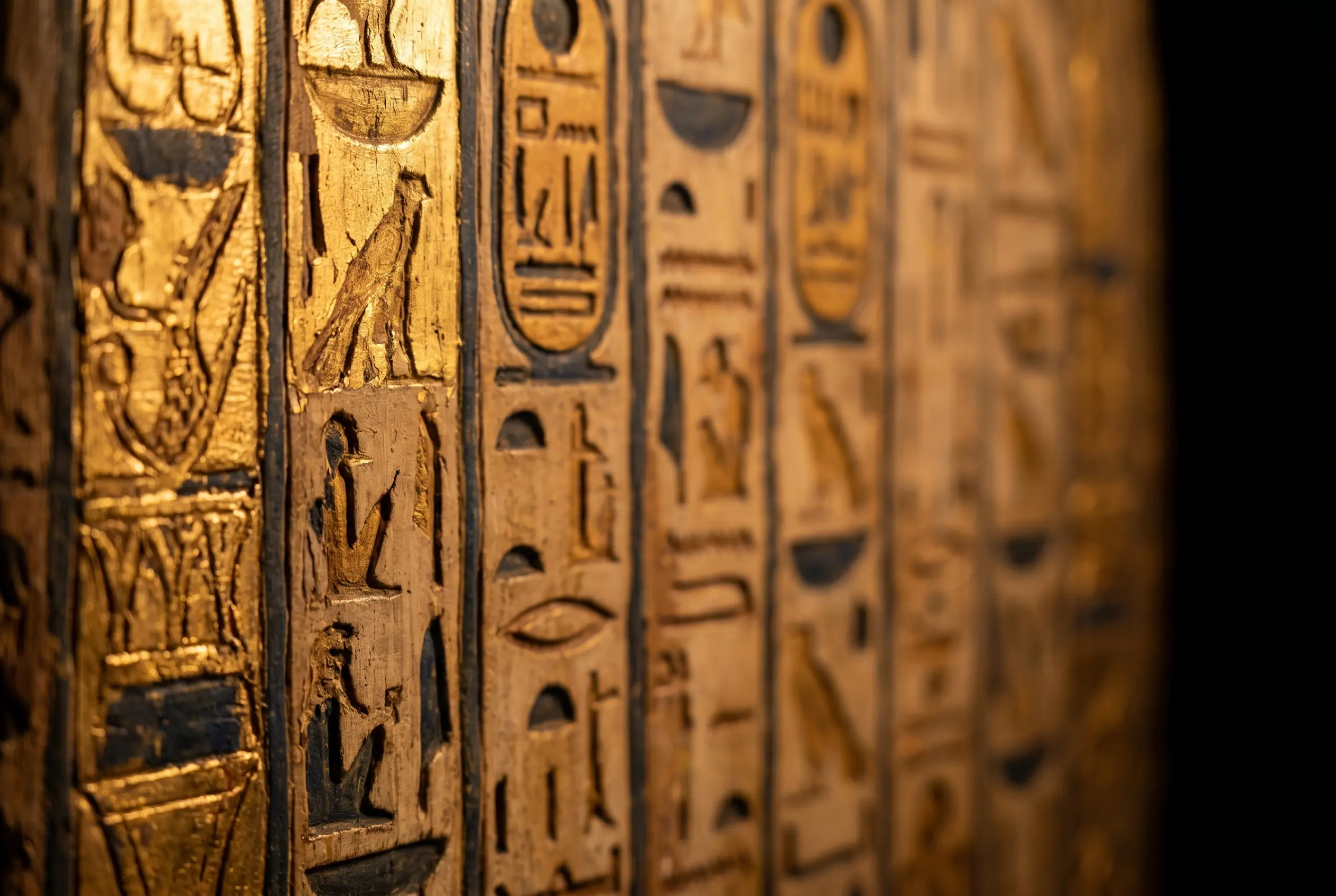
What makes the collection significant is the word “original.” These are ancient objects, not reproductions. A 3,000-year-old painted panel carries the specific choices of the artisan who applied the pigment, the surface wear of time, and a physical trace of an individual moment of human production. The RBCM’s official exhibition announcement frames the rooms as “intimate, atmospheric” spaces designed to feel like passage rather than display.
Four Zones, One Civilization
The exhibition divides into four thematic sections. Visitors move through them in sequence, following a path that mirrors the journey ancient Egyptians believed the soul would take after death.
- Mummification: Preservation practices and the ritual knowledge that governed them. This section covers what the physical body required to begin the journey ahead, including the elaborate 70-day process in its most developed classical form and the specialist knowledge it demanded from those who performed it.
- The Underworld: The mythology of the realm of the dead serves as the interpretive backbone here, where imagery of divine judgment, including the weighing of the heart against the feather of Ma’at, the Egyptian goddess of truth and cosmic order, gets direct visual representation alongside the texts that shaped it.
- The Grave: Coffins, grave goods, jewelry, and objects buried alongside the deceased, many of them as functional as they were symbolic. Egyptian scribes produced manuscripts specifically to guide souls through these passages. Researchers at the Fitzwilliam Museum in Cambridge have studied a 3,300-year-old Book of the Dead papyrus that shows exactly how much care went into producing that guidance, including the correction of artistic errors partway through the work.
- The Afterlife: The culmination of the sequence, covering the belief system that made all the preparation worthwhile: continued existence beyond death, imagined in substantial detail and provisioned for with equivalent care.
Walking those four zones in order means moving through a route the ancient Egyptians spent generations mapping in ritual text, tomb painting, and funerary architecture. The sequence isn’t a curatorial arrangement; the Egyptians prescribed it, and the exhibition follows their directions.
Reconstructed Scents and a Virtual Descent
Built into the rooms alongside the artifacts are immersive films, ambient soundscapes, and scientifically reconstructed ancient Egyptian scents. The RBCM has woven those elements through the exhibition’s four zones rather than staging them as a separate interactive annex at the end.
Scientifically reconstructed scents in a museum context are uncommon. The olfactory sense doesn’t process a smell as “historical” the way the eye reads a label, so the effect is immediate in ways that even spectacular artifacts can’t always achieve on their own. Ancient Egyptian funerary ceremony assigned specific resins, oils, and incense to specific stages of the ritual process, with particular materials designated for particular moments in the preparation of the body and the performance of burial rites. Approximating them in a gallery gives visitors a sensory connection to the ritual atmosphere that painted surfaces can describe but can’t produce.
The RBCM positioned this show as its summer blockbuster, a label the museum itself has used in its programming materials. The most ambitious single interactive is a virtual 3D ride through the Egyptian underworld, making kinetic what the exhibit’s painted objects and texts describe in symbolic form. Hands-on stations run alongside the permanent artifacts throughout the gallery, built for family visits and school groups as much as for artifact-focused adults.
Twenty-Five Years of Egypt at the RBCM
Allison Bond, the recently appointed chief executive of the Royal BC Museum, was direct about what drives the museum’s programming decisions around this subject.
Over the past 25 years, ancient Egypt has consistently been among our most popular exhibition themes, so we know people are still interested and still feel like they have more to learn about this incredibly complex ancient civilization.
Bond spoke in statements accompanying the exhibition’s June 5 opening.
Twenty-five years of consistent audience preference is a specific kind of evidence. Ancient Egypt has perennial pull in the museum world because it’s one of the few ancient civilizations where physical artifacts simultaneously function as archaeological evidence and as objects of inherent visual power. A New Kingdom coffin decorated with hieroglyphic texts and painted divine figures holds a visitor’s attention without needing a label to explain itself.
Ancient Egypt’s civilization lasted roughly 3,000 years, making any single exhibition at best a concentrated window onto one tradition within a vast, slowly evolving culture. Bond’s framing of the show as “a new look at a familiar topic” acknowledges the repeat visitor as an explicit constituency. Audiences return to this subject because they’ve found it rewarding before. What this exhibition adds to that relationship is 250 original artifacts, scientific olfactory reconstruction, and a virtual geometry ride that didn’t exist as museum technology when the RBCM first started programming Egypt exhibitions a quarter century ago.
The Royal BC Museum is among the oldest continually operating museums in Canada, and Bond, as its recently appointed chief executive, is positioning it as a destination for ambitious international exhibitions of this scale.
Planning Your Visit
The exhibition is the RBCM’s summer anchor for 2026, covering a seven-month run from its June 5 opening through the new year. The museum sits at 675 Belleville Street in Victoria on lək̓ʷəŋən territory, acknowledged by the museum as the traditional lands of the Songhees and Xwsepsum Nations.
| Detail | Information |
|---|---|
| Exhibition dates | June 5, 2026 to January 3, 2027 |
| Address | 675 Belleville Street, Victoria, BC V8W 9W2 |
| Exhibition location | Second floor, Royal BC Museum |
| Museum hours | 10 a.m. to 6 p.m. (confirm current hours at rbcm.ca) |
| Transit access | Multiple routes stop within one to two blocks; no museum-operated parking lot on site |
| Transit family benefit | BC Transit 30-day pass holders may bring up to four children aged 12 and under free with paid adult admission |
| Membership admission | Museum members free; Combo members (RBCM and IMAX Victoria) free for both venues |
| Paired experience | IMAX Victoria operates on site at the same address |
The RBCM recommends 2 to 4 hours for the full museum visit. For visitors adding a film, IMAX Victoria’s current showtimes are listed on the IMAX site. Those planning multiple visits can compare RBCM membership options, which cover unlimited entry to the galleries and exhibitions.
Frequently Asked Questions
How Long Should Visitors Plan to Spend at the Ancient Egypt Exhibit?
The RBCM recommends 2 to 4 hours for the full museum experience. The Egypt exhibition covers 9,000 square feet across four thematic zones, plus the virtual 3D underworld ride and hands-on interactive stations. Visitors primarily interested in the collection should budget at least 90 minutes for the exhibition floor alone, separate from the main galleries on other floors.
Is Ancient Egypt: Obsessed with Life Appropriate for Young Children?
Yes. The museum describes the exhibition’s interactive components, including hands-on stations and the virtual 3D ride, as designed for the whole family. The content covers mummification, death, and afterlife beliefs, so parents may want to preview the material for very young children. BC Transit 30-day pass holders can bring up to four children aged 12 and under free with a paid adult admission.
What Historical Period Does the Exhibition Cover?
The exhibition focuses on the classical pharaonic period from roughly 2686 to 1069 BCE, covering the Old Kingdom through the New Kingdom, the era Egyptologists call the Age of the Pyramids. Objects from the Late and Greco-Roman periods of ancient Egyptian history are also included, extending the collection’s historical range beyond the pharaonic core.
Does the Museum Offer Parking?
The Royal BC Museum does not own or operate a parking lot. Several privately run lots are available nearby, with street parking on surrounding streets. Victoria’s transit network has multiple routes stopping within one to two blocks of 675 Belleville Street, and bike racks are available around the building.
Can Visitors Combine the Egypt Exhibition with an IMAX Victoria Film?
Yes. IMAX Victoria operates on site at 675 Belleville Street. Combo memberships cover both the museum galleries, including the Ancient Egypt exhibition, and documentary IMAX screenings. Single-visit tickets combining museum admission with an IMAX documentary are also available, and the museum shop carries exhibition-related merchandise.
Ancient Egypt: Obsessed with Life is open at 675 Belleville Street in Victoria through January 3, 2027.
