
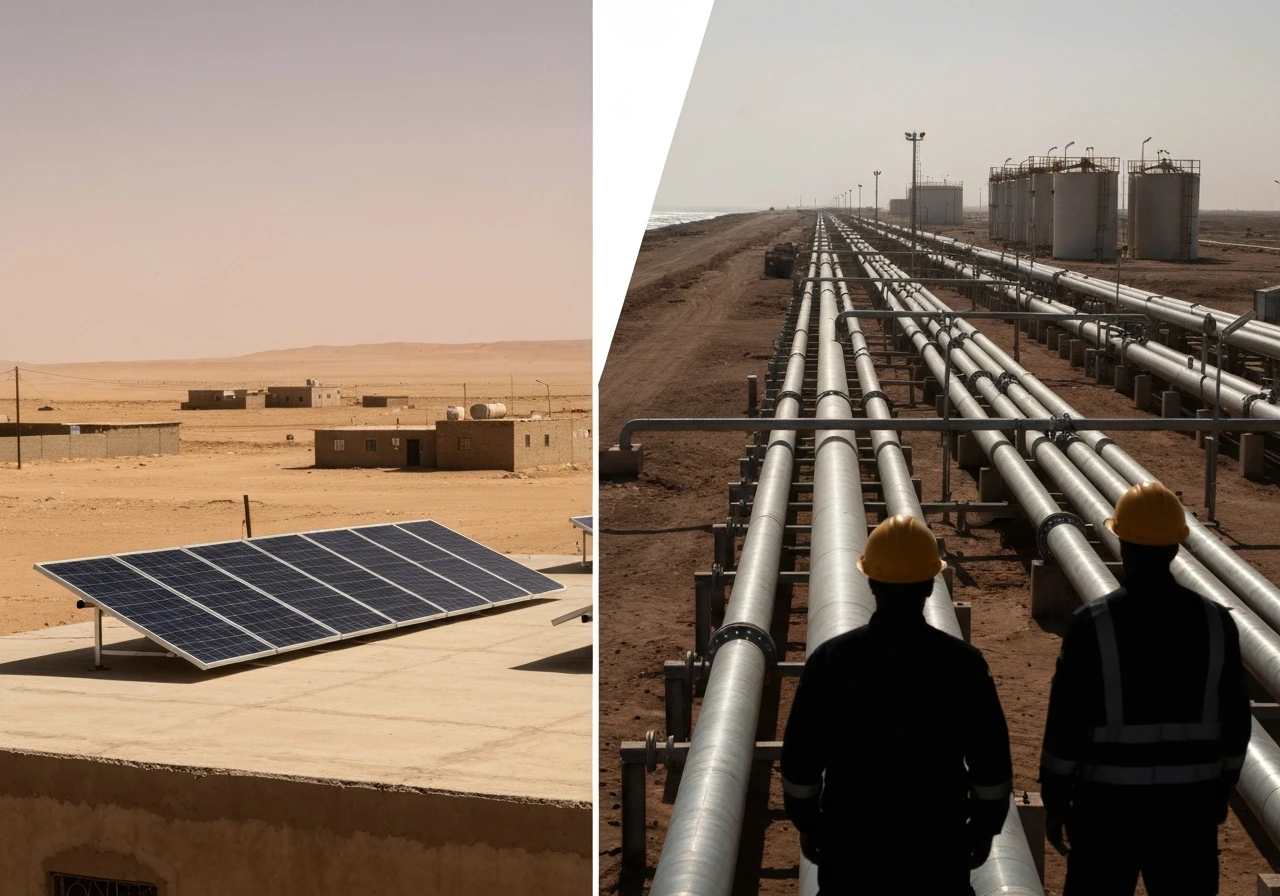
Middle East climate adaptation now runs on two extremes. In the Syrian village of Khirais, 24 households keep the power on around the clock for roughly 20 cents each a month. Six hundred kilometres away, Jordan has signed a deal worth billions of euros to pull drinking water out of the Red Sea. Same problem, wildly different price tags.
The region is heating at twice the global average, and the comfortable assumption that oil money can buy a way out of the climate is cracking. Qatar’s emissions, Jordan’s empty taps and Syria’s dead grid each show the same thing: wealth changes the scale of the response, not the guarantee that it works.
The Heat Is Outrunning an Old Survival Playbook
The Middle East is warming at roughly twice the global average, a pace flagged repeatedly in regional warming data from the World Meteorological Organization (WMO, the United Nations weather and climate agency). Projections point to summer temperatures climbing about 4 degrees Celsius by the end of the century, with combined heat and humidity that could push past the threshold the human body can survive outdoors.
That math reorders everything built on top of it. Intensifying droughts and dust storms speed up desertification, and farm collapse uproots whole communities; the loss of the wetlands that sustained Iraq’s Marsh Arabs has already pushed families toward cities with no room for them. Climate stress has shifted from a background risk to a primary driver of instability, fuelling competition over land and freshwater that no single community, rich or poor, can absorb alone.
Governments have started to move. The United Arab Emirates passed a national climate change law, and others are pouring money into infrastructure meant to lock in water, power and movement. Three projects, in three very different states, show how differently that money behaves once it hits the ground.
Qatar Bet on Rails to Break Doha’s Car Habit
Wealth has not spared Qatar. Decades of fast, car-centric growth left Doha with severe sprawl and one of the highest per-capita greenhouse gas emission rates on the planet, plus commutes that drain time and productivity. Rising heat only deepens the trap, because hotter streets push more people into air-conditioned cars, which burns more energy and warms the city further.
The state’s answer is the Doha Metro, a fully automated rail system that will eventually run 75 trains across about 300 kilometres on four lines, the Red, Green, Gold and Blue. Built by the state-owned operator Qatar Rail and financed through the Qatar Development Bank, it sits at the centre of the country’s National Vision 2030 development plan and carried heavy passenger loads during the 2022 World Cup.
The climate logic is twofold. Every train trip displaces car journeys, trimming carbon dioxide and the local pollutants that foul city air, and by clustering homes, offices and civic space around stations, the network nudges the city toward denser, mixed-use neighbourhoods instead of endless heat-soaking sprawl.
We simply cannot afford to move ahead with the current development model. We have to change the way people move.
That was Abdulla Al-Subaie, managing director of Qatar Rail, framing the system as survival rather than convenience. The network also widens cheap mobility for lower-income residents, an equity gain folded into the climate one.
Jordan’s Multi-Billion Wager on the Red Sea
Jordan does not have the luxury of a slow-moving threat. It is one of the most water-scarce countries on earth, and the taps are already running dry.
A Water Map Running on Empty
The everyday numbers are stark, and they explain why patience is not on offer.
- Households in Amman, the capital, receive piped water just two days a week; some regions get supply only once a fortnight.
- A study in Al-Mafraq Governorate found 43% of residents had experienced water contamination.
- Annual per-capita water availability has fallen to about 60 cubic metres, Water and Irrigation Minister Raed Abu Soud said recently.
- The UN children’s agency UNICEF projects that worsening water stress could cut Jordan’s gross domestic product (GDP) growth by up to 6% by 2050.
It gets tighter. Regional models suggest groundwater and surface water will each drop about 15% by 2040, dragging internal long-term resources down from 65 to 46 cubic metres per person. Lower aquifer recharge and heavy farming are pushing up salinity and the concentration of arsenic, selenium and radium, which means costlier treatment on top of a shrinking supply.
Pulling Supply From the Sea
The centrepiece response is the Aqaba-Amman Water Desalination and Conveyance Project, billed by its builders as the world’s second-largest desalination plant. A reverse-osmosis facility on the Gulf of Aqaba will produce 851,000 cubic metres of water a day, enough to cover up to 40% of national drinking water for more than 3 million people, then send it about 445 kilometres north to Amman, climbing more than 1,000 metres along the way. The technical scope of the Aqaba desalination contract puts the headline cost at 4 billion euros (about 4.3 billion US dollars).
It is structured as a build-operate-transfer (BOT) concession, in which a private consortium led by infrastructure investor Meridiam and water specialist Suez finances, builds and runs the system for 30 years before handing it back to the state, with backing from development lenders. The official account of the Aqaba-Amman water programme describes a renewable-powered design meant to ease pressure on depleted aquifers rather than drain them further.
“This project is really transformational for people in Jordan,” said Souad Farsi, the European Investment Bank’s representative to Jordan. The catch is time: the plant is not expected to deliver at full tilt until near the end of the decade, which is a long wait for a household rationed to two days of water a week.
A Syrian Village Fixed Its Blackout for Pennies
Syria shows what adaptation looks like when there is no national budget to lean on. After more than a decade of war and economic collapse, a UN humanitarian overview warns of a further 1 to 3 degrees Celsius of warming by 2050, fuelling heatwaves, droughts, wildfires and dust storms on top of broken infrastructure.
The grid is the weak point. In 2021, water levels in the Euphrates reservoirs fell so far that hydroelectric stations went offline, and parts of the northeast were cut to two hours of power a day. At the worst moments, electricity was rationed to water stations, hospitals and bakeries only, to stop basic services collapsing altogether.
Many households fell back on diesel generators, trading blackouts for fumes that worsened the air in places already battered by conflict. Kerosene lamps filled the gaps, a cheap but hazardous source of light and indoor pollution.
In the village of Khirais, residents took a different route with help from the Aga Khan Foundation (AKF, a development agency within the Aga Khan Development Network). In early 2021 the foundation mounted solar panels on the community centre, and all 24 households formed a cooperative, each paying about 20 cents a month toward maintenance, as detailed in the foundation’s account of the Syrian village solar project.
The payoff is 24-hour power for every home and shared space, around one kilowatt an hour per household, enough to run lights, a refrigerator and basic appliances. The generators and lamps are gone, indoor air has cleared, working days have stretched, and AKF has since helped more than 3,400 households across Syria add solar-powered water pumps while copying the model in other communities.
Three Models, Three Price Tags Compared
Set side by side, the three responses are almost a controlled experiment in what climate money buys at different scales.
| Project | Headline cost | What it delivers | How it is paid for | Time to impact |
|---|---|---|---|---|
| Doha Metro (Qatar) | Multi-billion state spend | Toward 75 trains on about 300 km of automated rail | State, via Qatar Rail and the Qatar Development Bank | Operating since 2019, still expanding |
| Aqaba-Amman desalination (Jordan) | 4 billion euros | 851,000 cubic metres a day, up to 40% of drinking water | BOT concession, Meridiam-Suez consortium, donor-backed | Full supply expected near 2029 |
| Khirais solar co-op (Syria) | A few thousand dollars | Round-the-clock power for 24 households | Community fees plus an NGO grant | Live since 2021 |
The gap in financial engineering is just as wide as the gap in cost. Jordan’s plant leans on guarantees from institutions like the World Bank’s Multilateral Investment Guarantee Agency (MIGA), as set out in its guarantee record for the Aqaba-Amman water concession, while the village co-op needed nothing more than panels, a roof and a membership list.
Why the Cheapest Fix Travels Furthest
Big projects buy scale that nothing else can match. A desalination plant can water millions; a metro can pull a whole city off its cars. But scale comes with long timelines, heavy debt and single points of failure, and water and power systems that cross borders depend on cooperation that conflict in Gaza, Iran and beyond is steadily shredding.
Decentralized solar carries none of that baggage, which is why it spreads. The same logic is showing up in state-led programmes too, from Saudi Arabia’s Riyadh Action Agenda on land restoration and drought resilience to its work on soil mapping to keep farming viable under water stress. What makes a fix copyable tends to come down to a short list:
- An upfront cost a community can actually fund
- No reliance on a fragile central grid or cross-border deals
- Local ownership, so people maintain what they paid for
- A modular design that can scale village by village
None of this means the village panel beats the desalination plant. Jordan cannot run on cooperatives, and Doha cannot fix sprawl with rooftop solar. The honest read is a portfolio, where mega-infrastructure and grassroots kit each cover a pressure point the other cannot reach.
Still, the arithmetic is hard to ignore. The Khirais cooperative bought permanent power for the price of a few panels and pocket change a month, while Jordan is borrowing billions for water that will not flow until the end of the decade. In a region this far ahead of the global thermostat, the size of the cheque was never the real measure of resilience.
Frequently Asked Questions
Why is the Middle East warming faster than the rest of the world?
The region is heating at roughly twice the global average, according to the World Meteorological Organization. Its dry land surfaces, limited cloud cover and geography amplify the warming, and summer temperatures could climb about 4 degrees Celsius by the end of the century, pushing heat and humidity toward the limit the human body can survive outdoors.
What is the Aqaba-Amman Water Desalination and Conveyance Project?
It is a 4 billion euro plan to build the world’s second-largest desalination plant on Jordan’s Gulf of Aqaba coast, producing 851,000 cubic metres of drinking water a day and piping it about 445 kilometres north to Amman. Once running, it is designed to cover up to 40% of national drinking water for more than 3 million people.
How little does Jordan’s per-person water supply now amount to?
Water and Irrigation Minister Raed Abu Soud said annual per-capita availability has fallen to about 60 cubic metres, far below the 500 cubic metre line commonly used to define absolute water scarcity. Internal long-term resources are projected to fall further, from 65 to 46 cubic metres per person, by 2040.
How does the Doha Metro help Qatar adapt to climate change?
The fully automated Doha Metro displaces large numbers of car trips, cutting carbon dioxide and local air pollution, and it encourages denser neighbourhoods around stations instead of heat-trapping sprawl. It runs toward 75 trains across about 300 kilometres on four lines and anchors the country’s National Vision 2030 plan.
How did the Khirais solar project in Syria work?
With support from the Aga Khan Foundation, solar panels were installed on the village community centre in early 2021, and all 24 households formed a cooperative paying about 20 cents a month for upkeep. The system delivers around-the-clock power, roughly one kilowatt an hour per home, replacing diesel generators and kerosene lamps.
Which Middle East climate adaptation model is most replicable?
Decentralized solar like the Khirais cooperative is the easiest to copy, because it is cheap, locally owned and independent of fragile national grids or cross-border cooperation. Large projects such as desalination plants and metro systems deliver far greater scale but need billions in financing and years to build, so most experts favour a mix rather than a single solution.
