
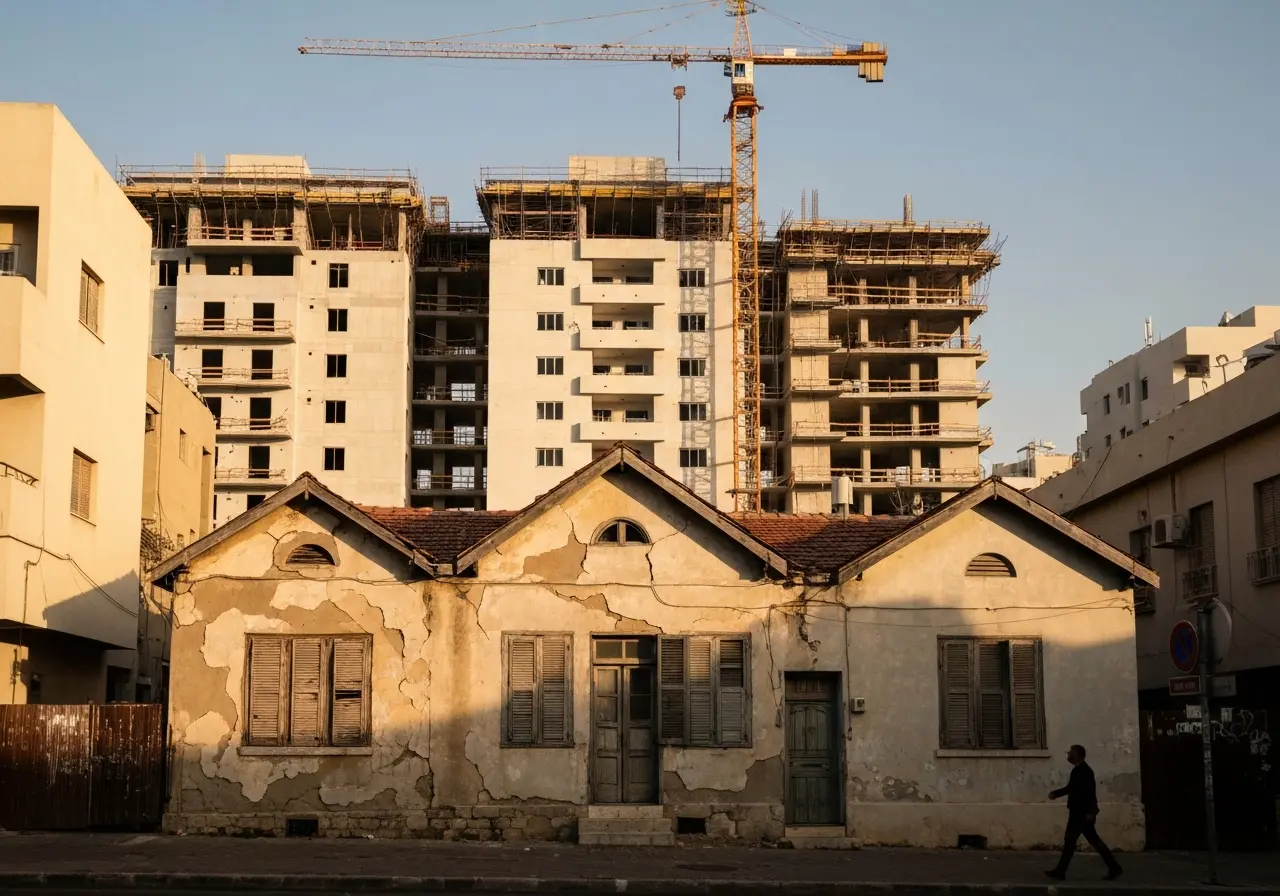
Three small, decaying houses on a single stretch of Bar Kokhba Street in central Tel Aviv have changed hands for NIS 24.5 million (the Israeli new shekel, or close to $7 million), and not one of them is worth keeping. Each is roughly 60 square meters, very old, and already slated for the wrecking crew. What the buyer, a development company, paid for is the dirt underneath and the right to build something far taller on top of it.
That right is the whole game. The structures are scrap, the land is scarce, and the future tower exists only on paper until the Tel Aviv-Yafo Municipality decides how many floors and apartments the site can legally carry. The price tag is a bet that the answer comes back generous.
What Changed Hands on Bar Kokhba Street
The transaction covers three adjacent lots, two semi-detached houses and one detached house, on a combined 407 square meters in the southern part of Bar Kokhba Street near the Trumpeldor Street intersection. The deal was brokered by Haim Kapustin of the DreamTown real estate agency, who spent months stitching together a seller group that had no reason to agree on anything.
One house belonged to a single businessman. The other two units were held by 10 heirs, the kind of fragmented inheritance ownership that routinely freezes Israeli urban-renewal sites for years. A few years ago the owners floated a combination deal, in which a developer builds in exchange for a share of the new apartments, but disagreements between the landowners killed it before it moved.
This time the lot went to a single outside buyer for cash, and the math changed. Faced with a clean offer rather than a multi-party construction arrangement, the sellers came to the table.
- NIS 24.5 million paid for the combined site
- 407 square meters of land across three adjacent lots
- 60 square meters the footprint of each old house
- 11 sellers in total, one businessman and 10 heirs
“The negotiations took several months,” Kapustin said of the process. The result is a consolidated parcel ready for demolition and a developer holding all the cards on a block where almost nothing trades.
Why the Dirt Costs More Than the Houses
Strip out the buildings and the price works out to about NIS 60,000 per square meter of land. That figure looks startling next to the going rate for finished apartments in the area, which sit around NIS 55,000 per square meter for older units and roughly NIS 58,000 for new ones. In other words, the buyer paid land prices that rival the per-meter cost of a built, livable home.
That only makes sense if you stop valuing the houses and start valuing the air above them. A 60-square-meter teardown produces nothing on its own. A consolidated 407-square-meter plot, by contrast, can support a mid-rise apartment building once the right permits land, and the spread between scrap value today and built value tomorrow is the entire investment thesis.
The table below shows why the structures barely register in the pricing.
| Component | What it is | Indicative value |
|---|---|---|
| Existing houses | Three teardowns, ~60 sqm each, demolition-bound | Effectively zero |
| The land | 407 sqm consolidated, city-center location | ~NIS 60,000 per sqm |
| Old apartments nearby | Resale units in surrounding 1950s-70s blocks | ~NIS 55,000 per sqm |
| New apartments nearby | Recently completed renewal units | ~NIS 58,000 per sqm |
Buyers in this market are not purchasing shelter. They are purchasing a future floor count, and the gap between what the lot is zoned for now and what it might be zoned for soon is where the money is made or lost.
The Bet Rides on Rights the City Hasn’t Granted
Here is the catch the headline price hides. The single most important variable, how much can actually be built, has not been settled. It can only be resolved by the Tel Aviv-Yafo Municipality, and in a district this dense the city treats added height and density as a sensitive matter rather than a rubber stamp.
The Precedent Next Door
The clearest guide is what neighbors already got. Urban-renewal projects in the area built under TAMA 38/1 (National Outline Plan 38, Israel’s national framework for seismic retrofitting and added density) typically rose five floors above the ground floor, plus a partial sixth, holding 9 to 11 apartments. The older 1990s-era plan still applying to the Bar Kokhba site allows similar rights.
Why the Municipality Holds the Pen
A developer building entirely new structures, rather than reinforcing an existing one as TAMA 38/1 required, may be able to push the rights slightly higher. But that uplift is a request, not an entitlement, and it runs through the Tel Aviv-Yafo municipal planning framework, where preserving the texture of a tightly packed historic core competes directly with the drive to add homes.
The Lot Size Sets the Ceiling
Even a friendly ruling has a hard limit: the parcel is only 407 square meters. Generous rights on a small footprint still produce a modest building. The lot will not allow much more than the five-to-six-floor envelope the area already shows, which means the upside on this wager is real but bounded. The buyer is betting on a better permit, not a skyscraper.
Quarters 5 and 6 Rewrite the Density Math
The bet does not sit in a vacuum. Bar Kokhba Street falls inside Tel Aviv’s central rova 5, one of the two city-center quarters now at the heart of a major rezoning. The municipality has decided not to oppose the District Committee’s removal of a building-rights restriction across quarters 5 and 6, a 1,680-dunam swath of the core, a move expected to lift the potential apartment count in the zone by around 20%.
That plan matters for a buyer holding a teardown lot for three reasons.
- It is the third such city-center plan to advance, after quarters 3 and 4 were approved and unlocked significant development, so the template is no longer experimental.
- Lifting the rights cap directly raises what individual lots inside the zone can support, which is precisely the variable this deal is exposed to.
- It signals that City Hall, for all its sensitivity about density, is leaning toward more homes in the center rather than fewer, per the city’s deposited master plan for the central quarters.
The constraint is heritage. Much of quarter 5 sits inside the UNESCO-listed White City, the Bauhaus-era ensemble of more than 4,000 buildings recognized in 2003, and that protected status keeps a tight leash on what rises among the low modernist blocks.
The Neighborhood Behind the Numbers
Bar Kokhba is a short central artery. It crosses Bograshov Street, meets Dizengoff Street near Dizengoff Center, and runs on toward Zamenhof, with the sold lots sitting at the quieter southern end by Trumpeldor. The streetscape is dominated by three-and four-story buildings thrown up between the 1950s and 1970s, modest in scale and aging fast.
Deals here are rare. Owners tend to hold, fragmented inheritances stall sales, and the small lot sizes make assembly painful, which is part of why a consolidated 407-square-meter parcel drew a clean cash buyer at all. Scarcity, not glamour, is the local pricing engine.
The wider center is also mid-transformation. Years of upheaval tied to central Tel Aviv’s long-running light rail disruption reshaped foot traffic and street life around Dizengoff, the same corridor this block feeds into, a reminder that location value here is being rewritten in real time.
What the Lot Will and Won’t Deliver
Run the likely outcome and the picture is solid rather than spectacular. A new building on the site lands somewhere near the neighborhood’s existing renewal envelope, five floors over a ground floor with a partial sixth, and perhaps a touch more density if the developer wins added rights as a fully new structure. Call it roughly 10 apartments, give or take, sold into a market where new units fetch around NIS 58,000 per square meter.
Against that, the buyer is in for NIS 24.5 million on the land alone, before demolition, design, financing and construction. The margin depends almost entirely on the permit. A standard approval makes this a competent deal; a rights uplift riding the quarters 5 and 6 rezoning turns it into a strong one.
The timing is not incidental either. TAMA 38 ended in Tel Aviv in 2024 and its national runway closes for good in May 2026, pushing urban renewal onto municipal plans like the city-center rezoning. Developers buying teardown lots now are positioning for the regime that replaces it, not the one expiring.
For now the parcel is exactly what it was the day the deal closed: three condemned houses on 407 square meters, priced as if the building permit is already in hand. If the municipality grants the density the quarters 5 and 6 plan points toward, the buyer looks early and right. If the rights come back capped to protect the dense historic core, the same NIS 24.5 million buys a much smaller building and a much thinner return.
