
Yaacov Agam, the Israeli pioneer of kinetic art, died on Sunday in Paris at 98. He had lived in Paris since 1951, and his death came weeks after he received the 2026 Israel Prize for Visual Arts at a private ceremony in April at the museum in Rishon LeZion that bears his name. Israel’s President Isaac Herzog described Agam as “one of the most respected and recognized Israeli artists in the world,” and added that he had given the world “a unique artistic language of movement, change and renewal.” The Times of Israel and the Jerusalem Post both reported his death on Sunday.
Per the same outlets, the artist’s coffin was placed for public viewing at the Yaacov Agam Museum of Art on Monday afternoon, from 2 p.m. to 4 p.m. The funeral procession left from the Rehovot military cemetery at 5 p.m.
From Sand Dunes to a Sand Dune’s Movement
Agam was born Yaacov Gibstein on May 11, 1928, in Rishon LeZion, in what was then British Mandate Palestine, the son of Rabbi Yehoshua Gibstein, a rabbi and kabbalist, and Kendel Yokheved Gibstein. As a boy, the Times of Israel records, he often ran away from school to the sand dunes outside the settlement, watching how the wind reshaped them. The shapes never held; the same hill looked different every time he returned to it, a fact he later said was the seed of his life’s work. That observation became the thesis of his art: the piece does not move, the viewer does.
His adolescence was interrupted in 1946, when British forces arrested him during Operation Agatha, the sweep known in Hebrew as Black Sabbath, and held him for several months at the Latrun detention camp. After the war he enrolled at the Bezalel Academy of Art and Design in Jerusalem, where he studied under Mordecai Ardon. He moved to Zurich in 1949 to study under Johannes Itten at the Kunstgewerbeschule, then settled in Paris in 1951, a city that would be his home and studio for the next seventy-five years.
Le Mouvement, and the Print That Took His Name
Agam’s first solo show opened at Galerie Craven in Paris in 1953, two years after his arrival. The wider attention came in 1955 with Le Mouvement, the group show at Galerie Denise René that put him alongside Marcel Duchamp, Jean Tinguely, and Alexander Calder. The exhibition was a hinge moment for kinetic art in Europe, and it is the show in which the Agamograph began to take shape. The technique is a print that uses a barrier-grid or lenticular surface to present a different image depending on the angle from which the viewer looks, a method he later registered under his own name.
He scaled it up for the 30-foot square “Complex Vision” on the facade of the Callahan Eye Foundation Hospital in Birmingham, Alabama, in 1969, and in lenticular print form the technique became the work most associated with his name. The interactivity drew critics as well as buyers: the Times of Israel’s obituary notes that some dismissed the work as “childish” or “unprofessional” because it required the viewer to move.
I grew up with an instinctive sense of creativity, and that’s the basis of Judaism, the sense of creativity, that nothing stands in one place, that change is based on the viewer’s position, and things look different every time.
That was Agam, at 97, in April, when he received the Israel Prize in a small ceremony in his own museum. The Times of Israel’s Jessica Steinberg reported his remarks at the time.
Public Works That Outlived the Studio
The Agamograph dominates the catalogue, but the public commissions reshaped cities from Paris to Tel Aviv. Agam furnished the antechamber of the Élysée Palace for President Georges Pompidou between 1972 and 1974, a commission later moved to the Centre Pompidou, and installed the monumental fountain at the La Défense business district in 1975. The Fire and Water Fountain in Dizengoff Square in Tel Aviv, completed in 1986, is the Israeli counterpart, a kinetic sculpture of color, water, and music that the Jerusalem Post calls one of the most recognizable public artworks in the country.
Across the wider map, his commissions ranged from a nine-pillar monument, Peaceful Communication with the World, at the 2009 World Games in Kaohsiung, Taiwan, to “Faith – Visual Pray,” a piece representing both Jewish and Christian symbols presented to Pope Francis in 2014.
In 1979, his Star of Peace was installed at Ben-Gurion University in Beersheba, a kinetic sculpture whose silhouette reads as the five-pointed star of Islam from one angle and the six-pointed Star of David from another, made to mark the peace between Anwar el-Sadat and Menachem Begin.
| Work | Year | Place |
|---|---|---|
| Complex Vision | 1969 | Callahan Eye Foundation Hospital, Birmingham, Alabama |
| Élysée Palace antechamber | 1972-1974 | Paris (later Centre Pompidou) |
| La Défense fountain | 1975 | Paris |
| Star of Peace | 1979 | Ben-Gurion University, Beersheba |
| Fire and Water Fountain | 1986 | Dizengoff Square, Tel Aviv |
| Peaceful Communication with the World | 2009 | World Games, Kaohsiung, Taiwan |
| Faith – Visual Pray | 2014 | Presented to Pope Francis |
Each of those works depends on the same trick: a piece that does not move on its own, but changes as the viewer walks around it. The catalogue lists the prints, but the cities list the monuments that most people will actually pass on a street in Paris, Tel Aviv, New York, or Beersheba.
The Method Behind the Art
The same principle of the viewer-as-partner that animated the Agamograph was, in 1996, the basis of an award he did not get for any single artwork. UNESCO gave him the Jan Amos Comenius Medal for the “Agam Method,” a program for the nonverbal visual education of young children that he had been developing for years.
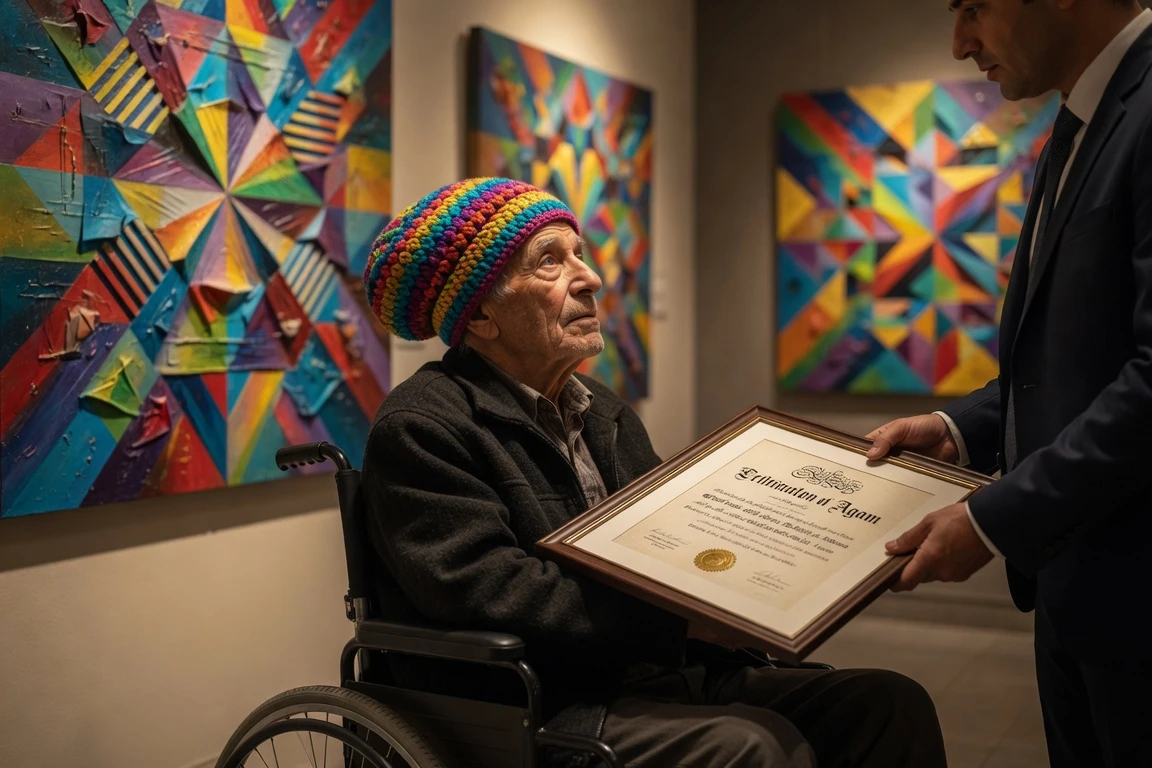
Three decades later, on the morning of April 20, 2026, two days before Israel’s Independence Day, Agam entered the museum in Rishon LeZion that bears his name to receive the 2026 Israel Prize for Visual Arts. He was in a wheelchair, unable to travel to Jerusalem, and the Education Minister, Yoav Kisch, brought the framed certificate to him. “When I look around at my works, what I see is beyond the pieces themselves,” Agam said at the ceremony. “I turn my head and see something different. Everything changes here. That’s the reality.”
The prize committee’s citation, released in January when the award was announced, said his work had “echoed a decades-long contribution to both Israeli and international art over the past 70 years” and had “broke the boundaries of traditional visual art” to “pioneer new languages in kinetic art and op art.”
His works, which have become part of some of the most important museums and collections in the world, and also here at the President’s House, expressed an extraordinary creative vision and were a source of inspiration for generations of artists and creators.
That was President Isaac Herzog, writing on X on the day Agam died.
Late Recognition, Mixed Echoes
The prizes of the last months of Agam’s life stood in contrast to the early reception of his work. Some of his contemporaries had treated interactive art as a provocation, dismissing his pieces as “childish” or “unprofessional” because they required the viewer to move, the Times of Israel’s obituary notes. He outlived the complaint. By the time of his death, his work filled the lobby of the President’s House, where Herzog had known him personally since childhood, and his career had been formally closed by a prize awarded in his own museum.
In Tel Aviv, the Fire and Water Fountain he built for Dizengoff Square in 1986 was removed in 2016 for restoration and returned two years later, but without its full color and water mechanism, a condition the Times of Israel reports residents still complain about. At the Israel Prize ceremony in April, Kisch told Agam he would “look into it.” Sports and Culture Minister Miki Zohar, in a statement on Sunday, said Agam had given Israeli creativity “a unique and inspiring language” and that his “artistic legacy will continue to illuminate and influence generations of creators in Israel and around the world.”
What He Leaves Behind
Agam is survived by his second wife, the French harpist Chantal Thomas d’Hoste, and by his son from his first marriage, Ron Agam, an artist based in New York City. His first wife, Clila, died at 49. She is remembered in the 29 outdoor “Pillars of Clila” that stand outside the Rishon LeZion museum he helped design with the architect David Nofar, which opened in 2018.
Inside that museum, a 72-foot-long Panoramagam winds the length of the gallery, and a central “Jacob’s Ladder” pillar rises in red, white, and blue. The work that drew the largest public audience, though, is the one that lives outside the building and across an ocean: the 32-foot-tall, 4,000-pound steel Hanukkah menorah, designed in 1977, that goes up each winter at the corner of Fifth Avenue and 59th Street in Manhattan, a Guinness World Record holder. Israeli installation art has continued in that lineage, with Tal Tenne Czaczkes’ 180-square-meter Flag of Flags canopy of nearly 700 found flags now touring the country’s schools and hospitals.
The principle he kept returning to, that what you see depends on where you stand, is now embedded in the public works that will outlast him. From Dizengoff Square to Fifth Avenue, the cities that hold his pieces will go on reading that line without him.
