
Egypt’s Ministry of Transport on August 13 rejected any connection to the small cargo ship Tihama after Houthi missiles killed six people in the Bab el-Mandeb Strait. Databases had listed an Alexandria address for its manager; Cairo said the reports were inaccurate, the owner is Yemeni, and the vessel never touched Egyptian ports or cargo.
The strike itself hit a vessel Yemeni officials describe as a civilian ferry that keeps food, gas and passengers moving between Aden, Djibouti, Somalia and Socotra. That gray-zone trade, not Egypt’s flag or registry, now carries the heaviest cost.
Three Missiles South of Mocha
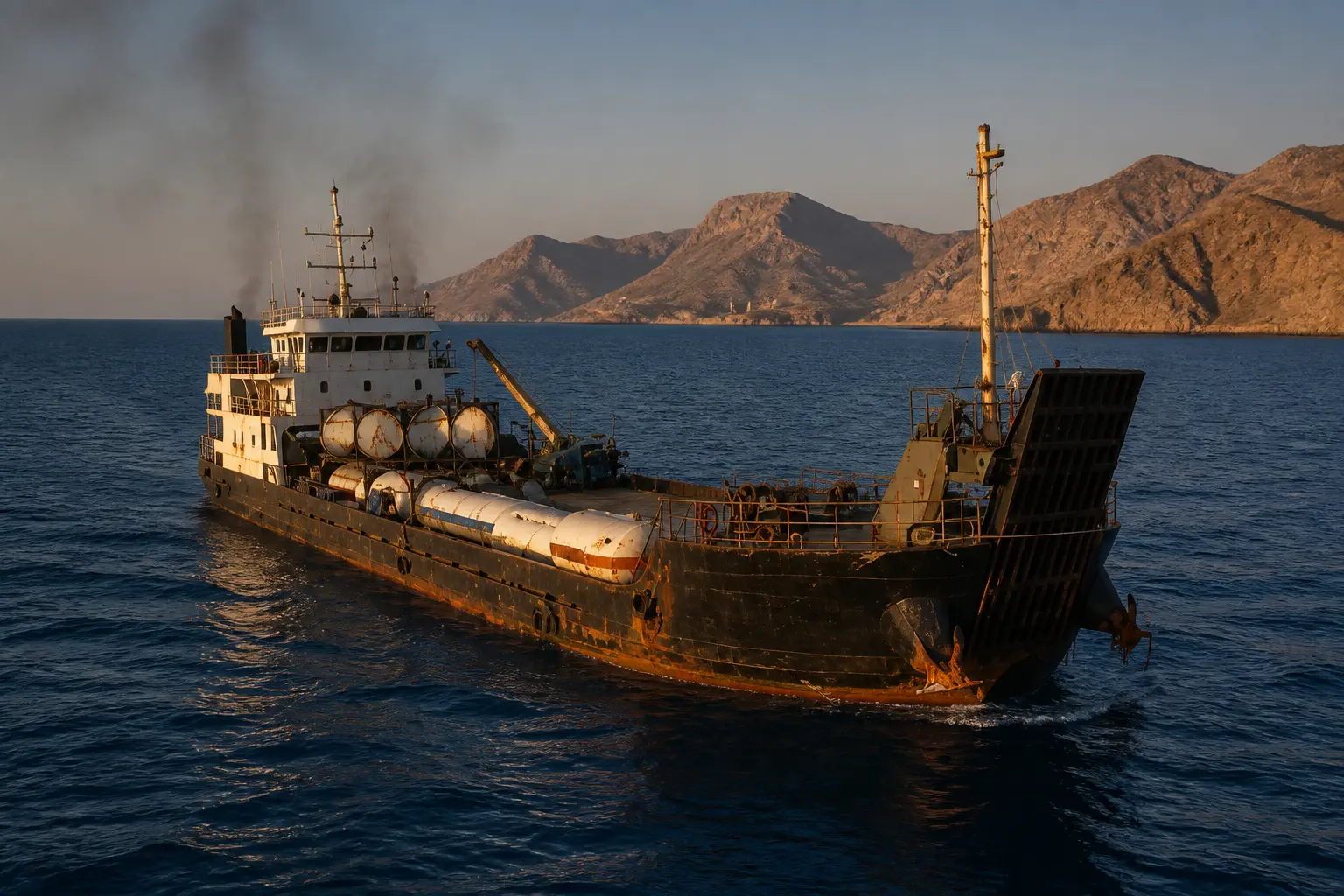
Yemen’s Coast Guard and Transport Ministry said the Tanzanian-flagged Tihama (IMO 1031329) took repeated ballistic missile hits on Tuesday morning while sailing the strait south of Al-Mokha. A fire broke out. Four crew died on board: three Pakistanis and one Indonesian. Two Coast Guard members died in a follow-on strike on rescuers. Ten more people were hurt, seven of them crew.
| Category | Detail |
|---|---|
| Dead | 6 total (3 Pakistani crew, 1 Indonesian crew, 2 Yemen Coast Guard) |
| Injured | 10 (7 crew among them) |
| Weapons claimed | Three ballistic missiles |
| Location | Bab el-Mandeb, south of Al-Mokha / Mocha |
| Flag / IMO | Tanzania / 1031329 |
Houthi media called the target a ship carrying Saudi military equipment and linked the hit to their campaign against government-held Mocha, which had faced strikes for four days. Ambrey, the British maritime security firm, said the Tihama was neither Saudi-owned nor Saudi-operated and had sailed from Mocha days earlier. Pictures examined by observers and shared widely showed an empty open deck with no visible military cargo.
- Aug 10-11 window: Vessel under way or near the strait; initial tracking near Dhubab.
- Tuesday morning: Missile strikes, fire, crew casualties.
- Rescue phase: Second strike hits Coast Guard team boarding or assisting.
- Evening claim: Houthi statement via Al-Masirah asserts Saudi military cargo.
- Aug 13: Egypt Transport and Foreign ministries issue formal denials and condemnation.
It was the first deadly Houthi attack on a commercial vessel since U.S. and Israeli strikes on Iran began in late February, according to multiple tallies. The sequence matters: the first missiles killed crew, and the second wave hit the people sent to save them. That pattern raises the cost of any rescue in the strait.
Mocha had already been under pressure for four days when the Tihama was hit. The Houthi claim tied the ship to that local fight even as Ambrey and the open-deck images pointed away from a Saudi military run.
Cairo Moves Fast to Erase the Alexandria Line
Shipping databases listed Blue Sea For Management Marine as manager and owner’s representative, with an apartment address in Smouha, Alexandria. Egypt’s Transport Ministry stated the company is not registered with the Egyptian Chamber of Shipping and holds no license from the Maritime Transport and Logistics Sector to act as a maritime agency. Operations, it said, run through a Dubai branch. The owner is a Yemeni national. The ship has never entered an Egyptian port, was not bound for Egypt, and carried no Egyptian cargo.
- Flag: Tanzania
- Claimed owner: Yemeni national
- Manager listing: Blue Sea For Management Marine (Alexandria address in databases, Dubai ops per Egypt)
- Egyptian license status: None for agency work; not chamber-registered
The same databases that produced the Alexandria hit also show the firm managing a tiny two-vessel general-cargo fleet of roughly 2,586 DWT total, active at ports that include Mokha, Jeddah, Dubai, Jebel Ali and several Egyptian and Horn of Africa calls. Egypt’s statement treated the address as a paper trail that did not equal legal presence or control. The Foreign Ministry separately condemned the attack on the “Yemeni commercial vessel TIHAMA” and an earlier Saudi tanker strike, calling such acts a serious threat to Red Sea navigation safety.
A database line in Smouha was enough to pull two ministries into a public reply within days. Cairo’s message was narrow and repeated: no registration, no license, no port call, no cargo, no ownership. The Dubai branch, not Alexandria, was where Egypt said the work actually ran.
That speed reflects how fast a paper address can become a political problem when a hull burns in the Bab el-Mandeb. Neutral coastal states treat the correction as part of keeping their own shipping lanes clear of blame.
The Ferry That Links Aden to Socotra
Yemeni government officials described the Tihama as a civilian ferry run by a private company licensed for maritime transport. Its regular work ferries passengers and civilians on round-trip routes linking Aden, Djibouti, Somalia and Socotra. It has also carried gas to provision Socotra and moved food and other supplies. At the time of the attack some accounts said it was out of service for engine repairs and docked or near shore; others placed it under way. Joint Forces spokesmen on the western coast noted they could strike Houthi ferries moving military gear but said they protect civilians aboard the same vessels.
That dual civilian-military utility is the daily reality for small operators along Yemen’s Red Sea and Gulf of Aden coast. The same hull that brings cooking gas to an island can, in wartime, become a suspected logistics platform. Visual evidence after the strike showed no military equipment on deck. The gap between Houthi claims and the empty photos is where the operators live.
The route set itself explains the exposure. Aden to Djibouti, Somalia and Socotra is short-sea work that larger lines often skip. Gas and food for an island population move on hulls like this one, or they do not move at all. When engines fail or a ship sits near shore, the same vessel can look idle to one side and tactical to another.
- Passenger and civilian ferry legs on the Aden round trips
- Gas runs to provision Socotra
- Food and general supply moves along the same coastal chain
- Ports and calls that also appear in the manager’s wider two-vessel pattern: Mokha, Jeddah, Dubai, Jebel Ali, Horn of Africa
What the Competing Stories Leave Unsettled
What We Know
- Six dead, ten injured; three missiles reported; fire on board; Tanzanian flag; IMO 1031329.
- Egypt formally denies ownership, management registration, licensing, port calls and cargo links.
- Yemen government labels it a licensed civilian ferry on established supply routes.
- Houthis claim Saudi military cargo and take credit.
- Ambrey assessment: not Saudi-owned or operated.
- Open-deck photos and video circulating show no visible military loads.
What’s Unconfirmed
- Exact cargo at the moment of impact and whether any military items were below deck or earlier in the voyage.
- Precise ownership chain behind the Yemeni national and any Riyadh commercial ties.
- Whether AIS was fully active or intermittent in the approach to the strait.
- Full extent of Blue Sea’s Dubai versus residual Egypt paper presence.
OSINT accounts that first flagged an Egyptian commercial manager later noted Cairo’s rare public distancing. Some posts asserted the ship moved Saudi weapons under a Yemeni owner with the AIS dark. Those claims remain assertions, not settled fact. The empty-deck images undercut the cleanest versions of both the pure-military and pure-passenger stories.
Each side’s version serves a different need. The Houthi claim links the hit to Mocha and to Saudi equipment. Yemeni officials stress a licensed ferry on food and gas runs. Egypt cuts every legal thread to Alexandria. Ambrey and the photos sit between those poles and leave the below-deck and earlier-voyage questions open.
| Source | Core claim on the Tihama |
|---|---|
| Houthi media / Al-Masirah | Saudi military equipment; part of Mocha campaign |
| Yemen government officials | Licensed civilian ferry on Aden-Djibouti-Somalia-Socotra supply routes |
| Ambrey | Neither Saudi-owned nor Saudi-operated; sailed from Mocha days earlier |
| Egypt Transport / Foreign ministries | No Egyptian owner, license, port call, or cargo; owner is Yemeni |
| Open-deck images | No visible military cargo on deck after the strike |
Crews and Small Operators Hold the Exposure
The dead and wounded were not Egyptian or Saudi decision-makers. They were Pakistani and Indonesian seafarers plus Yemeni Coast Guard members trying to pull survivors off a burning deck. Pakistan’s foreign ministry condemned the attack that killed its nationals. The private company running the ferry loses a hull and faces the next insurance and routing calculation in a war zone where every coastal freighter can be labeled dual-use.
- Multi-national crews on low-profile deck cargo and ferry runs absorb the first kinetic and legal risk.
- Yemeni private operators keep Socotra and Horn links open when larger lines stay away; they also become the easiest targets for both Houthi claims and retaliatory suspicion.
- Database addresses in places like Alexandria create instant political heat for neutral states that then must issue public denials to protect shipping lanes and reputations.
- Coast Guard and naval rescue teams face secondary strikes once they board or approach.
These parties rarely appear in the initial Houthi statements or the Egyptian press releases. They are the ones who sail the routes, load the gas cylinders, and count the dead when the missiles arrive.
A two-vessel fleet of roughly 2,586 DWT has little spare hull to lose. When one ship burns south of Mocha, the remaining capacity and the next premium both move against the operator. Crews from Pakistan and Indonesia on a Tanzanian-flagged run show how far the labor market sits from the political claims made about the cargo.
Red Sea Pressure Spreads Beyond One Hull
The Tihama hit sits inside a wider Houthi campaign that has already included strikes on Saudi-linked tankers and threats against ports that move oil for China and India. An earlier ADNOC tanker strike in the same campaign and repeated Houthi hits on Saudi-linked tankers show the pattern. Broader Houthi threats to oil flows through Saudi ports raise the stakes for every coastal state that wants the strait kept open.
Egypt’s interest is concrete. The Suez Canal and Red Sea approaches remain core revenue and strategic assets. A single apartment address pulling Cairo into the story forced a rapid, multi-ministry response. That response protects neutrality on paper. It does not remove the underlying opacity that lets a two-vessel manager with an Alexandria apartment address and two-vessel fleet appear in global databases next to a ship that ends up burning off Mocha.
Such attacks constitute a serious threat to the security and safety of navigation in the Red Sea, one of the most important international waterways.
Egypt’s Foreign Ministry used that language while rejecting any Egyptian stake in the Tihama itself. The warning stands even after the ownership line was cut.
Small ferries and large tankers now share the same threat envelope. The Tihama was the first deadly commercial case since late February, yet the tanker strikes and port threats already defined the campaign’s reach. Coastal states answer for database trails; crews answer for the fire.
How Database Trails Outrun Legal Control
Global shipping platforms still list Blue Sea For Management Marine against an Alexandria apartment and a two-vessel fleet. Egypt’s Chamber of Shipping and the Maritime Transport and Logistics Sector say that listing creates no license and no agency right. The gap between a database field and a legal presence is where the August 13 denials were aimed.
Operations, Cairo said, run through Dubai. The owner is a Yemeni national. The Tihama never entered an Egyptian port and carried no Egyptian cargo. Those points close the file for the ministries. They do not scrub the older address from every commercial screen that OSINT accounts and insurers still read.
For a neutral state that depends on Suez and Red Sea traffic, the fix is a public break with the paper trail. For the next small operator, the same opacity remains: a manager line in one country, a flag in another, and a hull working gas and passengers through a strait under missile threat.
Why Rescue Work Draws a Second Strike
Four crew died in the first hits. Two Coast Guard members died when a follow-on strike caught the rescue. That second wave is now part of the cost of approaching a burning deck in the Bab el-Mandeb. Yemen’s Coast Guard still moved to assist; the casualties show what that choice can bring.
Joint Forces spokesmen on the western coast say they protect civilians on ferries even when they reserve the right to hit vessels moving military gear. The Tihama case tests that line in reverse. Rescuers became targets after the commercial hull was already on fire. Ten more people were hurt, most of them crew who had already survived the opening missiles.
Pakistan’s condemnation focused on its dead nationals. The Indonesian seafarer and the Yemeni rescuers complete the list. None of them wrote the cargo claims or the database entries. All of them met the missiles first.
Ownership Fog Leaves the Next Ferry Exposed
No independent registry dump has publicly named the Yemeni owner or produced a clean chain of title that satisfies every side. MagicPort and similar platforms still show the Alexandria contact for Blue Sea. Egypt’s chambers and licensing sector say that contact does not create legal presence. The ship itself, or what remains of it, sat near a small wharf south of Dhubab in post-strike imagery. Whether it ever resumes the Socotra run is secondary to the pattern: small commercial hulls in Yemen’s coastal trade will keep drawing dual claims, and the crews who sail them will keep paying first.
Cairo drew a bright line on August 13. The operators who still need to move gas and food between Aden and the islands have no such line to draw.
