
Tiroche’s June 28 auction in Israel will offer three museum-grade works valued at NIS 1 million ($300,000) each, with two Reuven Rubin depictions of 1920s and 1930s Jerusalem and a 1972 Mordecai Ardon painting leading the catalogue. The lots are drawn from three private collections built up in Sydney, the United States and elsewhere over decades, and they are returning to the Israeli market at a moment when few expected the high end to hold.
CEO Amitai Hazan framed the catalogue in terms that reach beyond price. “It’s not just which paintings, it’s the quality,” he said. “They are museum-grade collections.” The Tiroche’s June 28, 2026 auction catalogue runs alongside works by early twentieth-century painters Yehezkel Streichman, Mordecai Ardon and Menachem Shemi, with contemporary pieces by Michal Rovner, Israel Hershberg, Fatima Abu Rumi and Lea Nikel rounding out the sale.
Three Lots at $300,000 and the Overseas Collections Behind Them
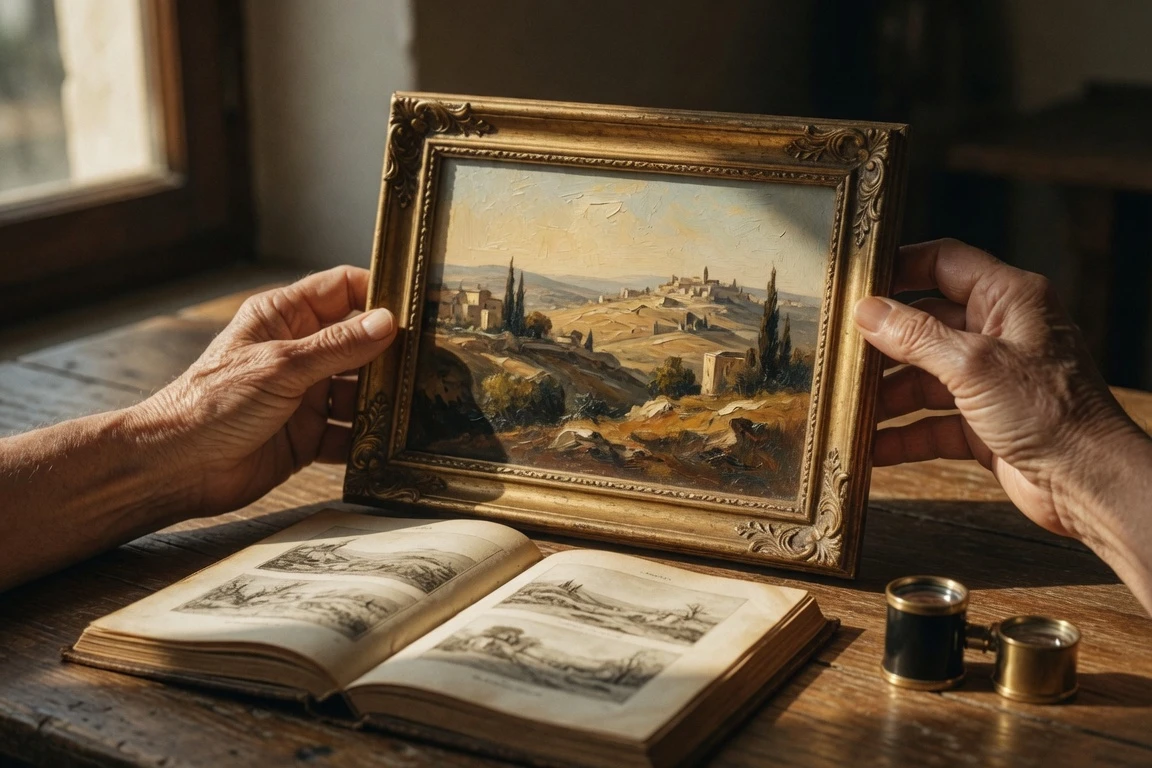
The headline pieces trace a clear path home. Two Rubins, painted in Jerusalem during the 1920s and 1930s and widely regarded as the peak of his career, are each estimated at NIS 1 million ($300,000). A 1972 Ardon painting carries the same estimate, and Hazan pointed to that figure as “on the very high end for Israeli art.” All three enter the sale from collections assembled outside the country, and Hazan said the auction house had been working on bringing them in for years.
The provenance is the second-order story. Joseph and Gerda Brender built their Israeli art collection in Sydney. Rubin and Peggy Zimmerman spent the 1960s and 1970s focusing on four artists (Rubin, Gutman, Ardon and Moshe Castel). Nathan Kaplan, a Zionist activist from Chicago, is the third overseas seller. Hazan compared the Zimmermans’ choices to early bets on tech: “If you compare it to tech investments, they invested in Apple and Facebook when they were just starting. They had a very good eye.”
| Collection | Built by | Focus | Status at Tiroche |
|---|---|---|---|
| Brender | Joseph and Gerda Brender (Sydney) | Israeli art holdings accumulated over years of contact with the auction house | Discussions paused after October 7, then resumed |
| Zimmerman | Rubin and Peggy Zimmerman | Four artists (Rubin, Gutman, Ardon and Moshe Castel), collected in the 1960s and 1970s | Saw the bullish market and decided to move ahead on selling |
| Kaplan | Nathan Kaplan, Zionist activist (Chicago) | Israel Paldi work among pieces coming to the block | The third of the three overseas collections |
Hazan linked the willingness to sell directly to a market that surprised him. Other works in the sale are expected to fetch several thousand dollars and upward, and the top estimates reflect what he called a market stronger than expected after the coronavirus pandemic and almost three years of war with Hamas, Hezbollah and Iran.
Why the Israeli Art Market Defied Predictions
The conventional read on a wartime art market is retreat. Hazan said the opposite happened. He had initially heard that Israeli art prices were expected to soften, that collectors were pivoting toward modern works, and that younger high-tech buyers in particular were stepping back from the older canon. None of that materialized at the high end.
The Israeli art world’s broader vitality is part of the backdrop. The 2025 death of Israeli kinetic art pioneer Yaacov Agam’s 2025 death at 98 closed a chapter that had run from the 1950s onward, and the country’s contemporary scene now stretches from Agam’s heirs to names like Michal Rovner, Israel Hershberg, Fatima Abu Rumi and Lea Nikel, all in this sale. Against that span, Hazan’s framing of foundational Israeli works returning home at peak estimates looks less like a contrarian bet and more like a market correction in the other direction.
The auction house’s own experience tracks the read. Hazan said the lot rotation at the top end has resisted the downturn some advisors warned about. Even a market shaped by active conflict and a global pandemic is producing estimates the auction house once would have reserved for the very deepest collections.
The Zimmmermans’ decision to move ahead is the cleanest illustration. They watched the same market Hazan watched, and they chose to sell now rather than wait. Two Rubin Jerusalem canvases and a 1972 Ardon entering the catalogue at $300,000 each is the result.
A Nostalgia Market Forged After October 7
Hazan traced the demand shift to a single date. Since the October 7, 2023 Hamas onslaught, he said, collectors of Israeli art have been looking for older works, seeking a sense of nostalgia in painting and sculpture as the country was shaken to its core by one of the most traumatic events in its history. The auction house had been in touch with the Brender family for several years, and those conversations paused after October 7. The Zimmermans joined the sale later, after seeing what Hazan called the bullish market.
The market woke up, it was like a signal for these collections that it was time to sell.
Hazan drew three parallels to other cultural moments that pulled Israeli audiences back toward foundational work. He pointed to the sold-out reunion concerts for “The 16th Sheep,” the recent reunion of the comic troupe Zehu Ze, and a broader pattern he described in plain terms:
- The sold-out reunion concerts for “The 16th Sheep,” featuring some of Israel’s most beloved musicians
- The reunion of the comic troupe Zehu Ze
- Hazan’s own framing: “People want to go back to the beginning, to the things that make you feel good.”
That nostalgia is not nostalgia for the art market. It is nostalgia for an era in Israeli cultural memory that the older works make visible. A Rubin Jerusalem from the 1920s is not a contemporary object; it is a foundational one, and Hazan argued that the demand at the top end reflects a country reaching for its own origin stories after a year and a half of war.
Holding Auctions Through Air Strikes and Short Wars
The June 28 sale is being staged inside an active conflict, not in its aftermath. Tiroche has run auctions through the worst of it. On April 14, 2024, the day before an earlier sale, the Iranian military launched its first-ever direct attack on Israeli territory. Hazan had been planning to postpone. By the next morning, Israeli air defenses had blunted the strike, the mood had flipped, and his advisors pushed him to hold the auction anyway.
“This is our country, we live from peak to peak,” Hazan said. The April 14, 2024 auction went ahead.
A second disruption landed a year later. An auction planned for mid-June last year had to be postponed because of the 12-day war with Iran. The June 28, 2026 sale is the rescheduled event, and Hazan was blunt about what running an auction house inside the conflict cycle costs in planning terms. “It’s hard to do business like this in Israel, you plan things for months, and almost nothing works out the way you planned,” he said.
What the two episodes show is the operating shape, not a thesis about resilience. Tiroche held when the air was clear and postponed when it was not. The June 28 sale lands in a window where the schedule and the high-end demand both held.
Bidders, Eras, and What June 28 Will Test
Most of the 2,000 expected bidders will attend virtually. The cross-era contest sits at the centre of the sale: Ardon was more successful in the United States in the 1960s and 1970s, while Rubin’s works are from the 1920s. Two different collector pools, two different historical contexts, $300,000 estimates on each. Hazan’s framing was characteristically direct: “Those works are now 100 years old.”
- 2,000 – expected bidders, most attending virtually
- $300,000 – top estimate per lot, equal to NIS 1 million
- 100 years old – Hazan’s framing of the Rubin works
- April 14, 2024 – the auction Tiroche held despite Iran’s first direct attack on Israeli territory
Hazan said he feels a sense of satisfaction that seminal Israeli works, “the good ones,” could end up back home. The Times of Israel reported the auction house’s annual sale under that framing on June 26, two days before the bidding opens.
