
When Emily Blunt stepped onto the 2026 Met Gala carpet in a custom look that took over 250 hours to build by hand, the fashion world froze. That dress came from a Saudi designer. She was not alone that night. What happened at the Met Gala was not a coincidence. It was a statement years in the making.
A Saudi Designer Owned the Night at the Met Gala
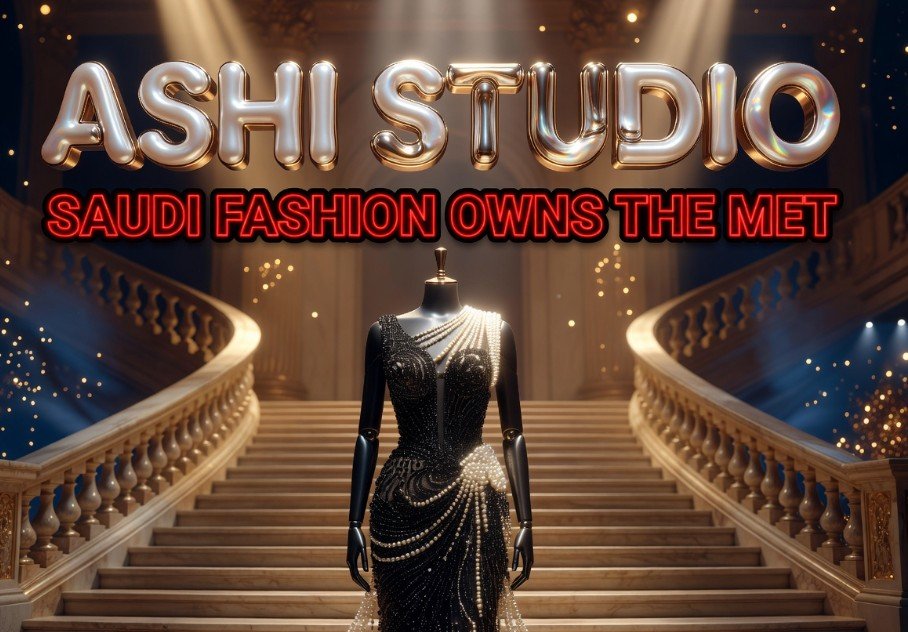
The 2026 Met Gala, themed “Fashion Is Art,” gave Saudi couturier Mohammed Ashi the biggest stage of his career. His label, Ashi Studio, did not just attend. It commanded the red carpet.
Four high-profile guests walked the carpet in Ashi Studio that night:
- Emily Blunt in a custom midnight-black corseted top and voluminous silk trousers, hand-embroidered with glass beads and tassel detailing
- Sabine Getty in a hand-painted bodice referencing 18th-century classical nudes, with a ghostly handprint stretched across the fabric
- Ananya Birla in a metallic sculptural gown that looked cast rather than sewn, with the stillness of a monument
- Jennifer Rubio in a deep amber corset with raised figurative elements carved directly into the bodice
Blunt’s custom look alone took over 250 hours to complete, crafted by multiple artisans working entirely by hand. Beaded fringe sleeves, tassel collars, and layers of handwork made the piece impossible to miss. Styled by Jessica Paster and paired with half a million dollars worth of Mikimoto pearl jewellery, it was one of the most talked-about looks of the night.
Mohammed Ashi trained at Esmod in Paris. He then refined his craft at Givenchy and Elie Saab before founding his label in Saudi Arabia in 2007. He later moved his atelier to Paris, and today Ashi Studio has studios in Paris, Dubai, and Lugano.
In 2023, Ashi became the first designer from the Gulf region to join the official Paris Haute Couture Week calendar under the Federation de la Haute Couture et de la Mode. The Met Gala 2026 was his next defining chapter. The house has now dressed Beyonce, Lady Gaga, Queen Rania of Jordan, and Zendaya over the years.
A Government That Decided Fashion Was Serious Business
The Ashi Studio moment did not happen by accident. It grew out of a deliberate, well-funded effort to build Saudi Arabia into a global creative force.
Saudi Arabia’s Ministry of Culture established the Fashion Commission in 2020. Its mission was direct: develop the sector, connect designers with the world, and position the Kingdom as a fashion destination. These are the key programs powering that push:
- Saudi 100 Brands: A flagship initiative providing designers with training, funding, and access to global fashion weeks
- Riyadh Fashion Week: Launched with strong international media attention, it attracted 70 buyers in its latest edition, most from outside Saudi Arabia
- Fashion Futures: A structured development program giving designers international exposure and professional tools
- Parsons Partnership: The Fashion Commission partnered with Parsons School of Design in Riyadh with a goal of training 1,000 Saudi fashion professionals by 2030
In early 2026, the Saudi 100 Brands program took four Saudi labels to Galeries Lafayette in Paris. Beneath the department store’s iconic glass dome, Saudi fashion sat alongside the most respected names in the world.
The Saudi fashion market was valued at an estimated $32 billion in 2025 and is projected to reach $44.8 billion by 2032, growing at a compound annual rate of 5.2 percent.
Women now make up 52 percent of the fashion workforce in Saudi Arabia. That number reflects a broader shift in how the Kingdom sees fashion: not as decoration, but as economic opportunity and cultural identity.
“Being linked with Saudi Arabia’s Vision 2030 offers a huge opportunity,” said Burak Cakmak, CEO of the Saudi Fashion Commission, referring to the Kingdom’s plan to diversify its economy beyond oil.
Heritage Is the Secret Weapon Behind Saudi Design
Ask any Saudi designer what sets their work apart, and the answer keeps coming back to the same place: the land, the craft, the memory.
Shahd AlShehail is the founder of Abadia, an ethical luxury brand she launched in 2019. Her spring 2026 “Meditation” collection put Sadu weaving front and center. Sadu is a traditional Bedouin textile technique passed down through generations, primarily by women.
“Traditional craftsmanship shapes the foundation of how I think about design,” AlShehail said. “Techniques like Sadu weaving carry rhythm, patience and memory within them.”
Abadia works with over 40 female artisans across Saudi Arabia and the Middle East, ensuring traditional crafts like Sadu weaving and Naqda embroidery stay alive and financially viable. This is not charity work. It is a business model built around the idea that heritage is commercial.
Major international retailers are proving AlShehail right. Net-a-Porter and Selfridges anchored their spring 2026 buys around Abadia’s Sadu pieces. A UK expansion to Harrods and Browns is planned for June 2026.
“There is a confidence in creating from our own cultural references and experiences, rather than trying to fit into an existing narrative,” AlShehail said. “Audiences today are drawn to brands that feel honest, rooted and emotionally lasting.”
Cultural liberalization inside Saudi Arabia has also expanded what designers can do. As public life opens up and dress norms continue to evolve, a new generation of creators is experimenting with silhouettes, textiles, and aesthetics that would not have been possible a decade ago.
Social Media and International Buyers Are Fueling the Momentum
Saudi fashion is reaching global audiences faster than ever, and social media is a big reason why.
Platforms like Instagram and TikTok have given Saudi designers direct access to consumers worldwide, without needing a showroom in Paris or New York to be discovered. A single viral red carpet moment, like Ashi Studio at the Met Gala, can reach millions of people within hours. That kind of visibility used to take decades to build. Now it can happen overnight.
The numbers behind Saudi fashion’s audience are impossible to ignore:
| Key Market Indicator | Data |
|---|---|
| Fashion Market Value (2025) | $32 billion |
| Projected Market Value (2032) | $44.8 billion |
| Market Growth Rate (2026-2032) | 5.2% CAGR |
| Women in Fashion Workforce | 52% |
| Saudi Population Under Age 30 | 60% |
International retailers attending Riyadh Fashion Week and Paris showcases are placing real orders. The strongest demand is coming in couture, eveningwear, and luxury modest fashion, categories where Saudi designers have a natural and authentic edge.
Buyers are not just curious anymore. They are commercially committed. Brenda Bellei, CEO of White Milano, noted a “strong rapport between price and quality” in Saudi collections after attending Riyadh Fashion Week. Selfridges has expressed plans to deepen activations with Saudi brands into 2026.
Other Saudi designers are also drawing global attention. Yousef Akbar, who founded his label in 2017, has dressed Nicole Kidman, Sharon Stone, and Chrissy Teigen. Arwa Al Banawi has been redefining Saudi ready-to-wear on the international stage since 2015. Saudi fashion is no longer built around one name. It is a growing ecosystem.
What is happening in Saudi fashion right now is bigger than any single gown or any single designer. It is a creative movement with government infrastructure behind it, a billion-dollar market growing beneath it, and a generation of young, bold storytellers driving it forward. From a hand-embroidered corset on the steps of the Met to Sadu weaving landing on the shelves of Selfridges, Saudi designers are not just entering the global conversation. They are changing it. This is one of the most exciting stories in fashion right now, and it is still just getting started. Drop your thoughts in the comments below. What do you think Saudi fashion will look like on the world stage five years from now?
