
The Saudi Ministry of Hajj and Umrah said on Tuesday that every pilgrim registered for this year’s pilgrimage had completed the move from Mina to Arafat, where they performed the ritual standing that anchors the rest of the Hajj. The “Holy Sites Train” carried roughly 350,000 worshippers; a fleet of more than 24,000 buses moved the rest along ring routes closed to all non-permitted traffic.
The transport figure is the headline. The number that will define this Hajj sits one degree away from logistics: forecasters put Arafat’s afternoon temperature between 42 and 48 degrees Celsius on the Day of Arafah, against the 51.8°C peak recorded inside the Grand Mosque during the 2024 heat disaster that killed 1,301 pilgrims, most of them unauthorised.
The Numbers Behind the Arafat Transfer
This year’s total pilgrim count reached 1,707,301, according to Saudi Arabia’s General Authority for Statistics, a 2.04 percent gain on the 1,673,230 who performed Hajj in 2025. International arrivals accounted for 1,546,655 of that total, drawn from 165 nationalities. The remaining 160,646 were citizens and residents already inside the Kingdom.
Of the international cohort, 1,485,729 entered through air ports, 54,429 came overland and 6,497 arrived by sea. Male pilgrims edged ahead at 893,396 against 813,905 female pilgrims, a near-balance that has held for three years.
- 1,707,301 total pilgrims, the largest cohort since the 2019 pre-pandemic ceiling
- 350,000 moved by the Mashaer Metro on its single-day shuttle schedule
- 24,000+ buses on dedicated corridors between Mina and Arafat
- 35 international languages carrying the Arafat sermon in real time
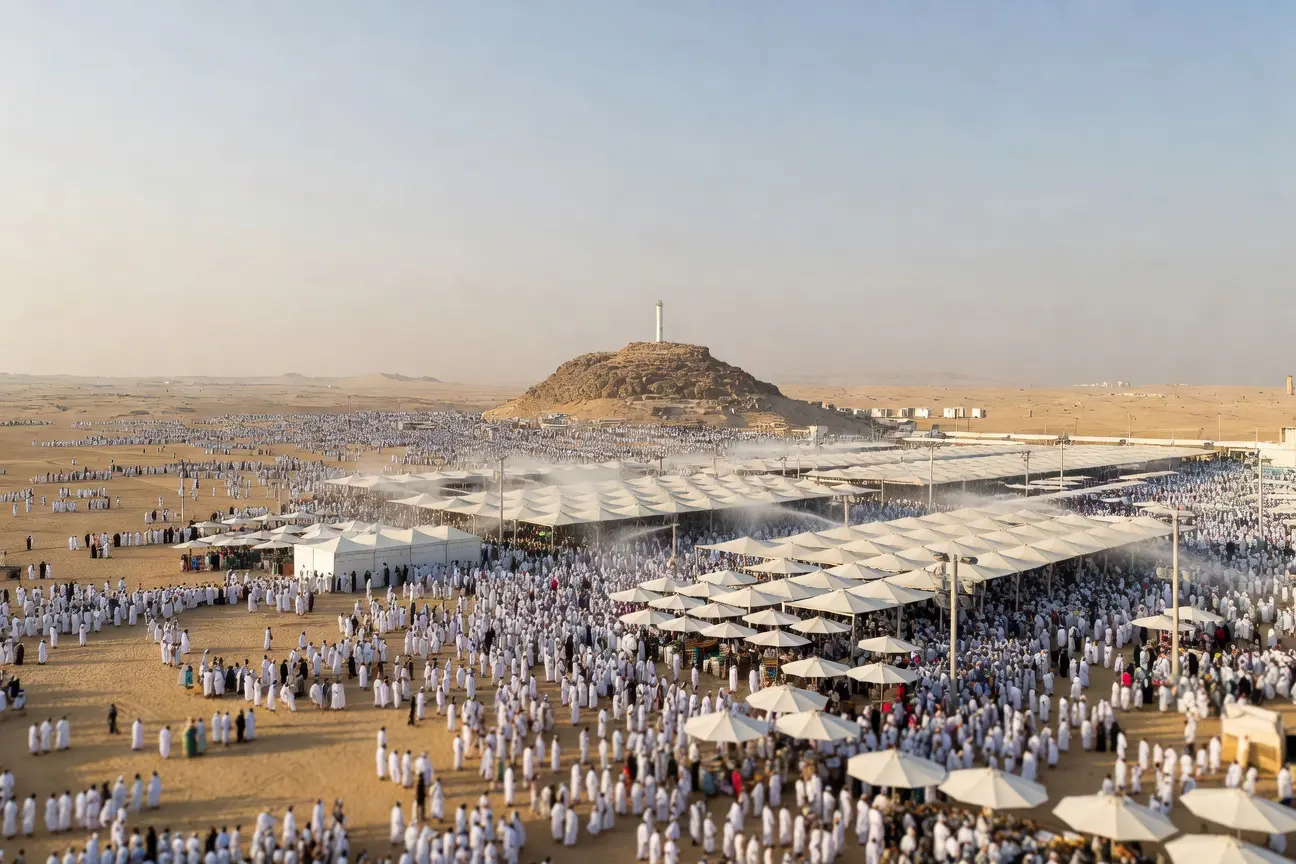
The Saudi authorities are framing the transfer as proof that the post-2024 overhaul has held. Pilgrims arrived inside the daylight window the Ministry had set, before the sun reached its apex over Jabal al-Rahmah, the rocky outcrop known to pilgrims as the Mount of Mercy at the eastern edge of the Arafat plain.
The Crowd-Management System Saudi Arabia Built
The Mashaer Metro, branded by the Ministry as the Holy Sites Train, ran nine stations along an 18-kilometre line that connects Arafat, Muzdalifah and Mina. Its capacity has been deliberately capped at around 350,000 boardings per day so it does not become the choke point its 2010 launch year suggested it might. Everything else moves by road.
The bus fleet, the larger workhorse, is split across more than 17 separate operators including the Saudi Public Transport Company and several Hajj mission carriers. Lanes feeding Arafat were sealed to private cars, taxis and unpermitted vehicles by the new vehicle ban that took effect on the 8th of Dhu Al-Hijjah, a policy iAqaba covered earlier this season in the rollout of the Saudi Hajj vehicle restrictions across Mina, Muzdalifah and Arafat.
Smart applications, biometric Nusuk cards and a unified geofence around the holy sites let crowd-monitoring teams in the Mecca command centre see live density readings tile by tile. The Ministry has been pushing the digital stack for three Hajj seasons; this one is the first where every authorised pilgrim carries the same credential.
| Mode | Approx. capacity | Route | Operating window |
|---|---|---|---|
| Mashaer Metro (Holy Sites Train) | ~350,000 pilgrims | 9 stations linking Mina, Arafat, Muzdalifah | Shuttle, peak Day of Arafah |
| Dedicated bus fleet | ~1.3 million pilgrims | Ring corridors closed to private traffic | Rolling shuttle, multi-day |
| Pedestrian walkways | Tens of thousands | Shaded paths between Mina and Muzdalifah | Overnight Al-Nafrah leg |
The Heat Question That Defines This Hajj
Every operational improvement Saudi Arabia rolled out this year traces back to the same memory. Two summers ago, an unusually punishing combination of humidity and direct sun pushed survivable limits below what an outdoor multi-hour ritual demands. The Saudi Health Ministry’s final count put deaths at 1,301, with 83 percent of fatalities among pilgrims who travelled without a permit and therefore had no access to air-conditioned tents or registered medical clinics.
The 2024 Memory That Shaped This Buildout
Egypt lost more than 600 nationals in the 2024 season, the highest single-country toll. Indonesia counted 132, India 98 and Jordan 60. Cairo revoked 16 travel-agent licences in the weeks that followed. Tunisia’s president fired his minister of religious affairs. Riyadh promised the largest cooling and shading buildout in the pilgrimage’s modern history before the next season opened.
What 272,000 Square Metres of Cooling Buys
The shaded and cooled footprint at Arafat has been expanded to more than 272,000 square metres, roughly five times the area available in 2024. Inside the canopies sit a mix of mechanical cooling and atomised water cover. The headline pieces:
- 18 canopies at the Mount of Mercy itself, each fitted with 36 misting fans
- 107 misting-fan columns spread across the plain’s main standing zones
- 7 advanced cooling units stationed at the Jabal al-Rahmah base
- 400+ misting and cooling stations across Mina, Arafat and around the Grand Mosque
- Heat-reflective road coatings on key pedestrian routes between Mina and Muzdalifah
The Heatstroke Count Already Climbing
By the morning of the Arafat standing, ministry medical teams had already logged 144 heatstroke cases across the holy sites, a number that always swells on the Arafah and Muzdalifah days because pilgrims walk longer and rest less. The Saudi Ministry of Health repeated its call for umbrellas, which it has measured as lowering the ambient temperature around a walking pilgrim by up to 10°C, and for fluid intake above the daily baseline.
A Bigger Mount of Mercy Hospital and a Wider Medical Net
The Mount of Mercy Hospital has been operated at full capacity for the first time in its modern configuration, paired with a wider network of static health centres and mobile ambulance posts inside the Arafat boundary. Saudi authorities say more than 50,000 healthcare staff and 3,000 ambulances are on duty across the holy sites this season, with rotating shifts to keep emergency cover continuous through Day of Arafah and the overnight Muzdalifah leg.
Preventing heat exhaustion begins with using umbrellas while moving around, drinking sufficient amounts of water and fluids, and avoiding long walks under direct sunlight.
That guidance came from the Saudi Ministry of Health, restated through the Saudi Press Agency advisory on heat-protection conduct for the Day of Arafah. The Ministry’s pilot programmes added five new field hospitals around the Arafat perimeter this year, plus expanded triage tents capable of receiving up to 1,200 heat patients per hour at peak.
The Sermon Reaches 35 Languages
The other story Saudi authorities are pushing is reach. This year’s Arafat sermon, delivered from the Namira Mosque, was broadcast with simultaneous translation into 35 languages including English, French, Turkish, Indonesian, Persian, Russian, Chinese, Urdu, Punjabi and Pashto. The audio feed ran through the Ministry’s digital channels and inside every air-conditioned tent across the plain.
Sheikh Abdulrahman Al-Sudais, who heads the Presidency of Religious Affairs at the Grand Mosque and the Prophet’s Mosque, said the multilingual push was intended to reach pilgrims who speak no Arabic and to widen the audience well past the Arafat boundary itself. Roughly two-thirds of this year’s international cohort came from non-Arabic-speaking countries, according to the breakdown by nationality published alongside the General Authority for Statistics tally on Hajj 2026 demographics.
Sundown, “Al-Nafrah” and What Tomorrow Brings
At sunset on Tuesday, the rite known as Al-Nafrah began. Pilgrims broke camp at Arafat and moved en masse to Muzdalifah, where they combined the Maghrib and Isha prayers and spent the night gathering pebbles for the next day’s stoning ritual at the Jamarat in Mina. The Mashaer Metro switched its direction; the bus fleet ran its mirror schedule.
- Tuesday sunset: Al-Nafrah departure from Arafat begins, with the first wave on the train and shuttle buses
- Tuesday night: Pilgrims pray and rest at Muzdalifah, collecting stones for the stoning ritual
- Wednesday before dawn: Movement to Mina starts, with vulnerable groups travelling first under the Ministry’s tafweej schedule
- Wednesday daylight: Stoning of the Aqaba Jamrah, sacrifice, head-shaving and the first tawaf al-ifadah at the Grand Mosque
- Through Saturday: Three days of stoning at all three Jamarat, with the final farewell tawaf before departure
If the heat infrastructure holds through the Mina days, when crowd density at the Jamarat bridge runs even higher than at Arafat, Saudi Arabia will be able to say its largest single-season buildout passed its hardest test. If the heatstroke count keeps climbing past Wednesday afternoon, the questions raised two summers ago return to the table, with the cooling investment that was supposed to settle them now its own data point.
