
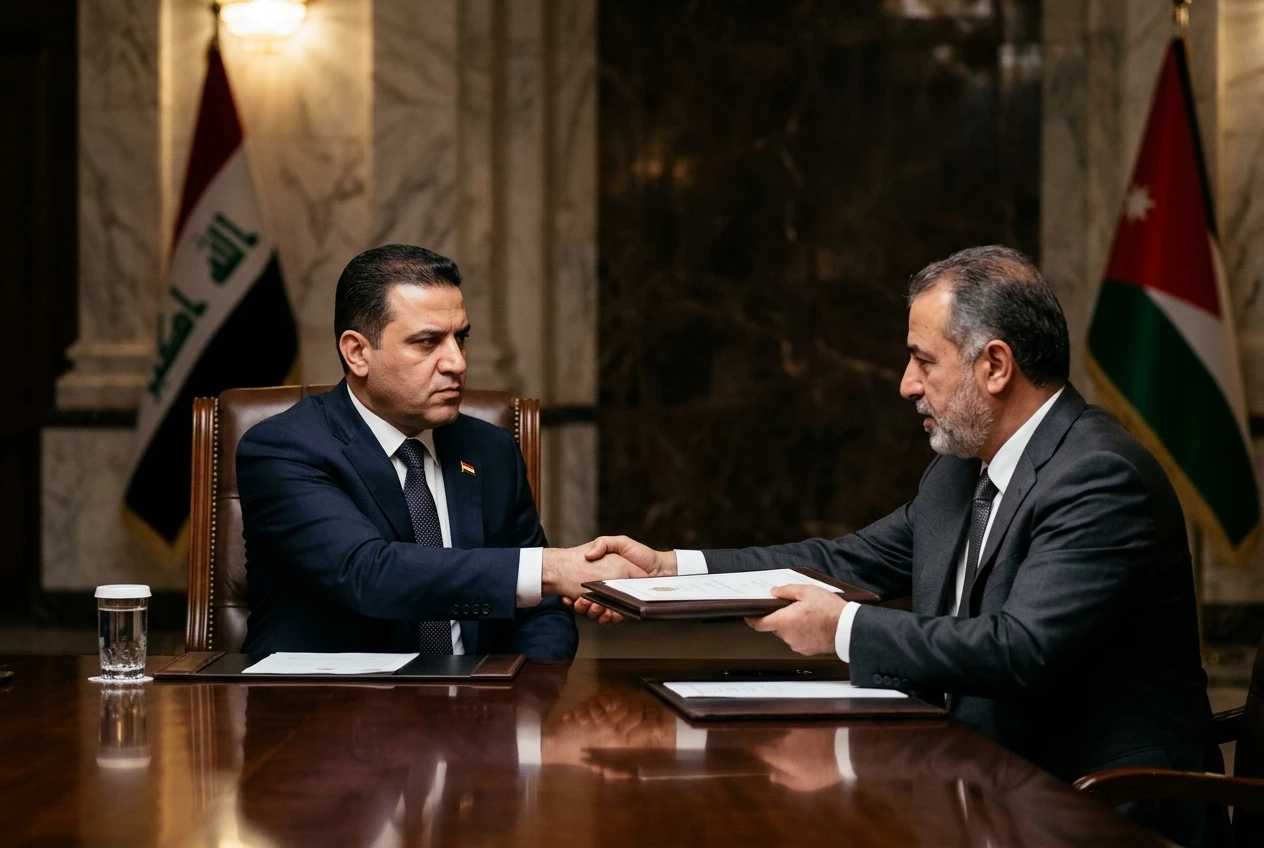
Iraqi Prime Minister Ali al-Zaidi sat across from a Jordanian ministerial delegation in Baghdad on July 2 for his first high-level economic talks with Amman since taking office last month. The session, led on the Jordanian side by Industry Minister Yarub Qudah, ran through the cross-border Basra-Aqaba pipeline, electrical grid work, and remaining trade irritants. Jordanian Prime Minister Jaafar Hassan used the same conversation to invite his Iraqi counterpart to visit Amman.
The 1983 plan to pipe Iraqi crude to Jordan’s Red Sea port has been studied, negotiated, and quietly abandoned for four decades. This time, the pipeline is being pushed by Baghdad itself. What changed is a war with Iran that shut the Strait of Hormuz, the waterway through which an estimated 90 percent of Iraq’s crude exports once moved.
Baghdad Meeting Sets Bilateral Agenda
The July 2 meeting, confirmed by Jordan’s state-run news agency, came nine days before Al-Zaidi is due in Washington for talks with President Donald Trump. It was also the first time a sitting Iraqi prime minister hosted a Jordanian economic delegation since Al-Zaidi’s swearing-in on May 16. Both governments framed the session as the start of a working channel.
Zaidi told Qudah that Jordan serves as a “vital strategic” partner for Iraq and that Baghdad intends to scale up mutual investments despite regional challenges, according to the Jordanian readout of the July 2 Baghdad meeting. Qudah relayed an invitation from Jordanian Prime Minister Jaafar Hassan for Zaidi to visit Amman. The Jordanian minister praised Iraq’s recent anti-corruption steps and economic reform measures as the foundation for a stronger partnership. Both officials used the session to move from diplomatic courtesies to commercial terms.
The session produced no signed agreements but locked in three working tracks. Officials agreed to keep pushing the Basra-Aqaba pipeline, advance electrical interconnection between the two national grids, and start removing trade barriers that have slowed private-sector business between the two countries. Al-Zaidi, a 40-year-old banker with no previous political office, came to office on May 16 after Washington pressured Iraq’s parliament to drop an Iran-aligned rival. His business-friendly profile, plus the US backing that installed him, sets a different starting tone for talks that prior Iraqi governments either delayed or derailed on ideological grounds. The two teams set a follow-up framework rather than a summit.
- Cross-border oil pipeline: accelerate the 1,700-kilometer Basra-Aqaba crude line designed to carry up to 2.5 million barrels per day to the Red Sea
- Electrical interconnection: advance a feasibility-stage plan to link the Iraqi and Jordanian national grids
- Trade and investment: lower remaining barriers and connect Jordanian and Iraqi business councils to drive private-sector growth
Hormuz Shuts, Basra Looks for a Second Route
Iraq shipped an estimated 90 percent of its crude through the Strait of Hormuz before the war with Iran. Once Tehran moved to close the corridor, output from Iraq’s main southern oil fields dropped by 70 percent, per an Atlantic Council assessment. Southern storage tanks, designed for operational throughput rather than long-term holding, simply filled. Without an alternative pipeline to the Red Sea, the production cut became a shutdown.
Iraq’s northern pipeline to Turkey reopened on March 17, with Baghdad aiming to lift throughput to 770,000 barrels per day within 75 days. That is a partial fix to a deeper problem. The Basra-Aqaba pipeline, when complete, is designed to carry 2.5 million barrels per day to the Red Sea, enough to recover the bulk of what Hormuz took offline.
The corridor also fits into a wider trilateral framework under which Egypt, Iraq, and Jordan have held regular summits since 2019, with energy integration as a named pillar. Cairo’s Mediterranean ports would extend the route westward, away from both the Gulf and the Suez Canal. The structures have been on paper for years. Iraq’s position on the project has flipped: pro-Iran Shia factions in Baghdad had long opposed any westward route on the grounds that it would bring Iraqi oil close to Israel, and that resistance has largely fallen silent during the export crisis. Egypt’s stake in that pipeline, from Suez exposure to Mediterranean debt service, is laid out in a recent regional analysis of the Basra-Aqaba-Egypt pipeline gap.
Meanwhile, Jordan’s Red Sea port of Aqaba started absorbing Iraqi imports at scale as Baghdad rerouted commercial supply chains around the Gulf. The economic logic for the pipeline, once theoretical, has become operational. Amman now holds both an export route for Baghdad and a logistics gateway for Iraqi imports, on the same stretch of Jordanian territory. The two roles sit closer to each other than they have in four decades.
- 3.4 million bpd: Iraq’s pre-war oil exports shipped via the Strait of Hormuz
- $260 million to $280 million: Iraq’s estimated daily revenue loss from the Hormuz disruption
- 250,000 barrels per day: initial capacity through the restarted Iraq-Turkey pipeline on March 17
- $5 billion: former PM Al Sudani’s April estimate for the Basra-Aqaba pipeline
- January 11, 2022: Iraq’s cabinet approval date for the latest pipeline agreement
The Basra-Aqaba Pipeline Returns to the Front Burner
The Basra-Aqaba line has been on drawing boards since the summer of 1983, when Saddam Hussein-era planners sketched a route to bypass the Strait of Hormuz. Iraq’s cabinet approved the latest agreement version on January 11, 2022. Physical work on parts of the route only started last year.
The first phase links the southern oil hub of Basra to Haditha in the western Al-Anbar governorate. From Haditha, a second phase would extend the line across Jordanian territory and onward to the port of Aqaba, a stretch of up to 1,000 kilometers on its own. The combined corridor, when finished, is designed to carry 2.5 million barrels per day to the Red Sea. Iraq’s pre-war exports through the strait were 3.4 million barrels per day.
Former Iraqi prime minister Mohammed Shia’ al-Sudani valued the project at nearly $5 billion and allocated $1.5 billion for 2026 under a 2019 oil-for-projects deal with Chinese contractors. Iraq’s new cabinet under Al-Zaidi has kept the funding envelope intact. Iraq also dispatched a parliamentary delegation to Amman in recent weeks to follow up on construction. Each phase still needs contractors, financing closure, and political stability on both sides of the border. None of those have arrived yet.
A Banker in the Prime Minister’s Office
Al-Zaidi, a banker by training, was chosen as prime minister-designate on May 13 and sworn in three days later. He chairs Al-Janoob Islamic Bank, ran no prior political campaign, and arrived in office under a banner of anti-corruption and economic reform. President Donald Trump publicly endorsed him after Washington suspended cash payments from Iraq’s oil revenues held at the Federal Reserve Bank of New York to block a rival, Iran-aligned nominee. The US pressure campaign pushed Iraq’s Coordination Framework, a coalition of Shia parties aligned with Iran, to settle on a compromise candidate with no militia ties and no political record.
Al-Zaidi used his first weeks in office to set up the Supreme Sovereign Council for Integrity, Oversight and Recovery of Public Funds. He chairs the body, which monitors ministries, governorates, and procurement.
Iraqi security forces have since arrested dozens of officials, including Oil Ministry Undersecretary for Refining Affairs Adnan al-Jumaili, arrested at his home on May 30. Cash, properties, vehicles, and gold seized in the al-Jumaili probe alone had reached about $86 million by late June, the Iraqi Supreme Judicial Council said. He has also cancelled the $764 million Baghdad international airport project over corruption concerns, per Iraq’s new anti-corruption arrests and the $86 million seizure.
Jordan serves as a “vital strategic” partner for Iraq.
That is how Iraqi Prime Minister Ali al-Zaidi characterized the relationship during his July 2 meeting in Baghdad with a Jordanian ministerial delegation led by Industry Minister Yarub Qudah. Al-Zaidi himself does not come from a partisan background; he comes from the business community.
What Amman Stands to Gain, and the Risks It Carries
Amman comes out of the new channel with three concrete upsides. A functioning Basra-Aqaba pipeline would deliver discounted crude to Jordanian refineries and generate transit fees on the Jordanian leg of the route. Aqaba’s role as Iraq’s import gateway through the Hormuz disruption has already lifted throughput at the port. Sustained engagement with a US-backed Iraqi government gives Jordan a stable partner in Baghdad at a moment when Iraqi domestic politics remain unsettled.
The risks run through Baghdad, not Amman. Al-Zaidi’s anti-corruption drive has prompted public objections from major Shiite political parties, who form the power base of his own administration. Iraq still sits 136 of 182 countries in Transparency International’s 2025 Corruption Perceptions Index, and activists have long argued that the country’s politics is structurally built around graft.
Amman, for its own part, must keep its fiscal house in order if it wants the transit fees and energy savings the pipeline would bring. The project also carries political risk on the Iraqi side: domestic opponents framed any westward pipeline for decades as a route that brings Iraqi oil close to Israel. That objection has gone quiet during the export crisis. Securing construction-period revenue for the corridor is the harder, more basic problem. Both governments will need to keep the corridor politically viable while contractors move dirt.
The Pushback Waiting in Baghdad
Iraq’s broader recovery depends on Al-Zaidi’s ability to defund and absorb Iran-aligned militias, a condition Washington attached to resuming Iraq’s dollar access and security cooperation. A joint statement from Al-Zaidi’s June 15 meeting with US Special Presidential Envoy Tom Barrack, posted by the US Embassy in Baghdad, said Iraq is committed to complete disarmament and disbandment of armed groups operating outside state authority. Barrack relayed that President Donald Trump looks forward to welcoming Al-Zaidi to the White House in mid-July, per the joint readout of Al-Zaidi’s June 15 meeting with envoy Tom Barrack. A 2021 estimate from Iraq’s Federal Commission of Integrity held that $350 billion had been smuggled out of the country since the 2003 invasion, equivalent to 32 percent of state revenues over that 18-year period.
For Jordan, the July 2 meeting marks the start of an economic conversation. The Basra-Aqaba line still needs construction contracts for its Haditha-to-Aqaba stretch, most of which runs through Jordanian territory. Iraq’s new cabinet must keep oil revenue flowing while the corridor is built, a hard equation when monthly oil income has collapsed to below $2 billion during the Hormuz shutdown. Al-Zaidi is expected to travel to Amman in the coming weeks to accept the invitation Hassan extended in Baghdad. The shape of that visit, signed contracts or only more working sessions, will decide whether the July 2 channel carries weight.
