
Riyadh’s staggered working hours initiative went live on June 2, covering more than 50 government and private entities across six of the capital’s business districts under a flexible four-hour attendance window. The same week, Qatar activated its annual outdoor work ban from 10am to 3:30pm, Kuwait prohibited delivery motorcycles during midday hours and also cut public sector daily hours from seven to six, and Bahrain confirmed summer outdoor work restrictions beginning mid-June. Saudi Arabia’s annual midday outdoor ban for private-sector workers follows the same timing, under enforcement rules in place since at least 2021.
Six Work Zones and a Four-Hour Window
The Royal Commission for Riyadh City’s flexible hours initiative runs as a joint program with MHRSD. The Royal Commission for Riyadh City (RCRC) oversees the capital’s strategic urban development; the Ministry of Human Resources and Social Development (MHRSD) is the kingdom’s primary labor regulator. Their joint launch statement frames the pilot as a component of a wider traffic and mobility package, alongside road network upgrades and public transport expansion already being deployed across Riyadh.
The six zones enrolled are:
- King Abdullah Financial District (KAFD)
- Digital City
- Diplomatic Quarter
- Laysen Valley
- Granada Business
- ROSHN Front
Two start-time bands govern the scheme. Entities under the Civil Service Law give employees an arrival window from 5:30am to 9:30am. Those governed by the Labor Law use a window from 7am to 11am. Both schedules distribute arrivals across a four-hour span, the mechanism the initiative uses to reduce peak-hour pressure on the capital’s road network.
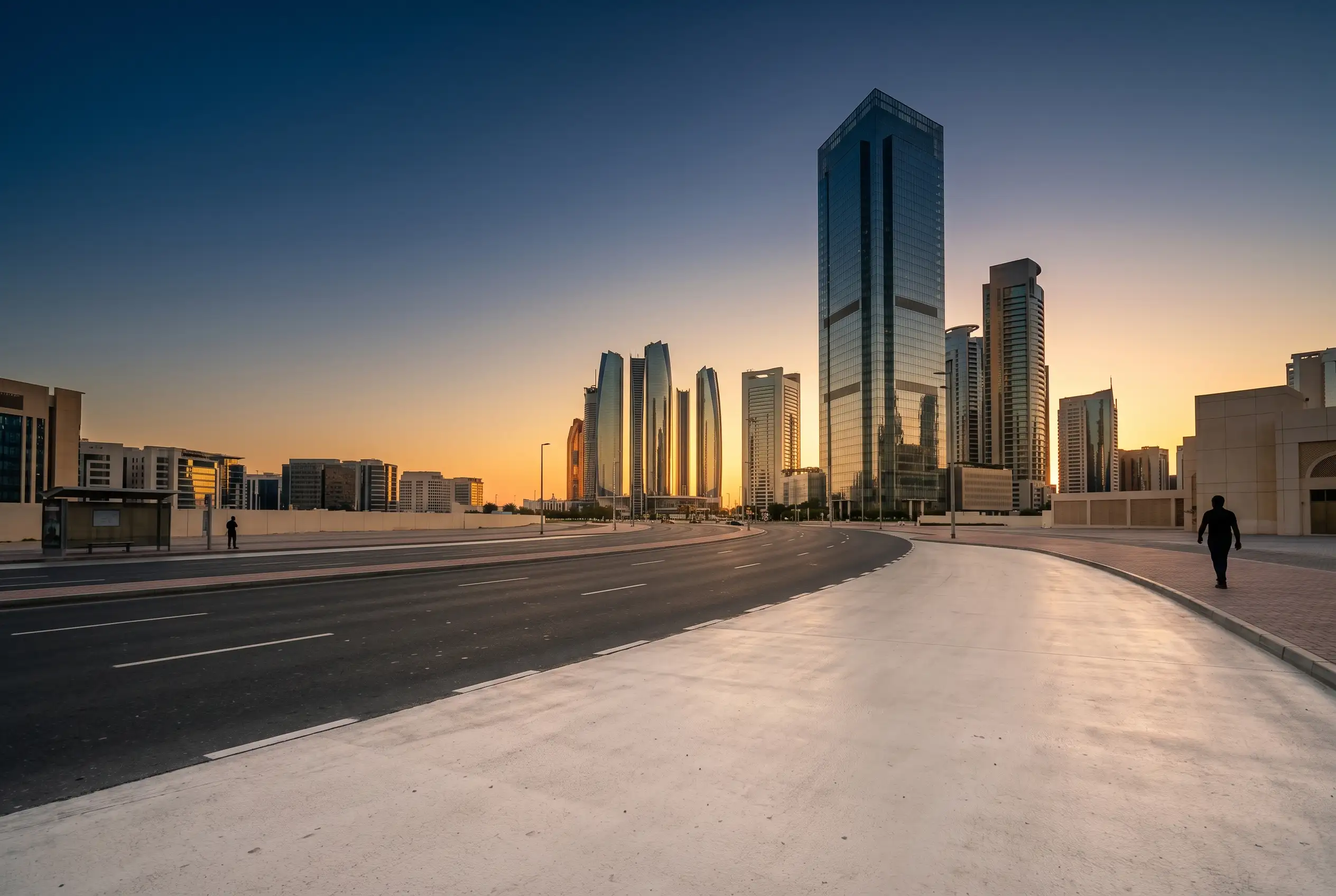
Administrative positions with fixed schedules are the target population. Healthcare workers, public school employees and staff in field or operational roles are excluded, per the joint launch statement. KAFD alone houses the headquarters of major Saudi banks and international firms operating in the kingdom. The Diplomatic Quarter concentrates embassy and international organization staff. Together with Digital City, Granada Business, Laysen Valley and ROSHN Front, the six districts form a high-density employment cluster whose simultaneous morning arrivals have become a documented bottleneck on Riyadh’s arterial roads.
A Capital City Running Ahead of Its Roads
Riyadh has been adding corporate activity, residential population and construction workload faster than the road network built to serve it. Saudi Arabia’s Vision 2030 development program targets the capital as one of the world’s top-ten city economies, pulling corporate relocations, tourism megaprojects and a rapidly expanding workforce into a city whose main arterials were designed for a much smaller population.
The RCRC’s official launch announcement via the Saudi Press Agency described the initiative as “a key component of a city-wide strategy to optimize urban mobility and ease peak-hour congestion.” Alongside the staggered hours pilot, the commission said it is running road network upgrades, expanded public transport and modern traffic management tools in parallel. Physical road capacity takes years to add; a scheduling policy can be activated in days.
Staggered work schedules have a long track record as a transport demand management tool in high-density city economies, used as a lower-cost complement to infrastructure investment before large projects come online. The Riyadh pilot applies the model to a capital growing at a pace that places it among the fastest-expanding major cities anywhere. The RCRC said it will assess the initiative and may extend it to further zones based on results from the initial six.
The northwestern quadrant of Riyadh, which houses KAFD, Digital City and the Diplomatic Quarter, has seen the heaviest commercial development under Vision 2030 and draws some of the most concentrated inbound commuter traffic in the metropolitan area. The staggered hours pilot points directly at that corridor.
Outdoor Work Bans Sweep the Gulf the Same Week
| Country | Restricted hours | Season | Scope | Enforcement note |
|---|---|---|---|---|
| Qatar | 10am-3:30pm | June 1 – Sept 15 | All outdoor workers | Site closures and company fines on first offence |
| Bahrain | 12pm-4pm | June 15 – Aug 31 | Outdoor direct-sunlight work | Up to 3 months imprisonment and BD 500-1,000 fine |
| Kuwait | 11am-4pm | June – August | Delivery motorcycles; outdoor work ban also in effect | Public sector daily hours cut from 7 to 6 |
| Saudi Arabia | 12pm-3pm | June 15 – Sept 15 | All private sector outdoor workers | Violations reported to hotline 19911 |
Qatar and Bahrain Set the Strictest Windows
Qatar’s outdoor work restriction runs from 10am to 3:30pm daily between June 1 and September 15, under Ministerial Decision No. 17 of 2021, which Qatar’s Ministry of Labour enforces each summer. The 5.5-hour prohibited window is the widest among Gulf states. When Qatar expanded the ban under that decision in 2021, enforcement was immediate: inspectors fined 98 companies and closed 232 construction sites for three days within the first month, most violations found at contracting firms whose project deadlines pushed supervisors to put crews back outside before the permitted hour. The compliance record in subsequent seasons was built on the credibility of that opening campaign.
Bahrain’s restriction starts June 15 and runs to August 31, covering outdoor work under direct sunlight from 12pm to 4pm. The penalties are the most explicit in the region. Article 192 of Bahrain’s Labour Law provides for imprisonment of up to three months, a fine between BD 500 and BD 1,000 (approximately $1,325 to $2,650 at current exchange rates), or both. The criminal liability dimension places Bahrain’s framework in a different legal category from the financial-only approaches used elsewhere.
Kuwait Targets the Delivery Economy
Kuwait has banned delivery motorcycles from operating between 11am and 4pm from June through August, targeting the outdoor workforce segment with the greatest sun exposure in an urban setting. Summer temperatures in Kuwait regularly exceed 50°C, and delivery riders spend hours on open roads with no shade or shelter. Kuwait’s Civil Service Commission simultaneously cut public sector daily working hours from seven to six for the summer period, effective June 1 to August 31, citing electricity grid stability alongside worker wellbeing as the drivers.
Saudi Arabia’s annual outdoor ban for private-sector workers runs from 12pm to 3pm under the National Council for Occupational Safety and Health (NCOSH) and the labor ministry, with coverage extending across the entire private sector outdoor workforce. Violations are reported to the labor ministry’s unified hotline, 19911, or the ministry’s official application, and the ban covers construction, delivery and outdoor maintenance sectors from mid-June through mid-September.
The Workers Outside the Six-Zone Perimeter
The Administrative Workforce in the Six Zones
The RCRC flexible hours pilot targets administrative workers inside six formal commercial districts. Saudi Arabia’s annual outdoor ban covers the private sector workforce doing outdoor work across the entire kingdom. The two instruments are separate legal frameworks from different parts of government, responding to different problems.
The exclusion clause in the pilot reflects what flexible scheduling requires: positions where the start time does not affect service delivery. Operational and field roles at the six zones, from security to facilities maintenance, carry fixed staffing requirements that a variable arrival time cannot accommodate. Healthcare and public school staff are separately excluded under the same logic. The initiative delivers its flexibility benefit to desk workers and reaches no further.
Outdoor Labor and the Summer Ban
The workforce covered by the annual outdoor ban is predominantly the construction, delivery and site maintenance sector, workers whose roles rarely overlap with the designated business zones in the pilot. Saudi Arabia’s summer temperatures regularly exceed 45°C during the midday hours the ban covers. Heat exhaustion and heat stroke are documented occupational health risks in Gulf construction and outdoor service work, and the three-hour midday prohibition targets the hottest window of the day.
The outdoor workforce in Saudi Arabia is predominantly migrant labor from South and Southeast Asia, working in conditions where heat is a daily operational constant. The midday ban covers the peak hours, but crews typically start before dawn and return to outdoor sites after 3pm, extending their heat exposure on either side of the prohibited window. Compliant employers are required to provide shaded rest areas, hydration stations and scheduled break protocols as additional layers alongside the ban itself.
Across the Gulf, workplace flexibility measures for office workers multiplied after the pandemic, from remote work days and compressed weeks to formal flex-time frameworks written into labor codes. For outdoor and construction workers, the regulatory additions took a different form: annual heat bans, mandatory rest protocols and hydration requirements, built into law in sectors where scheduling choice doesn’t fit the nature of the work but legal enforcement can reach.
Saudi Arabia Hit 94% Compliance Last Summer
The labor ministry and NCOSH run joint enforcement of the annual outdoor ban. When the 2025 outdoor ban season ended in September, the labor ministry reported 94% private sector compliance. Minister Ahmed Al-Rajhi cited the figure as evidence of growing employer awareness around occupational heat safety. NCOSH highlighted the contribution of annual pre-season awareness campaigns in improving the rate year over year.
Qatar’s enforcement record shows what active monitoring produces. When Qatar’s Ministry of Labour expanded its outdoor ban in 2021, the opening month produced more company fines and worksite closures than any subsequent season, establishing the cost of non-compliance early for the construction industry. Saudi Arabia’s compliance rate is the product of years of enforcement effort and awareness campaigns run each spring; it also means roughly 6% of covered establishments in a country running construction at gigaproject scale were still not compliant in 2025.
Bahrain’s criminal liability provisions introduce a separate compliance driver. The imprisonment provision alongside the BD 500 to BD 1,000 fine exposes individual site managers to personal legal risk, changing the on-site calculus in ways that purely financial penalties rarely accomplish for large contractors.
- 94% private sector compliance with Saudi Arabia’s 2025 outdoor work ban, per the labor ministry
- 50+ entities enrolled in Riyadh’s staggered hours pilot as of June 2
- 5.5 hours of daily prohibited outdoor work in Qatar, the widest window among Gulf states
Saudi Arabia’s outdoor ban for private-sector workers activates in ten days, adding a second scheduling constraint alongside the staggered hours pilot. The Saudi Arabia outdoor work ban regulatory enforcement covers a workforce several orders of magnitude larger than the pilot’s initial cohort, and the two populations being governed barely overlap.
